Part 2: A Bar Owner Yelled At A 6-Year-Old For Throwing A Grieving Biker’s Keys Down A Storm Drain—Then She Turned Around And Screamed, “You Drank! You Can’t Go!”
Part 2
The rain kept falling on the giant man crying on the curb, and for a long moment nobody in that parking lot moved.
Allison knelt down on the wet asphalt next to her daughter. Charlie was trembling all over, her little fists clenched at her sides, her black hair bow drooping in the drizzle. She wasn’t crying. She was staring at the biker as if she was afraid he might get up and try to ride away anyway.
“Charlie,” Allison whispered. “Baby, how did you know?”
“I heard the grown-ups inside,” Charlie said. Her voice was shaking. “By the cookies. They said he had four beers and he was going to ride home anyway because nobody was gonna tell a guy that big what to do.” She swallowed hard. “And then I saw him walking funny to his motorcycle.”
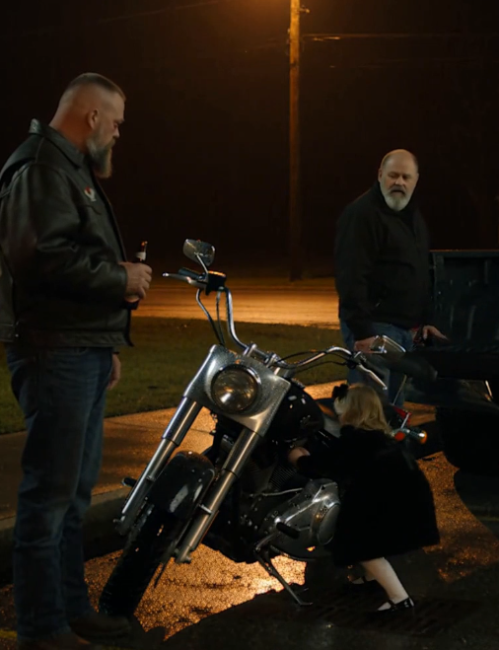
Allison couldn’t speak.
“My daddy got killed by a man who drank,” Charlie said, louder now, turning to the biker on the curb. “And nobody stopped that man. So I stopped you.”
The biker lifted his head out of his hands.
His face was wet and red in the yellow parking lot light. He looked at Charlie for a long time.
“She’s right,” he said hoarsely, to nobody and everybody. “She’s right.”
Rick Malloy pushed through the little crowd, holding his beer.
“Come on, Ox, don’t listen to this. The kid’s upset. You’re fine.” He jingled a set of keys of his own. “I’ll drive you home myself.”
Allison stared at him. Rick’s own face was flushed, and his words were slurring around the edges. He had obviously been drinking for hours.
The biker named Ox looked up at Rick for a long moment.
“No,” he said.
He pulled his phone out of his jacket with shaking fingers and called a cab.
A few of the other bikers had come outside by then: older men in leather jackets with gray beards, red eyes, and black armbands. They stood around awkwardly. One of them, a tall man with a ponytail, put a hand on Ox’s shoulder and sat down on the curb beside him without a word.
Allison didn’t know these people. She only knew that she needed to get her daughter out of the rain.
“Stay right here,” she told Charlie. “Don’t move. I’m going to get your coat from inside.”
She hurried across the wet lot and up the steps into the funeral home. The front lobby was warm and smelled like lilies. Through the east doors, she could hear the quiet hum of her church friend’s viewing. Through the west doors came the low voices of the bikers’ memorial.
On an easel beside the west doors stood a large framed photo board covered in snapshots. They showed a grinning, red-faced man in a leather vest at cookouts, on motorcycles, and at the lake. A gold nameplate hung above the photos.
Celebrating the Life of Duane Haskins.
Allison stopped.
Her hand went to the doorframe. The lobby tilted around her.
She knew that name. She’d heard it read aloud in a courtroom. She’d seen it on a police report and a death certificate, and in her nightmares every night for two years.
Duane Haskins.
Part 3
Two years earlier, at 1:40 in the morning on the second Sunday in September, Tom Dawson had been driving home on Route 12 after a double shift at the hospital where he worked as a respiratory therapist.
He was thirty-four years old. He had a four-year-old daughter named Charlie, who called him Daddy Bear. He sang to her over the phone every night he worked late.
A pickup truck came across the center line at sixty-eight miles an hour.
The driver was Duane Haskins. His blood alcohol was 0.19 when they finally tested him at the hospital, more than twice the legal limit. He walked away with a broken wrist.
Tom died at the scene.
Allison remembered the knock on the door at four in the morning, two deputies with their hats in their hands. She remembered Charlie asleep in her bed down the hall, and having to tell her when she woke up.
Duane Haskins pleaded guilty to aggravated vehicular homicide. His lawyer got the blood test partially excluded on a technicality about chain of custody. He was sentenced to three years, served eighteen months, and was released early in the spring.
Then Allison had sued the bar.
She’d learned that Duane had been drinking for seven hours that night at the Anchor Tap on Lakeview Road. Ohio had a law about serving people who were visibly drunk. Her lawyer was sure they had a case.
But at the deposition, the bar’s owner, Rick Malloy, testified under oath. He said he’d personally cut Duane off at ten p.m. and told him to go home. He said Duane must have kept drinking somewhere else after that, at another bar, or in his truck.
There were no other witnesses who would say otherwise. The case was dismissed.
Allison had gone home that afternoon and cried in her car in the driveway for an hour so Charlie wouldn’t see.
Now she stood in the lobby of Whitfield Funeral Home, staring at a photo board full of the smiling face of the man who killed her husband.
Five days ago, Duane Haskins had left a friend’s bonfire party drunk, climbed into his truck, and run it off a county road into a tree. He’d been out of prison for seven months.
Allison grabbed Charlie’s coat from the rack and walked back outside on legs that didn’t feel like hers.
Ox was still sitting on the curb in the rain. His cab had just pulled up at the edge of the lot.
Allison walked straight to him. Charlie ran to her side.
“Duane Haskins,” Allison said. Her voice was very quiet and very steady. “That’s who you’re here for.”
Ox looked up at her. Something in his face changed. Then he looked at Charlie, and back at Allison, and he went completely still.
“Dawson,” he said slowly. “Your husband was Tom Dawson.”
Allison didn’t answer. She didn’t have to.
Ox stood up slowly. For a moment he looked like he might fall. He looked over at Rick Malloy, still standing by the tailgate with a beer in his hand, watching them.
The cab driver honked.
Ox opened the back door of the taxi. Then he stopped and turned back to Allison.
“Mrs. Dawson,” he said, his voice cracking, “I was at the Anchor Tap that night.”
Part 4
Ox Talley came to Allison’s house on Maple Street at ten o’clock the next morning.
He stood on her front porch in a clean flannel shirt instead of the leather jacket, holding his hat in his hands. He looked like he hadn’t slept at all. Allison almost didn’t let him in.
Charlie peeked around the corner of the hallway in her pajamas, clutching a stuffed bear.
They sat at the kitchen table. Allison didn’t offer him coffee.
“I’ve known Duane since we were fourteen,” Ox said. “Grew up on the same street. Got our first bikes the same summer. He was my best friend for thirty-five years.” He stared at his big scarred hands on the table. “He was also a drunk. We both were.”
Allison waited.
“That night two years ago, we were at the Anchor Tap together. Started around six. I quit around eleven-thirty because I had to work in the morning. Duane kept going.” Ox swallowed. “Rick never cut him off. Not at ten. Not ever. He was pouring shots for him past midnight, laughing. Called him Duaney.”
Allison’s hands went cold.
“Around twelve-forty-five, Duane went to leave,” Ox said. “Couldn’t walk straight. I grabbed his keys off the bar and told him I’d drive him home.” His voice broke. “Duane laughed at me. Then Rick reached over the bar, took the keys out of my hand, and tossed them back to Duane. Said, He’s fine, Ox. Don’t be a mother hen.”
The kitchen was dead silent.
“I let him go,” Ox whispered. “I had a few in me myself. I didn’t want a fight. I told myself he’d be fine. He always was.” He pressed his hands over his eyes. “Forty minutes later he hit your husband’s car.”
Allison was crying now, without a sound.
“Rick lied,” she said. “Under oath. He said he cut Duane off at ten.”
“I know.”
“You knew? You knew for two years?”
“I read about your lawsuit in the paper.” Ox looked up at her. His face was wrecked. “Nobody asked me. And Duane was my brother. And I was ashamed, Mrs. Dawson. I was so ashamed I drank more. Every night for two years, I drank so I wouldn’t have to think about those keys in my hand.”
From the hallway, a small voice spoke.
“Are you gonna drink again?”
Charlie stood in the kitchen doorway with her stuffed bear.
Ox looked at her for a long moment.
“No,” he said. “I’m not.”
That afternoon, Allison’s phone started buzzing.
Somebody at the funeral home had filmed the parking lot scene on their phone. It was twenty seconds long and showed a little girl snatching keys and throwing them down a storm drain. A man yelled You little brat! It cut off before Charlie screamed anything.
Rick Malloy had posted it on the Anchor Tap’s Facebook page.
This is what we’re dealing with in Fallston. A grieving man loses his best friend, and some woman’s out-of-control kid throws his keys down the sewer at the funeral. Somebody needs to teach parents some respect.
By evening it had forty thousand views.
And at six o’clock, an envelope was taped to Allison’s front door.
Inside was a handwritten invoice from Rick Malloy for six hundred and forty dollars for replacement keys, key fob reprogramming, and towing of motorcycle from funeral home. Underneath he’d scrawled a note.
Pay this by Friday or I’m filing a police report for destruction of property. Your kid needs to learn consequences.
Allison read it at her kitchen table with shaking hands.
Then her phone rang. It was Ox.
“Mrs. Dawson,” he said, his voice low and tight. “Rick just came by my shop. He told me if I ever talk about that night, he’ll make sure everybody knows I was drinking too.”
Part 5
On Sunday afternoon, Allison found Ox sitting in his truck outside her house. He’d been there an hour, working up the nerve to knock.
Beside him on the passenger seat was a small, cracked smartphone in a camouflage case.
“Duane’s mom gave it to me after the burial on Friday,” Ox said when Allison came out to the curb. “June Haskins. She’s seventy-four. She said Duane would’ve wanted me to have his things.” He held it up. “I didn’t look at it until last night.”
Allison frowned. “Why are you showing me this?”
“Because Duane filmed everything,” Ox said. “Cookouts, rides, nights at the bar. He thought he was going to be famous on the internet someday.” He swallowed. “He never deleted anything. This phone has eleven years of videos on it.”
He tapped the screen and turned it around.
The video was time-stamped September 11, 12:51 a.m., two years ago. Thirty-nine minutes before Duane Haskins hit Tom Dawson’s car on Route 12.
It was shaky and dim, shot from somebody’s hand at a bar. A neon beer sign glowed in the background. The camera swung around to a red-faced man behind the bar, balding, with a gray goatee, pouring whiskey into two shot glasses.
It was Rick Malloy.
“Last one, Duaney,” Rick laughed, sliding a shot across the bar. “On the house.”
The camera wobbled. Duane’s voice came out slurred and loud. “You’re the best, Ricky.”
Then the camera swung, and there was Ox at the end of the bar, younger, heavier, holding a set of truck keys. “Duane, give it up. I’m driving you.”
Then Rick’s hand reached into the frame. He plucked the keys from Ox’s fingers and tossed them across the bar.
“He’s fine, Ox. Don’t be a mother hen.”
The video ended.
Allison sat down on the curb in front of her own house.
She played it again, and again. She watched the man who had sworn under oath that he cut Duane off at ten o’clock pour him a free shot at 12:51 a.m. and hand him his keys.
“I’m going to give this to the state,” Ox said quietly. “And to your lawyer. And to anybody who’ll watch it.”
“Rick will say you were drinking too.”
“I was,” Ox said. “I’ll say it first.”
That night, Allison called her old lawyer, Diane Parks. She hadn’t spoken to her in a year. Diane watched the video on her laptop and was silent for almost a minute.
“Allison,” she said finally. “The state liquor control commission is holding the Anchor Tap’s license renewal hearing next Thursday. There’s already a complaint pending from another family.” She took a breath. “If we bring this, we can reopen your case.”
Part 6
On Monday morning, a city public works truck pulled up beside the storm drain in the Whitfield Funeral Home parking lot.
Ox had called the city on Friday. A worker named Marcus Bell climbed out in an orange vest and rubber boots. He pried up the iron grate with a crowbar and fished around in the muddy water below with a long magnetic pole for twenty minutes.
He came up with a set of keys on a worn leather fob, still dripping.
He handed them to Ox.
“Heard what happened,” Marcus said. “My cousin was at that funeral. Said a little girl did what none of y’all could.” He shook his head. “Hope you’re doing okay, man.”
Ox held the keys in his palm for a long time.
Then he drove them, not on his motorcycle, which was still sitting where Rick had towed it, but in his truck, to the little house on Maple Street.
Charlie answered the door. Allison stood behind her.
Ox crouched down on the porch until he was eye level with the six-year-old in her purple pajamas.
“The city fished these out of the drain,” he said. “I thought you should see them.”
Charlie looked at the keys in his hand. Then she looked at him very seriously.
“Are you gonna use them?”
“Not tonight,” Ox said. “Not when I’ve been drinking. Not ever again.”
Charlie studied his face for a long moment, the way six-year-olds do when they are deciding whether to believe a grown-up.
Then she disappeared down the hallway and came back with a folded piece of construction paper.
It was a crayon drawing. It showed a parking lot at night with a black motorcycle and a big man with a beard. A tiny girl in a black dress threw something shiny into a round hole in the ground. Across the top, in huge uneven letters, she’d written:
I SAVED HIM.
Ox couldn’t speak.
He just held the drawing in both hands, standing on that porch.
“You can keep it,” Charlie said. “So you remember.”
Over the next three days, Ox did something he hadn’t done in two years. He didn’t have a single drink. He went to a meeting in the basement of St. Paul’s Lutheran on Tuesday night, and again on Wednesday. He told his riding club, the Rust Belt Riders, what he was going to do on Thursday. Thirty men in leather jackets told him they’d be there.
And he went to see June Haskins.
Duane’s mother lived alone in a small brick house on Elm Street. She was frail and gray-haired and seventy-four years old. She had buried her son five days before. When Ox showed her the video, she watched it in silence with her hand over her mouth.
When it ended, she set the phone down on her kitchen table.
“My son killed that young woman’s husband,” June said quietly. “He was drunk, and it was his fault, and I’ve prayed every night for that family.” Her chin trembled. “But Rick Malloy poured those drinks and threw him those keys. And then he lied about it so he could keep his bar open.”
She looked up at Ox.
“When is that hearing?”
Part 7
The Ohio Liquor Control Commission held regional license hearings in a plain conference room on the third floor of the county administration building. It usually drew a handful of lawyers and bar owners.
That Thursday, there were nearly two hundred people.
The Rust Belt Riders came first: thirty men and women in black leather with gray beards and gray braids. They filed in silently and lined the back wall, arms folded. Behind them came the people of Fallston. There were church friends of Allison’s, nurses who had worked with Tom, the families of two other victims of drunk drivers, and a dozen members of the local chapter of Mothers Against Drunk Driving holding framed photographs.
Rick Malloy sat at the front table with his attorney, a sharp-dressed man from Columbus. He wore a pressed shirt and a confident smile.
His attorney spoke first.
“The Anchor Tap has operated responsibly for twenty-two years,” he said smoothly. “The tragic events involving Mr. Haskins were thoroughly examined in civil court two years ago, and my client was found to have acted appropriately. He cut Mr. Haskins off at ten p.m. These new complaints are an attempt by grieving families to relitigate a closed matter.”
He sat down.
The hearing officer, a gray-haired woman named Judith Crane, looked over her glasses.
“Is there anyone who wishes to speak in opposition to the license renewal?”
Allison Dawson stood up, her hands shaking.
“Yes, ma’am,” she said. “But I’m not the one who should speak first.”
Mack “Ox” Talley stood up from the second row.
He walked to the front of the room and stood beside the witness table. He was so big the chair looked like a toy next to him.
“My name is Mack Talley,” he said. “I was at the Anchor Tap the night Duane Haskins killed Tom Dawson. I was drinking with him. I’m a drunk. I’ve been sober for eight days.”
Rick Malloy’s smile vanished.
Ox told it all, quietly and plainly, without looking away from the hearing officer. He told her about the seven hours, the shots past midnight, and the keys in his hand. He told her about Rick reaching across the bar.
Then Diane Parks, Allison’s lawyer, played the video on the conference room screen.
September 11, 12:51 a.m. Rick Malloy poured two shots of whiskey. “Last one, Duaney. On the house.” His hand plucked the keys from Ox’s fingers and tossed them across the bar.
“He’s fine, Ox. Don’t be a mother hen.”
The room was dead silent.
Rick’s attorney was on his feet. “That video’s authenticity hasn’t been—”
“I can authenticate it,” said a quiet voice from the third row.
June Haskins stood up, frail and gray, in her Sunday dress.
“That was my son’s phone,” she said. “That was my son’s voice. He’s gone now, and he did a terrible thing. But that man behind the bar helped him do it.” She looked straight at Rick Malloy. “And then he lied to a judge so he could keep selling beer.”
Rick Malloy’s face had gone the color of ashes.
Judith Crane took off her glasses and set them on the table.
“The Anchor Tap’s liquor license is revoked, effective immediately,” she said. “This commission will also be referring the matter of Mr. Malloy’s prior sworn testimony to the county prosecutor for review of possible perjury charges.”
Rick Malloy walked out of the hearing room without a word to anyone.
When the crowd finally began to move, a small girl in a purple dress pushed her way through the forest of legs to the front of the room.
Charlie Dawson stood in front of Ox and looked all the way up at him.
“Did you tell the truth?” she asked.
“I did,” Ox said.
Charlie nodded seriously. Then she held up her pinky finger.
“Promise you won’t drink anymore.”
Ox looked at that tiny pinky for a long moment. Then he crouched down, all 290 pounds of him, and hooked it with his own.
“Will you hold me to it?” he asked.
Part 8
Rick Malloy was charged with perjury in December. He pleaded guilty in March and was sentenced to eighteen months in county jail. The Anchor Tap closed for good. A bakery opened in the building the next year.
Allison Dawson’s wrongful death case against the Anchor Tap was reopened and settled that spring.
She used part of the settlement to start a college fund for Charlie. The rest, after talking to Ox for a long time at her kitchen table, she put into something new.
On the first Friday in May, one year after the hearing, a small hand-painted sign went up outside Ox Talley’s motorcycle repair shop on Route 12:
CALL A BIKER. FREE RIDES HOME. NO QUESTIONS. NO JUDGMENT.
Underneath was a phone number.
Every Friday and Saturday night from ten p.m. until three in the morning, sober volunteers from the Rust Belt Riders sit by their phones. Some of them have been sober for decades, and some for a few months. When someone calls from a bar, a party, or a parking lot, two riders come in a borrowed van. One drives the caller home. The other drives the caller’s car home behind them, so nobody has to choose between leaving their car and getting in it drunk.
In its first year, Call a Biker gave more than nine hundred rides. Now there are chapters in four Ohio counties.
Ox drives every Friday night himself.
He hasn’t had a drink since the night a six-year-old threw his keys down a storm drain.
Every year on the anniversary of that night, a small envelope arrives at his shop on Route 12. Inside is a handmade card in a child’s handwriting, decorated with glitter glue and stickers.
The first card said 365 DAYS! in purple marker, with a drawing of a motorcycle and a smiling bear.
The second said 730 DAYS!
The third, this past October, said 1,095 DAYS! It had a drawing of a big man with a beard holding hands with a little girl, and at the bottom, in careful nine-year-old cursive: I’m proud of you. Love, Charlie.
Ox keeps every card in the top drawer of his workbench.
On the wall of his shop, right above the phone where the Call a Biker volunteers sit on weekend nights, hangs a simple wooden frame behind glass.
Inside is a set of motorcycle keys on a worn leather fob, still stained with storm drain mud. They have never been cleaned.
Beside them, in the same frame, is a crayon drawing of a little girl in a black dress throwing something shiny into a round hole in the ground. The big letters across the top say I SAVED HIM.
New volunteers always ask about it on their first night.
Ox tells them the truth every time.
“A six-year-old did what no grown man would do for me that night,” Ox says. “She threw my keys away, because she lost her daddy on a night when nobody threw those keys for him.”
That parking lot was full of adults who saw a giant grieving biker with a beer in his hand. Every one of them decided it wasn’t their place to say anything. The man running the bar had decided the same thing two years earlier, and then he lied about it.
It took a little girl in a black dress to say what all of them should have said. When she did, the biggest, toughest man in that lot sat down on the curb and cried, because he knew she was right.
If this story stayed with you, follow our page for more stories like this. And if someone you love has been drinking tonight, take their keys. They might be mad at you, but they’ll be alive.