Part 2: The Biker Who Blocked the Parking Lot — And the Little Girl Who Saw What Nobody Else Could
I had seen Brick before that night.
Everybody at Miller’s Market had.
He came in every Thursday around seven, after the dinner rush but before the store got quiet enough to hear the fluorescent lights buzzing. He always parked in the same spot near the front window, not because he wanted attention, but because he liked to see his bike while he drank coffee.
That Harley was never the point.
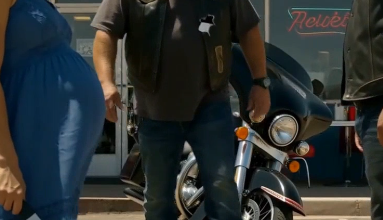
It was just there. Black paint. Saddlebags. A road-worn windshield. Warm metal ticking after the engine shut off. The smell of gasoline and leather came in with him every time the automatic doors opened.
Brick would fill a large coffee, no cream, no sugar, and stand near the lottery machine even though I never saw him buy a ticket.
People moved around him like water around a rock.
Mothers pulled carts closer. Teenagers lowered their voices. Men who thought they were tough suddenly became interested in reading cereal labels. He was big, yes, but it was more than size. He carried stillness like a warning.
Later, I learned his name was Thomas Bricker, but the club had called him Brick for twenty-five years because nothing moved him unless he chose to move.
He rode with a local club called the Clinch River Riders. They weren’t angels. They weren’t devils either. Mostly working men, veterans, mechanics, roofers, two retired cops, one barber, and a woman named Darlene who could back a trailer better than any man in Knox County.
Brick was their road captain.
That meant he decided when they rolled, where they stopped, who needed gas, and who was too tired to keep pretending he wasn’t. He spoke in short sentences.
“Hydrate.”
“Helmet on.”
“Ride tight.”
“Don’t act stupid.”
His brothers listened.
Not because he yelled.
Because he didn’t.
The strange thing was what he did when he thought nobody noticed.
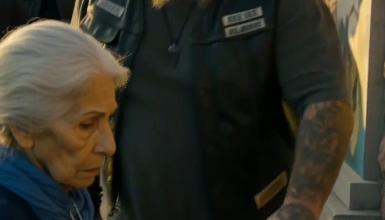
One rainy night, he stood in the parking lot holding an umbrella over Mrs. Alvarez while she loaded groceries into her sedan. She was eighty-two and moved like every bone had an opinion. Brick stood there getting soaked while she fussed about eggs.
Another time, a young mother came in with two boys and not enough money for diapers. Brick paid without looking at her.
He just tapped his card and said, “Receipt’s yours.”
Then he walked out before she could thank him.
That was his rule. Help fast. Leave faster.
A month before the incident, I saw him with the purple juice box.
A little girl named Emma had been crying near the bakery because her mother’s card declined. Her mother was red-faced and apologizing to everyone, like poverty was a crime committed in public. Emma kept asking for the unicorn juice.
Brick picked it up, set it on the belt with his coffee, and paid for both.
When Emma smiled at him, he looked almost scared.
Not annoyed.
Scared.
He crouched down, huge knees cracking, leather vest creaking, and handed her the juice box with two fingers like it was made of glass.
“Don’t spill,” he said.
Emma giggled. “You sound like my grandpa.”
Brick swallowed hard and stood.
I saw his hand shake once when he picked up his coffee.
That was the first seed.
I missed it.
We all did.
We thought he was uncomfortable around kids because he looked like a man who belonged near engines and old roads, not cartoon straws and tiny rain boots.
Later, Darlene told me Brick had a daughter once.
Not dead.
That would have been simpler to understand.
She was alive, somewhere in Ohio, with two children of her own and a last name he had never been invited to share. Brick had not seen her in fourteen years. He had missed too many birthdays while drinking, riding angry, and acting like silence was a personality.
He got sober at forty-one.
By then, some doors stayed closed.
So every Thursday, he bought black coffee and sometimes something small for somebody else’s child.
Not to fix the past.
Just to stand near kindness without asking it to forgive him.
The night it happened, the store was loud in ordinary ways.
Cart wheels squeaked. Rain tapped the windows. A freezer motor kicked and rattled like an old truck. Somebody near produce dropped a jar of salsa, and the smell of tomatoes and vinegar spread across the front aisle.
Brick had just reached the register.
Coffee in one hand. Purple juice box in the other.
I raised an eyebrow.
He looked at the juice box like it had betrayed him.
“For later,” he said.
“Sure,” I said.
That was the closest thing we had to a joke.
Then the scream came.
It started deep in aisle six and moved through the store faster than any alarm.
“My baby! Somebody stop him!”
I turned and saw a man rushing toward the front doors with a child in his arms.
He was white, mid-thirties, brown jacket, baseball cap pulled low. Normal-looking. That was the worst part. He did not look like a monster. He looked like a man who might help you reach the top shelf.
The little girl was fighting him.
Pink rain boots. Blonde hair. Tiny hands grabbing air. Her face was red from screaming.
Behind him came her mother, a white American woman in her late twenties, thin, frantic, one sleeve torn from catching on a display rack. She fell once, got back up, and screamed again.
That scream emptied every thought from my head.
Customers froze. A man near the pharmacy stepped forward, then stopped. Someone yelled, “Hey!” Someone else dropped a basket. The automatic doors opened like they were helping the wrong person escape.
Brick moved.
But not the way I expected.
He did not sprint after the man.
He did not tackle him.
He did not grab a weapon or shout threats.
He turned, walked straight through the open doors, tossed his coffee into the trash without slowing, and crossed the sidewalk to his Harley.
The rain had gotten heavier.
His boots hit the wet concrete. The leather cut shifted on his shoulders. The chain at his waist clicked once against his belt.
The man carrying the child was already halfway across the parking lot, heading toward the exit that opened onto Asheville Highway. Cars were moving slow under the lamps. A semi groaned past on the road beyond.
Brick swung onto the Harley.
The engine fired with a deep crack that shook the glass.
People inside gasped.
He rolled forward, not fast, not wild, just precise. He turned the bike broadside across the parking lot exit, blocking the lane between two concrete posts. No car could pass. No running man could slip through without going around him and into traffic.
Then Brick did something I still see when I close my eyes.
He stood up on the footboards.
Rain ran down his shaved head and into his gray beard. His tattooed hands hung open at his sides. His face went blank. Not angry. Not dramatic. Blank like poured concrete.
The man stopped.
The child screamed against his shoulder.
Brick folded his arms.
No words.
No threats.
Just a huge biker on a rumbling Harley, leather black in the rain, blocking the only clean exit.
The man looked left. Cars. Looked right. A ditch and traffic. Looked back at the store. People were coming now. A father from aisle two. A stock boy with a broom. Me with the phone in my hand, finally finding my voice for 911.
Brick still did not speak.
The engine idled under him, V-twin thumping like a giant heart.
The man lowered the girl.
Not gently, but not throwing her either. He set her on her feet, backed away, then ran between two parked cars toward the side street.
The mother reached the girl first.
She dropped to her knees so hard I heard it from inside. She wrapped the child in her arms, rocking, crying, saying her name over and over.
“Emma. Emma. Emma.”
Brick stayed where he was.
Still standing.
Still blocking the exit.
Still silent.
Police caught the man two blocks away near a closed tire shop.
By then, the store had become a storm of crying, talking, shaking, and people saying the same things because fear makes language small.
“You saved her.”
“He saved that baby.”
“That biker saved her.”
Emma’s mother carried her over to Brick.
The little girl had one pink boot on. The other was gone.
Her mother looked up at him with tears all over her face.
“Thank you,” she said. “Oh my God, thank you.”
Brick climbed off the bike slowly.
His face softened for half a second.
Emma looked at him with wide eyes and whispered, “Mommy, he wasn’t scared.”
Brick gave a rough little smile.
“No, ma’am,” he said. “Just blocking traffic.”
Then Emma said the line that made everybody cry.
“He stood still like a wall.”
And for a few hours, that was the story.
Big scary biker. Little girl saved. Bad man caught.
A clean ending.
The kind people like because it tells them courage looks like someone who never trembles.
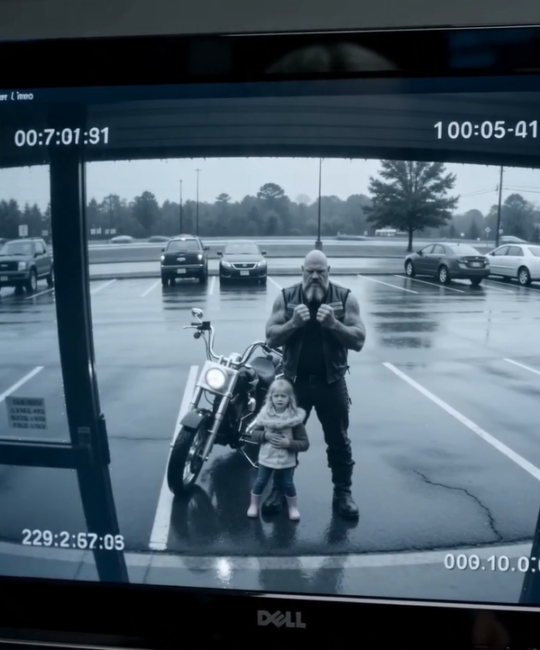
But the security footage told the truth.
The next morning, police came back for the footage.
I was there when our manager, Calvin, pulled it up in the cramped office behind customer service. The room smelled like toner, old coffee, and wet cardboard. Brick stood in the corner because the officers had asked him to confirm his statement.
He looked miserable.
Not guilty.
Just tired of being seen.
On the monitor, we watched the whole thing again from three angles.
Aisle six. Front doors. Parking lot.
We saw the man grab Emma near the seasonal display. We saw her mother turn at the exact wrong second to pick up a dropped coupon. We saw the man move fast, too fast, toward the exit.
Then the parking lot camera took over.
There was Brick walking to his Harley.
There was Brick starting the engine.
There was Brick blocking the exit.
There was Brick standing on the bike like a stone wall in the rain.
Calvin muttered, “Lord have mercy.”
One officer nodded. “Man didn’t flinch.”
Brick said nothing.
Then the detective rewound and zoomed in.
Not on the suspect.
On Brick.
The image was grainy, black-and-white, rain cutting across the frame. But it was clear enough.
His hands were shaking.
Not a little.
Violently.
The same tattooed hands everyone had been staring at all night. The hands with scarred knuckles. The hands that looked like they belonged to a man fear would avoid.
They were trembling so hard that when he folded his arms, his fingers kept jumping against his biceps.
For two full minutes, while the man held Emma, while the engine rumbled under him, while every person in that parking lot thought he was fearless, Brick was shaking like a man standing at the edge of a cliff.
Nobody spoke in the office.
The detective looked at him.
“Mr. Bricker?”
Brick stared at the monitor.
His jaw moved once.
“Yeah,” he said. “I saw it.”
Calvin, trying to be kind, said, “Adrenaline does that.”
Brick’s eyes stayed on the screen.
“No,” he said.
One word.
Flat.
Heavy.
Darlene arrived five minutes later because somebody from the club had called her. She came into the office wearing a leather cut over a red flannel shirt, gray braid down her back, rain on her boots.
She saw the paused frame.
She saw Brick’s hands.
Her face changed.
“Tommy,” she said softly.
That name hit different.
Not Brick.
Tommy.
He closed his eyes.
And that was when the second twist came out.
Fourteen years earlier, his own daughter had called him from a rest stop near Dayton, Ohio. She was twenty-three, angry, scared, and traveling with a newborn because she had finally left a man who liked to break furniture before he broke people.
Brick was drunk when she called.
He did not answer.
The man found her before police did.
She survived. The baby survived. But she never called her father again.
Brick had been carrying that unanswered phone call longer than he had carried any club patch.
So when Emma screamed in aisle six, he heard a child.
But he also heard a phone ringing fourteen years too late.
That was why he did not chase.
Chasing was panic.
Blocking the exit was control.
He was not fearless.
He had simply learned that fear can still stand in the right place.
After the footage, the story changed inside our store.
Outside, it stayed simple. News vans came. A reporter called him a hero. Somebody online called him “the biker wall.” People shared a blurry photo of him standing in the rain with his arms crossed, the Harley sideways beneath him.
Brick hated all of it.
When the local station asked for an interview, he said, “Talk to the mother.”
When they asked for a quote, he said, “Kid’s alive. That’s the quote.”
When the mayor’s office wanted to give him a certificate, he sent Tiny Pete from the club to pick it up. Tiny Pete was six-foot-six and cried at commercials. He accepted the certificate, folded it wrong, and brought it to Brick at the clubhouse.
Brick used it to level a wobbly table.
That was Brick.
But the seeds started making sense.
The purple juice box.
The way his hand shook when Emma smiled at him weeks before.
The way he stood near the front window where he could see both his bike and the door. We thought it was habit. Maybe it was. But habits are often scars with schedules.
Darlene told me more one night when she came in for coffee and found me restocking gum by register three.
“Brick wasn’t always quiet,” she said.
I looked at her.
She smiled without humor.
“Used to be loud. Mean loud. Thought every problem was a nail and he was the hammer.”
“What happened?”
She looked toward the parking lot, where Brick sat on his Harley with both boots down, staring at the rain.
“Life hit back.”
The Clinch River Riders had tested him after he got sober. Brotherhood sounds easy until a brother stops being fun. Drunks are noisy. Sober men are raw. Brick had to learn to sit in rooms without numbing them. He had to apologize to people who did not owe him forgiveness. He had to stop using his size like an argument.
Some brothers left him alone.
Some didn’t.
Darlene didn’t.
Tiny Pete didn’t.
A retired cop named Harlan didn’t.
They dragged him to meetings. Made him eat when he was shaking. Took his keys when grief made him stupid. Parked outside his apartment on the anniversary of the unanswered phone call. Not to talk.
Just to be there.
“Ride or die ain’t about dying,” Darlene said. “It’s about who keeps riding beside you when you’re hard to love.”
That stayed with me.
Emma came back to the store ten days later.
Her mother had not planned it. She told me she wanted to get the fear out of the place before it settled in Emma’s bones. Brave woman. Pale, tired, but brave.
Emma wore two pink rain boots again.
She also carried a folded picture.
Brick was at the coffee station.
The whole store got quiet when they walked in.
Emma’s mother knelt beside her and whispered something. Emma nodded and walked toward Brick.
He saw her coming.
His face tightened.
Not because he didn’t care.
Because he did.
Emma held out the picture. It was a crayon drawing. A giant man in black standing in front of a tiny stick girl. A motorcycle looked like a dog with wheels. Above the man, in shaky letters, her mother had written: THE WALL.
Brick took it.
His tattooed hand shook once.
Emma noticed.
Children notice what adults pretend away.
“You’re shaking,” she said.
Her mother froze.
The whole coffee area froze.
Brick looked at his hand.
Then at Emma.
“Sometimes walls shake,” he said.
Emma thought about that. Then she placed her tiny palm against his knuckles.
“But they still stand.”
Brick looked away fast.
Darlene, who had followed him in that day, suddenly became very interested in the beef jerky rack.
Brick folded the drawing carefully and slid it inside his leather cut, over his heart, behind a patch worn soft from years of rain.
That became the third twist.
The man who looked like he carried weapons carried a child’s drawing instead.
And every Thursday after that, when he bought coffee, the corner of that paper showed inside his vest if you knew where to look.
Not displayed.
Just kept.
Brick started parking differently after that night.
Still close to the front.
Still where he could see the door.
But now he parked at a slight angle, not enough to block anyone, just enough that his front wheel pointed toward the exit.
A small thing.
A ritual.
Every Thursday at 7:18, he came in. Black coffee. Sometimes a juice box. Sometimes gum. Sometimes nothing but the coffee and that heavy silence that made people uncomfortable until they learned it was not aimed at them.
He never talked about fear.
Men like Brick don’t pass their insides around for strangers to inspect.
But once, during a thunderstorm, I saw him standing outside beside a young cashier named Megan whose hands were shaking after a man yelled at her over a coupon.
Brick did not tell her to calm down.
He did not say she was fine.
He just stood there under the awning while rain hammered the roof and his Harley ticked behind him.
Megan wiped her face.
“I hate that I shake,” she said.
Brick sipped his coffee.
“Means your body showed up.”
She laughed once, watery.
“What if I can’t stop?”
He looked at the parking lot exit.
“Then shake standing.”
That was all.
Shake standing.
The phrase moved through the store. Not as a slogan. We weren’t that kind of place. But people remembered it.
Emma’s mother remembered it.
Darlene remembered it.
I wrote it on a sticky note and stuck it under my register, where only I could see.
Once a month, Brick and two brothers from the Clinch River Riders rode past the closed tire shop where police caught the man. They never stopped long. Just rolled by, slow and low, engines thudding against the brick walls, then turned back toward Asheville Highway.
Not a victory lap.
More like checking a fence after a storm.
Emma called him Wall Man for almost a year.
Brick pretended to hate it.
He did not.
The last time I saw Emma with Brick, she was five and missing both front teeth.
She came into Miller’s Market wearing a yellow raincoat and carrying another drawing. This one had a motorcycle, a store, a stick mother, a stick girl, and a huge square with a beard.
Brick was at register three.
Coffee. Black. No lid yet.
Emma ran up to him before her mother could stop her and wrapped both arms around his leg.
Every adult nearby held their breath.
Brick looked down like someone had handed him a live wire.
Then, slowly, he put one tattooed hand on top of her hood.
Not patting.
Not hugging exactly.
Just resting there.
A big hand. A small child. A whole store pretending not to stare.
Emma looked up.
“Are you still scared sometimes?”
Brick nodded once.
“Yep.”
“But you still stand?”
He looked toward the glass doors, where rain streaked the parking lot and his Harley waited under the lights, engine cold, front wheel angled toward the exit.
His voice came rough.
“Try to.”
Emma smiled like that was enough.
Maybe it was.
Outside, Brick fired the Harley. The engine rolled deep through the wet evening, under the grocery lights, past the carts, past the exit he had once blocked with nothing but steel, fear, and both boots planted.
The taillight disappeared toward I-40.
Still shaking.
Still standing.
Follow the page for more biker stories about the people behind the leather.