Part 2: Three Bikers at Dawn — And the Boy Memphis Forgot
I am Malik’s aunt, though in our family that meant second mother, emergency driver, homework checker, and the woman who got called when my sister ran out of brave.
Her name was Tasha. She worked nights at Methodist South, cleaning rooms most people were too sick to notice. She came home smelling like bleach and vending machine coffee, with her shoes in one hand because her feet hurt too bad to keep them on.
Malik was her only child.
His father had been gone since Malik was five. Not dead. Not exactly. Just one of those men who disappeared slowly until nobody could say the exact day he left. Malik never complained about it. That was what made it worse. Children who stop asking for things have already learned too much.
The club was called Iron Psalm MC. I had heard of them before, the way people hear about bikers. In half-truths. Fights at bars. Toy drives at Christmas. Men with records. Men who showed up at funerals for people who had no family. Men you crossed the street to avoid, unless you needed the kind of help polite people were afraid to give.
Deacon rode lead.
The other two were named Rooster and Clay. Rooster was white, seventy if he was a day, with a beard down to his chest and hearing aids he pretended didn’t exist. Clay was younger, Black, thick through the shoulders, with Bible verses tattooed on his forearms and a laugh that sounded like gravel in a coffee can.
Every morning at 6:12, they came.
Not 6:10. Not 6:15.
6:12.
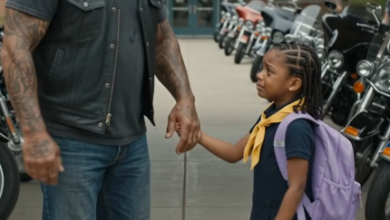
The first week, Malik rode behind Clay because Clay had the quietest voice. Deacon rode in front, Rooster in back. They never revved hard. Never blocked traffic. Never shouted at the boys who watched from the corner. They simply existed there, heavy and steady, like old brick walls.
The gang noticed immediately.
Of course they did.
Three men in leather escorting one child to school on Harley touring bikes was not subtle. But the strange thing was, Deacon never looked at them. Not once. He kept his eyes forward, gloved hands calm on the bars, jaw tight.
That was the first thing that made me wonder.
A man who looks like Deacon usually wants you to know he sees you.
But Deacon acted like looking would cost him something.
By the third week, Malik started eating breakfast again. Just toast at first. Then eggs. Then cereal standing at the counter like a normal thirteen-year-old boy with milk on his chin and one sock missing.
The bikers waited outside.
Rain came. They came.
Cold came. They came.
One morning, Tasha opened the door and found Deacon sitting on the porch steps with a small brown paper bag. Inside was a pair of gloves. Black. Plain. Too big for Malik, but warm.
“Hands get cold on the ride,” he said.
Tasha tried to pay him.
He looked offended.
“Ma’am,” he said, “don’t insult me before coffee.”
That was Deacon. Ten words when two would do. A look that could empty a room. Hands big enough to scare you. Hands gentle enough to fix a child’s collar before picture day.
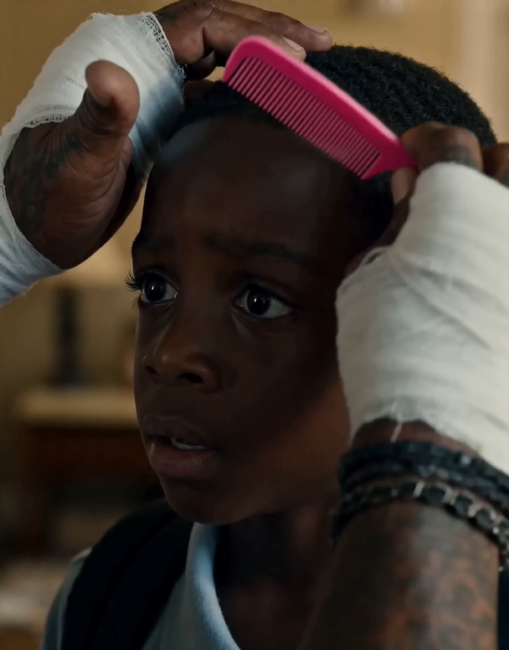
And always that pink comb.
I saw it again when Malik’s hair got flattened under the helmet. Deacon would take the comb from inside his cut, run it once through Malik’s hair, then put it back like it was sacred.
A month in, I asked Clay about it while the others were checking tire pressure outside a Shell station on Elvis Presley Boulevard.
“Why the comb?”
Clay looked at Deacon, then looked away.
“Not my story, ma’am.”
That was the first time I understood something.
The club knew.
Whatever Deacon carried, they all knew it. And they protected it the way they protected Malik: without making speeches about it.
Brotherhood, I learned, was not loud. It was Rooster pretending not to notice when Deacon’s hands shook at one particular intersection. It was Clay riding closer to him on bad mornings. It was three men rearranging their work schedules, doctor appointments, and court dates to move a boy safely through six blocks of Memphis.
Six blocks.
That was all.
But for Malik, it might as well have been a war zone.
The first real test came in November.
It was one of those Memphis mornings where the sky looked bruised and the air smelled like wet asphalt, fried food, and old leaves packed into gutters. Malik had a science project due. He had stayed up late gluing cardboard planets to wire hangers, and he was proud of it in that shy way boys are proud when they’re afraid pride will get laughed at.
At 6:12, only two bikes came.
Clay and Rooster.
No Deacon.
I saw Malik’s face change before anybody said a word. Fear knows how to return to a body. It does not knock. It kicks the door in.
“Where’s Mr. D?” Malik asked.
Clay took off his gloves slowly.
“He’s coming.”
But his voice did not sound sure.
Five minutes passed. Then ten.
Tasha stood on the porch with her arms crossed tight against her chest. Rooster kept looking toward the end of the block. The corner boys had gathered near the boarded-up laundromat, hoods up, hands in pockets, watching.
One of them laughed.
I still remember that laugh.
It was not loud. It did not have to be. Malik heard it, and his cardboard Saturn started trembling in his hands.
Then a dark sedan rolled slowly past the house. Too slowly. The passenger window lowered two inches. Nobody inside said anything. They just looked.
Clay stepped forward.
Rooster did too.
For one second, I thought it was going to become the kind of story the evening news loves. Older bikers. Street crew. Child in the middle. Cameras later. Candles on sidewalks. People saying how terrible it was while changing the channel.
Then Deacon’s Harley turned the corner.
The sound came before the bike, a low V-twin pulse bouncing between the houses like thunder trapped under the street. He rode in slow, no helmet, face gray with pain, one sleeve of his hoodie cut open at the wrist.
His right hand was wrapped in gauze.
Blood had come through.
He stopped at the curb, killed the engine, and for a moment there was only rain ticking on metal.
Clay walked toward him.
“What happened?”
Deacon swung one leg over the bike like every bone in him had filed a complaint.
“Dropped a transmission at the shop.”
“Your hand?”
“Still got the other one.”
Rooster cursed under his breath.
Tasha came off the porch. “You are not taking my child anywhere bleeding.”
Deacon looked at her. Not hard. Not soft either.
“Ma’am, that boy has a project due.”
That was all he said.
Malik stood frozen with his solar system. The gang boys across the street had stopped laughing.
Deacon took two steps toward my nephew and lowered himself like he had that first morning. His knees cracked. His leather cut creaked. He pulled the pink comb out with his left hand because his right was useless.
The comb slipped once.
His jaw tightened.
He tried again.
Malik whispered, “You don’t have to.”
Deacon looked up at him.
“Yeah,” he said. “I do.”
That morning, Deacon could not ride lead. Clay took front. Rooster rode back. Deacon rode beside them in Tasha’s old Buick, because she refused to let him handle a motorcycle with a bleeding hand. He hated that more than the injury. You could see it in his face.
But he got in.
All the way to school, the three bikes and one Buick moved through South Memphis like a funeral procession for fear itself.
At the drop-off, every kid stopped and stared.
Malik climbed out holding his science project. Deacon got out too, pale and sweating, and walked him to the front gate.
One of the corner boys had followed on a bicycle. He stopped across the street and shouted, “You need old men to babysit you now?”
Malik flinched.
Deacon did not turn around.
He put his good hand on Malik’s shoulder and said, low enough that only we heard it, “Go learn something they can’t steal.”
Malik walked through the gate.
For a moment, we all thought that was the victory.
A hurt biker. A scared boy. A school gate. The gang backing down.
It felt like the end.
It was not.
Because that afternoon, Deacon vanished.
At 3:05, Clay and Rooster came to pick Malik up.
Deacon was not with them.
Clay said he was resting.
Rooster said nothing.
Bikers are terrible liars, not because they lack practice, but because silence does most of their lying for them.
That night, Malik called me from his room. His voice was small.
“Auntie, Mr. D didn’t just hurt his hand.”
I sat up.
“What do you mean?”
“I saw him at the school office. Before he left. He was looking at my file.”
That sounded bad until Malik added the part that made my stomach drop.
“He asked the secretary if my address was still on Walker Avenue.”
I drove to Tasha’s house.
Clay was already there, standing in the driveway under the yellow porch light with rain shining on his leather shoulders. Rooster sat on his bike at the curb, smoking a cigarette he never lit.
Tasha was crying in the kitchen.
Deacon had gone to Walker Avenue.
Not Malik’s current house. The old one. The block where the gang had first approached him. The block Malik’s family had left years ago after a shooting put a bullet through their front window.
I asked Clay why Deacon would go there.
Clay rubbed both hands over his face.
“Because he knows that block.”
“How?”
Rooster finally spoke from the doorway.
“Because he used to belong to them.”
Nobody moved.
The refrigerator hummed. Rain tapped the window over the sink. Somewhere outside, a Harley ticked as its engine cooled.
Clay looked sick when he said it.
“Twenty years ago, Deacon ran with the same crew that’s trying to pull Malik in. Different name back then, same bloodline. He was thirteen when they got him. No father. Mama working doubles. Same route to school. Same gas station. Same threats.”
Tasha’s face hardened.
“You brought that man near my son?”
Clay nodded once, like he deserved the hit.
“Yes, ma’am.”
Rooster stepped inside, his old boots heavy on the linoleum.
“And he’s the reason your son is still walking.”
Then Clay told us.
Deacon’s real name was Marcus Bell. At thirteen, he had been recruited on the same six blocks. At fifteen, he was carrying packages. At seventeen, he watched his best friend Eli die behind a fried chicken place because both of them had mistaken fear for loyalty.
Eli.
That name landed somewhere deep.
The pink comb.
The shaking hands at the intersection.
The way Deacon never looked at the boys on the corner.
Clay said Deacon left the gang after Eli died, but leaving did not make him clean. He did two years in prison for things he never bragged about and never excused. When he got out, Iron Psalm MC took him in because Rooster had known his mother.
“They didn’t save him,” Clay said. “They gave him somewhere to be useful while he saved himself.”
Now Deacon had gone back to the street that made him.
Not to fight.
Not to threaten.
To stand there.
Alone.
We found him on Walker Avenue just before dark.
He was standing under a busted streetlight across from the old gas station, his right hand bandaged, his leather cut dark with rain. His Harley was parked at the curb, engine off. That scared me more than if it had been roaring.
Three young men stood twenty feet from him.
One of them was the boy who had shouted at Malik outside school. He looked older up close. Hard eyes, soft cheeks. Maybe sixteen. Maybe still young enough for somebody to save if the world moved fast.
Deacon was not yelling.
He was not making fists.
He was just talking.
We could not hear all of it from the car, but I caught pieces through the rain.
“Same lie.”
“Same corner.”
“Same graveyard waiting.”
The sixteen-year-old said something sharp. Deacon did not react.
Then the boy pointed at Deacon’s vest.
“You think leather makes you different?”
Deacon looked down at his cut. His face did something strange. Not a smile. Not pain exactly.
“No,” he said. “What I carry under it does.”
He reached inside.
For one awful second, I thought he was reaching for a weapon.
So did everyone else.
The boys stepped back. Clay moved forward. Rooster’s hand went to his side.
But Deacon pulled out the pink comb.
Small. Cheap. Plastic. The kind sold in packs at beauty supply stores.
He held it in his huge tattooed hand like it weighed more than steel.
“This was Eli’s little sister’s,” he said.
The rain softened everything after that.
Deacon told the boys what he had never told Malik. What he had barely told his own brothers.
The night Eli died, he had been carrying that comb in his pocket because Eli’s sister, Nia, had handed it to him that morning. She was seven. She had asked Marcus — Deacon before he became Deacon — to fix her brother’s hair before school pictures because their mama had left early for work.
Marcus laughed at her.
Eli told him to do it anyway.
So Marcus stood in a cracked bathroom mirror on Walker Avenue and combed Eli’s hair, complaining the whole time. Eli grinned. Nia clapped. For ten minutes, they were not corner boys. They were just kids late for school.
That afternoon, Eli was killed.
The comb stayed in Marcus’s pocket through the ambulance lights, through the police questions, through prison intake, through every cell search where he somehow managed to keep it hidden. When Iron Psalm gave him his first cut, he stitched a tiny inside pocket for it himself.
That was the seed I had seen the first morning.
The impossible thing in the vest of a dangerous-looking man.
Not softness.
Memory.
Not a prop.
A wound he had learned how to carry without letting it rot him from the inside.
Deacon looked at the sixteen-year-old boy.
“You think I’m here for Malik,” he said. “I am. But I’m here for you too. Because somebody should’ve stood on this block when I was thirteen.”
The boy spat near Deacon’s boot.
But his eyes had changed.
Deacon did not move.
“You touch Malik, and every morning you’ll see us. Not because we want trouble. Because we already know what trouble costs.”
Clay and Rooster stepped out of the car then. Not fast. Not dramatic. Just present.
The three young men backed away first.
No chase. No victory yell. No movie scene.
Just three boys disappearing into rain, and three old bikers standing on a street that had taken too many children.
Tasha got out of the car.
She walked up to Deacon and slapped him across the face.
Hard.
Clay inhaled. Rooster looked at the sky.
Deacon accepted it.
Then Tasha hugged him.
Harder.
He stood stiff for half a second, like kindness was a language he still translated slowly. Then his good arm came around her shoulders.
“I should’ve told you,” he said.
“Yes,” she answered. “You should’ve.”
Malik learned the truth two days later.
He did not ask if Deacon had been bad.
Children understand survival better than adults give them credit for.
He asked, “Did anybody ride with you?”
Deacon shook his head.
Malik looked at the pink comb in Deacon’s hand.
Then he said, “Then ride with me tomorrow.”
And Deacon did.
For four months total, they came.
Every school morning. Every afternoon.
The gang never touched Malik.
But here is the twist most people miss.
Those rides did not just save one boy from joining a gang.
They pulled Deacon back through the worst street of his life twice a day until the street no longer owned him.
By Christmas, he could stop at that intersection without his hands shaking.
By January, he started looking at the corner boys. Not with hate. With recognition.
By February, one of them asked Clay if the club needed help with their food drive.
It was the same sixteen-year-old who had spit near Deacon’s boot.
Clay made him carry canned beans for six hours.
Rooster called him lazy.
Deacon gave him gloves.
No one said the word rescue.
Bikers do not like soft words.
They prefer useful ones.
The escort ended in March.
Not because the danger vanished. Danger does not vanish in neighborhoods like ours. It just learns which houses are guarded by people who keep showing up.
It ended because Malik asked to walk one morning.
Tasha almost said no.
I almost said no.
Deacon just looked at him.
“You sure?”
Malik nodded. He was still skinny. Still thirteen. Still too young to have learned the weight of certain things. But his shoulders sat different under his backpack.
Deacon handed him the pink comb.
Malik frowned.
“I can’t take that.”
“Not keeping it,” Deacon said. “Borrowing courage.”
Malik put it in his pocket.
Then he walked those six blocks.
Clay rode half a block behind him. Rooster circled once near the gas station. Deacon stayed at the curb in front of Tasha’s house, sitting on his Harley with both boots planted, engine idling low.
He did not follow.
That was harder for him than following.
I watched his hand grip the throttle. The knuckles went white under old ink. His jaw worked like he was chewing nails.
When Malik turned the last corner toward school, Deacon killed the engine.
The sudden quiet felt enormous.
Every year after that, on the first Monday of school, Deacon rode Walker Avenue at 6:12 a.m.
Sometimes alone.
Sometimes with Clay and Rooster.
Sometimes with half the club behind him, leather creaking, engines low, coffee steaming from gas station cups.
He never honked. Never waved. Never made it a parade.
He just rode the route.
Past the old gas station.
Past the laundromat.
Past the corner where Eli died.
Then he stopped by Tasha’s porch, whether Malik lived there or not, and checked the mailbox hinge because it always came loose.
That was his ritual.
Not flowers.
Not speeches.
A ride and a repair.
The pink comb stayed in his vest, except one day each year, when Malik borrowed it before school pictures.
By the time Malik was seventeen, he was taller than Deacon expected and better at math than anyone expected. He still called him Mr. D. Deacon pretended to hate it.
He did not.
Last spring, Malik graduated.
Deacon stood in the back of the auditorium because he said chairs made his knees angry. He wore his leather cut over a clean black shirt. The pink comb was in its inside pocket. Rooster had passed the year before, so Clay stood on one side of him, one empty space on the other.
When Malik’s name was called, Tasha screamed loud enough to embarrass three generations.
Deacon did not scream.
He put two fingers to his mouth and whistled once, sharp and fierce, the way men whistle at the end of a long ride when the last bike finally makes it home.
Afterward, Malik walked through the crowd in his cap and gown and handed Deacon something small.
A new comb.
Black this time.
Deacon looked at it for a long while.
Then he tucked it into his vest beside the pink one.
No speech.
Just two combs in one pocket.
Two boys from the same street.
One lost.
One walking across a stage with his mother crying into a paper program.
That evening, three Harleys rolled down South Parkway in the gold Memphis light. Clay rode lead. Malik rode in the middle, helmet too big, graduation tassel taped to the back. Deacon rode last.
The engines faded past the gas station.
No one on the corner said a word.
Only leather, thunder, and home.
Follow the page for more biker stories about the people behind the leather.