Part 2: A Mother Threw Every New Outfit Her Daughter Owned into the Trash—Then a Device Fell from Her Handbag and Her Father Called the Police
Part 2
Twenty minutes earlier, Elaine had been standing inside Mercer Alterations, the small shop attached to the family garage, shortening Sophie’s new cream coat.
Sophie had brought it over because one sleeve covered half her hand. Ryan had purchased it from an expensive boutique after telling her the navy coat she already owned made her look “like someone’s tired substitute teacher.”
Elaine disliked the remark, but Sophie defended him.
“He notices details,” she said.
Elaine had heard similar explanations for months. Ryan noticed when Sophie arrived at work seven minutes late. He noticed which male attorney spoke to her near the elevators. He noticed when she stopped for coffee after church instead of driving directly home.
Sophie called it attentiveness.
Mark called it uncomfortable.
Elaine said nothing because Sophie had accused both parents of treating her like a child. The accusation was not entirely unfair. After Sophie’s older brother died in a highway accident eight years earlier, Elaine began checking weather reports before Sophie drove, calling if she was ten minutes late, and keeping a spare key to her apartment without asking.
Fear had taught Elaine to cross boundaries while calling it love.
That morning, her fingers passed over a hard circle sewn into the coat’s lower hem. At first she assumed it was a magnetic fastener. Then she found the same uneven ridge in the cuff.
She opened the lining and removed a small battery-powered tracking tag wrapped in fabric matching the coat.
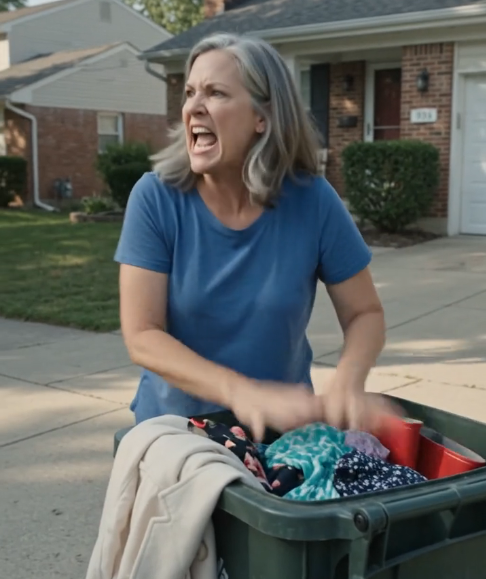
Elaine did not pause to explain. She carried the coat outside, grabbed every gift Ryan had left at Sophie’s apartment, and began throwing them away.
By the time Sophie arrived, three neighbors were watching. One recorded from across the street until Mark asked him to lower his phone.
“You could have shown me,” Sophie said after Mark called the police. “You didn’t have to destroy everything.”
“I thought there might be more devices.”
“So you made a scene?”
“Yes,” Elaine said. “And I was wrong to make the decision without you.”
Her apology did not repair the torn coat.
Officer Nina Alvarez, a forty-seven-year-old Latina patrol officer with silver-framed glasses and a careful voice, arrived with her partner. She asked everyone to stop touching the objects. Each device was photographed where it had fallen, then placed separately for documentation.
Nina did not promise an immediate arrest. A tracking tag alone could have innocent explanations, she said. Ownership, activation records, messages, video, and proof that tracking continued without consent would matter.
Sophie kept insisting Ryan was protective, not dangerous.
Then Nina asked whether he had ever appeared somewhere Sophie had not told him she would be.
Sophie looked toward the trash bin.
A bookstore. Her dentist’s office. A coworker’s birthday dinner. Her grandmother’s grave.
“He said we had the same instincts,” she whispered.
Nina examined the folded pharmacy receipt from Sophie’s bag. On the back, someone had written a phone number and five words:
Don’t take the red boots home.
Sophie recognized the handwriting.
It belonged to Ryan’s mother.
Part 3
Karen Cole arrived before the officers left.
The fifty-three-year-old white American woman stepped from an aging sedan wearing a grocery-store uniform beneath a brown cardigan. Her hands shook so badly that she dropped her keys twice.
Ryan had told Sophie that his mother lived in Cincinnati. In reality, Karen rented a room twelve miles away.
“He didn’t want you speaking to me alone,” she said.
Karen admitted she had hidden the money and bus ticket inside Sophie’s handbag three weeks earlier. She had used blue thread because it was the only spool in the sewing kit she kept in her car.
The handbag contained Ryan’s tracker when Karen opened it. She did not remove the device.
“I thought he would know,” she said. “I thought he would punish you for losing it.”
Sophie stiffened. “He has never hit me.”
Karen nodded. “His father never hit me either.”
Ryan’s father had controlled the household through money, keys, and information. He recorded mileage from Karen’s car, called her workplace to verify her shifts, and checked grocery receipts for places she had not mentioned. Whenever she objected, he told relatives she was forgetful and needed supervision.
Ryan grew up watching fear presented as responsibility.
That history explained his behavior. It did not excuse it.
Karen had noticed the same pattern when Ryan began asking her what Sophie wore, whether she spoke to former classmates, and why she still visited her parents twice a week. After Karen refused to answer, Ryan stopped bringing Sophie to see her.
Two months earlier, Karen saw several unopened tracking tags in his apartment. He claimed they were for luggage. Later, while washing Sophie’s new red boots before a family dinner, Karen felt a rigid shape beneath one insole.
She warned Sophie through the pharmacy receipt because Ryan often inspected messages on Sophie’s phone.
“Why didn’t you tell the police?” Mark asked.
Karen looked at the pavement. “Because the last time I called for help, everyone asked what crime had happened yet.”
Nina did not defend the system. She asked Karen to describe what she had seen and whether she still had access to any receipts, packaging, or messages.
Karen produced an old phone from her cardigan pocket. It contained photographs of the unopened devices, messages ordering her to report Sophie’s movements, and a voice recording in which Ryan threatened to tell Karen’s landlord she was stealing medication unless she cooperated.
Sophie sat down on the driveway.
She then confessed something Elaine had not known. For six weeks, Sophie had been quietly planning to leave Ryan. She had changed her email password and opened a separate bank account, but each time she visited an apartment listing, Ryan appeared nearby or mentioned the neighborhood later.
She began to believe she was careless.
Ryan encouraged that belief. He told her grief over her brother had made her distracted, like her mother. He offered to organize her schedule, manage her passwords, and drive her to work.
The new clothes were not simply gifts. They were replacements for the belongings Sophie had begun leaving at her parents’ house.
Elaine crouched beside her daughter. “I should have asked before cutting them.”
“You should have trusted me to decide.”
“Yes.”
“And I should have told you.”
“You were trying to find a safe way.”
Sophie looked at the torn cream coat in the bin. “I wasn’t sure there was one.”
When Nina turned over the red boot, Elaine noticed the blue thread beneath its heel. The final knot formed a small X.
Her brass thimble slipped from its cord and struck the driveway.
Elaine had seen that exact stitch once before—twenty-seven years earlier, inside another woman’s coat.
Part 4
In 1999, Elaine was a twenty-nine-year-old alteration assistant working behind a dry cleaner near the Columbus bus terminal. She was pregnant with Sophie’s older brother and saving every spare dollar for a crib.
One February evening, a young woman entered carrying a brown wool coat. Her left cheek was pale beneath poorly blended makeup, but there was no visible injury. She asked Elaine to sew the inside pocket shut.
When Elaine asked why, the woman placed sixty dollars, a bus schedule, and two birth certificates inside it.
“If my husband searches my purse, he’ll take them,” she said.
The woman was Karen Cole.
Elaine had not known her name. Karen had paid cash and returned the next morning before the shop opened. Elaine sewed the pocket with blue thread because the black spool was empty. Her supervisor would have charged extra for hidden work, so Elaine completed it during lunch and refused payment.
Before closing the seam, she tied the final knot in a small X, the way her mother had taught her.
Karen left town with seven-year-old Ryan. She stayed away for four months.
Then Ryan became ill, and Karen returned because her husband’s insurance covered the specialist he needed. She told herself she would leave again after the treatment. Months became years. By the time she finally separated from Ryan’s father, her son had learned to associate surveillance with keeping a family together.
“I remembered your thimble,” Karen told Elaine. “It was hanging from your neck that night too.”
After Ryan introduced her to Sophie, Karen recognized Elaine immediately. She said nothing because she was ashamed that the escape Elaine helped create had not lasted.
The money in Sophie’s bag had been an attempt to repay those sixty dollars.
Elaine pushed it back toward her.
“That wasn’t a loan.”
“I know,” Karen said. “But this isn’t repayment. It’s a bus fare for the next woman.”
Sophie refused the money as well. She had savings and a job. What she needed was for Karen to preserve the evidence and tell the truth, even if doing so meant testifying against her son.
Karen closed her fingers around the folded bills.
“I will.”
The officers helped Sophie document the messages without responding to Ryan. She agreed to spend the night somewhere he did not know, while an advocate helped her consider a protection order and a safe way to retrieve essential belongings.
Elaine offered the family home.
Sophie shook her head. “That is the first place he’ll expect.”
She chose to stay with Tasha Greene, a thirty-one-year-old Black coworker whose address Ryan had never been given. Mark wanted to follow them in his truck. Sophie said no.
His jaw tightened, but he handed her the truck’s spare emergency phone and stepped back.
Before leaving, Sophie picked up the torn cream coat.
“You’re not taking that,” Elaine said.
Sophie met her eyes.
Elaine corrected herself. “Do you want to take it?”
“No. But I don’t want it in the trash.”
Together, they placed the coat on Elaine’s worktable. Nina suggested leaving every hidden compartment untouched until investigators finished documenting it.
The gifts remained sealed in clear bags instead of being discarded. For the first time that afternoon, the objects belonged neither to Ryan nor to Elaine’s fear. They belonged to the evidence Sophie had chosen to preserve.
That evening, Mercer Alterations closed early.
Elaine taped a plain handwritten note inside the door:
Private safety checks available. No purchase required.
She did not yet know how many women in the neighborhood would understand exactly what it meant.
Part 5
Ryan was not arrested that afternoon.
Investigators first verified the devices, activation records, store receipts, and messages Karen had preserved. Building footage later showed Ryan placing one tracker beneath Sophie’s car and another inside the lining of her work tote while waiting outside her office.
The evidence also revealed that he had accessed a shared location account after Sophie withdrew consent. Combined with threatening messages and repeated appearances at private locations, it supported stalking and unlawful tracking charges under the applicable investigation.
When officers went to speak with him, Ryan insisted Sophie had agreed to location sharing months earlier. That was partly true. She had once shared her phone location during a winter road trip.
Consent given for one journey, Nina explained later, did not become permanent ownership of someone’s movements.
Ryan’s attorney arranged for his surrender. A judge issued temporary no-contact conditions while the case proceeded.
Karen attended the hearing. She did not ask Sophie to forgive her son. She also refused to describe him as a monster.
“He learned this in my house,” she told the prosecutor. “Then he chose to keep doing it after she said no.”
Sophie moved to a new apartment and changed departments at work. She did not abandon her job, church, or parents, although fear changed the route between them. For several weeks, she startled whenever a car remained behind her through two turns.
Elaine responded by calling more often.
On the fifth day, Sophie finally said, “Mom, I left one person who watched where I went. I can’t replace him with you.”
Elaine went silent.
“You’re right,” she said.
She returned the spare key to Sophie’s old apartment, stopped checking her bank activity, and began asking before offering advice. Protecting Sophie required Elaine to confront the uncomfortable resemblance between anxious care and control.
The neighborhood did not respond perfectly. Someone posted a photograph of the trash bin online and described Elaine as a “hero mother.” Strangers offered money, clothing, and security cameras. A local reporter asked Sophie to hold one of the devices for a photograph.
She declined every request.
“I don’t want my worst month turned into someone else’s inspiring content,” she told Elaine.
The plain note in Mercer Alterations remained.
At first, only one woman asked for help. She brought in a diaper bag her former partner always seemed able to find. Elaine discovered no device. Instead of dismissing her, she connected her with a local technology-safety advocate who helped review account permissions and shared passwords.
The next customer was an older man whose daughter worried about a used car purchased from her former boyfriend. Then came a college student with a backpack, a nurse with a gifted keychain, and a grandmother carrying a child’s winter coat.
Elaine realized a seamstress could identify unusual weight, altered linings, and fresh stitching, but she was not an investigator. She could also destroy evidence if she cut carelessly, just as she nearly had with Sophie’s clothes.
So she asked Nina and a domestic-violence technology specialist to help design a safer process.
The shop created a private appointment system. Elaine inspected fabric and construction without removing suspicious objects. If something needed documentation, the customer decided whether to contact an advocate or police. No names were written on the public calendar. No photographs were taken. No one had to explain a relationship to receive an inspection.
Mark built a narrow cabinet with numbered evidence trays, then learned that he could not call police on someone else’s behalf unless there was an immediate emergency. Choice mattered even when waiting frightened him.
Tasha volunteered one Saturday a month, helping people secure email accounts and separate shared subscriptions. Karen came on weekday mornings and repaired hems. She never handled a customer’s bag without permission.
The boutique that sold Ryan’s gifts initially denied responsibility. The devices had been added after purchase. Still, its owner agreed to train staff to recognize returns involving altered linings and to preserve receipts without forcing customers to confront gift buyers.
Ryan eventually pleaded guilty to reduced stalking and unlawful-surveillance-related charges based on the evidence available. He received probation, mandatory intervention programming, restrictions on contacting Sophie, and monitoring by the court. The outcome did not satisfy everyone.
Karen believed the sentence was too light.
Sophie believed prison alone would not teach him that access was not intimacy.
Elaine learned not to decide which belief was correct for them.
Months later, investigators returned the cream coat. The lining had four separate cuts, two made by Ryan and two by Elaine.
“I can replace the whole lining,” Elaine told Sophie.
Sophie ran her thumb across the damaged fabric.
“No. Mend the openings. Leave them visible.”
Elaine used blue thread. At each repaired slit, she tied the final knot in a small X.
Part 6
Two years later, Sophie stood behind the counter at Mercer Alterations while Elaine tried to thread a needle.
Arthritis had stiffened Elaine’s fingers. The brass thimble still hung from her neck, but she used it less often. Sophie took the needle without comment and guided the blue thread through its eye.
The shop looked almost unchanged from the street. There was no large sign announcing what happened there. Wedding dresses hung beside work uniforms. Spools filled the same wooden rack Mark had built when Sophie was a child.
The private inspection appointments continued twice a week through a partnership with a local advocacy organization. Elaine no longer examined suspicious items alone. The goal was not to teach customers to hunt for devices themselves or to promise that every threat could be found inside a seam. It was to give them a quiet place to slow down, document concerns, and choose their next step.
Karen still came on Wednesdays.
Her relationship with Ryan remained limited to letters approved under the terms of his supervision. He completed the required program, found steady work, and wrote Sophie an apology that did not ask her to answer.
She read it once and placed it in a file.
Forgiveness was not a deadline.
Sophie had not become fearless. She still checked the parking lot before walking to her car. She did not accept expensive gifts easily, and for a long time she avoided cream-colored coats.
But she stopped apologizing for visiting friends without explanation. She traveled alone to Maine. She gave Tasha her itinerary because she wanted to, not because someone demanded it.
Elaine changed too. When Sophie went three days without calling, she waited. When she wanted to ask who Sophie was dating, she asked instead, “Is there anything you want me to know?”
Sometimes the answer was no.
Elaine practiced accepting it.
On a cold November afternoon, a nineteen-year-old college student entered the shop carrying a red backpack. Her mother waited in the car because the young woman had asked to come inside alone.
Sophie invited her to sit. She did not ask whether the person she feared was a boyfriend, parent, roommate, or stranger.
“What would make you feel safer today?” she asked.
The student placed the backpack on the counter.
While the advocate documented an altered seam, Elaine remained by the window. Her hands wanted to intervene. She folded them around the brass thimble and waited until Sophie asked for help.
After closing, Sophie removed the cream coat from a garment bag in the back room. She had kept it not as evidence of Ryan’s generosity or Elaine’s rescue, but as a record of choices—some taken from her, some made for her, and finally some returned.
One blue repair had loosened near the pocket.
Elaine reached for the needle, but Sophie smiled and sat beside her.
“Show me the knot again.”
Elaine guided her fingers through the first stitch, then let go.
Sophie repaired the opening herself. When she finished, the small blue X was uneven, visible only when the lining was turned toward the light.
She hung the coat back inside its bag, leaving the repaired seam exactly as it was.
Follow this page for more heartfelt stories about family, hidden courage, misunderstood choices, and the quiet moments when someone takes their life back. 🌷
#FamilyDrama #HiddenTruths #SecondChances #EmotionalStory #QuietCourage
Prompt ảnh Thumbnail – Nano Banana Pro
Eye-level medium-close candid smartphone photograph in bright clear daytime on the driveway of a modest Columbus, Ohio home, a 56-year-old white American woman with gray-streaked dark hair, a faded blue work blouse and a brass thimble hanging from her neck violently empties expensive new dresses, red boots and a cream winter coat into an open curbside trash bin while gripping dressmaker’s scissors; her 24-year-old white American daughter, barefoot in jeans and a pale sweater, rushes toward her with a shocked, betrayed expression; beside them, a 58-year-old white American father in a navy hospital-maintenance uniform crouches near the overturned handbag, holding a tiny blinking black device that has just rolled onto the pavement as he urgently raises his phone to call police; clothing scattered across the driveway, tense family conflict, the mysterious device clearly visible but unexplained, natural skin texture, imperfect handheld framing, realistic daylight and colors, raw everyday-life photography, not cinematic, no readable text, no logo, no watermark.
Video Prompt 1 – Part 1
Eye-level medium handheld documentary shot, realistic 10-second daytime video on a Columbus, Ohio driveway, 4 escalating scenes: Scene 1, a 56-year-old white American mother with gray-streaked hair angrily throws her 24-year-old white American daughter’s new dresses, red boots and cream coat into a curbside trash bin, shouting, “You are never wearing anything he gave you again!” Scene 2, the barefoot daughter rushes forward, crying, “You’re the one controlling my life!” as three neighbors watch in confusion. Scene 3, the mother overturns a handbag; keys and cosmetics scatter, then a tiny black device rolls beneath a car. Scene 4, her 58-year-old white American father in a navy hospital-maintenance uniform grabs the device, raises his phone and says, “Call the police—he can see us right now.” Raw handheld movement, clear daylight, lifelike expressions, no POV, no subtitles, no readable text, no logo, no watermark.
Video Prompt 2 – Part 1 Shock Version 2
Medium-close handheld documentary shot, realistic 10-second daytime video outside a modest Ohio home, 4 escalating scenes: Scene 1, a 56-year-old white American seamstress with gray-streaked hair cuts open her 24-year-old white American daughter’s expensive cream coat beside an overflowing trash bin, declaring, “Your boyfriend hid something inside every gift.” Scene 2, the furious daughter in jeans and a pale sweater grabs for the coat and shouts, “Stop destroying my life!” while her mother pulls a tape-wrapped black disk from the lining. Scene 3, a second device falls from the daughter’s handbag as her 58-year-old white American father in a navy work uniform freezes, then urgently calls police. Scene 4, the daughter’s phone vibrates without showing its screen; she turns pale and whispers, “He knows Mom touched the clothes.” Her mother finds blue stitches in a hidden pocket and replies, “Then someone else knew you needed to escape.” Bright daylight, raw realism, no POV, no subtitles, no readable text, no logo, no watermark.