Part 2: The Girl Who Worked After School Was Called “Greedy” — Then Her Answer at the Honor Ceremony Silenced the Room
For months, Emily Carter had been the kind of girl adults praised in public and children avoided in private.
Teachers said she was responsible.
Students said she was cold.
Both sounded true, depending on where you stood.
Every morning, she arrived before the first bell with a canvas tote bag that looked too heavy for her shoulder. Inside were homework folders, a dented thermos, two granola bars, a roll of quarters, and a small purple notebook held shut with a rubber band.
Nobody knew what was inside the notebook.
That made it easier to talk about her.
At 7:15, while other students leaned against lockers and compared weekend plans, Emily stood near the cafeteria entrance with a plastic container of muffins.
“Two dollars each,” she would say.
She never begged. She never smiled too much. She simply held the container and waited.
Some mornings, teachers bought one out of pity. Some students bought one because the muffins were actually good. Others walked past and smirked.
“Saving for a mansion?” a boy named Tyler once asked.
Emily looked at him for half a second. “Blueberry or banana?”
That was the thing about Emily. Insults seemed to land on her and slide off, but not because they did not hurt. If anyone looked closely, they might have noticed the way her thumb rubbed the edge of the container until the plastic squeaked.
Nobody looked that closely.
After school, she went straight to work.
On Mondays and Wednesdays, she helped Mr. Alvarez, the janitor, wipe cafeteria tables and stack chairs. On Tuesdays, she watched two little boys on Maple Street until their mother finished her nursing shift. On Thursdays, she worked three hours at Miller’s Grocery, bagging cans and smiling at customers who sometimes asked why a child was working so much.
Emily always gave the same answer.
“I like staying busy.”
It sounded proud.
It sounded rehearsed.
It sounded like a wall.
The first small crack appeared in April, during a rainy Tuesday afternoon.
Mrs. Donnelly, Emily’s English teacher, stayed late grading essays. She had forgotten her umbrella and was standing by the front doors, considering a wet run to her car, when she saw Emily outside by the curb.
Emily was not waiting for a ride.
She was kneeling beside a sixth-grade boy named Mason Lee, whose backpack had spilled open across the sidewalk. His papers were soaked. His face was red with the kind of embarrassment children carry like a wound.
Mrs. Donnelly watched from behind the glass.
Emily picked up Mason’s notebooks one by one and shook off the rain. Then she took something from her own backpack.
A twenty-dollar bill.
Mason pushed it away.
Emily said something too soft to hear.
The boy shook his head harder.
Emily folded the bill and tucked it inside one of his wet folders. Then she stood, pulled her hood up, and walked away before he could return it.
The next morning, Mason had a new backpack.
When Tyler saw it, he laughed and said, “Nice. Did Money Emily sell you that too?”
Mason opened his mouth.
Emily, standing three lockers away, shot him a look so sharp he closed it again.
Mrs. Donnelly noticed.
It bothered her the rest of the day.
The second crack came during lunch duty.
A seventh-grade girl named Harper dropped her tray in the cafeteria. Mashed potatoes splattered across the floor, and chocolate milk burst open under a table. Several students groaned loudly.
Harper froze.
She was one of those quiet girls who seemed to apologize for taking up space. Her face crumpled before anyone said a word.
Emily stood from a nearby table.
She had not finished eating. In fact, her lunch was barely touched, just half a peanut butter sandwich and an apple with a bruise.
Without speaking, she grabbed napkins and began cleaning the mess.
“Careful,” Tyler called from two tables away. “She might charge you.”
A few students laughed.
Emily did not look up.
Harper whispered, “I’m sorry.”
Emily leaned close enough that only Harper heard. “Don’t cry in front of people who are waiting for it.”
Then Emily lifted the tray, carried it to the counter, and came back with another lunch.
Mrs. Donnelly saw that too.
She also saw Emily slide her own meal ticket across the cashier’s counter.
That afternoon, Emily did not eat.
The third crack was in the purple notebook.
It happened by accident.
Emily had stayed after school to scrub paint from art room tables. The art teacher, Ms. Lane, had offered her ten dollars because the annual showcase had left the room in chaos. Emily accepted before Ms. Lane even finished asking.
“Of course she did,” a student muttered from the doorway.
Emily’s hand tightened around the sponge.
Later, when she bent to rinse a bucket, the purple notebook slipped from her backpack and landed open on the floor.
Ms. Lane picked it up.
She did not mean to read it.
But the page was right there.
It was not a diary.
It was a ledger.
At the top, in careful handwriting, Emily had written:
May Goal: $412
Below that were lines of numbers.
Muffins: $18
Babysitting: $45
Miller’s: $62
Janitor help: $25
Notes: $5
Remaining: $257
On the next page, there was only one sentence.
Do not be late again.
Ms. Lane closed the notebook quickly, as if she had touched something private.
When she handed it back, Emily’s face had gone pale.
“I didn’t read it,” Ms. Lane said.
Emily stared at her.
Ms. Lane softened her voice. “Emily, is everything all right at home?”
For a moment, the girl looked fifteen again. Not sharp. Not difficult. Just tired.
Then the wall came back.
“Yes, ma’am.”
She took the notebook, stuffed it deep into her bag, and scrubbed the table so hard the sponge tore in half.
After that, Ms. Lane began watching more carefully.
So did Mrs. Donnelly.
They noticed Emily never bought anything from the vending machines. They noticed she wore the same gray cardigan every week, even after one sleeve began to unravel. They noticed she flinched whenever the office phone rang during class.
Once, during math, the intercom crackled.
“Emily Carter, please come to the front office.”
Every head turned.
Tyler whispered, “Maybe they found where she hides all her money.”
Emily stood so fast her chair scraped the floor.
She forgot her pencil.
When she returned ten minutes later, her eyes were dry, but her hands were shaking.
The counselor, Mrs. Reed, followed her to the classroom door.
“You don’t have to go back in right now,” she whispered.
Emily shook her head. “I have a test.”
“But, honey—”
“I have a test.”
She walked in, sat down, and scored a 96.
That should have made people wonder.
Instead, it made them colder.
There is a strange thing people do when someone refuses to explain their pain. They turn the silence into evidence.
By May, the rumors had grown teeth.
Emily was greedy.
Emily thought she was better than everyone.
Emily only helped when money was involved.
Then came the announcement that she had won the Outstanding Student Service Award.
The award committee chose her for academic excellence, after-school service, and “remarkable work ethic.”
The students nearly choked on the phrase.
“Service?” Tyler said in the hallway. “She charges for everything.”
Emily was standing nearby, taping a flyer to the wall for her weekend car wash fundraiser.
She did not turn around.
She just pressed the tape flat with two fingers and walked away.
The flyer read:
CAR WASH — SATURDAY ONLY
Donations accepted
At the bottom, in tiny handwriting, she had added:
No amount too small.
Nobody asked what the donations were for.
They thought they already knew.
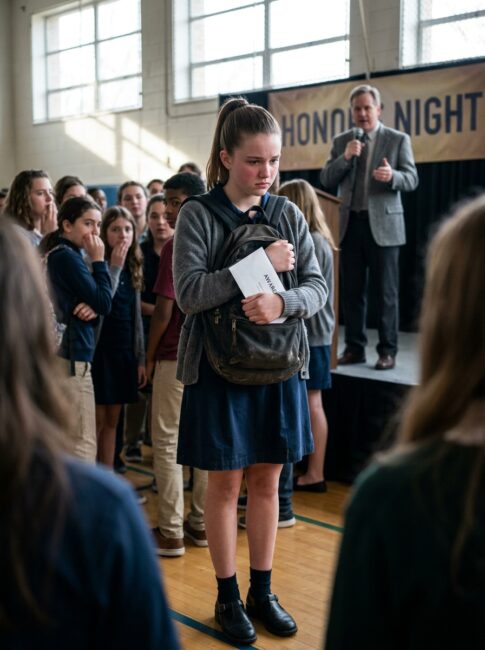
Honor Night arrived warm and gold, with sunlight still resting on the gym windows.
Parents filled the bleachers. The band played a song that sounded brave and slightly off-key. Teachers stood along the walls, clapping for children they had watched grow all year.
Emily came alone.
That was the first thing Mrs. Donnelly noticed.
Most students had someone beside them, a mother fixing their collar, a grandfather taking pictures, a little sibling stealing candy from a purse. Emily walked through the double doors by herself, carrying the same old backpack and wearing a navy dress that was too plain for the occasion.
Her shoes were polished.
Her cardigan sleeve had been mended with dark thread.
She chose a chair near the aisle, not with the award winners in front, but at the edge of the second row, as if she wanted a quick exit.
When the principal called her name, applause rose in a polite wave.
Emily walked to the stage.
The gym lights made her look smaller.
Principal Harris smiled as he read from a card.
“Emily Carter has maintained high honors while working after school and contributing more than one hundred service hours to our school community. She has demonstrated discipline, leadership, and perseverance.”
A few students exchanged looks.
Tyler folded his arms.
Then Principal Harris handed her the certificate and the white envelope.
“This award includes a five-hundred-dollar scholarship contribution, sponsored by the Briarwood Community Foundation.”
That was when Emily froze.
Not dramatically. Not enough for everyone to notice.
But Mrs. Donnelly saw her fingers stop moving around the certificate.
Five hundred dollars.
For most children in that room, it was a future deposit. A line on a college dream. Something parents would help manage later.
For Emily, it looked like oxygen.
She took the envelope.
Her mouth trembled once.
Then she shoved it into her backpack.
The whisper came fast.
“There she goes again.”
“Money Emily.”
“Couldn’t even wait.”
Principal Harris heard enough to frown.
Maybe he wanted to protect her. Maybe he wanted to turn the moment into something respectable again. Either way, he leaned toward the microphone.
“Emily, would you like to tell everyone what you plan to do with the award money?”
The question hung there.
Emily looked at him.
Then she looked at the crowd.
For the first time all night, the room truly saw her face. Not the rumor. Not the nickname. Not the girl selling muffins by the cafeteria door.
Just Emily.
She stepped toward the microphone.
Her voice came out quiet, but clear.
“I’m going to pay the electric bill.”
The gymnasium changed.
It did not gasp. It did not murmur. It simply stopped.
Even the band students in the corner lowered their instruments.
Principal Harris blinked. “The electric bill?”
Emily nodded once.
“My mom’s oxygen machine plugs into the wall.”
No one moved.
Emily’s hand tightened around the microphone stand. She seemed to regret speaking, but she did not step back.
“My mom used to work at the laundry on Fifth Street. Last winter, she got sick. Then she got worse. Now she can’t work much, and some days she can’t walk from the bedroom to the kitchen without help.”
Mrs. Donnelly put a hand over her mouth.
Ms. Lane lowered her eyes.
Emily kept going, not because she wanted to, but because the silence had opened a door she could no longer hold shut.
“My dad left when I was nine. My older brother, Noah, joined the Army last year. He sends what he can, but he’s not home. So after school, I work.”
Her eyes flicked toward the students.
“I know what people call me.”
A few children looked at their shoes.
“I heard it in the hallway. In the cafeteria. Outside the office. I heard it when I sold muffins. I heard it when I babysat. I heard it when I cleaned tables after everyone went home.”
Her voice did not break.
That made it worse.
“I didn’t answer because explaining takes time, and I needed that time to work.”
There it was.
Not anger.
Not self-pity.
Just math.
Cruel, ordinary math.
Emily reached into her backpack and pulled out the purple notebook. The rubber band snapped lightly against the cover as she opened it.
“I write down every dollar because every dollar already has a place to go.”
She looked down at the page.
“Rent. Medicine. Bus passes. Groceries. Mom’s inhalers. The oxygen company. The past-due electric bill. School lunch for my sister.”
A new murmur rose, softer this time.
Sister?
Emily looked toward the back of the gym.
Near the doorway stood a little girl with tangled blond hair, clutching a stuffed rabbit by one ear. Beside her was Mrs. Reed, the counselor, who looked as if she had been trying not to cry for several minutes.
The little girl lifted one hand.
Emily’s face changed when she saw her.
It was quick, almost invisible, but it was the first real softness anyone had seen from her all year.
“That’s Lily,” Emily said. “She’s seven.”
Lily tucked herself partly behind Mrs. Reed.
Emily turned back.
“She thinks I stay after school because I’m in clubs.”
A fragile laugh moved through the room, but it died quickly.
“She doesn’t know I clean classrooms. She doesn’t know I sell muffins. She doesn’t know I skipped the spring dance because our heat was almost shut off. She just knows I bring home cereal and tell her the marshmallow pieces are the best part.”
Tyler stared at the floor.
His mother, sitting beside him, slowly turned to look at her son.
Emily swallowed.
“The science notes were five dollars because Mason needed a backpack, and I didn’t want him to know I bought it.”
Mason, three rows back, covered his face with one hand.
“The cafeteria lunch was mine because Harper was already crying, and I know what it feels like when everyone watches you fall apart.”
Harper began crying again, quietly this time.
Emily’s fingers trembled on the notebook.
“And the car wash money from Saturday wasn’t for me.”
She paused.
This was the twist that landed deepest, because by then everyone thought they finally understood.
They did not.
Emily looked at Principal Harris. “It was for Mr. Alvarez.”
The janitor, standing near the side doors in his brown work shirt, looked up sharply.
Emily’s mouth pressed into a small line.
“He told me not to say anything.”
Mr. Alvarez shook his head once, but his eyes were wet.
Emily continued anyway.
“His wife died in March. He missed work to take care of her. Some of us noticed he stopped bringing lunch. He always gave me extra cleaning shifts when I needed money, even when I knew he could do it himself.”
She looked down at the notebook again.
“So I raised one hundred and thirty-eight dollars to put a grocery card in his locker.”
Mr. Alvarez turned toward the wall.
No applause came.
Applause would have felt too loud for what had just been placed in the room.
Emily closed the notebook.
“I’m not saying this because I want anyone to feel bad.”
That was the sentence that broke Mrs. Donnelly.
Because Emily meant it.
She truly did not want revenge.
She was not standing there to shame them, though shame had found them all the same.
“I’m saying it because you asked what I’m doing with the award money.”
She touched the envelope inside her backpack.
“I’m paying the electric bill first. Then, if there’s anything left, I’m buying Lily sneakers that don’t pinch her toes.”
A sound came from the back row.
Not a sob, exactly.
More like a breath someone had been holding for months.
Principal Harris stepped away from the microphone and wiped his glasses.
For several seconds, Emily stood alone on the stage with her certificate bent slightly in her hand.
Then Lily slipped free from Mrs. Reed and ran down the aisle.
Her little shoes slapped against the gym floor.
Emily turned just as Lily reached the stage steps.
No teacher stopped her.
No one said ceremony rules mattered.
Lily climbed onto the stage and threw both arms around Emily’s waist.
Emily held her with one arm, still gripping the certificate in the other hand. Her chin lowered to the top of Lily’s head.
The room saw it then.
Not a greedy girl.
Not a cold girl.
A child holding another child together.
The applause began somewhere near the teachers.
It was gentle at first, uncertain and ashamed. Then it spread through the gym, not like celebration, but like an apology trying to find its shape.
Emily did not smile.
She only closed her eyes.
That may have been the most painful part.
She looked too tired to enjoy being believed.
After the ceremony, people did what people often do when guilt arrives late.
They gathered.
They offered words.
They tried to hand Emily money in folded bills and awkward envelopes. Some apologized directly. Some apologized by complimenting her dress. Some avoided her eyes and told Lily she was adorable.
Emily accepted very little.
“Thank you,” she said again and again, with the careful politeness of someone who had learned that kindness could disappear if handled wrong.
Tyler waited near the trophy case until the crowd thinned.
His mother stood behind him with one hand on his shoulder, not pushing, just keeping him there.
When Emily passed, Tyler stepped forward.
He looked smaller than he had in the cafeteria.
“I’m sorry,” he said.
Emily stopped.
Lily held her hand and leaned against her side.
Tyler’s face reddened. “For calling you that.”
Emily studied him for a moment.
Everyone nearby pretended not to listen.
Then Emily said, “Don’t call anyone something you haven’t earned the right to know.”
It was not cruel.
That made it land harder.
Tyler nodded.
His mother’s hand tightened on his shoulder.
Mr. Alvarez came next. He carried his cap in both hands.
“You shouldn’t have told them about me,” he said, though his voice had no anger in it.
Emily looked down. “You shouldn’t have skipped lunch.”
He let out a small laugh that cracked in the middle.
Then he reached into his shirt pocket and pulled out a grocery card. It was the same one Emily had hidden in his locker, the corner worn from being carried around.
“I kept it,” he said. “Was saving it for a bad week.”
Emily’s face softened. “Was this one not bad enough?”
Mr. Alvarez smiled through tears. “Maybe I was saving it because nobody had done something like that for me in a long time.”
For a moment, neither of them spoke.
Then Lily tugged Emily’s sleeve and whispered something.
Emily bent down.
Lily whispered again, louder this time. “Can we still get the sneakers?”
A few adults laughed softly, grateful for the mercy of a child asking for something simple.
Emily nodded. “Yes. We can get the sneakers.”
Mrs. Donnelly offered to drive them home.
At first, Emily refused.
Of course she did.
Then Mrs. Reed gently said, “Your mother is expecting you. She called the office to make sure Lily got there safely.”
That made Emily pause.
“She called?”
Mrs. Reed nodded. “She said to tell you she was proud.”
Emily looked away quickly.
The gym was almost empty by then. Chairs scraped. Programs fluttered on the floor. The big banner that read HONOR NIGHT sagged slightly at one corner.
Outside, the evening had cooled.
Mrs. Donnelly drove an old blue sedan. Emily sat in the front seat, while Lily climbed into the back and talked to her stuffed rabbit about white sneakers with sparkles.
No one said much on the ride.
They passed Miller’s Grocery, where Emily’s manager was locking the front doors. They passed the laundromat on Fifth Street, its windows glowing blue in the dusk. They passed houses with porch lights on, warm squares of life that looked easy from the road.
At a small duplex near the edge of town, Emily asked Mrs. Donnelly to stop.
The porch light was off.
Emily noticed immediately.
Her hand went to the backpack.
Mrs. Donnelly saw the movement.
Not panic, exactly.
Practice.
Emily thanked her, helped Lily out, and walked up the cracked path. Before opening the door, she paused and looked back.
Mrs. Donnelly expected a wave.
Instead, Emily lifted the white envelope.
A promise.
Inside the house, a woman’s thin voice called, “Girls?”
Lily ran in first.
Emily followed, but not before turning the porch light switch.
Nothing happened.
She tried again.
Still nothing.
For one second, the old fear crossed her face.
Then, from inside, Lily shouted, “Emily! Mom says your name was said on a microphone!”
Emily let out a breath that was almost a laugh.
She stepped inside and closed the door.
The next morning, a brown envelope appeared on Principal Harris’s desk. It was filled with donations from teachers, parents, and students. No note. No signatures.
Just one line written across the front.
For the electric bill, and the sneakers.
By Monday, Emily was back near the cafeteria doors with her muffin container.
But something had changed.
Students still slowed when they passed her, though now they did it differently. Some bought muffins without making jokes. Some said good morning. Harper brought an extra lunch and pretended it was accidental. Mason carried his backpack like it mattered.
Tyler stopped in front of the container.
“Blueberry,” he said.
Emily handed him one.
He gave her five dollars.
She reached for change.
He shook his head. “Keep it.”
Emily looked at him for a long moment.
Then she took two muffins from the container and put one back in his hand.
“You paid for two,” she said.
Tyler accepted it.
At the end of the hallway, Lily appeared beside Mrs. Reed, wearing new white sneakers with tiny silver stars. They flashed under the fluorescent lights each time she bounced on her toes.
Emily saw them and finally smiled.
Not a big smile.
Not the kind that fixes everything.
Just a small, tired, beautiful thing that belonged completely to her.
And as the bell rang, she closed the muffin container, picked up her backpack, and walked her little sister to class before going to her own.
Some stories do not end with the whole world changing.
Sometimes they end with a porch light paid on time, a child’s shoes no longer hurting, and a room full of people learning to look twice before deciding who someone is.
Follow the page for more heartfelt stories that stay with you long after the final line. ❤️