Part 2: The Poor Boy Placed Last on the List — Until His Name Was Called First and the Whole Auditorium Stood
Caleb Brooks had spent most of eighth grade trying not to be noticed.
That was hard to do in a school like Millstone, where new sneakers were noticed, old jackets were noticed, and silence was noticed most of all. If a child did not explain himself, other people did it for him.
Caleb was poor.
That much was obvious.
He arrived every morning before the front doors opened, usually with damp hair and a backpack missing one zipper pull. In winter, he wore a coat too thin for the weather, one sleeve patched with black thread. In spring, when everyone else wore promotion hoodies, Caleb kept wearing the same gray sweatshirt with the faded logo no one recognized.
He never asked for help.
That made some adults admire him and some children distrust him.
There was a difference, though nobody said it aloud.
The first small misunderstanding happened in October.
A sixth-grade boy named Owen lost twenty dollars from his backpack during gym. By lunch, half the school had heard. By last bell, someone had seen Caleb near the locker room.
That was enough.
“Maybe Riverbend Motel charges extra now,” a boy named Brandon said near the water fountain.
Caleb heard him.
He did not answer.
The next morning, Owen found the twenty-dollar bill folded inside his math book with no note. He told the teacher it must have slipped there somehow.
But Mrs. Avery, Caleb’s homeroom teacher, had seen something strange the day before. She had seen Caleb standing alone by the lost-and-found box, holding a crumpled bill and looking toward Owen’s table.
When she asked if he needed something, Caleb shook his head so fast it looked like fear.
“No, ma’am.”
He walked away before she could ask again.
The second crack appeared near Thanksgiving.
Millstone held a canned food drive. Students brought bags from home and stacked them in bright cardboard boxes near the office. The parent committee took pictures. The local paper came by.
Caleb brought nothing.
At least that was what everyone saw.
Brandon made a show of dropping six cans into the box while Caleb passed.
“Don’t worry,” Brandon said. “Some people receive, some people give.”
Caleb stopped walking.
For one second, his face went hard.
Then he kept going.
Two days later, Mrs. Avery stayed late grading essays and saw Caleb outside the cafeteria, speaking quietly with Mr. Ellis, the custodian. Mr. Ellis opened the back storage room, and Caleb carried in two grocery bags.
Not school bags.
Real grocery bags.
Heavy ones.
When Mrs. Avery stepped closer, Caleb turned sharply.
The bags were filled with canned soup, peanut butter, rice, and baby formula.
“Caleb?” she asked.
His face flushed.
Mr. Ellis cleared his throat. “He said it was for the pantry.”
Caleb stared at the floor.
“I found a coupon stack,” he muttered. “And Mrs. Patel at the corner store gave a discount.”
Mrs. Avery looked at the bags again.
There was no way a boy with cracked shoes had bought all that easily.
“Do you want your name on the donation list?” she asked gently.
Caleb shook his head.
“No.”
“Why not?”
He looked toward the hallway, where the colorful donation poster listed family names in thick marker.
Then he said, “People act different when they know who gave.”
That sentence stayed with her.
The third crack came in January, on a morning so cold the school buses hissed steam against the curb.
Caleb arrived late.
He never arrived late.
When he walked into homeroom, his hands were red, and his hair was wet from melting frost. He handed Mrs. Avery a note from the office and slipped into his seat without taking off his backpack.
During silent reading, something fell from his sleeve.
A small hotel key card.
Brandon saw it first.
“Nice,” he whispered. “Room service?”
A few students snickered.
Caleb picked up the key card and shoved it into his pocket.
His hands were shaking.
After class, Mrs. Avery asked him to stay.
“Caleb, is everything all right at home?”
He gave the answer children give when they have learned adults cannot fix everything.
“Yes, ma’am.”
“Are you still living with your grandmother?”
He nodded.
“At Riverbend?”
His eyes flickered.
Then he looked at the clock.
“I need to get to science.”
She let him go, but later that day she called the number on his emergency form. No one answered. The voicemail was full.
That afternoon, she saw Caleb by the bike rack with a little girl in a pink coat two sizes too small. The girl had Caleb’s same serious eyes and one mitten.
Caleb took off one of his own gloves and put it on her bare hand.
“Keep it until we get inside,” he said.
“But your hand will freeze,” the girl said.
Caleb bent down and zipped her coat to her chin.
“I’ve got another one.”
He did not.
Mrs. Avery knew because his other hand stayed bare all the way down the sidewalk.
The fourth misunderstanding spread in March.
The promotion list was posted outside the main office. Students crowded around it, checking award categories and walking order. The front section included honor society, leadership council, academic distinction, service recognition, and donor-sponsored awards.
Caleb’s name was last.
Not just near the end.
Last.
Someone had printed it under “General Recognition,” after every club, every committee, every fundraiser title, every child whose family had paid for the promotion package.
Brandon tapped the page.
“Bottom of the list,” he said. “Makes sense.”
Caleb looked at his name.
His face did not change.
But Mrs. Avery, watching from her classroom door, saw his fingers curl around the strap of his backpack until his knuckles whitened.
Then Mrs. Langford walked by with a clipboard and smiled too brightly.
“All students are included,” she said. “That’s what matters.”
Caleb nodded.
He did not ask why his name had been moved.
He did not say that his grades were strong.
He did not mention the food pantry.
He did not mention Owen’s money.
He simply walked away.
That was Caleb’s way.
He let people place him where they wanted.
But the strange thing was, he never seemed to stay there.
Two weeks before promotion, Principal Mercer received a letter.
It came in a plain envelope with no return address, slipped under his office door before sunrise. The handwriting was careful, slanted, and unfamiliar.
Inside were three pages.
Not complaints.
Not requests.
Names.
Owen Miller, whose twenty dollars had been returned quietly.
Tessa Grant, whose little brother received baby formula from the school pantry after their mother lost work.
Mr. Ellis, who found grocery bags outside the storage room every other Friday.
Lila Brooks, Caleb’s younger sister, who had missed no school despite living at the Riverbend Motel.
And Caleb.
Always Caleb.
The letter did not praise him loudly. It simply recorded what people had missed.
Principal Mercer read it once.
Then he read it again.
After that, he called Mrs. Avery into his office.
“Do you know anything about this?” he asked.
Mrs. Avery looked at the pages.
She recognized the details immediately.
Some she knew.
Some she did not.
At the bottom of the last page, there was one final line.
Please do not let them send him across the stage last just because his family could not pay for what other families could.
Mrs. Avery sat down slowly.
“Who wrote it?” the principal asked.
She looked at the handwriting.
Then she noticed something.
A small smudge near the corner, as if the writer had been folding paper with wet hands.
“I think,” she said softly, “it was his grandmother.”
That afternoon, Principal Mercer went to Riverbend Motel.
He did not send an email. He did not call again. He drove there himself, past the grocery store, past the tire shop, past the county road where the sidewalks ended.
Riverbend Motel had blue doors, cracked pavement, and a vending machine that hummed louder than the traffic.
Room 17 had a plastic chair outside and a small pot of marigolds on the windowsill.
Caleb opened the door.
He looked shocked to see the principal standing there.
“Is my sister okay?”
That was his first question.
Not “Am I in trouble?”
Not “Why are you here?”
His sister.
Principal Mercer’s throat tightened.
“She’s fine,” he said. “May I speak with your grandmother?”
Inside, the room was clean but crowded. Two beds. A microwave. Schoolbooks stacked on a suitcase. A small table with medicine bottles lined neatly beside a jar of coins.
Mrs. Ruth Brooks sat near the window in a cardigan, one hand resting on a cane.
She tried to stand.
Principal Mercer told her not to.
Caleb stayed by the door, tense as a wire.
Mrs. Brooks knew why he had come before he spoke.
“You found the letter,” she said.
Caleb turned to her. “Grandma.”
She did not apologize.
“I wrote the truth,” she said.
Caleb’s face burned. “You promised.”
“No,” she said gently. “I promised not to make you sound pitiful. I did not promise to let them make you small.”
The room went quiet.
Principal Mercer looked at Caleb.
“Why didn’t you tell anyone?”
Caleb shoved his hands into his pockets.
“Tell them what?”
“That you’ve been helping stock the pantry.”
Caleb shrugged. “People needed food.”
“That you returned Owen’s money?”
“He dropped it.”
“That you gave your gloves to your sister and walked in freezing weather?”
Caleb looked away.
“That’s not a school thing.”
Mrs. Brooks closed her eyes.
Principal Mercer sat in the chair across from them.
“Caleb, your name was placed last because the committee used the paid promotion roster before the academic file was added. It should not have happened.”
Caleb’s jaw tightened again.
“But it did.”
“Yes,” the principal said. “It did.”
That mattered.
He did not soften it.
He did not excuse it as an accident too quickly.
Caleb looked at the floor.
“People were already going to think what they thought.”
Mrs. Brooks reached for his hand.
He let her take it.
“She raised me,” Caleb said after a moment, still not looking at the principal. “Then she got sick. Then my mom had to go work in Nashville because nobody here was hiring. She sends money, but not enough. Grandma says we’re in between places.”
His voice stayed steady, but his eyes did not.
“Lila thinks the motel is an adventure. I don’t want her to know it isn’t.”
Mrs. Brooks pressed his hand.
Principal Mercer looked around the room again.
At the jar of coins.
At the schoolbooks.
At the marigolds blooming outside a motel window.
“What do you want, Caleb?” he asked.
Caleb gave a small, tired laugh.
“I want the ceremony to be over.”
The principal nodded.
“I understand.”
But he did not leave it there.
The next morning, he called the promotion committee.
Mrs. Langford arrived in his office with her clipboard, pearls, and the same polished smile she wore at every school event.
Principal Mercer placed the original list on his desk.
“Caleb Brooks is first.”
Mrs. Langford blinked. “First?”
“Yes.”
“But the order has already been printed.”
“It will be corrected.”
Her smile thinned. “Principal Mercer, I understand wanting to be kind, but there are children who earned distinction through official channels.”
He folded his hands.
“Caleb earned distinction through channels nobody bothered to watch.”
Mrs. Langford looked offended.
“He is not in leadership council.”
“He leads quietly.”
“He is not a donor-sponsored student.”
“No,” Principal Mercer said. “He is the reason three donor-sponsored students had food in their homes.”
Mrs. Langford fell silent.
The main twist came the day before the ceremony.
Principal Mercer visited the county education office and returned with a sealed envelope. Inside was the Margaret Hale Citizenship Medal, an award not given every year, only when a student showed extraordinary service without seeking recognition.
Caleb was the recipient.
The letter had been reviewed by the district, verified by teachers, counselors, and community members.
Mrs. Brooks had not asked for an award.
She had only asked that he not be placed last because he was poor.
But the truth had traveled farther than shame ever expected.
On promotion morning, Caleb did not know.
He arrived in his worn shoes and pressed shirt, walking beside Mrs. Brooks, who wore her faded church hat with a small white flower pinned to the side. Lila skipped ahead in a pink dress borrowed from a neighbor.
At the auditorium entrance, Caleb saw the printed program.
His name was still at the bottom.
The corrected programs had not arrived.
Mrs. Langford had set out the old ones by mistake, or by habit. Maybe there was no difference.
Caleb stared at the page.
Mrs. Brooks touched his shoulder.
“Stand where your feet are, baby,” she whispered.
So he did.
When he saw the first chair empty, something in him moved.
Not pride.
Not defiance exactly.
Maybe exhaustion.
Maybe the quiet decision of a boy tired of being placed wherever people had room left over.
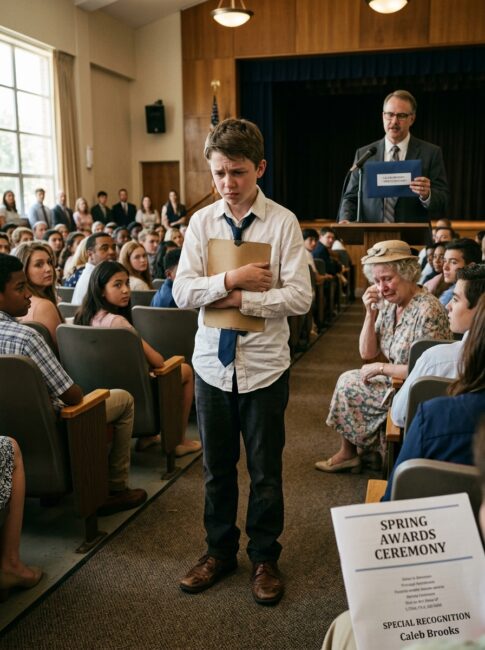
He walked to the front row and sat down.
That was the moment everyone judged him.
That was the moment the whispers began.
Then Principal Mercer stepped to the microphone.
He held the sealed envelope in both hands.
“The first name this morning,” he said, “is Caleb Brooks.”
Caleb did not move at first.
He thought he had heard wrong.
Then Principal Mercer continued.
“Recipient of the Margaret Hale Citizenship Medal, awarded for extraordinary service to fellow students, quiet leadership, and compassion shown without expectation of recognition.”
The auditorium became very still.
Mrs. Langford’s face lost color.
Brandon stopped smiling.
Principal Mercer did not list everything. He did not expose every family Caleb had helped. He protected the dignity Caleb had tried to protect.
But he said enough.
“He reminded us that a person’s place in line should never be decided by what his family can afford.”
For one second, no one clapped.
Then Mr. Ellis, the custodian, stood at the back wall.
His cap was in his hands.
Mrs. Avery stood next.
Owen’s parents stood.
Tessa’s mother stood.
Then row by row, the entire auditorium rose.
Not in excitement.
In recognition.
Caleb turned toward the back.
His grandmother was standing too, leaning on her cane with tears running down her cheeks.
Caleb finally stood.
His cracked shoes made no sound as he walked to the stage.
Caleb accepted the medal with both hands.
It was heavier than he expected.
A ribbon hung from it, blue and white, the school colors he had worn for three years without ever feeling they belonged to him.
Principal Mercer leaned toward the microphone.
“Caleb, would you like to say anything?”
Caleb looked at the crowd.
A few weeks earlier, he would have shaken his head.
He almost did.
Then he saw Lila in the back row, standing on tiptoe beside their grandmother, waving like this was the best day that had ever happened.
So Caleb stepped closer to the microphone.
His voice was small at first.
“My grandma says being last doesn’t mean you’re lost.”
The room listened.
He swallowed.
“She says sometimes it just means people didn’t know where to put you yet.”
Mrs. Brooks pressed a hand to her mouth.
Caleb looked down at the medal.
“I didn’t do things so people would stand up. I just know what it feels like when everybody can see you need something, and nobody wants to embarrass you by saying it.”
A few adults lowered their eyes.
“So I tried not to embarrass anybody.”
That sentence moved through the auditorium slowly.
It landed in places applause could not reach.
Caleb glanced at Brandon, then away.
“I don’t want anyone to feel bad for me. I just want my sister to remember this school as a place where people helped.”
Then he stepped back.
No polished ending.
No dramatic wave.
Just a boy in cracked shoes carrying a medal he had never asked for.
After the ceremony, people approached him carefully.
Owen tried to thank him for the money, but Caleb only shrugged and said, “You dropped it.” Tessa’s mother hugged Mrs. Brooks and cried into her shoulder. Mr. Ellis slipped Caleb a small paper bag with two warm biscuits inside, pretending it was extra from breakfast duty.
Brandon waited near the auditorium doors.
His face was red.
“I’m sorry,” he said.
Caleb looked at him.
Brandon shifted his weight. “For the motel jokes. And the list thing.”
Caleb did not answer right away.
Then he said, “Don’t make Lila hear that stuff.”
Brandon nodded quickly.
“I won’t.”
Caleb believed him just enough to walk away.
Outside, the morning sun was bright on the school steps. Families took pictures beneath the oak trees. Some children held balloons. Some held certificates. Lila insisted Caleb wear the medal for every photo, even the blurry ones.
Mrs. Brooks kept touching the ribbon as if checking that it was real.
“You mad at me?” she asked quietly.
Caleb looked at her.
“For the letter?”
She nodded.
He stared across the parking lot, where Mrs. Langford was collecting leftover programs from a table.
At the bottom of each one, his name still sat last.
Caleb took one program and folded it carefully.
Then he tucked it behind the medal in its small box.
“No,” he said. “I’m keeping it.”
Mrs. Brooks frowned. “Why keep that?”
Caleb looked at the printed page, then at the medal resting over it.
“So Lila knows paper can be wrong.”
His grandmother closed her eyes.
That afternoon, they walked back to Riverbend Motel because the buses ran late on Saturdays. Caleb carried Lila’s certificate when she got tired of holding it. Mrs. Brooks walked slowly beside them, her cane tapping against the sidewalk.
At Room 17, the marigolds on the windowsill had opened wider in the sun.
Lila asked if they could hang Caleb’s medal by the mirror.
Caleb hesitated.
Then he placed it around his grandmother’s neck instead.
She laughed through tears. “This isn’t mine.”
Caleb smiled a little.
“Yes, it is.”
For a moment, the small motel room felt less like a place people passed through and more like a home holding its breath.
On Monday, Millstone Middle School posted a new rule. Ceremony order would never again be tied to payment forms, donation lists, or family sponsorships. Principal Mercer also created a quiet fund for students who needed help, with no public names attached.
The first donation came in a plain envelope.
Inside were seven dollars in coins and a note written in Caleb’s careful handwriting.
For someone who doesn’t want everyone to know.
Mrs. Avery pinned the note inside her desk drawer, where no one else could see it.
And every spring after that, when students lined up for promotion, she looked twice at the child standing near the end.
Not with pity.
With attention.
Because sometimes the person placed last is the one who has been carrying everyone else forward.
Follow the page for more heartfelt stories that stay with you long after the final line. ❤️