Part 2: The Elderly Can Collector Was Thrown Out of the Mall — What He Did for a Lost Child Left Everyone Speechless
The service hallway smelled faintly of floor cleaner and warm electrical wiring. It was narrower than Derek remembered, with concrete walls and exposed pipes running above the ceiling tiles.
Walter moved quickly, although his knees clearly hurt him.
The little boy stayed close.
That detail bothered Derek almost as much as everything else.
A frightened child should have been pulling away from a stranger. He should have been crying for his mother or screaming for help.
Instead, the boy watched Walter’s hands.
Walter stopped beside a maintenance closet and reached into his coat pocket.
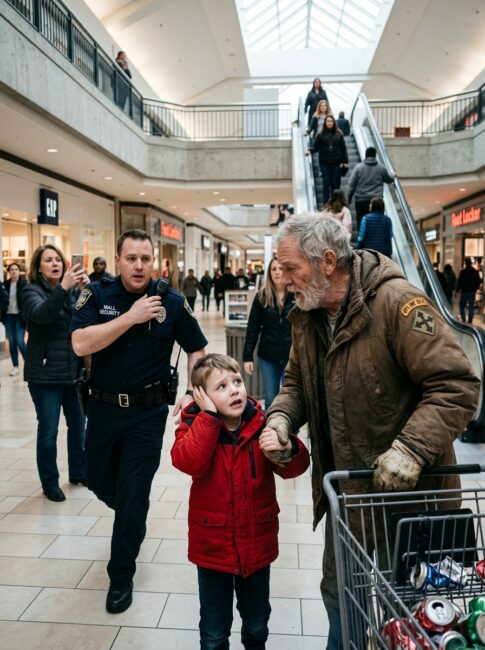
“Do not touch him!” Derek warned.
Walter ignored him and pulled out a small aluminum can, polished clean and flattened around the edges. He tapped it gently with one finger.
Once.
Then twice.
Then three times.
The boy’s shoulders lowered slightly.
Walter repeated the pattern.
Tap. Tap-tap. Tap.
The child pressed his fingers against the sides of his head, then slowly removed them. His breathing began to settle.
Derek lowered his radio but did not step closer.
“What are you doing?” he asked.
Walter opened his mouth, but only a strained whisper came out.
“Too loud,” he said.
His voice sounded damaged, as though every word required effort.
Derek glanced back toward the mall entrance. A crowd had gathered behind the staff door. Several people were filming.
“You need to bring him back outside,” Derek said. “His parents may be looking for him.”
Walter shook his head.
The boy suddenly pointed farther down the hallway.
Walter nodded as if the child had answered a question.
Then they continued walking.
“Sir, stop,” Derek said. “The police are being called.”
Walter kept moving.
The boy wore a small blue backpack with a cartoon train stitched onto the front. One zipper had been left open. A laminated card hung from the strap, turning slightly as he walked.
Derek caught a glimpse of the card when the child passed beneath a fluorescent light.
MY NAME IS NOAH. I AM AUTISTIC. WHEN I AM OVERWHELMED, I MAY NOT SPEAK. PLEASE GIVE ME SPACE.
Derek stopped for half a second.
The mall beyond the door was filled with amplified music, bright lights, crying children, ringing phones, and the echo of hundreds of voices. The crowd forming around Noah would only have made everything worse.
Walter had noticed that before anyone else.
Still, Derek did not understand why the old man was leading the boy deeper into the building.
Noah stopped at the end of the hallway and stared at a locked gray door. A paper sign had been taped across it.
FAMILY RESTROOM TEMPORARILY CLOSED — PLEASE USE SECOND FLOOR FACILITIES.
Walter bent down beside Noah.
The boy pressed his palm against the door and began tapping with two fingers.
Tap. Tap-tap. Tap.
Walter’s expression changed.
Until that moment, he had looked tired and cautious. Now a deeper fear moved across his face.
He tried the door handle.
Locked.
Derek stepped forward.
“That restroom has been closed since the plumbing leak,” he said. “There should not be anyone inside.”
Walter looked at him and pointed toward the base of the door.
A black leather purse lay partly hidden behind a decorative planter. One strap had been caught beneath the doorframe.
Derek’s stomach tightened.
He called into his radio.
“I need a master key at the first-floor family restroom. Right now.”
Walter shook his head and looked toward the maintenance closet behind them.
Then he reached beneath his shirt and pulled out an old brass key hanging from a shoelace around his neck.
Derek stared at it.
“You have a key?”
Walter did not answer.
The key turned inside the maintenance closet lock. Walter opened the door, moved past a stack of folded caution signs, and pushed against a narrow access panel in the back wall.
The panel opened into a dim service passage.
Derek finally understood.
The public restroom door might have been locked, but the old maintenance corridor still connected to the plumbing access behind it.
Walter knew the old building better than any current employee.
He stepped inside the dark passage without hesitation.
Noah followed him.
Derek followed Noah.
Behind them, the crowd remained gathered at the staff door, watching the old man they had already decided to fear disappear into the darkness with a lost child.
The service passage was barely wide enough for Walter’s shoulders.
Dust floated through the beam of Derek’s phone flashlight. Pipes ran along the wall, and the uneven concrete floor forced them to move slowly.
Noah began breathing faster again.
Walter stopped.
From his coat pocket, he removed the flattened aluminum can and placed it in Noah’s hands. Then he tapped the same pattern against the metal.
Tap. Tap-tap. Tap.
Noah copied him.
His fingers trembled at first, but the rhythm steadied him.
Walter pointed ahead, then held out his hand.
Noah took it willingly.
Derek watched them and felt the first sharp edge of shame rise inside his chest.
For nearly six months, he had removed Walter from the mall at least twice a week.
The old man always came in shortly after lunch, gathered bottles and cans from the food court, and left without disturbing anyone. Derek had assumed Walter was homeless.
He had never asked.
He had never noticed the small cards Walter sometimes left near the recycling bins.
Derek had thrown several of them away.
He remembered the handwritten words now.
Please leave clean cans here. Thank you.
Walter reached the end of the service passage and lifted another panel. The metal groaned as it opened.
A woman lay on the restroom floor.
Her face was pale. One arm was bent beneath her body, and her phone rested inches beyond her fingertips. A small paper shopping bag had fallen beside her, spilling a scarf and a child’s plastic train onto the tile.
Noah ran toward her.
“Mom,” he whispered.
It was the first word he had spoken.
Derek immediately called for paramedics.
Walter knelt beside the woman and checked her breathing with two fingers against her neck. His movements were slow but certain. He rolled her gently onto her side, then noticed a medical bracelet around her wrist.
TYPE 1 DIABETES.
Walter pointed to the purse trapped beneath the outer door.
“Glucose,” he whispered.
Derek hurried to the public entrance, unlocked it from inside, and pulled the purse free. By then, more security officers had arrived, followed by two shoppers who claimed they had medical training.
A woman in scrubs searched the purse and found an emergency glucagon kit inside a side pocket.
The crowd outside became silent as the paramedics arrived.
Nobody filmed anymore.
Noah sat on the floor beside Walter, clutching the flattened can in both hands. Walter kept tapping the rhythm softly whenever the noise grew too intense.
Tap. Tap-tap. Tap.
One of the paramedics stabilized Noah’s mother and placed her on a stretcher. She slowly opened her eyes as they prepared to move her through the service hallway.
Her gaze searched the room until she saw Noah.
Then she saw Walter.
Her eyes filled with tears.
“You came back,” she said weakly.
Walter lowered his head.
Derek looked between them.
“You know him?” he asked.
The woman reached for Walter’s hand.
“Everyone around here knows Mr. Reed,” she said. “Or they used to.”
Walter gently pulled his hand away, uncomfortable with the attention.
The paramedic asked the woman to rest, but she continued speaking in a quiet voice.
“Walter worked maintenance in this mall for twenty-seven years. He knew every hallway and every family who came through those doors.”
Derek looked at the brass key hanging from Walter’s neck.
The woman gave a tired smile.
“When Noah was little, crowded places were almost impossible for him. The lights, the music, the strangers touching him when he panicked. Walter was the first person who knew what to do.”
She looked toward the flattened can in Noah’s hands.
“He made that tapping pattern for his grandson.”
Walter turned away.
His face tightened, but he did not speak.
The woman’s voice softened.
“His grandson, Eli, was autistic too. He used to visit Walter here after school. Whenever the noise became too much, Walter brought him into the service hallway and tapped on an empty can until he felt safe again.”
Derek remembered seeing Walter’s cart outside the mall for months. He remembered the rain, the freezing mornings, and the way the old man collected every can as though each one mattered.
“What happened to your grandson?” Derek asked.
Walter stared at the floor.
The woman answered for him.
“Eli died three years ago. Leukemia.”
Noah leaned against Walter’s arm.
Walter closed his eyes for a moment.
Derek thought the story ended there.
It did not.
The mall manager, Susan Keller, arrived out of breath and pushed her way through the hallway. She looked at the open maintenance panel, the paramedics, and the crowd outside the restroom.
Then she saw Walter.
“Mr. Reed,” she said quietly.
Walter gave her a small nod.
Susan looked at Derek.
“He should not have been removed from the building,” she said.
Derek swallowed. “I was following the loitering policy.”
Susan shook her head.
“Walter was never loitering.”
She turned toward the crowd.
After Eli died, Walter sold most of his tools and stopped working at the mall. His throat cancer surgery came a year later, leaving him with a damaged voice and medical bills he never discussed.
Still, every week, he collected cans from the neighborhood.
He took them to a recycling center across town, where aluminum brought only a few dollars per bag.
The money never went into his own pocket.
Walter used it to buy sensory headphones, communication cards, and small weighted lap pads for children who struggled in crowded public spaces.
He donated them anonymously to the local library, two shelters, and the Rivergate Mall family room.
Susan pointed toward the maintenance closet.
On the top shelf sat a clear plastic bin filled with neatly labeled supplies.
QUIET KIT — FREE TO USE. PLEASE RETURN WHEN FINISHED.
Walter had restocked that bin for nearly two years.
He never asked for a sign.
He never asked for his photograph to be taken.
He never explained himself when shoppers looked at his cart with disgust.
Derek felt heat rise behind his eyes.
“I threw away your cards,” he said.
Walter looked at him without anger.
Then he placed one gloved hand on Derek’s shoulder.
“It is all right,” he whispered.
That simple forgiveness made Derek feel worse than any accusation could have.
Outside the hallway, the same woman who had pulled her daughter away from Walter earlier stepped forward. Her shopping bags rested on the floor.
“I thought he was taking the boy,” she said.
No one answered.
Noah’s mother was moved toward the ambulance. Before the paramedics carried her away, she reached for Walter again.
“You saved us twice,” she said.
Walter shook his head.
Then he pointed to Noah.
The child still held the flattened can.
“He showed me,” Walter whispered.
Noah’s mother recovered after several days in the hospital. Doctors later said the delay could have become dangerous if Walter had not understood what Noah was trying to communicate.
The boy had not wandered away because he was careless.
He had left the locked restroom after his mother collapsed, searching for help in a place that overwhelmed him. The noise took away his words before he could reach anyone.
Several shoppers noticed him.
Only Walter truly saw him.
A week later, Rivergate Mall placed a small bench near the family restroom. The bench stood beneath softer lighting, away from the loudest speakers.
A clear cabinet was installed beside it.
Inside were headphones, picture cards, fidget toys, and the familiar weighted lap pads Walter had quietly purchased with money from recycled cans.
Susan asked Walter whether the mall could place a plaque above the cabinet with his name and Eli’s name.
Walter declined.
After a long pause, he agreed to something smaller.
A handwritten card was placed inside the cabinet door.
For anyone who needs a quieter moment.
Walter began returning to the mall every Tuesday and Thursday morning.
He still pushed the same rattling cart. He still wore the same thin coat, although someone anonymously left a warmer one beside the bench before Christmas.
Nobody asked whether Derek had bought it.
Derek also stopped throwing away Walter’s handwritten cards.
Instead, he printed new ones and placed them beside every recycling bin in the food court.
Some shoppers brought bags of clean cans from home. Children began dropping their empty soda cans into the correct bins because their parents explained that the money helped other children feel safe.
Walter never gave speeches.
He never stayed when people tried to thank him.
He gathered the cans, checked the cabinet, and quietly continued with his day.
One afternoon, Noah returned to the mall with his mother.
He had something hidden behind his back.
Walter was sitting on the bench repairing the loose wheel of his cart with an old screwdriver. When Noah approached, Walter smiled and lifted one hand in greeting.
Noah placed a single blue soda can in Walter’s palm.
It had been cleaned carefully.
A red string was tied around the top.
Walter turned it over and noticed several letters written in black marker across the side.
FOR ELI.
For a moment, Walter did not move.
Then Noah tapped the can with one finger.
Tap.
Tap-tap.
Tap.
Walter answered with the same gentle rhythm.
He did not place that can inside his cart.
Instead, he tied it beneath the handle, where it made a faint metallic sound whenever the wheels rolled across the tile.
Most shoppers never understood why the old man smiled each time he heard it.
But Derek did.
Every Tuesday and Thursday, he opened the mall doors a few minutes early and watched Walter push his rattling cart toward the recycling bins, with one blue can swaying gently beneath his hand.
Follow our page for more stories about the quiet acts of kindness that are easy to miss in a crowded world.