Part 2: My Son Asked If I Feared Death — Ten Years Later, He Handed Me One Sentence
I started riding before I understood what I was trying to outrun.
At twenty-two, I bought an old Harley with chipped paint and a seat patched with electrical tape. I was working nights at a warehouse outside Cookeville, loading boxes until my lower back burned. My father had recently died from a heart attack at fifty-one. My mother was drinking too much. My younger brother had moved to Kentucky and stopped returning calls.
I did not have a grand philosophy.
I had anger, grief, and a machine loud enough to drown both of them out for an hour.
The Harley was never magic. It did not fix anything. It did not make me wiser. It gave me a place where I had to be present. Both hands on the bars. Eyes up. Shoulders loose. Attention on the road, the weather, the cars drifting too close to the line.
You cannot argue with yesterday while watching gravel gather near a curve.
That was enough at first.
Then I met Sarah.
She was working the late shift at a diner on Route 70N, the kind of place with cracked vinyl booths, burnt coffee, and a bell above the door that rang too loudly after midnight. I came in after a cold ride wearing a leather jacket stiff from the wind and boots that left muddy prints across her clean floor.
She looked at the tattoos running down my arms.
Then she looked at the mess behind me.
“You planning to mop that, cowboy?” she asked.
I liked her immediately.
Sarah never asked me to stop riding. She asked harder questions.
“Where are you going?”
“When will you be home?”
“Are you riding angry?”
That last one mattered.
Sarah understood something I had not learned yet: a motorcycle magnifies whatever you bring onto it. If you climb on furious, exhausted, distracted, or trying to prove something, the road does not care why you made the mistake.
By the time Caleb was born, I was riding less and thinking more.
I joined a local club called the Cumberland Iron Brothers. The name sounded tougher than most of us felt on a Monday morning. We were mechanics, warehouse workers, veterans, plumbers, one middle-school history teacher, and a nurse named Reed who had a grey beard down to his chest and carried extra bandages in his saddlebag.
The club had rules.
No riding after drinking. No leaving a brother alone on the shoulder. No showing off when kids were nearby. No pretending fear made you weak.
Our president, Big Mike, said it plainly.
“Fear keeps you checking mirrors, brother. Pride is what puts you in a ditch.”
Mike was a broad man with a shaved head and a soft voice. He had served in Afghanistan, lost two friends overseas, and never talked about it unless somebody needed to hear that surviving something did not mean you finished carrying it.
The club became part of Caleb’s childhood.
He learned the sound of our engines before he could read. On Saturday mornings, he would run to the front window whenever the low V-twin rumble rolled up our driveway. He knew Mike by his booming laugh, Reed by the peppermint candies in his vest pocket, and Tiny by the fact that a man called Tiny could weigh nearly three hundred pounds.
Caleb loved the motorcycles.
But he loved the rituals more.
He watched us check tire pressure before rides. He watched Reed inspect helmet straps. He watched Mike pull a younger prospect aside after the kid bragged about riding too fast in the rain.
Mike did not yell.
He simply said, “You got people waiting at home?”
The prospect nodded.
“Then act like it.”
The kid never told that story proudly again.
When Caleb was five, he drew the picture I kept inside my vest.
Sarah was standing in the kitchen making pancakes while Caleb worked at the table with a box of broken crayons. He drew our house first. Then Sarah. Then himself. Then me beside a lopsided motorcycle.
He held it up.
“What’s that bubble say?” I asked.
He pointed at the letters with a blue crayon.
“Come home, Dad.”
The words hit harder than I expected.
I folded the drawing carefully and placed it inside the inner pocket of my cut, beside Sarah’s photograph.
After that, I carried both everywhere.
Nobody could see them from the outside.
That was the point.
My third accident happened on a Thursday in October.
The sky had been threatening rain all afternoon, the clouds hanging low over Highway 111 like dirty wool. I should have waited at the diner. Reed told me that later. Sarah told me that before I left.
But the rain had not started yet, and home was less than twenty minutes away.
I wanted dinner with my family.
That decision still sounds harmless when I say it out loud.
I had been riding long enough to know harmless decisions can become dangerous in seconds.
The rain began near the exit toward Algood. Not heavy. Just enough to make the pavement shine. I slowed down, increased the space ahead of me, and moved carefully. A pickup approached in the opposite lane. White truck. Contractor rack. One headlight dimmer than the other.
Then its front tire crossed the center line.
Maybe the driver looked down. Maybe the road pulled him. Maybe he panicked when he saw me.
I never learned.
I remember the truck getting larger.
I remember the cold burst of rain against my gloves.
I remember deciding that the ditch was better than the grille.
The Harley hit the pavement on its side with a sound like metal tearing open. My shoulder struck next. Then my helmet. Then grass, mud, and silence.
For several seconds, I could not breathe.
The rain landed softly on my visor.
Somewhere above me, the truck stopped. A door slammed. A man shouted that he was sorry.
I tried to sit up and pain cut through my ribs.
Then I heard another sound.
Engines.
Low at first. Then closer.
Mike, Reed, and Tiny had been riding ten minutes behind me after leaving the same diner. They saw the traffic slowing near the shoulder and knew before they saw the bike.
Reed reached me first.
He dropped to his knees in the wet grass, one hand bracing my helmet, his nurse’s voice calm and clipped.
“Do not move, brother.”
“I’m fine.”
“You’re always fine. Stay down.”
Mike stood near the road, directing traffic away from the shoulder while Tiny called emergency services. None of them shouted at the pickup driver. None of them threatened him. Mike saw the man shaking beside his truck and said only one thing.
“Sit down before you fall down.”
That mattered.
People imagine men in leather cuts want an excuse for trouble.
Most of the riders I know have already seen enough trouble.
At the hospital, a doctor told me I had bruised ribs, a cut above my eye, and a shoulder that would ache whenever cold weather rolled through town. The helmet had done its job. My gloves had saved my palms. The jacket had saved most of the skin on my arm.
Sarah arrived with Caleb.
She came into the room first.
Her face looked calm until she reached the bed. Then her mouth tightened. She touched the bandage above my eyebrow with two fingers.
“You promised dinner,” she said.
“I know.”
Caleb stood near the door.
Eight years old. Small for his age. Hair sticking up in the back because nobody had remembered to comb it. He stared at the hospital bracelet around my wrist and refused to come closer.
I held out my hand.
He hesitated.
Then he crossed the room and placed his palm inside mine.
He did not cry.
Neither did I.
The next two days, the club helped recover the Harley and move it into my garage. Mike brought chili. Reed brought medical supplies Sarah did not ask for but used anyway. Tiny replaced the broken porch light because he noticed it flickering while carrying groceries inside.
That was brotherhood.
Not speeches. Not matching patches.
A porch light nobody asked about.
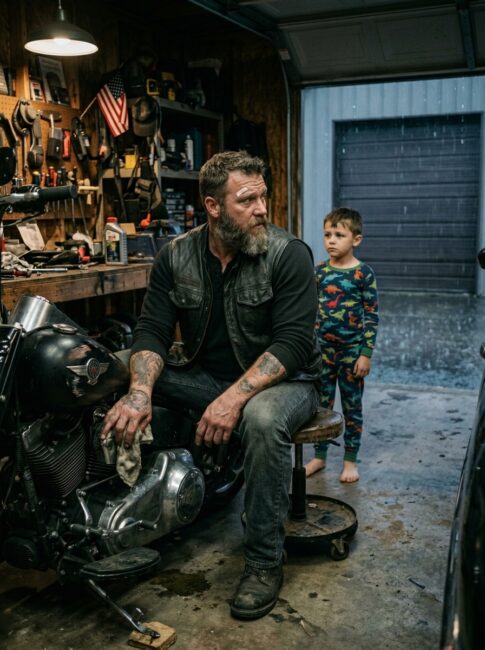
On Saturday morning, Caleb found me sitting on a stool beside the damaged bike. My left arm was stiff. My ribs hurt when I leaned forward. The garage smelled like wet leather, old gasoline, and the cleaning solvent I had poured into a metal pan.
That was when he asked the question.
“Dad, are you scared to die?”
I answered yes.
He asked why I still rode.
I thought about my father dying at fifty-one. I thought about the truck crossing the center line. I thought about Sarah standing beside a hospital bed, trying to stay angry because anger was easier than terror.
Then I said the words Caleb would carry for ten years.
“Feeling alive is stronger than feeling afraid.”
It sounded honest at the time.
It was honest.
But it was not complete.
Ten years passed faster than a highway exit you almost miss.
Caleb grew taller than Sarah first, then nearly as tall as me. His voice dropped. His hair became impossible. He traded dinosaur pajamas for worn hoodies and learned to make coffee strong enough to keep his mother from complaining before sunrise.
He never became obsessed with motorcycles.
That surprised people.
The boy who grew up around Harleys did not beg for one at sixteen. He did not ask for speed. He did not collect pictures of custom bikes or memorize every machine parked outside our garage.
He liked books.
He liked history.
He liked writing late at night with headphones on and a mug of coffee going cold beside his laptop.
Sometimes, when the club gathered in our driveway, he stayed outside with us. He listened more than he spoke. Mike treated him like a nephew. Reed still handed him peppermint candies from his vest pocket even after Caleb was old enough to drive. Tiny asked him for help writing emails because Tiny believed punctuation was a government conspiracy.
When Caleb turned eighteen, he applied to a small liberal arts college in Tennessee.
One evening, he came into the garage while I was changing the oil on the Harley. The bike had been repaired years earlier, though a long scrape remained along one side of the tank. I could have repainted it.
I left it there.
Not as a trophy.
As a reminder.
Caleb held a printed sheet of paper.
“Need you to read something,” he said.
“What is it?”
“My college essay.”
I wiped my hands on a shop rag.
“How long?”
“One sentence.”
I laughed because I thought he was joking.
He handed me the page.
At the top was the application prompt:
Describe the person who has influenced you most.
Beneath it, Caleb had written:
My father taught me that fearing death is normal, but fearing life is the real tragedy.
That was all.
One sentence.
Fourteen words of his own, built from a conversation I barely remembered having in a garage ten years earlier.
I read it twice.
Then a third time.
The space heater clicked behind me. Rain tapped softly against the garage door. Somewhere inside the house, Sarah closed a cabinet and called out that dinner was getting cold.
Caleb watched me carefully.
“Well?” he asked.
My throat tightened.
I folded the page once.
Then again.
I opened the inner pocket of my leather vest.
Inside were the two things I always carried: Sarah’s photograph from the summer before Caleb was born and the crayon drawing Caleb had made when he was five.
COME HOME, DAD.
I placed the essay beside them.
Caleb looked down at the pocket.
“You kept that drawing?”
“Yeah.”
“For thirteen years?”
“Yeah.”
He rubbed the back of his neck.
“You never told me.”
I shrugged.
“Didn’t need to.”
A month later, Caleb received his acceptance letter.
The admissions office mentioned his essay.
Not because it was long.
Because it was not.
The sentence had done enough.
But the acceptance letter was not the real twist.
The real twist was what Caleb said after he saw me place that essay near my heart.
He looked at the scarred Harley. Then at the vest. Then at me.
“Dad,” he said, “I think you misunderstood your own answer.”
I leaned against the workbench.
“What do you mean?”
Caleb sat on the stool beside the Harley, the same stool where I had been sitting ten years earlier when he asked whether I feared death.
He thought for a moment.
“You said you kept riding because riding made you feel alive.”
“That’s true.”
“I know.”
He looked toward the inner pocket of my vest.
“But that isn’t why you came home.”
The garage went quiet.
Caleb nodded toward the cut hanging from my shoulders.
“You carried Mom’s picture. You carried my drawing. Every ride. Even before the crash.”
I said nothing.
“You weren’t choosing the motorcycle over fear,” he continued. “You were choosing to come back to us while still doing something you loved.”
He paused.
“That’s different.”
The kid was right.
He was eighteen, and he had found the missing half of an answer I gave him at eight.
The road was never about proving I was not afraid of death.
I was afraid.
Every serious rider I trust is afraid in some form. Not paralyzed. Not careless. Aware. There is a difference.
Fear makes you check the weather. Fear makes you replace a worn tire instead of squeezing another month out of it. Fear makes you leave space between yourself and the car ahead. Fear makes you stop for coffee when your eyes feel heavy. Fear makes you look at the photograph in your vest pocket before you start the engine.
Pride tells you none of that matters.
The Cumberland Iron Brothers knew the difference.
After the accident, Big Mike quietly changed one of our club rituals. Before longer rides, he began asking every rider the same question.
“Who are you coming home to?”
Nobody had to answer aloud.
Some men touched wedding rings. Some glanced at phones filled with pictures of grandchildren. Reed once patted the peppermint candy in his vest pocket because his granddaughter demanded one every time he visited.
Mike usually looked toward a faded photograph taped inside his saddlebag.
We all had something.
The question was enough.
The first smaller twist arrived when I told Mike about Caleb’s essay.
We were sitting in the Route 70N diner where Sarah and I first met. The coffee still tasted burnt. The booths still squeaked when a man our size shifted his weight. Mike read the sentence, placed the paper on the table, and smiled slightly.
“Kid got accepted with this?”
“Yeah.”
“One sentence?”
“Yeah.”
Mike nodded.
“Efficient.”
Then he pulled out his wallet.
Behind his driver’s license was a folded copy of Caleb’s childhood drawing.
I stared at it.
“You have that?”
“Sarah made copies after your wreck.”
“Why?”
Mike slid the paper across the table.
The copy showed the same crooked motorcycle, the same oversized wheels, the same yellow sun, and the same speech bubble.
COME HOME, DAD.
Mike rubbed one thumb across the edge.
“After the hospital, we put one in every club brother’s saddlebag.”
I looked up.
“You never told me.”
“Didn’t need to.”
His answer sounded familiar.
The second smaller twist came from Sarah.
That night, I told her about the copies.
She stood at the kitchen counter slicing apples for a pie and gave me the look she used whenever I had taken too long to understand something obvious.
“You thought the club started asking who everyone was coming home to because of Mike?”
“Yes.”
She shook her head.
“It was Caleb.”
I stared at her.
“The morning after your crash, Caleb asked me why grown men needed motorcycles if motorcycles could hurt them. I told him loving something did not mean you stopped respecting it. Then he asked if your friends had families waiting too.”
Sarah placed the knife down carefully.
“He made me copy his drawing. Said every biker needed one.”
That was Caleb.
Eight years old. Scared. Trying to protect grown men with crayons.
The third smaller twist came several weeks later, after Caleb’s acceptance letter arrived.
The club gathered at our house for a small cookout. Nothing fancy. Burgers on the grill. Coffee in paper cups. A dozen Harleys lined up along the curb, engines quiet beneath the spring sun.
Mike called Caleb into the garage.
Reed, Tiny, and the others stood behind him. Even Daniel, once the nervous prospect and now a full-patch member with a toddler daughter, was there.
Mike handed Caleb a narrow black fabric patch.
No skull. No club emblem. No slogan designed for strangers to admire.
Just two words stitched in plain white thread:
COME HOME.
“This isn’t a club patch,” Mike said. “You didn’t earn a cut. That’s not what this is.”
Caleb ran one thumb across the stitching.
“What is it?”
Mike looked toward the line of motorcycles outside.
“A reminder.”
The club had made twelve.
One for every rider.
Mine went inside the vest, near the heart.
Beside Sarah’s photograph.
Beside Caleb’s drawing.
Beside the essay.
Caleb left for college in August.
The morning we packed his car, the driveway looked too small for all his boxes. Books. Clothes. A desk lamp. Coffee mugs Sarah insisted he needed. A toolbox Tiny gave him because Tiny believed every young man should own a wrench even if he planned to spend his life writing essays.
Caleb found the blue dinosaur pajamas in the back of a closet while packing.
He held them up and laughed.
“You kept these?”
Sarah shrugged.
“Didn’t need to throw them away.”
That sentence ran in the family.
Before Caleb left, he came into the garage.
The Harley sat near the workbench, clean but not polished enough to erase its years. The scrape from the Highway 111 crash still marked the tank. The damaged helmet had been replaced long ago, but I kept the cracked one on a shelf above the tools.
Not for drama.
For accuracy.
Machines fail. People make mistakes. Weather shifts. Roads collect oil, gravel, and rainwater. Coming home is never owed to you.
Caleb touched the edge of the old helmet.
“You still scared?” he asked.
“Yeah.”
He smiled.
“Good.”
I laughed once.
Then he hugged me.
He had become nearly as tall as I was. The boy who once stood in the garage doorway wearing one untied sneaker now carried his own car keys and a future I could not inspect for loose bolts.
That was harder than any ride.
After he left, I started a new ritual.
Before every weekend ride, I open the inside pocket of my vest.
First, Sarah’s photograph.
Then Caleb’s crayon drawing.
Then the folded college essay.
Finally, the black COME HOME patch.
I do not study them for long.
A few seconds.
Long enough.
Some Saturdays, the Cumberland Iron Brothers meet at the diner before taking the slower roads outside Cookeville. We drink coffee. Reed passes around peppermints. Tiny complains about his knees. Mike walks between the bikes without saying much, checking tires the way he always has.
Before the engines start, he asks the question.
“Who are you coming home to?”
Nobody answers aloud.
Nobody needs to.
The cuts creak. Boots scrape across pavement. Gloved hands settle onto handlebars.
Then the V-twins come alive one by one.
Caleb came home from college for Thanksgiving with longer hair, heavier books, and a habit of correcting my grammar when I texted him.
On Saturday morning, he found me in the garage preparing for a short ride.
The air smelled like cold concrete, leather, and fresh coffee. Outside, bare branches tapped lightly against the roof. A thin layer of frost covered the grass along the driveway.
Caleb picked up my vest from the workbench.
“You still carrying everything?” he asked.
“Yeah.”
He opened the inner pocket carefully.
Sarah’s photograph had softened at the edges. The crayon drawing was creased almost white along its folds. The essay had been refolded so many times that the paper felt like cloth. The small black patch rested beneath them.
COME HOME.
Caleb looked at the four objects for a long moment.
Then he tucked them back inside and pressed the pocket flat with his palm.
“Good,” he said.
I pulled on my gloves and rolled the Harley into the driveway. The engine caught on the second try, filling the cold morning with that low, steady rumble I had known for most of my adult life.
Sarah appeared at the front door holding her coffee.
Caleb stood beside her.
I looked at both of them before lowering my visor.
Not because I feared the road.
Because I respected what waited at the end of it.
I turned toward the quiet street and joined the brothers waiting near the corner. One by one, our taillights moved toward Route 70N, shrinking beneath the bare trees.
The engine settled into its familiar pulse.
Inside my vest, four small things pressed against my chest.
I rode carefully.
I came home.
Follow the page for more stories about the people behind the leather, the engines, and the scars.