Part 2: My Son Wouldn’t Let Go of the Biker — Then I Saw Why His Father Wasn’t Shaking
People in Kingman knew Mason by his road name.
Rook.
I never asked where it came from. One of his club brothers once told me it was because Mason could stay quiet for hours and still know exactly what was happening in every corner of a room.
That sounded right.
Before Noah was born, Mason had served overseas with the Army. After he came home, he rarely told stories about it. He did not hang medals on the wall. He did not talk about the things he had done or the things he had seen.
He kept one folded photograph inside the inner pocket of his leather cut.
In the picture, Mason was twenty-three. Clean-shaven. Thinner. Standing beside three other soldiers beneath a washed-out sky. The corners of the photograph had worn soft from being handled.
Only Mason came home.
That was all he ever said.
“Only me.”
The man who returned to Arizona looked like my husband. Same eyes. Same hands. Same habit of pouring coffee before he was fully awake.
But his body had learned rules his mind could not always overrule.
Do not stand behind him without speaking.
Do not touch his shoulders while he is distracted.
Do not wake him suddenly.
Do not mistake silence for calm.
The first time I learned that, I came up behind him in our kitchen and placed both arms around his waist.
I had done it a thousand times before deployment.
His coffee mug shattered against the tile.
He spun so fast that his elbow struck the cabinet. His eyes did not recognize me for one terrible second.
Then they did.
He stepped away from me as if he had burned my skin.
“I’m sorry,” he said.
I knew he meant it.
That almost made it worse.
For three years, Mason slept lightly. He checked the locks before bed. Then checked them again. Some nights, the sound of a truck braking on Route 66 pulled him upright before the headlights had passed our house.
He still held Noah when our son had nightmares.
That was the strange part.
If Mason was already sitting down and Noah climbed into his arms from the front, he could manage it. He would rest one scarred hand against our boy’s back and breathe carefully until Noah fell asleep.
But unexpected touch was different.
Touch from behind was worst of all.
The Steel Lantern Riders knew.
They adjusted around him without turning him into a fragile thing.
Brick, the club president, always called Mason’s name before approaching.
Mercy, a former paramedic with a long braid and a voice sharper than any wrench in the garage, never clapped him on the shoulder.
Even Rooster, who treated silence like an enemy, learned to stop announcing himself with jokes and start using two simple words.
“Behind you.”
That was brotherhood in our house.
Not speeches.
Not patches.
Remembering where to stand.
The idea for Noah’s ride came from Noah himself.
He had spent years watching Mason polish the Harley in our driveway, carefully avoiding the hot pipes, asking questions faster than Mason could answer them.
One Friday evening, Noah climbed onto the porch step and asked, “When can I ride with you?”
Mason stopped wiping the chrome.
His hand remained pressed against the rag.
For a long moment, I thought he would say no.
Then he looked toward the empty lot behind the old feed store.
“One slow lap,” he said.
Noah grinned.
Mason looked at me.
“Maybe two.”
The following morning, six Steel Lantern Riders arrived before sunrise.
Not to ride.
To make sure nobody else did.
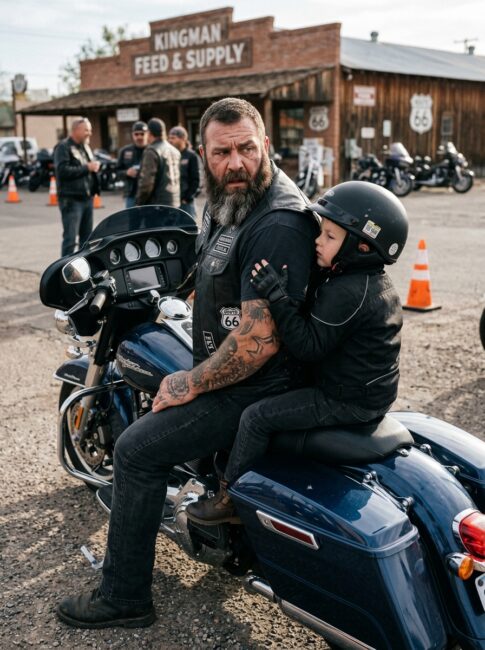
Brick parked his truck across one entrance to the lot.
Rooster blocked the other with his Harley and two orange cones borrowed from his construction job. Mercy walked the pavement twice, kicking aside loose gravel and checking for broken glass.
Mason inspected Noah’s helmet.
Then he inspected it again.
“Strap’s good,” Brick said.
Mason pulled gently at the buckle.
“Checking.”
Brick nodded.
Nobody rushed him.
The Arizona sun had barely cleared the roofs along Route 66, but the pavement was already beginning to warm. The air smelled like dust, gasoline, black coffee, and the faint metallic scent of engines cooling in the morning air.
Noah bounced on his toes beside the Harley.
His helmet tilted forward slightly whenever he looked down.
“Can we go now?” he asked.
Mason crouched in front of him.
The tattoos on his forearms shifted as he checked the jacket zipper one final time.
“You listen to every word,” Mason said.
Noah nodded.
“You keep your arms around me.”
Another nod.
“You do not let go until I tell you.”
“I know, Dad.”
Mason’s voice stayed steady.
Mine did not.
I stood by the feed-store window because I did not want Noah to see how nervous I was. It was not the ride itself that frightened me. Mason was cautious to the point of exhaustion. He would not take our son onto the road. He would not move faster than a bicycle.
What frightened me was the embrace.
Noah would be behind him.
Both arms around Mason’s waist.
His chest pressed against Mason’s back.
Exactly the position Mason’s nervous system hated most.
I had asked him about it the night before.
“What happens if you feel trapped?”
Mason sat on the edge of our bed, elbows on his knees.
“I stop the bike.”
“What happens if you panic?”
“I stop the bike.”
“What if you freeze?”
He looked toward the floor.
Then he said, “Brick will be there.”
It was not a perfect answer.
It was an honest one.
That mattered more.
When Mason started the Harley, the V-twin cracked through the quiet lot and settled into a deep pulse. Noah’s eyes widened behind the visor.
Mason eased forward.
Five miles an hour.
Then eight.
Maybe ten.
The motorcycle traced a wide loop between the cones. Brick walked near the center of the lot, watching. Mercy stood near the far edge. Rooster stopped joking for once.
Noah held on.
Mason completed one circle.
Then a second.
At the start of the third, a delivery truck turned toward the feed store, saw the blocked entrance, and hit its horn.
The sound tore across the lot.
Mason’s shoulders rose.
Even from the window, I saw it.
The old reflex.
The body preparing for something the rest of us could not see.
Brick took one step forward.
Mercy raised a hand toward the truck driver.
I forgot to breathe.
But Mason did not jerk the handlebars.
He did not accelerate.
He did not freeze.
Noah’s arms tightened around his stomach.
Mason slowed the Harley.
He finished the circle.
Then he guided the bike to the same spot where he had started and planted both boots on the pavement.
Brick and Mercy moved in beside him.
Mason switched off the engine.
The silence after a Harley stops can feel bigger than the noise.
Noah stayed attached to his father’s back.
For one second, I thought he was scared.
Then Mason asked why he would not climb down.
“Because on the bike I can hear your heart,” Noah said.
The club brothers lowered their eyes.
Mason’s hands remained on the handlebars.
Steady.
That should have been the ending.
A veteran father took his son on a careful first ride. A loud horn startled him. He made it safely back. His child said something sweet.
But Brick was staring at Mason’s hands.
So was I.
Because we both understood what had not happened.
Mason was not trembling.
That may not sound like much unless you have spent years learning the weather patterns of another person’s body.
I knew the early signs.
His fingers usually stiffened first.
Then his jaw.
Then the muscles beneath his shoulders tightened as if someone had pulled a wire inside him.
Sometimes he went quiet.
Sometimes he needed space.
Sometimes he stepped outside and stood beneath the porch light until his breathing belonged to the present again.
That morning, none of it happened.
Noah was still wrapped around him from behind.
Still resting the weight of his helmet against Mason’s leather cut.
Still pressing both small hands against the place where Mason’s vest ended and his shirt began.
Mason looked down at those hands.
Then he slowly lifted one of his own from the handlebar and placed it over Noah’s fingers.
No sudden movement.
No flinch.
No apology.
Just a father covering his son’s hand with his own.
I started crying before I understood why.
Mercy walked toward me but did not touch me. She stood close enough that I knew she was there.
Brick spoke quietly to Mason.
“You good, brother?”
Mason swallowed.
His voice came out rough.
“Yeah.”
Brick waited.
Mason looked at Noah’s hands again.
Then he said, “I’m good.”
Later that evening, after Noah had fallen asleep on the couch with his oversized helmet sitting proudly on the coffee table, Mason and I sat on the porch.
A freight train groaned somewhere beyond town. Tires whispered along Route 66. His Harley rested in the driveway, the engine cold.
I asked him what had been different.
Mason did not answer immediately.
He rubbed his thumb against the edge of his wedding ring.
Then he said, “I couldn’t see his hands.”
I waited.
“When somebody reaches from behind, my body thinks it knows what happens next.”
His eyes stayed fixed on the driveway.
“But with Noah, I didn’t see hands reaching.”
“What did you feel?”
Mason looked toward the living-room window.
Our son was asleep beneath a blanket, one sock missing.
“Weight,” he said. “Just a little weight against my back.”
He took a breath.
“And his helmet tapping my cut every time we turned.”
That was the twist none of us expected.
The ride had not been about Noah learning what a Harley felt like.
It had shown Mason the one kind of embrace his body did not reject.
A small boy leaning forward.
A helmet resting against leather.
A heartbeat answering another heartbeat through layers of cloth and skin.
For the first time in three years, Mason had been held from behind without bracing for pain.
The next morning, Mason went into the garage before breakfast.
I heard the side door close, then the scrape of a wooden stool across concrete.
When I stepped outside with two cups of coffee, he was sitting beside the Harley with Noah’s helmet in his lap.
The helmet was matte black with a small reflective strip along the back. Mason had added one tiny sticker near the lower edge.
A cartoon dinosaur.
Green.
Crooked.
Completely out of place beside the skull patch on his leather cut.
I smiled when I saw it.
“Noah picked it,” Mason said.
“I figured.”
Mason turned the helmet slowly in his hands.
“I thought I was doing it for him.”
“The ride?”
He nodded.
Then he set the helmet on the seat of the bike.
For years, I had watched Mason try to fight his way back into ordinary life by force.
He attended therapy even when talking felt like dragging wire through his throat. He stopped drinking after one bad winter because he realized the whiskey was making the nights worse. He learned grounding exercises. He ran before sunrise. He fixed motorcycles with Brick at the club garage because engines made sense in ways memories did not.
None of it was dramatic.
There was no single day when the old Mason returned.
That was not how it worked.
There were better mornings.
Bad nights.
Small victories nobody posted about.
The first time he sat through fireworks with noise-canceling headphones because Noah wanted him nearby.
The first time he ate at a crowded diner without choosing the booth closest to the exit.
The first time he let me rest my hand on the table beside his instead of pulling away.
The ride became another small thing.
Not a cure.
A doorway.
The Steel Lantern Riders understood that without needing it explained.
The following Saturday, Brick came by with a bag of coffee and placed two more cones in our driveway.
“For precision training,” he said.
Mason raised an eyebrow.
“You want to ride circles in my driveway?”
Brick shook his head toward Noah, who was already running outside with his helmet.
“Kid probably wants another lap.”
Mason looked at me.
I nodded.
This time, Noah climbed on with less ceremony.
Mason still checked every strap.
Still inspected the pavement.
Still kept the speed low.
But when Noah wrapped his arms around him, Mason closed his eyes for half a second.
Not because he was frightened.
Because he was letting the feeling arrive.
The Harley moved through the empty lot again.
One circle.
Two.
On the third, Noah began humming inside his helmet. We could not hear the song clearly over the engine. We heard only the uneven vibration of a five-year-old voice pressed against his father’s back.
Mason heard it.
When he stopped the bike, he did not ask Noah to climb down immediately.
He stayed there.
Boots planted.
Hands on the bars.
His son holding him.
That evening, Mason showed me the photograph he kept inside his cut.
The one from overseas.
He had never let me hold it before.
I looked at the four young soldiers beneath the pale sky.
Mason tapped one face.
“Evan.”
Then another.
“Luis.”
Then the third.
“Harper.”
His finger stopped.
“They used to complain I never relaxed.”
He gave a dry laugh.
“Guess they were right.”
I handed the photograph back carefully.
Mason slid it into the inner pocket of his vest.
Then he reached into the other pocket and pulled out something I had not seen before.
A folded drawing.
Crayon marks. A black motorcycle. Two figures sitting on it. One large. One small. A crooked green dinosaur floating above them for no clear reason.
At the bottom, Noah had written four words in uneven letters:
DAD AND ME RIDE.
Mason placed the drawing behind the photograph.
The dead and the living.
Same cut.
Different pockets.
The parking-lot ride became a Saturday ritual.
Not every week.
Only when Mason felt steady enough.
That mattered.
He never pretended the good days erased the hard ones.
Some Saturdays, he stood in the garage with his hand resting on the Harley seat and said, “Not today.”
Noah learned not to argue.
He would place his helmet on the workbench and ask if they could clean the bike instead.
Mason always said yes.
They polished chrome together. Checked the tire pressure. Wiped dust from the tank. Noah asked too many questions. Mason answered half of them and pretended not to hear the rest.
On riding days, the Steel Lantern Riders still came early.
Brick brought cones.
Mercy walked the pavement.
Rooster carried a folding chair for me and acted like he had not brought it specifically because he knew my knees went weak whenever Noah climbed onto the bike.
The route never changed.
One empty parking lot.
A wide turn near the feed-store loading bay.
A straight stretch beneath the faded Route 66 mural.
Then back to the starting point.
Ten miles an hour.
Sometimes less.
Afterward, Noah stayed seated for a few extra seconds with his helmet pressed against Mason’s back.
Mason let him.
One afternoon, I noticed Mason doing something different.
Before starting the bike, he lifted Noah’s gloved hands and placed them against his stomach himself.
Not waiting.
Not bracing.
Choosing.
The leather of his cut creaked as he leaned back slightly into his son’s weight.
Mercy saw it too.
She looked toward me.
Neither of us spoke.
There are moments too small for applause.
Too private for a photograph.
You let them pass quietly because making noise would change them.
At home, Noah’s dinosaur sticker began peeling away from the helmet.
Mason replaced it with another.
Then another.
He kept the old stickers inside his toolbox drawer beside spare bolts and folded shop rags.
I found them once while looking for a screwdriver.
Three tiny green dinosaurs.
All carefully saved.
I closed the drawer without telling him.
A year later, Mason still does not like being touched unexpectedly.
He still sits where he can see the door in crowded rooms.
He still wakes on some nights and walks out to the porch until the headlights on Route 66 blur into a steady line.
I do not sneak up behind him.
I say his name.
Then I wait.
PTSD did not vanish because a five-year-old rode around a parking lot on the back of a Harley.
Life is not that neat.
But on Saturday mornings, when the Arizona air is cool enough for coffee to steam through the lid of a paper cup, Mason opens the garage.
Noah appears with his helmet beneath one arm.
It is starting to fit him properly now.
The green dinosaur sticker is new.
The Steel Lantern Riders arrive one by one, their engines rolling through the neighborhood before settling into silence. Brick unloads the orange cones. Mercy checks the pavement. Rooster complains about waking up early and arrives earlier than everyone else.
Mason fastens Noah’s helmet strap.
Then he swings one leg over the Harley.
Noah climbs on behind him.
Small arms circle his waist.
A child’s helmet settles against the back of a leather cut.
The engine starts.
The V-twin pulse moves through both of them.
From the feed-store window, I watch my husband breathe.
One circle.
Then another.
Ten miles an hour.
No faster.
He does not need to go anywhere.
For now, this is enough.
His son is holding him.
And Mason is letting him.
Follow our page for more stories about the people behind the leather cuts.