Part 2: My Tattooed Biker Husband Walked Into A Public Pool — Then Our Daughter Let Go
My name is Dana Mercer, and for a long time I thought I was the brave one in our family because I looked normal while falling apart.
Cole never looked normal.
He rolled into my life on a Harley-Davidson Road King that sounded like a storm crawling down Broadway Street in Needles. You heard him before you saw him. That deep V-twin thump came first, bouncing off the old motel walls, rattling the diner windows, making tourists turn their heads and locals pretend they didn’t.
Then came the man.
Black leather cut. Long hair. Beard. Tattoos. Boots heavy enough to announce him on any floor. He smelled like gas, sun-baked leather, black coffee, and the metal dust from the welding shop where he worked off Interstate 40.
The first time my mother saw him, she said, “Dana, that man looks like a bad decision with legs.”
Maybe he was.
Maybe I was tired of good-looking decisions that lied politely.
Cole was not polite in the way people expect. He did not talk much. He did not fill silence because it made others uncomfortable. He looked at people straight, which made them think he was challenging them. Most of the time, he was just listening.
He rode with a local club called the Mojave Saints MC. The name scared people more than the men deserved, though I won’t pretend every one of them was clean. They were complicated. Divorced men. Sober men. Men with records. Men with tools. Men with children they saw every other weekend and regrets they saw every night.
Cole had his own past.
He had done a year in county when he was twenty-four after a fight outside a bar in Laughlin. He never blamed the other guy. He never said it was self-defense, even though his brothers said parts of it were. Cole’s version was simple.
“I had anger and hands. Bad combination.”
He got sober at twenty-nine.
He met me at thirty-two.
Molly came when he was thirty-six, and I watched a man everyone assumed was dangerous become terrified of a seven-pound baby in a yellow hospital blanket.
The nurse placed Molly in his arms, and Cole froze.
His tattooed hands did not move.
“Breathe,” I told him.
“I am.”
“You’re not.”
He looked down at our daughter. She made a tiny squeak.
Cole whispered, “She’s loud for a peanut.”
That was the first time I saw him smile with no armor on.
From then on, Molly ruled him.
Not in a spoiled way. In a gravity way.
Cole was still rough. He still rode. Still had club nights. Still came home with busted knuckles from work and grease under his nails. But he learned all the little things that never show up in biker stories told by men. Which socks had seams that bothered Molly. Which dinosaur cup she would drink water from. How to warm her blanket in the dryer for three minutes exactly. How to sit outside her door when she had nightmares without making her feel watched.
The Mojave Saints changed around Molly too.
Their clubhouse used to smell like beer, old smoke, and motor oil. After Molly learned to walk, it smelled like coffee, wipes, and peanut butter crackers. A prospect named Luis kept juice boxes in the parts fridge. Big Dave, who had skulls tattooed across his hands, learned how to braid because Molly said his first attempt looked “sad.”
Inside Cole’s leather cut, hidden behind the left lining, was a little patch Molly gave him when she was four.
It was a blue cartoon fish with one crooked eye.
She told him, “Put it inside so you don’t sink.”
Cole laughed when she said it, but not very hard.
He stitched it in himself that night.
Bad stitches. Thick thread. One drop of blood on the lining.
When I asked why he didn’t let me sew it neatly, he said, “It’s mine.”
That was the first seed.
The second was that Cole never swam.
Not with us.
Not at hotels.
Not at lakes.
Not even when the Mojave Saints did summer cookouts near the river and everybody else jumped in wearing cutoff jeans.
Cole always stayed on the bank.
Boots on.
Watching the water like it owed him money.
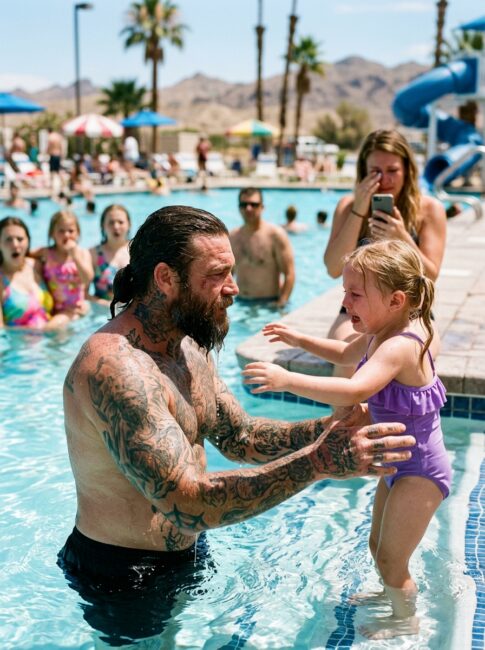
Molly’s fear started after a birthday party.
She was five. There was a backyard pool, too many kids, too much noise, and one inflatable flamingo that kept tipping over. Nothing terrible happened, not in the way people define terrible. She slipped off the shallow step, went under for maybe two seconds, and a teenage cousin pulled her up immediately.
But fear does not need much time to move in.
After that, Molly hated water in her face. She hated baths. Hated sprinklers. Hated the sound of pool filters. If a kid splashed near her, she screamed like the water had hands.
By June, I knew we needed help.
Needles gets brutally hot. Pools are not luxury out there. They are survival, community, childhood, and sometimes safety. I signed her up for lessons at the community pool, and for three weeks I watched my daughter stand on the first step like she was being asked to walk into traffic.
The instructor, Miss Carla, was patient. A Black woman in her fifties with silver braids, a whistle, and the calm voice of somebody who had seen a thousand children panic and live. She never pushed Molly too far. She sang. She played games. She let Molly throw rubber ducks from the deck.
Still, every day ended the same.
Molly shaking.
Me smiling too hard.
Cole asking quietly, “Better?”
Me saying, “A little,” because I did not want to admit I was failing.
On the twenty-first day, the heat was ugly. The kind that makes flip-flops stick to concrete. The pool deck smelled like chlorine, sunscreen, hot rubber, and snack bar nachos. Kids shouted. Water slapped tile. Parents sat under umbrellas scrolling phones while pretending not to judge other people’s children.
Molly stood on the shallow steps in a purple swimsuit with a ruffle she had picked because it looked like “mermaid armor.”
Her toes touched the water.
That was all.
Miss Carla held out a pool noodle.
“Molly, baby, just one more step.”
Molly shook her head.
I crouched beside her.
“Sweetheart, you’re safe.”
“No.”
“I’m right here.”
“No.”
“You don’t have to swim. Just stand.”
Her eyes filled.
“Water pulls.”
I looked at Miss Carla.
Miss Carla looked at me with kindness, which somehow made it worse.
Behind us, a boy laughed. Not at Molly, just at something his brother did. But Molly heard laughter and folded inward. Her shoulders rose. Her chin trembled. Her fingers gripped the rail until her knuckles turned white.
“I can’t,” she whispered.
Something in me cracked.
Not anger. Not exactly.
Exhaustion.
Three weeks of trying to be gentle can leave a mother feeling like she is made of wet paper. I sat back on my heels, and for one second I hated the pool, the lessons, the sun, the parents watching, the water for being water, and myself for not knowing the one sentence that would save my child.
Cole had come that day straight from the welding shop. He was still in jeans, boots, and his cut, hair tied back, sunglasses on, tattoos disappearing under leather. He had planned to watch from the fence. That was his role. Quiet backup.
But he saw my face.
Then he saw Molly.
He walked over.
His boots hit the concrete slow and heavy.
Thud.
Thud.
Thud.
Parents looked up.
Cole stopped beside me and lowered his voice.
“You tapped out?”
I wanted to say no.
Instead I nodded.
He looked at Molly.
She looked ashamed.
Cole took off his sunglasses. Then his leather cut. He folded it carefully on a plastic chair, the same way he folded flags at veterans’ rides. His boots came next. Socks. Shirt.
That was when the pool went quiet.
Because Cole Mercer without his shirt looked like a wall of ink.
Dragons, dates, roses, chains, a desert hawk, a little blue fish near his ribs, Molly’s birthday across his chest, old scars shining pale between the tattoos. People stared openly now. One mother pulled her toddler closer. A teenage boy whispered, “Whoa.” Miss Carla lifted one eyebrow but said nothing.
Cole stood there in black swim trunks, barefoot, exposed in a way I had never seen him choose.
Molly stared at him.
“Daddy?”
He smiled.
“Bug, I’m going in first.”
“You don’t swim.”
“I do today.”
I thought that was the climax. Tattooed biker conquers pool. Daughter follows. Cute video. Everyone claps.
I was wrong.
Cole walked to the pool steps, but his right hand shook.
Just once.
Molly saw it.
So did I.
And suddenly I understood there was something he had never told us.
Cole was afraid of water.
Not in the small way.
In the old way.
I learned the details later, but I saw the truth on his face before he ever said it. Cole had stared down men twice his anger. He had ridden desert highways through crosswinds that pushed trucks sideways. He had walked into courtrooms, hospitals, recovery meetings, and funeral homes without flinching.
But standing at the edge of that public pool, with children splashing and parents staring at his tattoos, he looked eleven years old.
His club brother Big Dave had once told me there was a river story. I had not asked. Biker wives learn there are doors you do not kick open unless the man inside is ready to come out.
That day, Cole opened it himself.
He stepped down one stair.
Then another.
The water climbed his shins, his knees, his thighs.
He stopped at waist-deep.
His jaw locked.
Molly whispered, “Daddy?”
Cole did not look at the crowd.
He looked only at her.
“If Daddy can go under,” he said, “you can touch the water.”
His voice was steady.
His hands were not.
Then he took a breath and sank beneath the surface.
For half a second, the whole pool seemed to hold still.
When he came up, water poured from his beard and hair. He wiped his face with both hands. The tattoos on his chest shone dark under the sun. His breathing was hard, but he smiled.
“Still here.”
That was for Molly.
Maybe for himself.
Then he pushed off and swam one slow lap. Not pretty. Not smooth. But strong enough. Each stroke looked like a man arguing with a memory and refusing to lose in front of his child.
When he reached the far wall, Miss Carla whispered, “Well, damn.”
I looked at her.
She shrugged. “Teachers get surprised too.”
Cole turned and came back. By then half the pool deck had phones out. I was one of them. I had started recording when he went under because I thought Molly might need to see it again later. I had no idea eight million strangers would watch my husband fight a ghost in swim trunks.
He stood in the shallow end, chest-deep, and held out both hands.
“Come to me, bug.”
Molly shook her head.
“I’ll hold you.”
“What if water pulls?”
“Then it pulls both of us.”
She cried harder.
Cole’s eyes got wet, though no one watching would have known whether it was pool water or something else.
“Molly,” he said, “I’m scared too.”
That was the twist.
Not that a tattooed biker got in a pool.
Not that our daughter swam.
The twist was that Cole did not teach her bravery by pretending fear was gone.
He taught her by admitting it was standing right there with him.
The pool deck went silent after that.
Men like Cole do not say those words easily. Not in public. Not shirtless. Not surrounded by strangers and phone cameras. Not with a reputation built on being impossible to move.
Molly stared at him.
“You are?”
He nodded once.
“Yeah.”
“But you went in.”
“Because you were watching.”
She thought about that.
Then she took one step down.
I stopped breathing.
The water touched her ankles.
She gripped the rail.
Cole did not move toward her. That mattered. He waited. He let her choose distance. Let her own the step.
“Next one,” he said.
She shook.
Then stepped again.
Water to her knees.
Miss Carla lowered herself into the water quietly, far enough away not to crowd, close enough to help. I kept recording with one hand over my mouth.
Molly stepped down until the water reached her waist.
Cole held out his hands.
She reached.
Their fingers met.
That was the sound I remember most. Not the applause later. Not the splashing. The tiny slap of her wet hand hitting his tattooed palm.
He closed his hand around hers.
“Got you.”
“Don’t let go.”
“Never first.”
For thirty seconds, they stood like that.
Father and daughter.
Both shaking.
Both still there.
After the video went viral, people saw what they wanted.
Some saw a tattooed man being gentle.
Some saw a father doing what fathers should.
Some saw ink and judged him anyway.
The comment that got shared the most said, “A fully tattooed man taught his five-year-old that courage comes in many shapes. Inked hands. Long hair. Standing in a public pool to hold a child’s hand. This is real courage.”
Cole hated that comment at first.
Not because it was wrong.
Because it was too close.
He did not like strangers calling him brave when they did not know what it cost him to step into that water.
Two nights after the pool video hit eight million views, the Mojave Saints gathered at our house. Not for attention. For Cole. They parked down the block because Molly was asleep and nobody wanted to wake her. I heard the engines cut off one by one. Then boots on gravel. Then quiet voices at the porch.
Big Dave brought coffee. Luis brought donuts. The club president, Preacher, brought nothing but himself, which was usually enough.
Cole sat in the garage with the door halfway open, his leather cut hanging on a hook, the blue fish patch hidden inside. He had not said much since the video spread. He went to work. Came home. Made Molly toast. Checked the bike. Scrolled comments until his face went hard, then put the phone down.
Preacher sat beside him on an overturned bucket.
“River?” he asked.
Cole stared at the concrete.
“Yeah.”
The story came out in pieces.
When Cole was eleven, his older brother, Mason, had drowned in the Colorado River near a campground outside Bullhead City. Cole had been there. The adults had been drinking. The boys had been dared to jump from a low rock into water that looked calmer than it was. Mason jumped first. Cole followed.
The current took Mason sideways.
Cole tried to grab him.
Couldn’t.
By the time adults understood the shouting was real, Mason was gone.
Cole survived because a stranger pulled him out by his hair.
After that, his father never said Mason’s name again. His mother kept Mason’s room untouched for two years. Cole grew up inside the silence of a death everyone blamed on nobody because blaming a child would be too cruel and blaming adults would be too honest.
So Cole blamed himself.
For thirty years.
That explained the water. The river cookouts. The boots on the bank. The way he watched Molly near sprinklers. The blue fish patch she had given him without knowing what it meant.
Put it inside so you don’t sink.
Kids have a way of naming wounds they cannot see.
The revelation broke me quietly.
Because I had spent three weeks thinking Cole was hanging back because swimming lessons were “my thing.” I thought he was being respectful. He was, but that was not the whole truth.
He had stayed out because water still carried his brother’s voice.
And on that twenty-first day, he stepped in anyway.
Not because he stopped being afraid.
Because Molly was more important than the fear.
Preacher asked, “Why didn’t you tell us?”
Cole gave him a tired look.
“What was I gonna say, brother? Big scary Riot don’t do pools?”
Big Dave leaned against the workbench.
“I don’t do elevators.”
Everybody looked at him.
He shrugged. “Got stuck in one in ’09. Hate ’em.”
Luis said, “I can’t sleep with a closet door open.”
Preacher said, “Hospitals.”
Cole looked up.
Preacher’s mouth tightened. “Since my boy.”
Nobody pushed.
Brotherhood sometimes begins when one man tells the truth and the others stop pretending they are made of stone.
The next Saturday, the Mojave Saints showed up at the community pool.
Not in cuts.
Not as a show.
Just as men.
Big Dave sat near the fence and did not laugh at anyone. Luis brought snacks. Preacher signed up his grandson for lessons. Two brothers admitted they couldn’t swim and asked Miss Carla about adult classes.
Cole watched from the shallow end with Molly.
She held his hand for the first minute.
Then she let go.
That was the moment from the video.
She released his tattooed fingers, stretched both arms in front of her, and kicked toward Miss Carla with her face tight and determined.
Three feet.
Maybe four.
It might as well have been the English Channel.
When she reached Miss Carla, the instructor lifted both hands.
“You did that.”
Molly turned back to Cole.
“I let go.”
Cole nodded.
His face did something I had only seen once before, the day she was born.
“Yeah, bug.”
“Did you see?”
“Every inch.”
I cried.
So did three strangers.
Cole did not cry in the pool. Not then.
He waited until later, in the truck, when Molly fell asleep wrapped in a towel with chlorine drying in her hair. He sat behind the wheel, both hands on it, looking through the windshield at the empty road.
Then he whispered, “Mason would’ve liked her.”
I touched his arm.
“He would’ve loved her.”
Cole nodded once.
The engine stayed off for a long time.
Swimming became our Saturday ritual.
Not dramatic. Not perfect. Real.
Some days Molly jumped in like the pool belonged to her. Some days she froze again and needed the steps. Some days she got mad because water went up her nose and declared swimming “rude.” Cole never rushed her.
He got in first every time.
Even after the viral attention died down.
Even when there were only two kids and one bored lifeguard.
Even on cloudy mornings when the water was colder than expected and his tattoos rose in goosebumps.
He would step down, sink under, come up, and say, “Still here.”
Molly would roll her eyes.
“Daddy, I know.”
But she watched.
Every time.
The Mojave Saints changed too.
Miss Carla started an adult beginner class on Thursday nights. At first, only two club brothers signed up. Then five. Then nine. Big Dave showed up in swim shorts with skulls on them and stood at the edge of the pool looking more scared than he had ever looked in a bar fight.
Cole stood beside him.
Dave muttered, “Say one word and I’ll drown you.”
Cole said, “Can’t. You ain’t in yet.”
Dave laughed, then stepped down.
Preacher came for his grandson but ended up learning to float on his back. He stared at the sky like it had personally offended him and said, “This feels like surrender.”
Miss Carla said, “It is.”
He kept floating.
Every year now, near the start of summer, the Mojave Saints pay for a block of swim lessons for kids in town whose families can’t afford them. They do it quietly. No fundraiser posters with their faces. No roaring parade. Just a check handed to the community center and a box of goggles in different colors.
Cole says it isn’t charity.
He says, “Kids near water need to know water.”
That is all.
Sometimes we drive past the Colorado River on our way out of town. Cole still gets quiet. He still watches the current. Grief does not evaporate because a man goes viral. Fear does not disappear because strangers clap.
But now he gets out of the truck.
He walks to the bank.
Molly takes his hand.
They stand there together while the river moves brown and strong under the desert sun. He never makes the river a villain. He never tells Molly to hate it. He just teaches her to respect it the way bikers respect weather, engines, and men with nothing left to lose.
One evening, Molly skipped a rock badly. It plopped two feet from shore.
“Terrible,” Cole said.
She put both hands on her hips. “You do it.”
He skipped one six times.
She gasped.
“You practiced?”
“A little.”
“With who?”
Cole looked at the water.
“My brother.”
Molly went quiet.
Then she picked up another rock and handed it to him.
“Show me like he showed you.”
Cole took it.
His tattooed fingers closed around the stone.
“Okay, bug.”
Last week, Molly swam the full width of the community pool.
No noodle.
No hand.
No panic.
She stood on one side in her purple goggles, cheeks puffed with focus, while Cole waited across from her in chest-deep water. The same public pool. Same desert heat. Same smell of chlorine and sunscreen. Same concrete that burned your feet if you forgot sandals.
But Molly was different.
So was he.
She pushed off the wall and kicked hard. Her arms chopped the water. Not graceful. Not yet. But hers. Every splash belonged to her.
Halfway across, she lifted her head.
“Daddy!”
Cole held up both hands.
“Keep coming.”
She did.
When she reached him, she grabbed his shoulders and laughed into his wet beard.
“I did it!”
Cole held her carefully, those inked arms wrapped around her like railings.
“You did.”
“Did I look brave?”
He looked at her for a long second.
Then he said, “You looked scared.”
Her face fell.
He touched her goggles.
“And you came anyway.”
She smiled then.
The good kind. The one that starts small because it has to travel from somewhere deep.
On the way home, she fell asleep in the back seat with damp hair and prune fingers. Cole’s leather cut lay folded beside her booster seat. The hidden blue fish patch peeked out from the lining, crooked and faded, still doing its job.
We drove past the old Route 66 sign as the sun dropped behind the desert hills.
The Harley waited at home in the garage, cooling from an earlier ride.
Tick.
Tick.
Tick.
Metal heart.
Wet towels in the back.
A sleeping child.
A man with tattoos on his hands and courage in the shape of staying.
Still here.
Follow the page for more biker stories about the gentle courage hidden under ink and leather.