The Captain Poured Coffee at a Woman’s Feet and Ordered Her to Clean It—But the Phone on the Table Was Still Recording
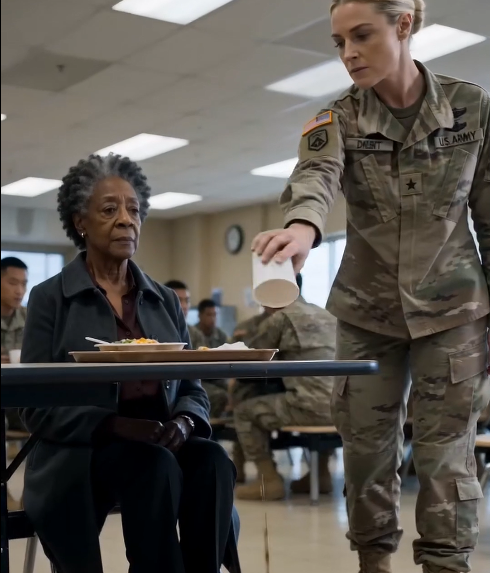
Captain Rebecca Hale poured the coffee slowly enough that nobody could pretend it had been an accident.
I was standing twelve feet away when she tilted the white paper cup over the beige cafeteria tile and watched the dark stream spread toward the shoes of the woman in the charcoal coat. Then Hale pulled three napkins from a dispenser, dropped them beside the puddle, and pointed at the floor.
“Clean it up.”
The woman looked down.
Then she looked at Hale.
Around them, lunch continued for perhaps two seconds longer before the nearest tables began falling quiet.
My name is Daniel Kim. I was a first lieutenant at Fort Mercer Readiness Center then, twenty-seven years old, six years into uniformed service and still young enough to believe there was always a correct procedure for a bad situation.
That afternoon taught me otherwise.
The woman Hale was confronting looked about sixty. Black, slim, short salt-and-pepper curls, dark coat buttoned over civilian clothes. She had arrived alone ten minutes earlier and taken the least desirable table in the cafeteria, the one beside a support column where the air vent blew too cold.
Nothing about her suggested authority.
No uniform.
No visible identification except the temporary visitor card clipped near her coat pocket.
Her lunch tray held soup she had barely touched, half a turkey sandwich, and a smartphone lying face-up beside a paper napkin.
Hale apparently believed the woman had been sitting in a section reserved for staff participating in an afternoon command briefing.
It was an easy mistake to fix.
It should have taken one sentence.
Instead Hale asked her to move.
The woman replied that she had been told to wait there.
“By whom?”
“I’m meeting someone.”
“That wasn’t my question.”
The woman remained calm.
Hale did not.
Captain Hale had been my operations officer for eight months. She was smart, efficient, ambitious, and exceptionally good at ensuring senior officers saw the most polished version of her work.
She was also skilled at identifying who could safely be pushed.
Junior enlisted soldiers.
New lieutenants.
Civilian employees without senior titles.
People unlikely to fight back.
The woman in the charcoal coat seemed to fit the pattern.
Hale picked up the coffee from the table.
The woman said, “Captain, that belongs to me.”
Hale looked at the cup.
Then poured it onto the floor.
“Now it doesn’t.”
Nobody laughed.
That seemed to irritate her even more.
She dropped the napkins.
“Clean it up.”
I stepped forward.
“Ma’am—”
Hale turned her head.
Just enough.
I stopped.
The woman watched that exchange closely.
Then she looked back at Hale.
“I’d rather you didn’t do that again.”
No anger.
No trembling.
No threat.
That calmness somehow made Hale more aggressive.
“You’re a visitor,” she said. “You don’t get to tell me how things work in my building.”
The woman’s eyebrows rose slightly.
“Your building?”
“You heard me.”
I noticed Staff Sergeant Owen at the next table lower his fork.
Two civilian kitchen employees had stopped talking.
Nobody intervened.
The woman bent—not toward the napkins, but toward her chair.
She removed her charcoal coat and folded it carefully across the chair back.
Underneath she wore a muted burgundy blouse.
Near her left collar was a small metal pin.
Old.
Worn.
Military medical insignia, though not anything currently issued.
Hale barely glanced at it.
I did.
The woman sat down again.
Her smartphone remained beside the tray.
She adjusted it perhaps half an inch, placing it between herself and Hale.
Hale smiled.
“You planning to call somebody?”
The woman rested her hands on the table.
“No.”
“Good.”
The phone screen dimmed.
Hale walked away.
The woman waited until she was several steps distant, then touched the screen once.
For less than a second, I saw the simple waveform of an audio recording already in progress.
She hadn’t started recording after the coffee hit the floor.
She had been recording before Hale ever approached the table.
And judging from the elapsed line on that screen, she had been doing it for quite a while.
Part 2
I picked up the napkins.
It was instinctive.
I had barely bent down when Hale’s voice reached me.
“Lieutenant.”
I straightened.
She was standing near the beverage station.
“I’ll get it, ma’am.”
“No.”
“It’s coffee on the floor.”
“I can see that.”
She walked back toward us.
Then she lowered her voice.
“Help her, and we can discuss your next evaluation.”
She smiled when she said it.
That was important.
Hale almost never sounded openly threatening.
She made consequences sound like administrative observations.
My next evaluation mattered.
I was competing for a logistics assignment I had spent nearly two years working toward. Hale was one of the officers whose recommendation could influence it.
I looked at the napkins.
Then at the woman.
She gave me the smallest shake of her head.
“Lieutenant,” she said, “leave them.”
There was no embarrassment in her voice.
If anything, she sounded concerned for me.
I stood.
Hale walked away again.
The woman waited until she was gone.
“Daniel Kim?”
I stared at her.
She nodded toward my uniform.
My name tape.
Of course.
Still, something about the way she said my name felt different.
“You know what an evaluation threat sounds like?” she asked.
My throat tightened.
“I’m not sure what you mean.”
“That’s all right.”
She didn’t push.
Instead she looked around the cafeteria.
Her eyes moved from the entrance to the security camera above the doors, then toward the corridor leading to operations.
“You work directly for Captain Hale?”
“Yes, ma’am.”
“How long?”
“Eight months.”
“Does she often correct people publicly?”
I didn’t answer.
She nodded.
Not as though my silence disappointed her.
As though it had answered the question.
I noticed the old pin again.
“Were you Army medical?”
She touched it.
“Once.”
“Officer?”
She smiled.
“Eventually.”
That word stayed with me.
Eventually.
She spoke like someone familiar with military life, but she didn’t use it to impress anyone. She knew how Hale’s authority worked, understood evaluations, recognized rank, and seemed completely unsurprised by the fact that junior personnel were reluctant to challenge a superior.
Then Sergeant First Class Malcolm Price passed our table.
He was fifty-two and had served at Mercer longer than almost anyone.
He stopped.
Looked at the woman.
Then at the pin.
“Ma’am, have you been here before?”
“A long time ago.”
Price narrowed his eyes.
“Medical detachment?”
She smiled.
“Before your time, Sergeant.”
He looked as though he wanted to ask another question.
Hale called him from across the room.
“Price.”
His expression closed.
“Yes, ma’am.”
“Something you need?”
“No, ma’am.”
“Then move.”
He did.
The woman watched him go.
“What happens when people disagree with her?” she asked.
I looked at the phone.
She noticed.
“You don’t have to tell me.”
“Then why ask?”
“Because sometimes the way someone chooses not to answer is useful too.”
That was the moment I stopped believing she was simply an old veteran waiting for lunch.
I looked at the temporary visitor card clipped to her coat.
The printed face was turned inward.
Only the edge showed.
She noticed me looking and turned it over.
Not enough for me to read the title.
Just enough to show that the stripe across the bottom wasn’t the ordinary visitor color.
It was the color used for state-level administrative access.
Then she turned it back.
She had not wandered into Hale’s cafeteria.
She had been given access to it.
And somebody above us knew she was there.
Part 3
Her name was Dr. Evelyn Carter.
I learned that much before I learned anything else.
She told me after Hale left the cafeteria for a few minutes.
“Doctor?”
“Clinical psychologist.”
“You work with veterans?”
“Among others.”
She had served twenty-four years before retiring from the military, first as an enlisted behavioral-health specialist and later as an officer after finishing her education.
She did not tell me her final rank.
I didn’t ask.
By then I understood that rank was not why she was there.
She asked me instead about a soldier named Private First Class Natalie Flores.
I knew Flores.
Everybody in operations did.
She had been one of the sharpest junior soldiers in our section until four months earlier.
Then something changed.
She stopped volunteering.
Stopped speaking during meetings.
Eventually requested reassignment.
Official explanation: family reasons.
Dr. Carter asked, “Did you believe that?”
I hesitated.
“No.”
She nodded.
Flores had contacted a veterans’ advocacy counselor after transferring.
According to Carter, Flores described repeated public humiliation, threats tied to evaluations, and being told that reporting problems would “follow her longer than the captain ever would.”
That phrase bothered me.
I had heard Hale say something close to it.
Not to Flores.
To someone else.
Carter had been asked to participate in a preliminary internal climate review because she had no current position inside Fort Mercer’s chain of command.
She was independent.
Experienced.
And, more importantly, soldiers had already been talking to her.
“How many?” I asked.
She didn’t answer.
Enough, apparently.
The phone beside her tray was not secretly recording random conversations.
Carter had been authorized to document her own interactions during the preliminary inquiry, subject to the review team’s procedures.
She had arrived early deliberately.
The formal team was scheduled for two.
She wanted thirty minutes in the building without an entourage.
She wanted to see how people behaved when they believed nobody important was watching.
Hale had walked directly into the test without knowing there was one.
Then Hale returned.
She saw me sitting with Carter.
“Lieutenant Kim.”
I stood.
“Yes, ma’am.”
“My office. Five minutes.”
Carter spoke.
“He was keeping me company.”
Hale looked at her.
“I wasn’t asking you.”
Carter’s expression changed slightly.
“You might want to reconsider the way you’re handling this.”
There it was.
An exit.
A clear one.
Hale could have apologized.
She could have asked who Carter was.
She could simply have walked away.
Instead she approached the table.
“You’re a civilian visitor who has ignored a direct request, challenged an officer, and disrupted my personnel.”
Carter looked at the coffee still spreading thinly between the napkins.
“I haven’t moved from my chair.”
Hale’s face reddened.
“Give me the phone.”
“No.”
The word was quiet.
Hale blinked.
“What did you say?”
“No.”
“Are you recording me?”
Carter did not answer.
Hale reached toward the phone.
Carter placed one hand over it.
Not violently.
Just enough.
“I wouldn’t do that.”
For the first time, Hale hesitated.
Then my own phone vibrated.
So did Hale’s.
Then Price’s.
A scheduling notification had gone out across the operations group.
The state review team had arrived early.
Hale looked at the message.
Her face tightened.
She looked at Carter.
Then toward the doors.
And finally back at the phone beneath Carter’s hand.
For the first time that afternoon, Captain Rebecca Hale seemed to wonder whether the woman she had been humiliating was actually waiting for her.
Part 4
Hale recovered quickly.
That was one of her strengths.
She ordered me back to operations and told Price to clear the cafeteria entrance for the review delegation.
Then she pointed toward Carter.
“Stay here.”
Carter almost smiled.
“I was planning to.”
Hale left.
I should have followed immediately.
Instead I remained beside the table for another few seconds.
“Dr. Carter,” I said quietly, “if that recording contains my conversation—”
“It contains what happened in my presence.”
My stomach dropped.
She saw it.
“Lieutenant, I am not here to trap junior officers.”
“That isn’t what I meant.”
“I know.”
She glanced toward the corridor Hale had disappeared into.
“I’m trying to understand why decent people keep deciding silence is safer.”
That hurt more than an accusation would have.
I went back to operations.
Hale was already reorganizing everything.
Files disappeared from desks.
People were told to straighten workspaces.
She ordered Price to move two soldiers out of the briefing room and replace them with more senior personnel.
That caught my attention.
“Why?”
Hale looked at me.
“Because I said so.”
One of the soldiers being moved was Specialist Aaron Webb.
Webb had filed a complaint two months earlier.
I knew because he had asked me how to submit it.
Suddenly the pattern was impossible to ignore.
Hale was not cleaning the building.
She was cleaning the room.
I said, “Webb should stay.”
The words came out before I could stop them.
Hale turned.
“What?”
“He works in operations. If this is a climate review, they may want junior personnel present.”
Hale stared at me for several seconds.
“Lieutenant Kim, go wait in my office.”
“No, ma’am.”
It was the first time I had openly refused her.
My heart was hammering.
Price looked at me.
Hale stepped closer.
“That an order you want me to repeat?”
Before I could answer, a voice came from the corridor.
“Captain Hale?”
A civilian woman stood there holding a dark folder.
Helen Ward.
I recognized her from a state headquarters briefing.
Behind her was Colonel Marcus Reed, Fort Mercer’s senior administrative commander.
Hale immediately changed.
Shoulders back.
Professional smile.
“Colonel. Ms. Ward. Welcome.”
Reed barely acknowledged her.
His eyes had moved past us.
Through the cafeteria doors.
Toward Carter.
He stopped.
“Is that Evelyn?”
Ward looked through the doorway.
“Yes.”
Hale followed their gaze.
Carter was still sitting beside the untouched sandwich.
Coffee remained on the floor.
The napkins were exactly where Hale had dropped them.
And the smartphone was still on the table.
Reed walked into the cafeteria.
Carter stood.
His expression softened.
“Dr. Carter. We weren’t expecting you until two.”
“I know.”
Reed looked down at the coffee.
Then at Hale.
Then at me.
Nobody needed to explain yet.
Ward approached the table and placed her folder beside Carter’s phone.
A small indicator was still moving across the screen.
Ward looked at it.
“How long?”
Carter answered with a time.
Hale heard her.
The color left her face.
Because the recording had begun before the first drop of coffee ever touched the floor.
Part 5
The first reversal wasn’t that Dr. Carter had once been an officer.
It wasn’t even that Colonel Reed knew her personally.
It was that Helen Ward already knew why Carter had come.
Ward was the lead civilian investigator assigned to a preliminary command-climate inquiry.
Carter was one of two independent advisers.
Her job was not to command anyone at Fort Mercer.
It was to listen.
Observe.
Identify patterns.
That distinction mattered.
Hale could not dismiss Carter as a superior officer pulling rank.
Carter had no operational authority over her.
She had something harder to fight.
Independence.
Ward asked everyone except Carter, Hale, me, Price, and Reed to leave the immediate area.
Then she looked at the coffee.
“Who poured this?”
Hale answered.
“There was a disagreement.”
Carter said nothing.
Ward repeated the question.
“I did,” Hale said.
“Accidentally?”
Hale hesitated.
“No.”
“Why?”
“She refused to move from a restricted table.”
Ward looked around.
There was no restricted marker.
No reserved sign.
Nothing.
“Was she informed this table was restricted before she sat?”
Hale looked at me.
I answered.
“I didn’t see any restriction, ma’am.”
Ward made a note.
Hale’s jaw tightened.
Then Ward asked about the phone.
Carter slid it toward her.
The recording played only a few seconds.
Hale’s own voice filled the space.
“Clean it up.”
Then Carter:
“I’d rather you didn’t do that again.”
Then Hale:
“Remember whose building you’re in.”
Ward stopped playback.
No one spoke.
That alone was bad.
But it wasn’t why Carter had been sent.
Ward opened the folder.
Inside were summaries from seven interviews.
The names were concealed from us at first.
Different ranks.
Different dates.
Same behaviors.
Public humiliation.
Threats involving evaluations.
Schedule retaliation.
Training opportunities removed.
Complaint channels discouraged.
Hale looked at Reed.
“Sir, I can explain individual personnel decisions.”
Reed replied, “Then you’ll have that opportunity.”
Hale looked relieved.
Only briefly.
Ward removed another sheet.
“We also have three statements using substantially similar language regarding career consequences.”
I knew the phrase before she said it.
Think about your evaluation.
My stomach turned.
Ward looked at me.
“Lieutenant Kim, did Captain Hale make any reference to your evaluation today?”
Hale looked at me too.
That was the moment.
Months earlier I would have found a softer answer.
I would have said there may have been a misunderstanding.
Instead I told Ward exactly what Hale said.
“Help her, and we can discuss your next evaluation.”
Ward wrote it down.
Hale interrupted.
“That was taken out of context.”
Carter finally spoke.
“It isn’t only the sentence.”
Everyone looked at her.
“It’s what happened immediately before and after it.”
She explained that coercive leadership rarely survived on one spectacular incident. It survived through repetition small enough to be explained away individually.
A changed shift.
A missed school.
A worse evaluation.
A public correction.
A private warning.
People eventually learned the cost of disagreement without anyone having to write the rule down.
Hale stared at her.
“You came here expecting to find something.”
Carter shook her head.
“I came hoping I wouldn’t.”
Then she told us about Natalie Flores.
The room changed.
Hale knew the name.
Carter had not accepted the assignment because of a professional curiosity.
Flores had once been Carter’s patient through a veteran-and-family support program after transferring away from Mercer.
Carter had watched a confident young soldier struggle to explain why she no longer trusted her own judgment.
That was why Carter volunteered.
Not to punish Hale.
To determine whether Flores had been alone.
Ward turned another page.
She wasn’t.
There were twelve statements now.
And the recording on Carter’s phone had just become number thirteen.
Part 6
The formal interview began that afternoon.
Not in the cafeteria.
In Conference Room B.
Hale was not handcuffed.
Nobody stripped insignia from her uniform.
Colonel Reed did not deliver a dramatic speech.
The process was quieter than that.
Ward placed the recorder on the table.
Carter sat to her right.
Reed attended as command representative.
I was interviewed separately first.
Then Price.
Then Webb.
The cafeteria recording was preserved according to review procedure.
Security footage confirmed the physical sequence even though it contained no useful audio.
Hale’s explanation was that she had been dealing with an uncooperative visitor and used poor judgment.
Poor judgment.
That phrase might have worked if the coffee were the only evidence.
It wasn’t.
Webb described losing a training opportunity after questioning a scheduling practice.
Price produced emails showing that Webb had originally been recommended for the course.
Flores’s records showed something similar.
Strong performance comments.
Complaint.
Then sudden negative language.
Hale argued that correlation was not proof of retaliation.
Ward agreed.
That surprised Hale.
Then Ward produced scheduling records, witness statements, messages, and evaluation drafts.
The case wasn’t built around one inference.
It was built around repetition.
Near the end, Hale asked to speak directly to Carter.
Ward allowed it.
“You let me do this,” Hale said.
Carter frowned.
“I let you?”
“You knew who you were. You knew why you were here. You could have identified yourself.”
Carter considered that.
“You knew enough.”
“No, I didn’t.”
“You knew I was a visitor.”
Silence.
“You knew Lieutenant Kim was your subordinate.”
Hale looked away.
“You knew the coffee belonged to me. You knew I hadn’t threatened you. You knew he wanted to help.”
Carter’s voice remained calm.
“You didn’t need my résumé to know how to treat any of us.”
Hale had no answer.
Then came the final revelation.
Carter had not originally planned to record inside the cafeteria at all.
She had activated the recorder minutes earlier after overhearing Hale speak to a young private near the beverage station.
The private had asked about resubmitting a leave request.
Hale told him, quietly enough that she thought nobody important was listening:
“Keep pushing paperwork and I’ll remember it when opportunities come around.”
Carter had started recording then.
Before Hale noticed her.
Before the table dispute.
Before the coffee.
The most important evidence wasn’t what Hale did to someone she underestimated.
It was what she did to a nineteen-year-old soldier when she believed nobody was paying attention.
Reed closed his folder.
Hale was temporarily removed from supervisory duties pending completion of the inquiry.
Her permanent outcome would come later.
Carter stood.
Before leaving, she returned to the cafeteria.
I followed her.
The coffee had been cleaned.
Someone had thrown away the napkins.
Carter looked at the spotless patch of floor for a long moment.
Then she asked me a question I didn’t expect.
“Do you know who cleaned it?”
I didn’t.
That seemed to bother her more than anything else that had happened.
Part 7
The review took almost three months.
Some allegations were substantiated.
Others weren’t.
Carter insisted both facts belonged in the final report.
Captain Rebecca Hale was ultimately removed from her operations leadership position after findings supported repeated misuse of supervisory authority and retaliatory personnel practices. She remained entitled to the same administrative process as anyone else.
There was no public ceremony.
No cafeteria announcement.
Life at Mercer simply changed.
Specialist Webb received another opportunity to attend the course he had lost.
Private Flores did not return to the unit, but she stayed in service.
Lieutenant Daniel Kim—me—got the logistics assignment I had worried about losing.
The strange part was that by then it mattered less.
What mattered more was what happened to my office door.
People started knocking.
A specialist asking whether an evaluation could be appealed.
A sergeant worried about a subordinate.
A private who wanted to know whether asking for help would become part of his reputation.
Sometimes I had answers.
Sometimes I didn’t.
But I stopped pretending not to hear the questions.
Dr. Evelyn Carter returned to Mercer once after the investigation ended.
It was early spring.
She wore the same charcoal coat.
I met her in the cafeteria.
She bought coffee.
I laughed when I saw it.
“So we’re trying this again?”
She smiled.
“Apparently.”
We sat at the same table.
I finally asked about the little medical pin.
She removed it and placed it in her palm.
It had belonged to her older brother, Thomas.
He had been an Army medic.
He died when Carter was nineteen.
She enlisted the following year.
“That’s why you became medical?”
“Partly.”
She turned the pin between her fingers.
“He was the first person who ever told me that frightened people don’t always look frightened. Sometimes they look difficult. Sometimes angry. Sometimes quiet.”
She pinned it back onto her blouse.
For a while we said nothing.
Then a young private walked past our table carrying an overloaded tray.
His elbow clipped Carter’s coffee.
The cup tipped.
A little coffee spilled across the table.
The private’s face went pale.
“Ma’am, I’m so sorry.”
Carter looked at the spill.
Then at him.
She pulled several napkins from the dispenser.
“It’s coffee,” she said.
The private hesitated.
Then Carter handed him half the napkins and kept half for herself.
They wiped the table together.
No one watched.
No one needed to.
Her phone remained beside her tray, screen dark this time, recording nothing at all.