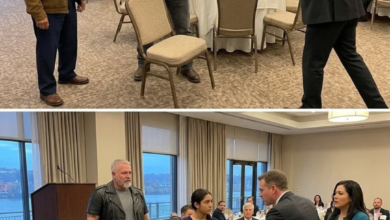
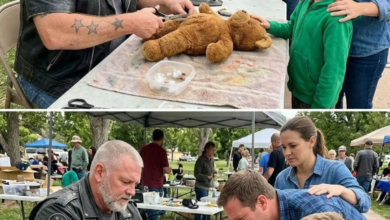
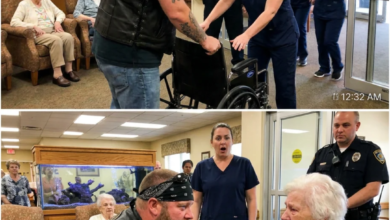
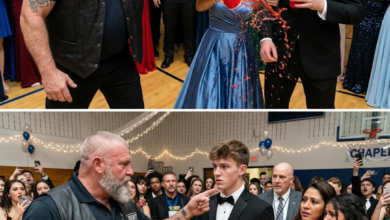
A RALLY INFLUENCER THREW A BIKER’S CARDBOARD CUTOUT INTO THE MUD ON LIVESTREAM—THEN A LITTLE GIRL’S VOICE CAME FROM HIS PHONE AND SAID, “DADDY, WHY DID HE THROW ME?”
Part 2
On the little screen, a nine-year-old girl in a hospital bed was still waiting for somebody to answer her.
Brock Delaney opened his mouth. Nothing came out.
His livestream chat was moving so fast it blurred. Grizz could see it reflected in Brock’s sunglasses: a wall of words scrolling upward, most of them in capital letters.
Grizz turned the phone back toward himself and softened his voice in a way nobody on row nine would have believed possible from a man that size.
“Nobody threw you, peanut. You just took a little spill. Like Sturgeon Creek, remember?”
On the screen, Maisie sniffled. “When I fell off the dock?”
“When you fell off the dock and came up laughing.”
“I wasn’t laughing. I was crying a little.”
“You were laughing a little too.”
A tiny smile. “Is my face okay?”
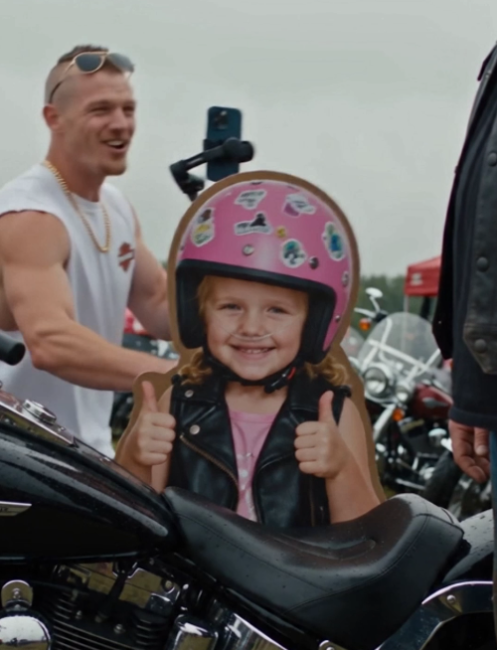
Grizz held the cutout up beside the phone so she could see it. He had wiped away most of the mud, though there was still a brown smudge across one cardboard cheek.
“Prettiest girl at the rally,” he said. “Still.”
Behind him, somebody in the crowd made a small sound and turned away.
Her full name was Maisie Jo Holloway. She had been born with half a working heart. The doctors used long words for it, but Grizz had learned to say it simply: the left side never grew right. She’d had three surgeries before she turned five. They bought her years, good years, full of scraped knees and fishing trips and horse posters.
And every August, the Copper Ridge rally.
She had come the first time at three, bundled in a sidecar Grizz built himself out of an old boat hull and sheet metal. At seven, she graduated to the back seat in a pink helmet she covered with stickers from every state they rode through. Six rallies in a row, she had never missed one. She knew the vendors by name. She knew which food truck gave free extra pickles to kids in helmets.
In April, her heart started giving out.
She’d been at Saint Brigid’s Children’s Hospital in Omaha for four months now, waiting on a transplant list for a heart that might come tomorrow, or next year, or not in time. Her mother, Jenna, slept on a fold-out chair beside her every night.
When August came, Maisie hadn’t asked to go. That was what broke him. She just quietly asked her mom to turn her bed toward the window on the day the rally started.
So Grizz went to a print shop in Lincoln and had them blow up her favorite picture: Maisie at seven, helmet on, thumb up, grinning like a jack-o’-lantern. He strapped it to his back seat and mounted his phone on the handlebars. He rode 520 miles to Copper Ridge with his daughter on a video call the whole way, and he sent her clips of every town and every truck stop.
“You’re going to the rally, peanut,” he’d told her. “One way or another.”
Now Brock Delaney cleared his throat and tried to find his grin again.
“Look, man, I didn’t know, okay? It’s content. It’s just a joke—”
Before he could finish, Darlene stepped out of the crowd, her orange lanyard swinging. She walked right past Brock as if he weren’t there. She stopped in front of the cardboard girl and held up her phone.
“Grizz, honey,” she said, her voice thick. “Can I take a picture with her?”
Part 3
Grizz looked at Darlene for a long second. Then he turned the phone so Maisie could see.
“Peanut. Miss Darlene from the info booth wants a picture with you.”
Maisie’s eyes went wide. “The lady with the lemon drops?”
“Same one.”
“Yes! Tell her yes!”
Darlene stood beside the cutout, put her arm around its cardboard shoulders, and smiled into her phone with tears on her face. Grizz snapped one on his own phone too and sent it to the hospital. Thirty seconds later, Jenna’s voice came through.
“She’s holding it up to the nurses. She’s showing everybody.”
A man in a leather vest stepped forward next. It was the same man who had slapped his knee five minutes earlier. He wouldn’t look Grizz in the eye.
“Mind if I…?”
“Ask her,” Grizz said, and held up the phone.
The man bent toward the screen. “Hey, sweetheart. I’m Lonnie. Can I get a picture with you?”
“Okay,” Maisie said. “Do a thumbs-up.”
He did a thumbs-up.
Then a woman with her two teenage sons asked. Then an older couple on matching trikes. Then four guys from a club in Nebraska who said they’d ridden past the Saint Brigid’s billboard on the interstate a hundred times.
By noon, the line stretched halfway down row nine.
By two o’clock, someone from the food trucks had brought over a folding table and a pop-up canopy so the cutout wouldn’t get rained on again. Somebody else brought a sharpie. Riders started writing messages on the back of the cardboard. Ride strong, Maisie. Hurry home, kiddo. Row 9 loves you.
Grizz stood beside his daughter for six straight hours and said maybe forty words. He took every picture and sent every one to Omaha.
Darlene stayed with him the whole afternoon, handing out lemon drops from her pocket. Somewhere around the hundredth photo, she leaned close.
“They don’t know who you are, do they?”
Grizz shrugged.
Most of the people in that line had no idea that the big, quiet man next to the cutout had been the rally’s head volunteer safety marshal for twenty-two years. He was the one who stood at the bottom of Dead Man’s Grade every August with a radio and a first-aid kit. He’d pulled more riders out of ditches than anyone could count, and he’d never taken a dime for it. He was the one who’d talked the founders into building the kids’ tent with free ear protection a decade ago.
“Doesn’t matter who I am,” he said. “Matters who she is.”
By sunset, Maisie had 312 photos. Jenna texted that she had looked at every single one, some of them twice. She’d fallen asleep with the tablet on her chest and a grin on her face for the first time in weeks.
Grizz sat on his camper step that night, cleaning the last of the mud off his bandana. He let himself believe the day was over.
At 11:14 p.m., his phone started buzzing and didn’t stop.
It was Lonnie, the man from the line.
“Grizz. Don’t watch it if you don’t want to. But Brock posted something. It’s got two million views.”
The thumbnail showed Grizz’s face, mid-kneel, with red arrows drawn around the cutout.
The title read: EXPOSED: Rally “Sick Kid” Dad Is Running A SCAM.
Part 4
The video was eleven minutes long. Grizz watched all of it standing up.
Brock had cleaned himself up and switched to a serious voice, sitting in a hotel room with soft lighting. He said he wanted to “own” his mistake from that morning. Then, almost immediately, he said he’d “done some digging.”
He showed a fundraiser page titled Help Little Maisie Get Her New Heart. It used her photo, the cardboard one, and had a goal of $250,000. It had already collected $41,000.
“I reached out to this guy,” Brock said gravely. “No response. No hospital records. Nothing. And you’re telling me a dying kid’s dad is out partying at a bike rally? Come on. Wake up, people. This is how scammers work. They find a cute picture and a sad story, and you open your wallet.”
Grizz had never made a fundraiser page in his life. He didn’t even know how.
But two million people had now watched a video saying he had.
By morning, the comments under Brock’s post had turned. People who had stood in line on row nine were being called gullible. Someone dug up Grizz’s old mugshot from a bar fight in 1999, back when he was twenty-one and stupid. Someone else found Jenna’s Facebook page and started posting on it.
At 7:30 a.m., the rally’s marketing director called.
Shawna Pike was polished and brisk, and she sounded like a woman reading from a script her lawyer had approved.
“Mr. Holloway, given the controversy, we’ve decided the cutout display needs to come down. It’s become a distraction. We’re also suspending your safety marshal credential, pending review. I’m sure you understand.”
“Who decided?”
“The decision came from marketing.”
“Brock works for marketing.”
A pause. “Mr. Delaney is our official ambassador. That’s not relevant here.”
Two security guards showed up at row nine an hour later. They were young and apologetic and wouldn’t meet his eyes. They took down the canopy and folded up the table, and they asked him to put the cutout away.
He called Omaha.
Jenna answered on the first ring. She’d been crying.
“Somebody showed her the video, Wade. One of the night aides, trying to be nice, I think. She asked me what a scam is.”
He heard Maisie in the background, small and hoarse.
“Daddy? Am I a scam?”
Grizz sat down hard on the camper step.
He’d been in Iraq. He’d buried his father and three friends from the road. He had held his newborn daughter while a surgeon explained that her heart was built wrong. He’d never felt anything like what he felt hearing those four words.
“No, peanut,” he said. “You’re the realest thing there is.”
When he hung up, Jenna texted him one more line.
Maybe you should just come home. Let it go. She doesn’t need any more of this.
He was still staring at that message at midnight when someone knocked on the camper door.
It was a skinny kid, maybe nineteen, in a hoodie, with a camera bag over his shoulder. Grizz recognized him from row nine. He’d been standing behind Brock the whole time, holding the backup camera.
He held out a tiny black memory card in a trembling hand.
“My name’s Tyler,” he said. “I film for Brock. Or I did. You need to see what’s on this.”
Part 5
They sat at the little fold-down table in Grizz’s camper, and Tyler plugged the card into a laptop.
“Brock records everything,” the kid said. “Even when he’s not live. He says you never know what’ll be content.”
The first clip was from Saturday morning, an hour before row nine. It showed the rally’s marketing trailer. Brock was sprawled on a couch, and Shawna Pike stood over him with her arms crossed.
“The board’s looking at our numbers Monday,” Shawna said. “Last year’s ambassador did four million impressions. You’re at half that. I need a viral clip by noon. Something people can’t stop sharing.”
“Like what?”
“I don’t care. Find a weirdo. Make it funny.”
Grizz didn’t move.
The second clip was the walk across the parking field. Brock had spotted the bagger from a distance, the cutout bouncing on the back seat.
“Oh, that’s perfect,” he muttered to Tyler. “Watch this. This’ll do numbers.”
The third clip was from Saturday night, in the hotel room.
Brock was scrolling his phone, laughing, while Tyler set up the lights. “Dude, somebody already made a fake fundraiser with her picture. Some random scammer in Florida. This is gold.”
“Shouldn’t we tell people it’s fake?” Tyler’s voice asked from behind the camera.
“Why? If people think the dad made it, he’s the villain, not me. Flip the story.” Brock tossed the phone aside. “Shawna’s gonna love this.”
Tyler stopped the video.
“I tried to quit after the first video,” he said quietly. “He said if I said anything, he’d make sure nobody ever hired me. He’s got a lot of followers. I’m nobody.” He swallowed. “But my little brother had leukemia when I was twelve. He’s fine now. But I remember what my mom looked like back then. I saw your wife’s face on that video call, and I couldn’t sleep.”
Grizz looked at the frozen frame of Brock grinning on the hotel bed.
“Why bring it to me?” he said. “You could post it yourself.”
“Because it’s your daughter,” Tyler said. “Not mine. You should decide.”
Grizz sat with that a long time.
Then he reached up to the handlebar mount he’d brought inside for the night and unclipped his own phone. He pulled up a file and turned the screen toward Tyler.
It was the video from row nine.
His phone had been recording the whole ride for Maisie, and it had never stopped. It caught everything from the handlebar angle: Brock striding up, the grab, the laugh, the cutout hitting the mud. It also picked up something nobody else had heard. Just before he grabbed the cutout, Brock had leaned toward his own gimbal and whispered.
“Watch this, chat. Easy views.”
Tyler let out a long breath. “So you had proof the whole time.”
“I had proof he was cruel,” Grizz said. “You’ve got proof he lied. That’s different.”
He picked up his phone and called Darlene. She answered on the first ring despite the hour.
“Darlene. When’s the closing ceremony?”
“Nine a.m. Main stage. Shawna’s having Brock hand out the trophies.” Her voice sharpened. “Why?”
“Because I’m going,” he said. “And I’m bringing Maisie.”
Part 6
The main stage at Copper Ridge sat at the bottom of a grassy hill that held about four thousand people. By 8:45 on Monday morning, every inch of it was full.
Shawna Pike stood at the podium in a white blazer. Brock was beside her in a fresh shirt, sunglasses on, a row of chrome trophies lined up on a table.
“Before we begin,” Shawna said brightly, “we want to address the weekend’s controversy. We take fraud very seriously at Copper Ridge, and we thank our ambassador for bringing it to light—”
She stopped.
A single bike was rolling down the center aisle of the hill at walking speed: an old black bagger with a life-size cardboard girl strapped to the back seat.
Behind it, people were standing up.
At first it was just row nine. Lonnie, the Nebraska club, the older couple on the trikes, and Darlene in her orange lanyard. Then more stood, and more after them. All over the hill, people were holding their phones up over their heads with the screens facing the stage. Every screen showed the same thing: somebody grinning beside a cardboard girl in a pink helmet, giving a thumbs-up.
Three hundred and twelve phones.
Grizz parked at the foot of the stage and cut his engine. He untied the cutout, held it under one arm, and walked up the steps. Tyler followed him, carrying a laptop.
Shawna leaned into the mic. “Sir, you’re not authorized—”
“Let him talk,” said a voice from the side of the stage.
It was Earl “Pop” Ellsworth, eighty-one years old, who had founded the Copper Ridge rally in 1979 with six friends and a keg. He still sat on the board, still in his original vest. He walked to the podium and gently moved Shawna aside.
“Wade,” he said. “Go ahead.”
Grizz didn’t make a speech. He nodded to Tyler, who plugged the laptop into the stage screens.
Four thousand people watched Shawna say find a weirdo. They watched Brock whisper easy views into his gimbal before ripping a sick girl’s picture off a motorcycle. They heard him laugh about a scammer in Florida and say flip the story.
Nobody on the hill made a sound.
Brock took off his sunglasses. “That’s out of context. That’s—”
“Son,” Pop said, without turning around, “I’ve been watching people for eighty years. That’s all the context there is.”
Then Grizz did one more thing. He set the cutout down and slowly rolled up the left sleeve of his thermal shirt, past the elbow.
On the inside of his forearm was a tattoo most people had always assumed was a lightning bolt. Up close, under the stage lights, it was a jagged heartbeat line. It wasn’t a design. It was a strip of paper from a hospital monitor nine years ago, traced exactly. It was the very first reading of a newborn girl’s broken heart, the morning she was born. At the end, where the line flattened out, a tattoo artist had drawn a tiny motorcycle.
“Doctors gave us that strip the day she was born,” Grizz said into the mic. They were the first words he’d said. “Said her heart might not last a year. She’s nine. She’s never missed one of these.”
He looked at Brock.
“I never asked anybody for a dime. I just wanted her to see the rally.”
The board voted on the stage, right there, with four thousand witnesses. Brock Delaney was stripped of the ambassador title and banned from Copper Ridge for life. Shawna Pike was relieved of her duties, effective immediately. Grizz’s marshal credential was restored. Pop pinned it back on his jacket himself.
The fake fundraiser page was gone by noon. Two of Brock’s sponsors dropped him before lunch.
Grizz was walking back to his bike through the crowd when his phone rang. It was Jenna.
He could barely make out what she was saying. She was crying so hard the words broke apart.
“Wade. Wade, they called. They have a heart.”
Part 7
Omaha was 520 miles away. The surgery was set for six that evening.
Grizz didn’t remember packing up. He remembered Darlene shoving a bag of sandwiches into his saddlebag, Tyler bungeeing the cutout back onto the seat with shaking hands, and Pop Ellsworth gripping his shoulder.
“Go,” the old man said. “We’ll handle the rest.”
Grizz rolled out of the rally grounds at 10:20 a.m.
He wasn’t alone for long.
By the edge of town, Lonnie and the four Nebraska riders had fallen in behind him. At the state line, nine more bikes were waiting on the shoulder. Word had spread through the rally, then through every club chat on the northern plains. At a gas stop in Valentine, a dozen riders from a Sioux City club were already idling at the pumps, and they’d paid for his fill-up before he arrived.
There were forty bikes by Norfolk and close to seventy by the Omaha city line, riding two by two in a long rumbling column.
At the front was a black bagger with a cardboard girl on the back seat, her thumb still up and her helmet still pink. The back of the cutout was covered in sharpie: Hurry home, kiddo.
He made it to Saint Brigid’s at 5:41 p.m.
Seventy motorcycles pulled into the visitor lot and shut down at once. The nurses on the fourth floor came to the windows.
Maisie was already being prepped in pre-op. The surgical team gave Grizz three minutes. He came through the doors still in his jacket, smelling of wind and gasoline and road dust, and his daughter looked up from the gurney. Her lips were blue-gray, and she was smaller than he remembered.
“Daddy,” she whispered. “You came back.”
“Told you I would.”
“Did I go to the rally?”
“You went, peanut. Three hundred and twelve people got their picture with you.” He brushed the hair off her forehead with one thumb. “And seventy of them just rode all the way here behind you.”
She tried to sit up to see. A nurse gently stopped her.
“Is my cardboard here?”
“Right outside.”
“Can it wait for me?”
Grizz looked down at her. The surgeon was already at the doors.
“It’s not going anywhere,” he said. “Neither am I.”
The surgery took nine hours.
Grizz spent all nine in the waiting room, the life-size cardboard girl propped in the chair beside him. Jenna’s head rested on his shoulder and her hand stayed locked in his. Outside, through the dark windows, he could see the seventy bikes still in the lot. Not one rider had gone home. Some slept on their seats. Lonnie paced the sidewalk with a coffee until two in the morning.
At 3:12 a.m., the surgeon came through the doors and pulled down her mask.
She was smiling.
“The heart’s working beautifully,” she said. “She’s going to have a long time with it.”
Jenna folded in half. Grizz caught her.
Over Jenna’s shoulder he watched the surgeon glance at the cardboard girl in the chair beside him, then back at him.
“Mr. Holloway,” the surgeon said. “When she woke up in recovery, she asked for something. She asked for all the pictures.”
Part 8
They printed every one of them.
Tyler set it up. He found a print shop in Omaha that worked through the night, and Darlene mailed the extras from the rally. In the end it was a thick spiral-bound book with a pink cover. It held three hundred and twelve photographs of strangers in leather jackets, grinning beside a cardboard girl, thumbs up.
Maisie kept it on her lap through six weeks of recovery. She learned their names. Lonnie. Mrs. Tuttle and Mr. Tuttle on the trikes. The four brothers from the Nebraska club. Darlene, of course, three times. Darlene had come back twice.
She looked at every single photo, every single day.
“That one’s my favorite,” she’d say, pointing to a burly man with no front teeth who had knelt down to her cardboard height. “He looks like a nice bear.”
In early October, a letter arrived at the hospital with no return address. Inside was an apology, handwritten and messy, signed by Brock Delaney. He’d lost his sponsors and deleted his channel, and he said he was working at his uncle’s tire shop. He’d enclosed a check for the hospital’s pediatric cardiac unit. He wrote that he didn’t expect forgiveness.
Jenna wanted to throw it away.
Maisie read it twice, slowly, sounding out the hard words.
“He’s sorry,” she said. “He can come to the rally next year. But he has to stand in line like everybody.”
Grizz didn’t say anything. But that night he folded the letter and put it in his saddlebag, where he kept everything that mattered.
The next August, the Copper Ridge Motorcycle Rally opened under a hot blue sky. An old black bagger rolled through the gate with a ten-year-old girl on the back seat. She wore a new pink helmet covered in brand-new stickers. Under her tiny leather vest was a thin pink scar running down the center of her chest.
She was riding for real this time.
The cutout came too. It had a place of honor now: a glass case in the main tent beside Pop Ellsworth’s original 1979 vest, the sharpie messages still visible on the back.
And when Maisie stepped off the bike at row nine, the line was already there.
It held three hundred people, then four hundred, waiting to get a picture with the real girl this time, standing next to her own cardboard self. Darlene was first, with lemon drops. Lonnie was second. Somewhere toward the back, standing in line like everybody else, was a quiet young man in a plain T-shirt with his hair grown out dark. He held a small bunch of grocery-store flowers.
Maisie spotted him. She gave him a thumbs-up.
That was the last surprise of the weekend, except for one.
When Grizz unstrapped his saddlebag that first night, he found something folded inside that Maisie had packed without telling him. It was a second cardboard cutout, smaller and freshly printed. It showed a seven-year-old boy with no hair and a huge gap-toothed grin, wearing a dinosaur T-shirt.
His name was Leo. He’d been in the room next to Maisie’s on the fourth floor for five months, and he was still there.
“He’s never been to a rally,” Maisie explained, very seriously. “So I brought him. That’s how it works now.”
This year, there were eleven cardboard kids at Copper Ridge. Riders call them the Cardboard Riders. Every one of them belongs to a child somewhere who couldn’t make the trip, and every one of them goes home with a book of photos.
“My kid hadn’t missed a rally since she was three,” Grizz says, when people stop him to ask about the girl in the glass case. “Last year she was in the hospital, so she went in cardboard. Three hundred people took pictures with her. She looked at every single one.”
A man in a gold chain saw a big tattooed biker with a cardboard doll and decided he was a joke. He never stopped to ask who was on the other end of that phone.
The people who stood in line in the rain and the mud for a girl they’d never met turned out to be the decent ones. The kindest of them was the quiet giant who knelt to wipe the dirt off a paper face.
If this story stayed with you, follow our page for more stories from the road. There are a lot of good people out there in leather.