Everyone Saw a Tattooed Biker Smash His Friend’s Whiskey in a Parking Lot—Nobody Saw the Grief Waiting Inside the Truck
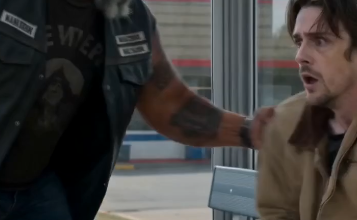
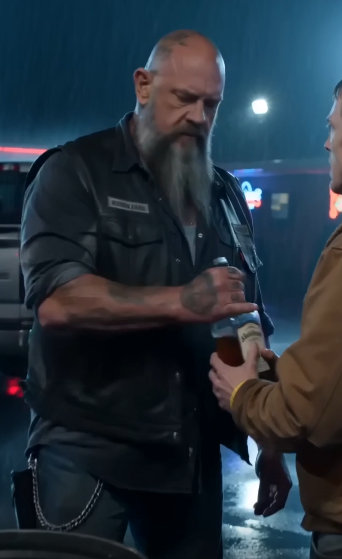
The enormous biker tore the whiskey from his friend’s hand and shattered it beside the truck, while a dozen strangers watched the grieving man collapse against the door and beg him to leave.
I was the biker holding the broken neck of that bottle.
My name is Mason Mercer, although everyone in the Black River Riders has called me Gravel since I was twenty-seven. At fifty-five, I stood six-foot-five and weighed almost 290 pounds, with a shaved head, a beard turning silver, old scars across my knuckles, and tattoos running from my wrists to the left side of my neck.
People often assumed I was dangerous before I opened my mouth.
That night, I gave them a reason.
It happened outside a roadside bar near Marietta, Ohio, where Route 7 follows the dark water of the Ohio River. Rain had polished the parking lot until every neon light looked like a wound across the pavement.
My Harley idled near the entrance, its V-twin rumble low and uneven.
Daniel Callahan stood beside his pickup with a bottle in one hand and his keys in the other.
We had been friends for thirty-one years. He had welded the cracked frame of my first motorcycle, stood beside me when I buried my father, and once driven six hours through a snowstorm because my wife called and said I should not be alone.
But the people outside that bar did not know any of that.
They saw a large tattooed biker cross the parking lot, grab a bottle from a smaller man, and throw it against the concrete.
Glass scattered.
Daniel stared at me as though I had struck him.
“What the hell is wrong with you?”
His voice carried across the lot. A couple near the entrance stopped walking. A waitress lifted her phone. Two men came out of the bar and watched my hands, perhaps deciding whether they needed to intervene.
I understood what they saw.
A bully.
A drunk.
A biker looking for an excuse to hurt somebody weaker.
Daniel shoved my chest. I did not move.
“Get away from me, Mason.”
“No.”
“It was my bottle.”
“I know.”
“My truck.”
“I know.”
“My life.”
That final sentence came out quieter than the others.
I looked at the keys trapped inside his fist.
Then I noticed the child’s yellow friendship bracelet wrapped around his wrist. The beads spelled AVA, though the last letter was hidden beneath his sleeve.
Daniel had never worn jewelry.
Not even his wedding ring after the divorce.
He tried to step around me, but I placed one hand against the truck door. Behind us, someone said the police were coming.
Daniel laughed without humor.
“Good. Maybe they’ll make you leave.”
I took his keys.
That looked even worse.
The two men near the entrance moved closer. One told me to return them. Another began recording as Daniel leaned against the truck and covered his face with both hands.
I could have explained.
I could have told everyone why I had followed Daniel for fourteen miles, why the unopened voicemail on my phone frightened me, or why I knew that particular date mattered.
But Daniel was still standing.
That was enough.
I lowered myself onto the wet pavement beside his truck, placed his keys beneath my boot, and waited.
After a long silence, he slid down beside me.
The rain kept falling. My leather vest creaked when I leaned against the tire. Daniel stared at the broken glass and whispered a name none of the strangers recognized.
“Ava.”
Then his shoulders began to shake.
The crowd believed I had destroyed a grieving man’s last comfort, but they had not heard the voicemail he left—or learned where those truck keys were meant to take him.
Want to know what Daniel said in that voicemail and why I stayed on the pavement until sunrise? Drop BROTHER in the comments — I’ll share more soon.
Daniel and I met in 1995 inside a welding shop that smelled of hot steel, stale coffee, and the kind of ambition young men mistake for certainty.
I was twenty-four and recently released from county jail after serving seven months for aggravated assault. A drunk had struck my younger brother outside a tavern, and I had kept swinging long after he stopped fighting back.
The judge called it uncontrolled rage.
My father called it family loyalty.
Daniel called it stupid.
He said that on my first day at Harlan Fabrication, while teaching me how to lay a clean bead across a steel plate. He was three years younger, twenty-one and skinny enough to disappear behind a welding curtain, but he had no fear of me.
“You keep carrying anger like that,” he said, “eventually it chooses where you go.”
I nearly hit him.
Instead, I listened.
Daniel became the first person who could challenge me without making me feel small. He showed me that a man could speak quietly and still refuse to move.
We bought our first used Harleys two years later. Mine leaked oil. His refused to start whenever anyone was watching. We pushed those machines almost as often as we rode them, laughing while strangers passed us on the highway.
The Black River Riders began with six men, three motorcycles that worked, two that sometimes worked, and no plan beyond Sunday breakfast.
Daniel earned the road name Duke because he could settle arguments before they became fights. He never raised his voice. He would simply stand between two angry men and wait until they remembered who they were.
Then Ava was born.
Daniel changed overnight.
He sold his motorcycle when she was three months old because diapers cost more than he expected. Eight years later, I found the same model in Cincinnati, rebuilt it, and parked it outside his house on Ava’s eleventh birthday.
She came running out before he did.
Ava was small, fearless, and born convinced that every scar had a story worth hearing. She climbed onto the passenger seat, placed both hands on Daniel’s shoulders, and demanded a ride around the block.
Daniel refused.
Ava negotiated.
They rode three careful circles while I watched from the curb.
Afterward, she cut a strip from her yellow softball jersey and told me to sew it inside my vest. Number fourteen would keep us from getting lost, she said.
I carried it from then on.
Ava grew into the kind of young woman who remembered custodians’ names, repaired broken jewelry with fishing line, and stopped on highways for animals too frightened to move.
She studied occupational therapy at Ohio University. She wanted to work with children recovering from serious injuries because, in her words, “Everybody talks about surviving. Somebody has to help them live afterward.”
A week before her twenty-fourth birthday, a truck crossed the center line on a wet county road.
Ava never reached the hospital.
Daniel called me from the sheriff’s office.
He did not say she was dead.
He said, “Mason, I need you to bring my jacket.”
That was how he had always spoken during catastrophe—asking for one ordinary thing because the truth was too large to hold directly.
I brought the jacket.
Then I stayed through the identification, the calls, the funeral home, and the first night inside his suddenly silent house.
For six days, Daniel functioned with frightening precision. He chose photographs for the memorial board. He found Ava’s favorite blue dress. He called her university and thanked the dean for sending flowers.
He did everything except grieve.
The club tried to reach him.
Bear brought food. Jonah repaired a loose porch rail. Eli sat in the driveway for two hours without knocking because he could not decide what words might help.
Daniel thanked everyone.
Then he closed the door.
On the seventh night, he called me at 10:58 p.m. I had already fallen asleep in my chair. When the phone rang, I saw his name and let it go to voicemail.
That decision still visits me.
I listened four minutes later.
At first, there was only the sound of his truck’s engine.
Then Daniel spoke.
“Mason, you still have that yellow strip?”
A pause followed. Long enough for road noise to fill the recording.
“Tell Ava I tried.”
The message ended.
I called him.
No answer.
I called again while pulling on my boots. Then I called Bear and told him to check Daniel’s house.
The driveway was empty.
I knew three bars Daniel used to visit before he became a father. Two had closed years earlier. The third sat along Route 7 near the river, fourteen miles south.
I started the Harley.
The engine caught on the second turn. Its rumble rolled through my quiet neighborhood while I pushed into the wet Ohio night.
I did not know what Daniel planned.
I only knew he should not be alone.
The Red Anchor looked nearly unchanged from 1995.
Same crooked neon sign. Same river smell beneath the tobacco and fryer grease. Same parking lot sloping toward a highway that moved fast after dark.
Daniel’s pickup sat near the far edge.
He was outside it, holding an open whiskey bottle.
His truck was running.
That was the detail that tightened everything inside me.
Daniel had not driven after drinking since Ava was born. He would leave his truck overnight rather than risk becoming the kind of man who endangered somebody else’s child.
Now the driver’s door stood open.
I killed the Harley and crossed the lot.
Daniel saw me when I was ten feet away. He lifted the bottle toward his mouth, but I took it before he could drink again.
“Give it back.”
“No.”
He reached for it.
I stepped away.
The bottle mattered less than the keys in his other hand, but I needed both of his hands empty. I could not wrestle a grieving man beside a running vehicle.
So I smashed the bottle.
It struck the pavement beside the rear tire. Glass broke. Whiskey spread across the rainwater in amber ribbons.
Every face beneath the awning turned toward us.
Daniel’s expression came apart.
Not from anger at first.
From betrayal.
“That was mine.”
“I know.”
“You followed me?”
“You called me.”
“I called to say goodbye.”
The sentence was quiet, but the woman recording us was close enough to hear it. Her phone lowered slightly.
Daniel moved toward the open door.
I blocked him.
He shoved me hard. His boots slipped, and I caught his elbow before he fell. From behind, someone shouted that I had grabbed him.
A man in a denim jacket came closer.
“Let him go.”
I released Daniel immediately, then reached through the open window and switched off the ignition.
Daniel swung at me.
His fist caught the edge of my beard and glanced off my jaw. There was little force in it. The man who had once lifted steel beams alone could barely keep his shoulders straight.
I did not strike back.
That confused the crowd.
Daniel hit my chest again.
Nothing.
Again.
Nothing.
Then he pressed both fists against my vest and bent forward until his forehead rested between them.
“Give me the keys.”
“No.”
“I can’t go back to that house.”
“Then we won’t.”
“You don’t understand.”
“I understand enough.”
“No, you don’t.”
He was right.
Nobody fully enters another parent’s grief. We stand at the edge of it, helpless, offering food, chairs, phone calls, and sentences that collapse beneath the weight of what happened.
I could not make Daniel’s loss smaller.
I could only keep the night from making it larger.
The man in the denim jacket asked whether he should call the police.
“Call whoever you need,” I said. “But don’t give him those keys.”
Daniel stared at me.
For one second, rage returned.
Then his knees weakened.
I guided him toward the rear tire, and we sat on the pavement. I placed the keys under my boot. He watched me do it but no longer tried to take them.
The woman with the phone approached cautiously.
“Does he need an ambulance?”
Daniel answered before I could.
“No.”
The word sounded automatic.
I asked him to look at me.
He refused.
I asked whether he planned to hurt himself.
Silence.
Rain ticked against the truck roof.
The bar’s neon sign buzzed behind us.
Finally, Daniel said, “I didn’t care if I came back.”
That was enough.
I called 911 and told the dispatcher my friend was grieving, intoxicated, and unsafe to be alone. I asked for medical help, not a confrontation.
Daniel heard me.
“You promised you wouldn’t let them take me.”
“I promised I wouldn’t leave.”
“That’s not the same thing.”
“No.”
The betrayal returned to his eyes.
This time, I accepted it.
There are moments when keeping a friend’s trust and keeping a friend alive no longer point in the same direction. Brotherhood becomes a cruel choice between being hated tonight and attending another funeral next week.
I chose the hatred.
Police arrived first, then paramedics. Daniel refused transport. He answered questions with the careful precision he had used at Ava’s funeral, insisting he was tired, not unsafe.
The officers saw a drunk man.
The paramedic saw a father in shock.
Her name was Lena Brooks. She was forty-six, steady-eyed, and spoke to Daniel without touching him.
“You don’t have to explain your whole life,” she said. “Just tell me whether you can stay safe for the next hour.”
Daniel looked toward the highway.
Then he looked at the broken bottle.
“No.”
One word.
That word saved him.
Daniel agreed to enter the ambulance only if I followed.
I told Lena I would ride behind them, but Daniel grabbed my vest.
“No bike.”
His grip tightened around the leather.
“Ride with me.”
I left my Harley beneath the bar’s awning and climbed into the ambulance.
The man in the denim jacket offered to watch the motorcycle until Bear arrived. The woman who had recorded us deleted the video without being asked.
Before the doors closed, she touched my arm.
“I thought you were attacking him.”
“So did he.”
Daniel heard that.
For the first time all night, the corner of his mouth moved. It was not a smile, but it belonged to the man I knew.
The county crisis stabilization center occupied one floor of a plain brick building beside Marietta Memorial Hospital. No sirens waited outside. No locked steel doors swallowed him.
There were chairs, warm lights, bad coffee, and people trained to sit with pain without demanding that it become articulate.
Daniel stopped at the entrance.
“I can’t do this.”
“You already are.”
“I don’t belong here.”
“Neither do I. We’ll be lost together.”
The intake worker asked whether Daniel wanted me present. He said yes.
Then she asked whether he had planned to drink and drive.
Daniel stared at the floor.
His fingers found Ava’s bracelet.
“I wanted the road to decide.”
Nobody moved.
Those six words contained everything he had refused to say at the funeral: the guilt, the exhaustion, the silence of his house, and the belief that surviving his daughter was some form of betrayal.
The intake worker did not recoil.
She asked what had stopped him.
Daniel pointed at me.
“He broke my whiskey.”
Then, after a pause, he added, “And sat down.”
They took him into a private room shortly after two in the morning.
I remained in the hallway.
Bear arrived with my helmet under one arm and Daniel’s duffel beneath the other. Jonah came twenty minutes later. Eli brought coffee and apologized because it was the only thing he knew how to say.
The three men stood in their leather cuts beneath fluorescent lights, looking like trouble waiting for an address.
A nurse asked them to lower their voices.
They had not spoken.
Bear sat beside me.
“You good?”
“No.”
“Duke?”
“No.”
He nodded.
That was our conversation.
At three thirty, a counselor asked me what support Daniel had at home. I listed the club, his ex-wife, two cousins in West Virginia, his shop foreman, and Ava’s college roommate.
The counselor stopped me.
“Who knows how serious tonight was?”
“Me.”
“Then he has one person, not a network.”
The truth stung.
We had surrounded Daniel with food and repair work. We had offered rides, errands, money, and quiet company. But none of us had said the plain words.
Are you thinking about dying?
We feared insulting him.
We feared the answer.
Mostly, we feared being unable to fix it.
At four fifteen, Daniel asked for me.
He sat beside a narrow window with a paper cup between his hands. The yellow bracelet looked too small around his wrist.
“You told them everything.”
“Yes.”
“You had no right.”
“I know.”
“You broke my bottle.”
“Yes.”
“Took my keys.”
“Yes.”
“Called the police.”
“I called help.”
“Same phone number.”
“Different reason.”
He looked outside. Dawn had not begun, but the dark was thinning near the river.
“I hate you right now.”
“All right.”
“You’re supposed to say something.”
“I’ll still be here when you’re finished.”
Daniel’s jaw tightened. His eyes filled, although no tears fell.
Then he asked the question I had feared.
“Why couldn’t it have been me?”
I had no answer.
A worse man might have offered one.
I pulled a chair beside him and sat close enough that our shoulders touched. The leather of my vest creaked. Daniel’s paper cup trembled.
I stayed.
At five, he told me about the last call from Ava. He had been working overtime and rejected it, planning to call after his shift.
She left a voicemail asking whether he remembered the first motorcycle ride around the block.
Daniel had listened to it forty-three times.
At six, he admitted he had put the whiskey in his truck before the funeral. Not because he wanted to drink then, he said, but because knowing it was available felt like an exit.
At seven, he slept for twenty-two minutes with his head against the wall.
I remained beside him.
When he woke, breakfast arrived on a plastic tray. He pushed it away. I ate one piece of toast from his plate, complained that it tasted like insulation, and placed the tray back.
Daniel ate the second piece.
Sometimes that is what victory looks like.
Not healing.
Toast.
The counselor recommended that Daniel remain for further evaluation and enter a structured grief program afterward.
Daniel refused.
Bear became angry.
“You almost drove drunk onto Route 7,” he said. “You don’t get to pretend this is nothing.”
Daniel stood so quickly his chair struck the wall.
“Don’t tell me what I get.”
Bear stood too.
They faced each other beneath the fluorescent lights, one man burning with grief and the other terrified enough to disguise it as anger.
I stepped between them.
Daniel pointed past me.
“You all want me locked somewhere because my pain makes you uncomfortable.”
“That isn’t it,” Bear said.
“It is exactly it.”
Bear’s hands curled.
He loved Daniel. That was the problem. Love had given him something enormous to lose and no graceful way to hold the fear.
Jonah entered from the hallway.
Our club president was sixty, Black, broad-shouldered, and quiet enough that men usually lowered their voices when he arrived.
He looked at Bear.
“Sit.”
Bear sat.
Then Jonah turned toward Daniel.
“We’re not voting on your life, Duke. But we are done helping you hide from it.”
Daniel stared at him.
Jonah removed his vest and draped it over the chair. Sewn inside was a faded hospital wristband bearing the name MICHAEL REED.
His son.
Michael had died from an overdose nine years earlier.
Most club members knew the story. Daniel did not know Jonah carried the bracelet.
“I thought watching him was the same as helping him,” Jonah said. “I sat outside apartments. Took his money. Checked his pockets. Threatened dealers.”
His voice remained level.
“I did everything except ask him what hurt.”
Daniel looked away.
Jonah continued.
“The last time Michael called, I let it ring because I was tired of saving him.”
Nobody spoke.
Daniel’s anger loosened.
Not because Jonah’s loss matched his. Grief does not become legitimate through comparison. It loosened because another father had entered the room without pretending he knew the exit.
Jonah placed Michael’s wristband beside Daniel’s yellow bracelet.
“Stay one day,” he said. “Hate us tomorrow.”
Daniel sat down.
He stayed.
The next seventy-two hours changed nothing visible. Ava remained dead. Daniel remained her father. His house remained full of objects that expected her return.
But professionals helped him make a plan for surviving the next hour, then the hour after that.
His ex-wife, Claire, arrived from Columbus. She and Daniel had divorced when Ava was sixteen, but grief erased whatever borders remained between them.
Claire did not hug him immediately.
She struck his shoulder once with the flat of her hand.
Then she held him.
“I already buried our child,” she whispered. “Don’t make me bury you too.”
Daniel’s face collapsed against hers.
I stepped into the hallway.
Some grief belongs only to the people who made the same child.
When Daniel left the center, he did not return home alone. Claire stayed in the spare room. Bear removed every bottle from the house. Jonah placed the truck keys in a lockbox to which Claire held the combination.
Daniel resented all of it.
The club’s challenge began there.
It is easy to call a man brother while riding beside him on a clear road. It is harder when he cancels plans, ignores calls, insults the people helping him, and refuses to shower for four days.
We created a schedule.
Daniel hated the schedule.
Monday breakfast with Bear. Tuesday grief group. Wednesday evening in my garage. Thursday dinner with Claire. Friday check-in with Jonah. Weekends belonged to whoever could keep him from disappearing into the empty house.
He accused us of guarding him.
We were.
He accused us of treating him like damaged equipment.
Sometimes we did.
So we learned.
The counselor taught us to ask directly whether Daniel felt safe. She taught us not to argue with grief, not to make promises we could not keep, and not to confuse a calm voice with a safe mind.
Most importantly, she taught us that companionship was not treatment.
Daniel needed both.
Three weeks after the parking lot, he returned to work for half a day. His foreman assigned him small welds at a bench rather than structural work. Daniel took offense until another employee placed coffee beside him and said everyone returned slowly after an injury.
“This isn’t an injury,” Daniel muttered.
The employee looked at the yellow bracelet.
“Looks like one.”
Daniel completed three welds.
Then he went home with Claire.
That night, he called me before the darkness became dangerous.
Progress sounded like this:
“Mason, come sit.”
I went.
Two months later, Claire brought a cardboard box to my garage.
Daniel had avoided Ava’s apartment since the funeral. Claire had packed most of it alone, labeling each box carefully so neither of them would have to open everything at once.
This one was marked FOR DAD.
Daniel stared at it from across the workbench.
“I can’t.”
“You don’t have to,” Claire said.
But he remained after she left.
Rain tapped against the garage door, softer than it had on the night outside the Red Anchor. My Harley rested on the lift. Bear pretended to reorganize sockets in the next bay.
Daniel opened the box.
Inside were photographs, a university sweatshirt, two paperback textbooks, and a dented metal container holding bolts, wire, and motorcycle parts.
At the bottom lay a small wooden sign.
DUKE’S GARAGE, it read in Ava’s uneven childhood lettering.
Daniel had built a workbench for her when she was nine. She used it to repair bicycles, lamps, jewelry, and anything neighbors would surrender.
The sign had hung above that bench until she left for college.
Beneath it was an envelope.
Daniel stopped breathing for a moment.
The letter was dated three months before the accident. Ava had written it after completing a class assignment about family influence.
It was not a farewell.
That made it harder.
She thanked Daniel for teaching her that broken things deserved patience before replacement. She described the motorcycle rides around the block, the lunches he packed badly, and the night he drove four hours because she was homesick during her first semester.
Near the end, she wrote that she hoped to open a therapy workshop where children could rebuild ordinary objects while rebuilding confidence in their own hands.
Daniel read the letter twice.
Then he handed it to me.
The final paragraph asked whether he would help design the workbenches someday.
Daniel walked outside.
I followed but kept several feet between us.
He stood beneath the garage awning, staring at the empty road. His hands shook. His eyes remained dry.
“I was going to leave her with nothing,” he said.
“You weren’t thinking clearly.”
“I was thinking about ending the pain.”
“That isn’t the same as wanting your life gone.”
“It felt the same.”
I did not contradict him.
After a while, he looked through the garage window at Ava’s wooden sign.
“She wanted benches.”
“Yes.”
“I can build benches.”
“Yes.”
That became the next hour.
Then the next.
Daniel designed a heavy wooden workstation with rounded corners, adjustable height, locking wheels, and drawers children could open with limited grip strength. He showed the plan to Ava’s former professor at Ohio University.
The professor cried.
Then she introduced him to a nonprofit rehabilitation center in Athens.
Six months after Ava’s death, we delivered four workbenches.
The Black River Riders funded the materials. Daniel refused payment for labor. The center agreed only after writing his hours down as a memorial donation from Ava Callahan’s family.
Children used the benches to repair lamps, radios, toys, and small wooden boxes.
Daniel attended the first workshop.
He remained near the door.
A ten-year-old boy named Marcus struggled to hold a screwdriver after a hand injury. Daniel knelt beside him but did not take the tool away.
“Want help?” he asked.
Marcus shook his head.
Daniel waited.
After several attempts, Marcus loosened the screw.
The boy smiled.
Daniel turned toward me, and for one brief second I saw the father he had been before the county road took Ava.
Not healed.
Still here.
That afternoon, Daniel removed the yellow bracelet from his wrist. I thought he was ready to store it somewhere safe.
Instead, he tied it around the handle of the first workbench.
The beads spelled AVA.
Now the last letter was visible.
One year after the night at the Red Anchor, Daniel asked me to meet him in the same parking lot.
I arrived at 11:30 p.m.
The bar’s crooked neon sign still buzzed. Route 7 still carried trucks beside the river. Rain threatened but never arrived.
Daniel’s pickup stood near the far edge.
For half a second, fear returned so sharply that my hands tightened around the Harley’s grips.
Then I saw two folding chairs behind the truck.
Daniel held coffee.
Not whiskey.
I shut off the engine. The sudden silence carried us backward one year, but only for a moment.
He handed me a cup.
“You came fast.”
“You chose a terrible meeting place.”
“I wanted to see it.”
We sat where the bottle had broken.
The parking lot had been washed by a year of weather. No glass remained. No stain marked the concrete.
Daniel looked toward the highway entrance.
“I don’t remember deciding to call you.”
“You remembered my number.”
“I remember wanting the pain to stop.”
“I know.”
“I still want that sometimes.”
The words no longer frightened me because he had learned to say them before they became instructions.
“What do you do then?” I asked.
“Call Claire. Call the counselor. Call you. Go somewhere with people.”
He drank his coffee.
“Sometimes I just make it through ten minutes.”
“Ten is enough.”
He nodded.
Daniel never bought another motorcycle. He said two wheels demanded more attention than he could promise during that season of his life.
But he remained with the club.
He welded broken frames, built accessibility equipment, and trained every new prospect in something that had nothing to do with riding.
He taught them how to stay.
Not to lecture.
Not to demand gratitude.
Not to assume a brother’s silence meant strength.
On the second anniversary of Ava’s death, the rehabilitation center opened a larger workshop. Above the entrance hung her childhood sign:
DUKE’S GARAGE.
Beneath it, a smaller plaque carried Ava’s own words from the letter:
BROKEN THINGS DESERVE PATIENCE.
Daniel stood in the back while children crowded around the workbenches. He wore a clean work shirt and Ava’s yellow bracelet around his wrist.
When the director invited him to speak, he declined.
Then Marcus—the boy with the injured hand—walked over and gave him a repaired clock.
The second hand moved with a faint, steady tick.
Daniel accepted it with both hands.
That evening, we rode to the river overlook. Daniel traveled in the support truck while seven Harleys moved ahead of him, their V-twins rolling through the hills like distant thunder.
At the overlook, Bear asked whether he missed riding.
Daniel considered the question.
“Some days.”
“You’ll ride again.”
“Maybe.”
Nobody pressured him.
Brotherhood had finally learned patience.
Before sunset, Daniel stood beside me at the railing. The river below held the last orange light of the day.
“You know what saved me?” he asked.
“The counselor.”
“She helped.”
“Claire?”
“Her too.”
“The club?”
Daniel shook his head.
“You sat down.”
That was all.
Not the broken bottle. Not the seized keys. Not the sirens or the promises made beneath fluorescent lights.
I had sat beside him when he believed every person would eventually grow tired of his grief.
And I stayed long enough for morning to prove him wrong.
Three years have passed now.
Every Friday, Daniel volunteers at Duke’s Garage. Every year on Ava’s birthday, the Black River Riders deliver tools and repair kits to the center.
At night, the small clock Marcus repaired rests on Daniel’s kitchen shelf.
It still ticks.
Sometimes Daniel calls me without speaking. I hear the quiet room around him, the refrigerator humming, a truck passing outside, his breathing finding a slower rhythm.
I do not fill the silence.
I sit on my porch, leather vest across my knees, and listen until he says he is ready to sleep.
People still remember the night I smashed his whiskey.
They tell the story as though breaking the bottle saved him.
It did not.
The bottle took one second.
Staying took all night.
Follow our page for more unforgettable biker stories about misunderstood actions, tested brotherhood, quiet courage, and the human hearts hidden beneath leather, tattoos, and roaring engines.