Part 2: Our Adopted Daughter Feared My Biker Husband — Then She Asked For His Hand
I married Daniel Mercer before I understood silence could be a language.
He was not the kind of man who filled a room with words. He filled it with weight. Heavy boots by the door. Leather cut hanging on the chair. V-twin rumble rolling up the driveway before dinner. Coffee black as road tar. One grunt for yes, two for I heard you, and a long stare for don’t push it.
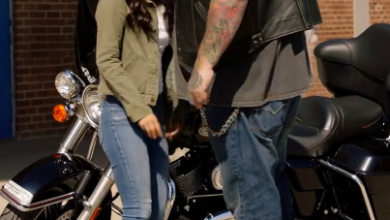
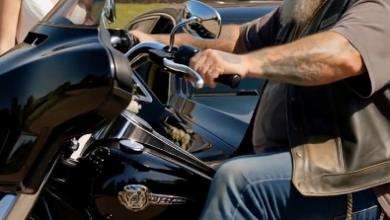
He worked as a diesel mechanic in Bend, Oregon, fixing trucks that came off Highway 97 with cracked belts, frozen brakes, and men too proud to admit they were stranded. He rode a black Harley-Davidson Road King with scratches on the saddlebags and a tiny chrome bell tied under the frame. He said the bell was for bad luck. I knew better. It had belonged to his mother.
Daniel looked like a man made out of threat.
He was six-foot-four, two hundred and eighty pounds, with sleeve tattoos running from both shoulders to his wrists. One arm had flames, chains, and an old club symbol he never explained much. The other had roses, a crow, and one tiny cartoon rabbit near his elbow. That rabbit was the first thing I noticed when we dated.
“What’s that?” I asked.
He pulled his sleeve down.
“Bad tattoo.”
“Looks like a bunny.”
“It is not a bunny.”
It was absolutely a bunny.
Years later, he admitted his younger sister had drawn it when she was seven. He got it tattooed the week after she died from pneumonia. That was Daniel. He hid tenderness in places people were too scared to inspect.
He had grown up rough outside Klamath Falls, mostly in trailers, sometimes in motels, always around men who believed boys should stop crying before they learned to spell their own names. His father hit first and explained later. His mother tried to soften the house with soup, gospel radio, and a hand on Daniel’s hair every night before bed.
That hand was the last gentle thing he remembered from childhood.
When his mother died, he was fifteen.
He told me he cried once at the funeral, and his father slapped him behind the church hard enough to split his lip.
“Men don’t leak,” his father said.
Daniel never cried again.
Not when his sister died. Not when he wrecked his first motorcycle and woke up with gravel in his skin. Not when doctors told us the third miscarriage was the last one my body could safely survive. Not when I folded the empty nursery blanket and put it in the closet because I could not look at it anymore.
He just got quieter.
That was part of why we chose adoption.
No, chose is too clean a word.
We crawled toward it.
After years of losses and doctors and prayers that came back unanswered, I found a photo of a little girl waiting in a Chinese welfare institute. Five years old. Serious face. Blunt haircut. Red sweater. The agency said she was shy, cautious, healthy, and slow to trust men.
Daniel looked at her picture for a long time.
Then he touched the screen with one finger.
“She looks like she’s already tired of everybody’s nonsense,” he said.
That meant yes.
The club teased him when the paperwork started. The old boys from the Cascade Ravens MC had seen Daniel break up bar fights by standing up. They had seen him ride through sleet, drag a brother’s bike out of a ditch, and stare down men who suddenly remembered they had somewhere else to be.
But adoption paperwork humbled him.
Home study. Fingerprints. Background checks. Financial statements. Parenting classes. Questions about trauma, attachment, culture, language, food, grief, identity. Daniel sat through every class with his arms crossed and his boots planted wide, looking like he was guarding the room from an invasion.
Then he went home and took notes.
He taped Mandarin words to the fridge.
Hello. Hungry. Bathroom. Safe. Sleep.
He practiced with that rough voice until our kitchen sounded like gravel trying to sing.
By the time we flew to China, he had packed stuffed animals, picture books, a pink jacket, and a tiny hairbrush in his carry-on. He also packed that little pink hair tie and looped it inside his vest before we left.
“Why?” I asked.
He shrugged.
“Dad stuff.”
That was the first seed I missed.
The hair tie was not for her hair.
It was for him.
A promise he did not yet know how to keep.
The day we met Mei, Daniel became smaller.
Not physically. That would have been impossible. He still filled the adoption office doorway like a storm cloud with boots. But something in him folded down. His shoulders lowered. His hands stayed open. His voice dropped into a whisper I had never heard before.
Mei sat on a blue plastic chair beside a caregiver, holding a stuffed panda by one ear. She did not run to us. She did not smile. She watched.
Her file had said she was “reserved.”
That word did not cover it.
She watched the social worker. Watched me. Watched Daniel. Watched the door. Watched every hand in the room. Her eyes were too old for five.
When I knelt and offered the little rabbit toy Daniel had picked out, she looked at it, looked at me, then slowly took it. My heart cracked open.
Daniel made the mistake of breathing too loudly.
Mei flinched.
He stopped breathing.
I am not joking.
He stood there like a statue until I touched his wrist and whispered, “Breathe.”
When the caregiver encouraged him to say hello, Daniel crouched down. His knees popped. His leather jacket creaked. He held out one hand, palm up, like he had been taught in the parenting class.
“Ni hao, Mei,” he said carefully.
Mei’s face collapsed.
She screamed.
Not a tantrum scream. A terror scream. The kind that empties the room. She dropped the panda, twisted toward the caregiver, and cried like Daniel had reached out from a nightmare.
He pulled his hand back so fast he almost hit the wall.
The caregiver spoke softly. The social worker smiled too hard. I picked Mei up because she allowed me to, though her little body stayed stiff against mine. Daniel stood ten feet away, staring at the floor.
Later, in the hotel bathroom, I found him sitting on the closed toilet lid with both hands over his face.
He was not crying.
Daniel did not cry.
But he looked like a man holding up a ceiling that had already fallen.
“She hates me,” he said.
“She’s scared.”
“Of me.”
“She doesn’t know you.”
He nodded, but I could see the old wound opening. Not from Mei. From somewhere deeper. Somewhere with a dead mother and a father who slapped tears out of a boy’s face.
The flight home was worse.
Mei clung to me from Guangzhou to Vancouver, Vancouver to Portland. Daniel sat across the aisle, too large for the seat, hands folded in his lap, watching every time she stirred. When she dropped her cup, he picked it up, cleaned it, and handed it to me instead of her. When she cried, he turned his face toward the window so his size would not make the crying worse.
At Portland airport, a man in a business suit saw Daniel with his tattoos, his leather vest, and the exhausted little Chinese girl hiding in my arms.
He stared too long.
Daniel stared back once.
The man looked away.
Outside, the November air smelled like rain, jet fuel, and coffee. Daniel loaded the suitcases while I buckled Mei into the car seat. She saw him through the window and started crying again.
He shut the door gently.
All the way home to Bend, the Harley stayed in the garage. We had taken my Subaru to the airport, but I knew Daniel missed the machine. Not for freedom. Not for drama. Because the bike was the one place his body understood what to do.
Parenthood gave him no throttle, no clutch, no familiar road.
Just waiting.
For three months, he waited.
He watched her learn the house. The couch. The kitchen. The stairs. The nightlight. My voice. The dog next door. The sound of wind hitting the bathroom vent. He learned not to walk behind her. Not to stand over her. Not to reach too fast. Not to knock hard. Not to laugh loud.
If she entered a room, he gave her the exit.
If she dropped something, he let me pick it up.
If she looked at his tattoos, he pulled his sleeves down.
Every night, after bedtime, he went to the garage and sat beside the Road King without starting it. Just sat there with his big hand resting on the seat, the little pink hair tie looped inside his cut.
I thought the crisis was that our daughter feared her father.
I thought the happy ending would be the day she stopped crying.
I was wrong.
The real crisis was that Daniel had started believing she was right to be afraid.
The morning it happened was ordinary.
That is how the biggest things sneak in.
Rain tapped the kitchen window. The heat clicked in the wall. A truck downshifting on Highway 97 grumbled somewhere beyond the neighborhood. Mei sat at the table eating cereal one piece at a time with her fingers, because spoons still frustrated her when she was tired.
Daniel sat at the far end of the table with black coffee and a repair manual.
Not reading.
Pretending to read.
He did that a lot.
His leather cut hung on the back of his chair. His tattoos were visible because he had come in from the garage wearing a sleeveless work shirt. Grease marked one forearm. The tiny rabbit tattoo peeked out near his elbow.
Mei kept looking at it.
I stood at the sink rinsing a bowl, watching in the reflection of the kitchen window.
Daniel did not move.
That was his gift to her.
Stillness.
Mei slid down from her chair. Her socks made soft sounds on the floor. She walked around the table slowly, holding the little rabbit toy from China against her chest.
Daniel’s eyes lifted.
Only his eyes.
She stopped beside him.
He did not speak.
She reached for his wrist.
His whole body went rigid.
Not because he did not want her touch.
Because he wanted it too much.
She tugged his hand down. It was enormous next to her fingers. Scarred. Grease-stained. Tattooed. The kind of hand strangers assumed could only break things.
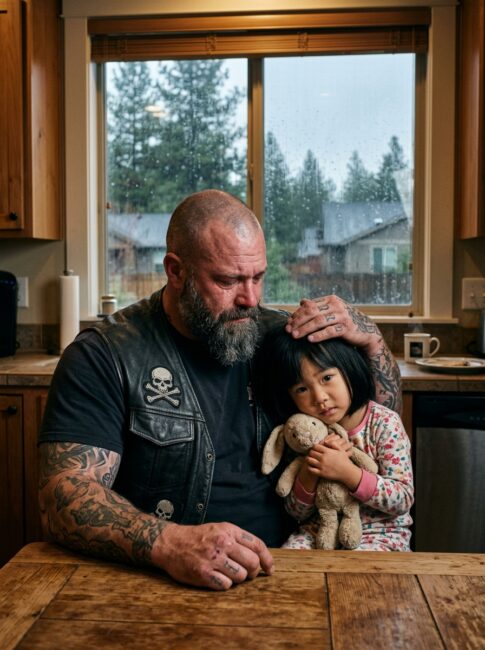
Mei placed it on top of her head.
Then she leaned slightly into his palm and said, “Pet.”
It was not perfect English.
It was perfect.
Daniel looked at me.
His face changed in a way I had never seen in all our years together. The hard parts lost their job. His mouth opened, then closed. His eyes filled so fast it scared me.
“Okay,” he whispered.
He moved his hand once over her hair. Slowly. So slowly. Like he was touching rain.
Mei closed her eyes.
That was the twist everyone saw.
The scary biker crying because his adopted daughter finally trusted him.
But what nobody knew, not even me until later that night, was that Mei had not chosen that gesture by accident.
She had seen a photo.
The week before, while I folded laundry, she found an old picture tucked inside Daniel’s toolbox. His mother, years before she got sick, standing behind a teenage Daniel on a porch in Klamath Falls. Her hand rested on his shaved head. His face was young, angry, and secretly happy.
Mei had carried that photo around for days.
I thought she liked it because Daniel looked younger.
But she had been studying it.
Studying love in a language she could borrow.
She did not know how to say, “I want you to be my dad.”
So she asked for the only thing she had seen a mother give a frightened boy.
A hand on the head.
I grabbed my phone because I wanted to keep the moment for us.
Not for the internet.
Daniel stroked her hair again.
Mei leaned into him.
And my husband, who had not cried in twenty-five years, folded over that tiny girl and broke without making a sound.
I posted the video that night because Daniel asked me to.
That surprised me.
Daniel hated being filmed. He hated attention. He hated the way people online turned real pain into something to scroll through while waiting for coffee.
But after Mei fell asleep, he sat beside me on the porch, his leather cut over his shoulders, the little pink hair tie still looped inside the snap. The Harley sat in the driveway cooling from a short ride around the block. Tick. Tick. Tick. The air smelled like rain, pine needles, and hot metal.
“Post it,” he said.
I looked at him. “Are you sure?”
He nodded.
“Some other dad might need to wait longer.”
That was all.
So I posted the video with his caption.
This little girl was scared of me for three months. Today she asked me to pet her hair. I didn’t know I’d been waiting for this my whole life until it happened.
By morning, it had been shared thirty thousand times.
By the next night, a million.
By the end of the week, six million people had watched my giant tattooed husband cry because a five-year-old girl placed his hand on her head.
The comments came in waves.
Some were sweet. Some were ugly. The internet always brings both casseroles and knives.
People wrote, “Real men cry.” Daniel hated that.
“Don’t make it about me,” he said.
People wrote, “She healed him.” He hated that too.
“She’s five,” he said. “She’s not a damn therapist.”
That was Daniel’s truth. He did not want Mei carrying his wounds. He wanted her carrying snacks, crayons, muddy rocks, and eventually too many stuffed animals.
The video changed things, but not overnight.
Mei still got scared when Daniel sneezed. She still hid when club brothers came over, even the gentle ones. She still woke some nights crying in Mandarin, reaching for a place we could not give back to her. Trust is not a door that opens once. It is a gate that has to be unlatched from the inside again and again.
Daniel never pushed.
The morning after the video went viral, he made pancakes and burned the first three because he was reading comments on my phone.
Mei pointed at the blackened pancake.
“Daddy bad cook,” she said.
Daniel froze.
Daddy.
The word landed harder than the video. Harder than the shares. Harder than the strangers calling him good.
He set the spatula down.
Walked to the garage.
Shut the door.
I found him sitting on the concrete floor beside the Harley with both hands over his face.
This time, he was crying.
Not loud. Daniel never did anything loud when it mattered. Just leaking through the fingers, shoulders shaking once, then stillness. The same man who had been slapped for crying behind a church now cried on a garage floor because a little girl called him Daddy over a burned pancake.
The pink hair tie finally made sense to me.
I asked him about it.
He took it off the snap and rolled it between his fingers.
“I bought it before we flew,” he said. “Thought maybe one day she’d let me carry one.”
That was the second seed.
He had not worn it as decoration.
He had worn it as a future.
After that, the club changed around Mei too.
The Cascade Ravens had never been quiet men. They came to our house like weather warnings, boots on the porch, pipes cracking outside, laughter too sharp for a child still learning safe.
Daniel met them in the driveway one Saturday.
“She gets scared,” he said.
One brother joked, “Of us?”
Daniel stared at him.
Nobody joked twice.
From then on, the bikes shut off at the corner and rolled silently into our driveway. Boots came off at the door. Voices dropped. Patches stayed, but sunglasses came off inside because Mei wanted to see eyes.
Brotherhood was tested not by a fight, but by softness.
Could rough men make themselves smaller for a child who needed the world less loud?
They could.
They did.
One by one, Mei learned them.
Bear, who was Black, fifty-two, and looked like he could lift a refrigerator, taught her to fist bump. Eli, a red-haired white prospect with freckles and nervous hands, brought sidewalk chalk. Marco, a Mexican-American rider with a silver cross tattoo, fixed her training wheels and pretended not to cry when she rode ten feet alone.
But Daniel stayed her center.
Not because he demanded it.
Because he waited.
Five years later, Mei was ten years old and fully in charge of our house.
That is not a joke.
She ran the kitchen timer. Corrected Daniel’s grocery lists. Told club members where to put their boots. Had opinions about curtains. Fed the dog treats when she thought I was not looking. Spoke English like she had invented sarcasm personally.
She also loved doing hair.
Mine. Her dolls’. The dog’s, once, which went badly. Daniel’s beard, if he fell asleep on the couch. Every pink clip in our house eventually found its way onto a dangerous-looking man.
The second video happened on a Sunday afternoon.
I was making chili. The garage door was open. Daniel sat on a stool in the driveway wearing his black leather cut over a gray T-shirt, arms tattooed, beard longer now, hair grown into a thick ponytail because Mei had once said he looked like a “motorcycle Viking” and he took it as a compliment.
His Harley stood behind him, chrome catching late sun. The engine was off, but the smell of oil and warm rubber still hung in the air.
Mei walked out holding a brush, pink ribbons, and the expression of a surgeon entering an operating room.
“Daddy needs a new look,” she announced.
Daniel looked at me.
I lifted both hands.
“Your daughter.”
He sighed.
“Be gentle, small boss.”
She climbed onto a step stool behind him and started brushing his hair. His face did what it always did when he was trying to survive tenderness. Jaw tight. Eyes forward. Arms crossed. Completely surrendered.
I filmed because I knew better now.
Mei divided his ponytail into little sections, braided them badly, tied pink bows at the ends, and then stepped back like an artist viewing a masterpiece.
Daniel turned toward the camera.
A six-foot-four biker with skulls on his vest, flames on his arms, a scar through one eyebrow, and three uneven braids tied with pink bows.
Mei put both hands on his shoulders and grinned.
“Daddy biker,” she said. “Beautiful hair.”
Daniel looked dead into the camera and said, “No club member sees this.”
I posted it thirty seconds later.
Ten million views.
The top comment said: Every little girl deserves a dad willing to look ridiculous on purpose.
Daniel read that one three times.
Then he printed it.
It is still taped inside his toolbox, beside the old photo of his mother’s hand on his head.
Mei is eleven now.
She still braids his hair when he lets her. Sometimes when he does not. She keeps emergency hair ties in his saddlebag beside the tire gauge, a flashlight, and one granola bar he pretends not to know is there for her.
The pink hair tie is still looped inside his leather cut.
Old now. Stretched. Faded.
He will not replace it.
On summer evenings, Daniel takes the Harley out after dinner and rides the same short loop around Bend. Past the gas station. Past the diner. Out toward Highway 97 where the sky opens wide and the mountains sit blue in the distance. Not fast. Not far. Just enough to clear the day from his bones.
Sometimes Mei waits on the porch for the engine to come back.
She knows the sound now.
Low first. Then closer. Then the little cough as he turns into the driveway.
He shuts off the bike before he reaches the garage because she hates the noise up close. The engine ticks in the cooling dark. His boots hit concrete. His leather creaks. He smells like road dust, pine wind, and gasoline.
Every time, Mei says the same thing.
“Daddy home.”
And every time, that giant tattooed man answers like it is still the first time.
“Yeah, baby. Daddy’s home.”
Then she reaches up.
He bends down.
And she places his hand on her head.
Pet.
Follow the page for more biker stories about rough men, soft moments, and families found on the road.