Part 2: They Said He Couldn’t Afford a Real Birthday Gift for His Daughter — Then He Opened the Box He Made by Hand
Emma froze before lifting the lid.
She had heard something inside the box.
Not a toy. Not music.
A faint mechanical click.
The room grew quieter as the children leaned closer.
Daniel crossed the carpet quickly and knelt beside his daughter. For a moment, the parents watching him saw only a tired man trying to stop a child from discovering how little he could afford.
“Please,” he whispered. “Let me fix one thing first.”
Emma looked at the bandage on his thumb.
There were two more beneath the cuff of his jacket.
“You hurt your hand again,” she said.
“It’s nothing.”
Daniel gently closed the lid and turned the box around. On the back was a small brass key, no larger than a coin. It had been secured with a thin piece of blue ribbon.
Emma touched the ribbon but did not untie it.
Her expression changed from excitement to recognition.
“That was Mom’s ribbon,” she said.
Daniel nodded once.
Across the room, Emma’s grandmother, Ruth, placed her paper cup on the table without taking a drink.
Until that moment, most of the parents knew only fragments of Daniel’s story.
They knew he repaired furnaces and air-conditioning units for a property-management company. They knew Emma lived with him in a modest duplex near the older part of town.
Some had heard that Emma’s mother died several years earlier.
None of them knew much more.
Daniel was not a man who volunteered explanations.
He worked. He attended school meetings. He packed Emma’s lunches and arrived early for every dance recital, even when his uniform shirt still smelled faintly of metal and dust.
At birthday parties, he stayed near the edge of the room and left before the other parents began discussing vacations or kitchen renovations.
That afternoon, he had arrived twenty minutes late.
Before entering the restaurant, he had remained in his truck for almost five minutes with the wooden box resting on the passenger seat.
Emma had seen him through the window.
She had thought he was nervous because the gift was unfinished.
Now she understood there was something else.
“Dad,” she said, “did you make this from the wood in the basement?”
Daniel looked down.
The other children watched with the restless curiosity of kids who had expected a new device or a flashy toy.
One boy pointed toward the gift table.
“My mom got Emma the tablet,” he announced proudly. “It has more storage than my brother’s.”
His mother smiled quickly, then looked uncomfortable.
Daniel ran one finger across the lid of the box.
“I know it does,” he said. “That was very kind.”
The wooden box appeared even smaller beside the expensive packages.
Emma loosened the ribbon and removed the key.
“Can I open it now?”
Daniel hesitated.
“I wanted to explain it first.”
“Explain what?”
He swallowed before answering.
“That it isn’t finished the way I hoped it would be.”
The mother who had criticized the missing gift bag leaned closer to another parent.
Her voice was quieter this time, but Emma still heard it.
“Maybe he should have bought something simple. Children remember when they feel embarrassed.”
Daniel heard that sentence too.
His shoulders lowered slightly.
Then Emma did something no one expected.
She slid the unopened box toward her father and stood up.
“I don’t want to open any more presents yet,” she said.
The party room became awkwardly still.
Her grandmother moved toward her, but Emma shook her head.
“I want Dad to finish explaining.”
Daniel stared at his daughter.
He seemed less worried about the parents than about disappointing the small girl standing in front of him.
“The key winds something inside,” he said. “But one piece is missing.”
Emma looked at the box again.
“What piece?”
Daniel reached into the pocket of his jacket and removed a tiny wooden figure.
It was shaped like a woman in a summer dress.
The carving was simple. The face had no detailed features, only the suggestion of a smile.
One of the arms had cracked.
Daniel had repaired it carefully with a narrow line of glue.
Emma covered her mouth.
She had seen that dress before.
There was a photograph on the bookshelf at home. Her mother, Laura, wore the same dress while standing beneath the maple tree in their old backyard.
Emma was only three in the picture, small enough to sit on Laura’s hip.
Daniel placed the wooden figure into a narrow slot on the lid of the box.
It fit beside two other figures.
One was a little girl.
The other was a man holding her hand.
No one in the room laughed again.
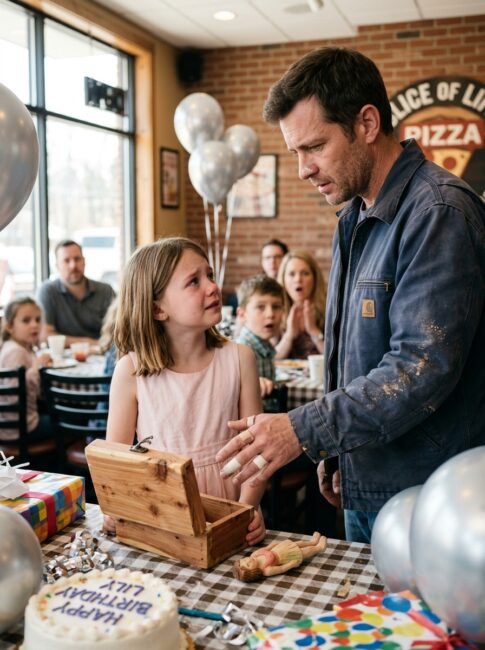
When Daniel turned the brass key, the mechanism resisted.
He stopped immediately.
“I need to be careful,” he said.
Emma knelt beside him.
“Is it broken?”
“No. It’s just old.”
That answer made Ruth look away.
The wood had come from an old cedar chest that once belonged to Laura’s mother.
Laura had used the chest for blankets, birthday cards, and the small things people keep because throwing them away feels impossible.
After Laura died from an aggressive illness when Emma was four, Daniel moved the chest into the basement.
For years, he could not open it.
He had tried once during Emma’s first winter in elementary school.
He lasted less than a minute.
The faint scent of cedar and Laura’s lavender hand cream had still remained inside. Daniel closed the lid, returned upstairs, and stood at the kitchen sink until Emma asked why the water had been running so long.
The chest remained untouched until three months before Emma’s tenth birthday.
One evening, Emma found Daniel sorting bills at the kitchen table.
A department-store advertisement had arrived in the mail. On the cover was the tablet most of her classmates wanted.
Emma had circled it with a pencil.
Daniel noticed the circle and looked at the price.
He picked up extra weekend shifts without telling her.
He repaired broken heating systems in apartment buildings before sunrise. He replaced pipes in unheated basements and crawled through narrow maintenance spaces where rusty screws tore the sleeves of his jacket.
After six weeks, he had nearly saved enough.
Then Emma quietly erased the pencil circle.
Daniel found the advertisement folded beneath the recycling bin.
At dinner, he asked whether she had changed her mind.
Emma pushed peas around her plate.
“Tablets get old,” she said. “Next year there will be a better one.”
Daniel smiled faintly.
“That is usually how it works.”
She kept staring at her plate.
Then she asked a question that stopped him.
“Do you remember Mom’s voice exactly?”
Daniel did not answer immediately.
“Yes,” he said at last.
“I don’t.”
Emma’s eyes filled, but she blinked hard and continued eating.
“I remember how she smelled after a shower. I remember her yellow mug. I remember the song she sang when the lights went out during storms.”
She looked at her father.
“But when I try to hear her talking, it sounds like someone far away.”
Daniel slept very little that night.
The next morning, he opened the cedar chest.
Inside were photographs, envelopes, hospital bracelets, and a small digital recorder Ruth had almost forgotten existed.
Laura had bought it during her final months.
She used it when writing became difficult.
Some recordings were reminders for Daniel. Some were private messages for Ruth.
Several were for Emma.
Daniel listened to only one.
Laura’s voice emerged through static, weaker than he remembered but unmistakably hers.
She spoke slowly.
“Daniel, this one is for her tenth birthday. Please don’t play it unless you think she is ready.”
Daniel turned off the recorder before the message continued.
He sat on the basement floor for a long time.
The tablet money remained in an envelope above the refrigerator.
Daniel could have purchased an ordinary speaker and placed the recorder inside a decorative box.
Instead, he began working after Emma went to bed.
He dismantled the cedar chest one panel at a time, saving every piece he could use.
He designed a small hand-cranked music box with a hidden compartment for the recorder. He carved the three figures for the lid.
Laura stood beneath a wooden maple tree.
Emma and Daniel faced her from the other side.
The mechanism was meant to turn slowly when the brass key was wound, carrying the figures toward one another until their hands almost touched.
Daniel had never built anything so delicate.
He knew how to repair boilers, replace motors, and diagnose failing compressors. Tiny wooden gears were different.
Several cracked.
He started again.
He watched online tutorials at the public library because the internet connection at home was unreliable. A retired cabinetmaker from his apartment route gave him spare tools and refused payment.
The blue ribbon came from Laura’s cedar chest.
The brass key came from an old jewelry box Emma used as a toddler.
The tiny wooden maple tree came from a branch Daniel collected behind their previous house before it was sold.
The final part was the recorder.
Daniel brought it to a repair shop and used part of the tablet money to restore the damaged battery connection.
The shop owner copied the recordings to a backup drive.
Daniel asked him not to play them aloud.
By the morning of Emma’s party, the box worked.
Almost.
One of the wooden gears slipped whenever the key turned too quickly. That was why Daniel arrived late. He had spent the final hour at his kitchen table, sanding the replacement gear while Emma was already at the restaurant with Ruth.
That was why his hands were bandaged.
That was why the varnish was still tacky.
Daniel had planned to give Emma the box privately after the party.
He never wanted her classmates to compare it with the gifts their parents had purchased.
He never wanted her to stand in a restaurant surrounded by expensive presents and pretend to be grateful for something imperfect.
The parents watching him did not know all of this yet.
They only saw him carefully wind the key.
The figures began to move.
The little wooden girl traveled slowly around the maple tree. The father followed behind her.
The repaired gear clicked once.
Then the two figures stopped beside Laura.
A tiny speaker hidden beneath the lid crackled.
Emma gripped the edge of the box.
For several seconds, there was only static.
Then Laura’s voice filled the room.
“Happy tenth birthday, my sweet Emma.”
Emma stopped breathing for a moment.
Daniel lowered his eyes.
Laura continued.
“If your dad found a way to play this for you, then he probably spent far too much time trying to make everything perfect.”
A few parents looked toward Daniel’s bandaged hands.
“He does that when he loves someone,” Laura said. “Sometimes you may need to remind him that love does not have to be perfect to be real.”
Daniel pressed his lips together.
Emma leaned against his shoulder.
Laura’s recording lasted less than two minutes.
She spoke about Emma’s laugh. She remembered how Emma used to sleep with one sock missing. She described the maple tree and the yellow mug and the storm-night song Emma had almost forgotten.
Then her voice became quieter.
“I wish I could see the person you are becoming. I already know I would be proud of her.”
Emma’s tears fell onto the uneven varnish.
Before the recording ended, Laura added one last sentence.
“Please give your dad a hug for me, because he will pretend he does not need one.”
Emma threw both arms around Daniel’s neck.
He held her tightly.
His eyes closed.
Around them, nobody reached for a phone. Nobody spoke.
The mother who had criticized the unfinished box turned away and wiped her face with the back of her hand.
The father who had joked about the garage lowered his paper plate to the table.
His daughter quietly took his hand.
The expensive gifts remained unopened behind them.
For the first time that afternoon, no one looked at the wooden box as though it were small.
After the party, Daniel tried to apologize to Emma for the uneven corners.
She sat beside him in the truck with the box resting carefully on her lap.
The restaurant windows reflected the late-afternoon light across the parking lot.
“I wanted it to work better,” he said. “I can fix the gear tomorrow.”
Emma turned the key gently.
The wooden figures moved toward the maple tree and stopped with another soft click.
“Don’t fix the sound,” she said.
Daniel glanced at her.
“What sound?”
“The little click.”
“The gear is catching.”
“I know.”
Emma traced the repaired arm on her mother’s wooden figure.
“It sounds like you making it.”
Daniel looked through the windshield for several seconds before starting the truck.
At school the following Monday, Emma’s teacher asked the class to write about their favorite birthday gift.
Several students described toys, electronics, and clothes.
Emma wrote about a scratched cedar box.
She did not mention the price of the tablet she had not received. She wrote about the three wooden figures beneath the maple tree.
She wrote about a voice traveling through time.
She wrote about her father’s hands.
The teacher asked Emma whether she could share the essay with Daniel.
Emma agreed.
When Daniel received the folded paper in her backpack, he read it at the kitchen table beside the unpaid bills and the small envelope of tablet money he had not spent.
Emma had written one sentence twice.
The first version was crossed out because her handwriting had become messy.
The second remained beneath it.
My dad could not buy me the most expensive gift in the room, so he gave me the only gift nobody else could have made.
Several days later, the mother who had criticized Daniel called Ruth.
She asked whether Daniel would accept an apology.
Ruth told her the truth.
“He probably already has.”
The woman became quiet.
Then she asked whether Daniel might show her how to make a small wooden box with her own daughter.
Daniel agreed, although he did not understand why Ruth smiled when she told him.
By spring, a few parents began meeting twice a month in the workshop behind the apartment-maintenance office.
The retired cabinetmaker brought scrap wood.
Children came with their parents and grandparents.
Some made uneven picture frames. Some made birdhouses with crooked roofs. One boy built a pencil holder that leaned noticeably to the left.
Nobody laughed at the mistakes.
Emma kept her cedar box on the bookshelf beside the photograph of her mother in the summer dress.
Every year on her birthday, she turned the brass key carefully.
The repaired gear still clicked at the same place.
Daniel offered more than once to replace it.
Emma always refused.
Some sounds are not flaws after they become part of a memory.
For more stories about the quiet moments that reveal who people truly are, follow this page and stay with us for the next story.