Police Said the Boy Was Just Another Runaway—Then a Biker Walked In and Signed His Name
Everyone in the station turned when the giant biker slammed cash on the counter and said, “That boy leaves with me tonight.”
The boy behind the glass looked twelve at most.
He was sitting on a metal bench inside the small holding area, knees pulled close, one sneaker untied, a dark hoodie swallowed around his thin shoulders. His face was pale under the fluorescent lights, and his eyes kept moving from the officers to the exit like he had already learned not to trust doors.
The biker looked worse.
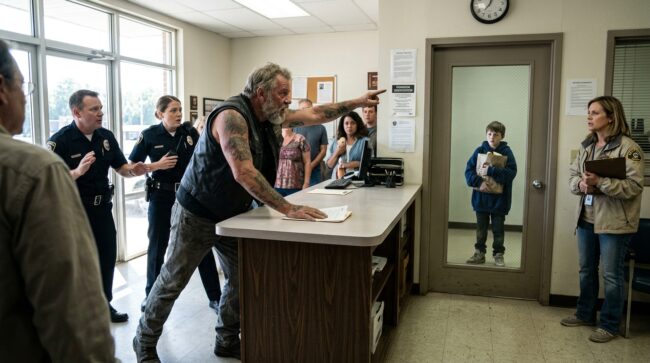
He stood in the lobby of the Marlow Police Department in Marlow, Ohio, at 11:47 on a rainy October night, soaked from the ride in. Water dripped from the hem of his sleeveless black leather vest. His tattooed arms were bare despite the cold. His beard was gray, his jaw hard, and his boots left muddy prints across the clean tile floor.
The woman at the front desk froze with her hand still on the keyboard.
Two officers near the coffee machine turned at once.
A young mother holding a sleeping toddler took one step backward.
The biker didn’t apologize for the mud. He didn’t lower his voice. He didn’t smile to make anyone feel safer.
He just pointed through the glass.
“I’m here for him.”
The desk sergeant, a square-faced man named Riley, looked from the biker to the boy and back again.
“Sir,” Riley said slowly, “you need to step back from the counter.”
The biker stayed still.
The boy lifted his head.
And for one strange second, fear crossed his face—not because the biker had arrived, but because the officers might send him away.
That was what nobody understood.
The boy had been found two hours earlier walking alone near Route 16, in the rain, with no phone, no coat, and a paper grocery bag clutched against his chest. A patrol car had pulled beside him after a gas station clerk called about a kid standing outside under the awning, shivering, refusing to answer questions.
Now he was inside.
Safe, according to everyone else.
But the biker looked at that boy as if the building itself was the danger.
“Name?” Sergeant Riley asked.
The biker’s eyes did not move from the glass.
“Cal Mercer.”
Riley frowned. “Relation to the minor?”
The biker paused half a second too long.
Then he said, “Enough.”
The lobby changed after that.
The young mother hugged her toddler tighter. The desk clerk glanced toward the panic button under the counter. One officer rested his palm near his belt, not touching anything, but making sure the biker saw the option.
Cal Mercer saw it.
He gave one small nod, like he had expected that too.
“I’m not here to make trouble,” he said.
His voice was rough, controlled, and somehow that made him sound more dangerous.
From behind the glass, the boy suddenly stood.
“Please,” he said.
It was barely a sound.
But everyone heard it.
Officer Jenna Morales had been the one who found the boy.
She was thirty-four, tired at the end of a twelve-hour shift, and still wearing rain on her shoulders when she brought him into the station. He had told her his name was Noah. Just Noah. No last name. No address. No parent to call.
He wouldn’t say where he lived.
He wouldn’t say why he was out.
He wouldn’t let go of the grocery bag.
When Jenna asked whether someone had hurt him, his eyes went flat in a way that made her stop asking in the patrol car. Some kids cried. Some shouted. Some lied quickly and badly.
Noah did none of those things.
He only stared at the passing streetlights and whispered, “Don’t take me back yet.”
Yet.
That word had stayed with her.
By the time they reached the station, a few people had gathered in the lobby because small towns collect trouble like weather. The gas station clerk had followed in his own truck, insisting he only wanted to make sure the kid was okay. A woman from the diner next door stepped in with a foil-wrapped sandwich. An elderly man waiting to report a stolen lawnmower sat in the corner pretending not to listen.
Everyone had an opinion.
“Probably ran away because his mom took his phone,” the clerk said.
“That boy looks hungry,” the diner woman muttered.
“Kids these days,” the elderly man said. “Out at midnight and nobody knows where they belong.”
Jenna ignored them.
She gave Noah a dry towel and asked him again for a last name.
He looked at the floor.
“Can I just sit?”
That was all.
So they let him sit.
They called around. Checked recent missing child reports. Nothing matched. No Amber Alert. No frantic parent calling dispatch. No family banging on the front door.
That should have been comforting.
It wasn’t.
At 11:38 p.m., dispatch got a call from a man asking whether a boy had been picked up near Route 16. He gave no last name. He only said the boy might be wearing a dark hoodie and carrying something in a paper bag.
Dispatcher asked who he was.
The man hung up.
Nine minutes later, the biker arrived.
And everything in the station tightened.
Cal Mercer filled the doorway like a bad decision. He had the look of someone used to being judged and uninterested in correcting anyone. His leather vest carried no bright patches, no club slogans, only a faded American flag and a small stitched name over the heart: MERCER.
The gas station clerk whispered, “That him? That who the kid was running from?”
The young mother heard and moved closer to the wall.
Jenna stepped into the lobby from the side hallway. She noticed three things immediately.
Cal’s hands were open.
His eyes were on Noah.
And Noah had stopped shaking.
That last part bothered her most.
“Mr. Mercer,” Jenna said, “how did you know he was here?”
Cal looked at her. “He wasn’t where he was supposed to be.”
“That doesn’t answer my question.”
“No.”
The desk sergeant’s mouth tightened.
Jenna moved slightly, blocking Cal’s view of the holding area. “Do you know this child?”
Cal’s expression did not change. “Yes.”
“What’s his full name?”
Silence.
The lobby heard it.
The gas station clerk muttered, “That’s not suspicious at all.”
Cal’s jaw flexed.
Noah pressed both palms against the glass. “He knows me.”
Sergeant Riley turned sharply. “Noah, sit down.”
The boy obeyed halfway, lowering himself back to the bench but staying forward on the edge, like he might spring up again if Cal disappeared.
Jenna kept her voice calm. “Noah, is this man a relative?”
Noah looked at Cal.
Cal looked at the floor.
That pause did more damage than a lie.
The diner woman whispered, “Oh, Lord.”
The elderly man in the corner leaned on his cane. “Somebody better call child services.”
“We already did,” Riley snapped.
The word child services made Noah flinch.
It was small. Almost nothing.
But Cal saw it.
His whole body changed.
Not violently. Not loudly.
His shoulders squared, his chin lowered, and for the first time since entering the station, he looked directly at Sergeant Riley.
“You don’t put him in the system tonight.”
The officer near the coffee machine stepped forward. “Careful.”
Cal didn’t blink.
Jenna lifted one hand. “Everybody calm down.”
But calm had already left the room.
The toddler woke and started crying against his mother’s shoulder. The gas station clerk held his phone at chest height, pretending he wasn’t recording. Rain rattled against the windows. Somewhere in the back, a printer coughed out paperwork nobody touched.
Sergeant Riley leaned across the counter.
“You don’t come into my station and tell me what happens to a minor.”
Cal placed both palms on the counter, slow enough that no one could mistake it for a lunge.
“I’m telling you he has somewhere safe to go.”
“Then you can explain your legal relationship.”
Cal said nothing.
Riley gave a humorless laugh. “That’s what I thought.”
Jenna turned toward Noah. “Is there someone we can call? Your mother? Your father? A grandparent?”
Noah looked down at the grocery bag on his lap.
His fingers tightened around the wet paper.
“No,” he said.
Cal’s eyes closed briefly.
A crack appeared in the silence.
Jenna noticed.
So did Riley.
“What’s in the bag, Noah?” Jenna asked.
The boy held it closer.
Cal’s head lifted.
“Don’t,” he said.
One word.
Too sharp.
Too protective.
Too late.
The room shifted again.
The officer by the coffee machine moved toward the holding area door. Riley stepped from behind the desk. The clerk stopped typing. The gas station man raised his phone higher now, no longer pretending.
Jenna looked at Cal. “Why don’t you want us to see what he’s carrying?”
Cal took one slow breath.
“Because it’s not yours.”
Riley pointed at him. “Step back.”
Noah stood again. “Please don’t take it.”
“What is it?” Jenna asked.
The boy shook his head.
Cal’s voice dropped lower. “Noah.”
The boy froze.
Everyone heard authority in that voice.
Everyone misunderstood it.
“There it is,” the gas station clerk whispered. “Kid’s scared of him.”
Noah turned toward the glass, eyes filling. “I’m not scared of him.”
But his voice broke, and in that room, broken voices were easy to twist.
Riley signaled to the officer. “Open the door.”
Cal moved.
Only one step.
But the station reacted like he had thrown a chair.
The young mother gasped. The clerk shouted, “Hey!” The officer near the holding door reached for his radio. Jenna stepped directly in front of Cal, both hands raised.
“Do not take another step,” she said.
Cal stopped.
The rain tapped harder against the windows.
Behind the glass, Noah clutched the grocery bag against his chest like it was a living thing.
And that was when the back door opened.
A woman in a county social services jacket entered with a clipboard under one arm and tired eyes that had seen too many midnight cases. Her name tag read T. Caldwell.
Noah saw her.
His face changed completely.
Not fear this time.
Panic.
“No,” Noah said.
The word came out so quietly that only Jenna heard it at first.
Then he said it again.
Louder.
“No.”
Ms. Caldwell looked from Noah to the officers. “This the juvenile?”
Sergeant Riley nodded. “Found wandering near Route 16. Refuses to provide guardian information.”
“I have emergency placement options,” Caldwell said, already opening her clipboard. “We can transfer him tonight.”
Noah backed away from the glass.
Cal’s hands curled once, then opened again. Discipline held him in place, but barely.
Jenna saw the effort.
That scared her more than anger would have.
“Noah,” she said gently, “nobody is trying to hurt you.”
The boy’s eyes cut toward her, desperate and disbelieving. “You don’t know that.”
The lobby went quiet.
Caldwell softened her voice. “Honey, we just need somewhere for you to sleep.”
“No.”
“You can’t stay here.”
“No.”
Cal took another step.
Jenna turned fast. “Mr. Mercer.”
He stopped again, but now every muscle in him seemed locked.
“I’ll sign,” he said.
Riley frowned. “Sign what?”
“Temporary release. Custody. Whatever paper keeps him from leaving with her tonight.”
Caldwell’s eyebrows lifted. “Are you kin?”
Cal looked at Noah.
Noah stared back through the glass.
There was something between them. Something old enough to have weight, but not old enough to be explained easily.
Cal said, “No.”
The answer hit the room hard.
Riley spread his hands. “Then no.”
“I have an address. Stable residence. No record. You can run me.”
“We will,” Riley said. “And until then, you need to sit down.”
Cal didn’t sit.
The gas station clerk said, “Why’s he so desperate to get the kid?”
That was enough for the young mother. She moved toward the door with her toddler, eyes wide, as if the lobby had become unsafe. The elderly man in the corner muttered something about calling the sheriff. The diner woman stood frozen with the sandwich still in her hands.
Jenna moved closer to the glass. “Noah, listen to me. If there’s a reason you don’t want emergency placement, you need to tell us.”
Noah shook his head.
His eyes were on Caldwell’s clipboard.
Not her face.
The clipboard.
Jenna followed his stare and saw nothing special. Standard forms. County logo. Intake sheets. A pen clipped at the top.
Then Caldwell said, “We can sort out the rest tomorrow.”
Noah’s face went gray.
“Tomorrow is too late,” he whispered.
Cal heard it.
This time, when he moved, he did not stop at one step.
He walked straight to the counter, pulled a folded document from the inside pocket of his vest, and slapped it down in front of Sergeant Riley.
The sound cracked across the lobby.
Riley’s hand went near his belt. “Back up now.”
Cal backed up one pace, jaw tight.
“Read it.”
Jenna reached for the paper before Riley could argue.
It was damp at the edges, folded too many times, and covered in neat handwriting that did not match Cal’s rough exterior. At the top was a school letterhead from Marlow Middle School. Below that, a list of dates. Signatures. Emergency contacts. A name she recognized from nowhere and everywhere at once.
Noah Whitaker.
Jenna looked up. “You knew his last name.”
Cal said nothing.
Riley’s face hardened. “And you chose not to give it?”
The officer by the holding door stepped closer to Noah, who was now standing in the corner with the grocery bag pressed to his chest.
Caldwell moved toward the door. “We need to proceed carefully.”
Cal’s voice cut through the room.
“Don’t touch the bag.”
Again, that sharp command.
Again, everyone heard guilt.
Riley turned fully toward him. “What is in that bag?”
Cal’s eyes stayed on Noah.
The boy began to cry without making a sound.
Jenna had seen children cry in many ways. Loud. Angry. Exhausted. Manipulative, sometimes. But this was different. Tears slipped down Noah’s face while his body stayed rigid, like he had been trained not to let grief make noise.
The holding room door buzzed.
The officer opened it.
“No!” Noah shouted.
He tried to turn away, but there was nowhere to go. Metal bench. Cinderblock wall. Glass. Door. Adults on every side.
Cal surged forward.
Jenna stepped in front of him and planted both hands against his chest.
“Stop!”
He stopped so abruptly that his boots squealed against the tile.
For one second, Jenna felt how much strength he was holding back. It was like standing in front of a running engine.
“Let him keep it,” Cal said.
His voice had changed.
It was still rough, but something underneath had cracked.
Riley came around the desk now. “Mr. Mercer, if you interfere one more time, you’ll be detained.”
Cal looked at the sergeant.
Then at the boy.
Then at the paper on the counter.
“I said I’ll sign.”
“You don’t have legal standing.”
Cal reached into his vest again.
Every officer in the room stiffened.
“Hands where we can see them!” Riley barked.
Cal froze.
Slowly, very slowly, he pulled out not a weapon, not a phone, not anything threatening.
A small plastic ID badge on a blue lanyard.
He laid it on the counter beside the school paper.
Jenna looked down.
The badge showed Cal Mercer’s unsmiling face.
Under his name were the words:
Volunteer Night Mentor — Marlow Youth Outreach
The lobby quieted, but only halfway.
It wasn’t enough.
Not yet.
Caldwell picked up the badge, checked it, then looked at Cal with new caution. “This program closed three years ago.”
Cal’s face went still.
Jenna noticed Noah’s reaction.
The boy stopped crying.
Not because he was calm.
Because Caldwell had just said something she should not have known so quickly.
Cal noticed too.
His eyes moved from Caldwell’s clipboard to her face.
For the first time that night, fear entered the biker’s expression.
Not for himself.
For Noah.
Jenna’s hand slipped from Cal’s chest.
“What’s going on?” she asked.
No one answered.
Then Noah, still cornered in the holding room, slowly opened the wet grocery bag.
Inside was a little girl’s pink winter glove.
A cracked inhaler.
And a folded photograph wrapped in plastic.
Caldwell took one step toward the glass.
Cal said one sentence, low enough that it felt meant only for the boy.
“Don’t show them her face.”
Noah looked up, terrified.
And every person in the station suddenly understood that the boy had not been wandering alone for himself.
Noah froze with the photograph half out of the bag.
The whole station seemed to lean toward him.
Rain ticked against the front windows. The fluorescent lights buzzed above the lobby. Somewhere in the back hallway, a phone rang twice and stopped. Nobody moved for it.
Officer Jenna Morales kept one hand lifted between Cal Mercer and Sergeant Riley, but her eyes were on the boy.
Noah’s fingers were white around the plastic-wrapped photo.
“Don’t show them her face,” Cal had said.
And somehow, that made everyone want to see it more.
Ms. Caldwell took another step toward the holding room door. “Noah, honey, give me the bag.”
The boy backed into the cinderblock wall.
Cal’s voice dropped. “Noah.”
The boy looked at him.
That one look changed the air.
It wasn’t fear.
It was permission.
Noah slowly pushed the photograph back into the bag, then pulled out the cracked inhaler instead. It was pale blue, scuffed along the edges, with a prescription label half-peeled from the side.
Jenna saw one word on it before Noah covered it with his thumb.
Lily.
A little girl.
The diner woman in the lobby pressed the foil-wrapped sandwich against her chest. The gas station clerk lowered his phone, but not all the way. Sergeant Riley frowned, trying to catch up to a story nobody had told him yet.
Jenna turned to Cal.
“Who is Lily?”
Cal did not answer quickly.
He looked toward Noah, then toward the social worker standing too close to the holding room door.
“Noah’s sister,” he said.
Noah’s mouth trembled.
Ms. Caldwell’s face changed by almost nothing. Almost.
But Jenna had been a police officer for eleven years. She had learned that lies were often loud, while recognition could be quiet as a blink.
Caldwell recognized the name.
Jenna saw it.
So did Cal.
Riley missed it. “Where is this sister?”
Noah shook his head.
Caldwell smiled too gently. “That’s what we need to find out. Noah, if your sister needs medicine, you must let adults help.”
The boy clutched the inhaler harder.
Cal said only one word.
“Jenna.”
She looked at him sharply. He had no right to use her first name. They had met less than an hour ago. Still, something in his voice stopped her from correcting him.
He nodded toward the clipboard in Caldwell’s hand.
Not the woman.
The clipboard.
Jenna glanced down and saw the top form. Emergency juvenile intake. County transfer request. A signature line already marked with a sticky tab.
Then she noticed something else.
The child’s name at the top was not Noah Whitaker.
It was Noah Wicker.
One wrong letter.
Small enough to be called a typo.
Wrong enough to hide a file.
Jenna reached out. “Ms. Caldwell, may I see that paperwork?”
Caldwell pulled the clipboard slightly back. “Officer, I can handle the intake.”
“I’d still like to see it.”
For the first time, Caldwell’s softness cracked.
Cal said nothing.
He only stood there, soaked and rigid, his tattooed arms hanging at his sides like he was forcing himself not to touch the world.
The gas station clerk finally stopped recording.
Because even he could feel it now.
Something was wrong.
Noah slid down the wall until he was sitting on the floor of the holding room, the grocery bag tucked between his knees. His eyes stayed on Cal.
“Is she okay?” he whispered.
The question was not for Jenna.
It was for the biker.
Cal looked through the glass at him, and the hard lines of his face seemed to age ten years.
“I don’t know,” he said.
It was the first honest thing anyone had said all night.
Jenna took the clipboard from Caldwell.
Not aggressively. Not dramatically.
But firmly enough that Sergeant Riley looked at her.
“Morales,” he warned.
“I need two minutes,” she said.
Caldwell folded her arms. “This is unnecessary.”
Jenna ignored her and walked to the front desk computer. Riley followed, irritated but curious. Cal stayed where he was, between Noah and the lobby, like a wall built from bad weather.
Jenna searched the name on the school paper first.
Noah Whitaker.
This time, the system found him.
Age twelve. Marlow Middle School. Address on Finch Avenue. Mother deceased. Father listed as unknown. Temporary guardianship assigned sixteen months earlier to Karen Whitaker, maternal aunt.
Jenna kept reading.
Her stomach tightened.
There had been three welfare calls from neighbors. Two closed as unfounded. One noted “children appeared nervous but physically unharmed.” The reporting officer was retired now. The file had no follow-up notes.
Then she searched Lily.
Lily Whitaker. Age six.
Medical alert: asthma.
Emergency contact listed: Karen Whitaker.
Jenna looked toward Noah through the glass. The boy had been found in the rain with his sister’s inhaler, a glove, and a hidden photograph.
Not running away.
Running somewhere.
“Where is Lily?” Jenna asked, but her voice had changed.
Noah looked at Cal.
Cal nodded once.
The boy’s words came out thin.
“In the old laundry room behind Ridge Apartments.”
The diner woman gasped.
Riley straightened. “What?”
Noah started talking fast now, like if he stopped, courage would leave.
“My aunt locked the bedroom door after dinner. Lily was wheezing. Her inhaler was empty. I climbed out the window to get the spare one from my backpack at school, but then I saw her boyfriend’s truck come back, and I couldn’t go home.”
His voice broke on the last word.
Jenna’s face went cold. “You left Lily in the laundry room?”
“No.” Noah shook his head hard. “She followed me. She was scared. She couldn’t breathe good, and it was raining, and I told her to hide there because it was warm behind the dryers.”
Riley was already reaching for his radio.
Cal’s jaw flexed. He had known some of it, not all of it. That was clear now. His silence had not been guilt. It had been restraint around a child’s secret.
Jenna looked at him. “How do you fit into this?”
Cal looked down at the school paper on the counter.
“I ride past the middle school most nights,” he said. “Used to run a youth outreach garage there before funding dried up. Kids came after school. Fixed bikes. Ate dinner. Talked if they wanted. Noah kept showing up even after the program closed.”
“Why?” Riley asked.
Cal shrugged once. “Garage had heat.”
Noah wiped his face with his sleeve.
“He never asked questions,” the boy said. “He just let me sit.”
That simple sentence changed the room more than any speech could have.
Cal had not been a kidnapper.
He had been the only adult Noah trusted because he never tried to own the truth before Noah was ready to give it.
Jenna turned sharply to Caldwell. “Did you know about the Whitaker case?”
Caldwell’s lips pressed together. “I know many cases.”
“You wrote the wrong last name.”
“It was a typo.”
“No,” Cal said.
Everyone looked at him.
He reached into his vest again, slower this time, and pulled out a folded sheet sealed in a plastic sleeve. The edges were worn from being carried too long.
“This came to the garage mailbox three days ago.”
Jenna took it.
It was a child’s handwriting, uneven and pressed too hard into the paper.
Mr. Mercer, if something happens, don’t let them send us back. Lily can’t run fast. I can.
Below that was a small drawing of a motorcycle.
And two children standing beside it.
Jenna looked at Noah.
The boy lowered his head.
Caldwell stepped backward.
Riley saw it then. The shift. The guilt. The wrong paperwork. The child’s panic when she entered.
“Ms. Caldwell,” he said carefully, “do you have a relationship with the guardian?”
Caldwell’s face hardened. “I’m not answering that without counsel.”
That was answer enough.
Within seconds, the station became motion.
Riley sent units to Ridge Apartments. Jenna called EMS. The officer by the holding room door stepped away from Noah as if embarrassed to have cornered him. The young mother with the toddler whispered, “Oh my God,” and turned her child’s face into her shoulder.
Cal finally moved to the glass.
Noah stood on the other side.
Neither of them smiled.
“You did right,” Cal said.
Noah shook his head. “I left her.”
“You got help.”
“I got caught.”
Cal’s eyes softened just enough to hurt.
“Sometimes that’s the same thing.”
Noah pressed his hand to the glass.
Cal did not touch the other side.
Not yet.
They found Lily twenty-three minutes later.
She was curled behind the dryers in the old laundry room at Ridge Apartments, wrapped in a towel someone had left in a basket. Her breathing was strained, but she was alive. Cold. Frightened. Alive.
When the radio call came through, Noah heard only one word.
“Located.”
His knees gave out.
Cal caught him through the holding room door as Jenna finally opened it, not with force this time, but with care.
Noah collapsed against the biker’s vest and made a sound that no twelve-year-old should ever make. It was relief and guilt and exhaustion all tangled together. Cal held him with one arm, not tight, not possessive, just steady.
Nobody in the lobby said a word.
Even Riley looked away.
But the deeper twist came after EMS confirmed Lily was being taken to St. Agnes Children’s Hospital.
Jenna sat with Noah in the interview room while Cal waited outside. There were forms now, real ones. Calls to the county supervisor. Calls to a judge. Questions about emergency protective custody.
Then Noah asked for his grocery bag.
Jenna brought it in.
He reached past the inhaler, past the pink glove, past the photograph wrapped in plastic. His fingers found something tucked at the very bottom.
A folded envelope.
He looked toward the small window in the interview room door, where Cal’s silhouette stood in the hallway.
“Can I give this to him?”
Jenna nodded.
Noah walked out carefully, like his body had become too tired for sudden movements.
Cal turned when the door opened.
The boy held out the envelope.
“My mom said if I ever saw you again, I had to give you this.”
Cal went still.
“My mom knew you?” he asked.
Noah looked confused. “She said you saved her once.”
Jenna watched the biker’s face lose all color.
Cal took the envelope with both hands.
On the front, written in faded blue ink, was his name.
Caleb Mercer.
Not Cal.
Caleb.
Noah’s mother had known his full name.
Cal opened the letter slowly. Inside was a photograph of a young woman standing beside a motorcycle in front of Marlow High School nearly twenty years earlier. She had dark hair, a shy smile, and a swollen lip partly hidden by bad lighting.
On the back was written:
You told me to leave before love became a cage. I did. He is safe because of you. Her name is Lily because you once said lilies grow back after winter.
Cal sat down hard on the hallway bench.
The envelope shook in his hands.
Jenna said nothing.
She understood enough.
Years before Noah was born, Cal Mercer had helped a frightened teenage girl get away from a violent home. He had probably given her a ride. Maybe money. Maybe a phone number. Maybe only one safe night and the kind of silence that lets a person keep their dignity.
Then life had carried them apart.
She became Noah and Lily’s mother.
She died before she could tell Cal what his small act had meant.
And now her son had found him again in the only way children find safe people—by remembering where warmth used to be.
Noah stared at the photograph. “That’s Mom.”
Cal pressed his thumb carefully over the edge, not touching her face.
“I knew her when she was about your age,” he said.
“Did you love her?”
The question was innocent enough to break the room.
Cal looked at Noah, then through the hallway window toward the rain-dark parking lot.
“No,” he said quietly. “I respected her.”
Somehow that answer hurt more.
Noah sat beside him.
For a while, they listened to the station around them: radios, footsteps, Riley’s low voice on the phone, Jenna giving instructions, rain easing outside.
Then Noah leaned against Cal’s shoulder.
The biker did not move.
He simply let the boy rest there.
When Jenna returned, she carried temporary release paperwork approved by an emergency judge. Not full custody. Not forever. Just tonight. Just enough.
Enough mattered.
Riley came with her.
He looked at Cal for a long second, then handed him a pen.
“You understand this makes you responsible for him until the county hearing tomorrow?”
Cal took the pen.
“Yes.”
“You understand officers will verify your residence?”
“Yes.”
“You understand this is not the end of the process?”
Cal looked through the window toward Noah, who was now asleep sitting upright, the grocery bag still under one arm.
“No,” Cal said. “It’s the beginning.”
He signed his full name.
Caleb Mercer.
And for the first time all night, nobody tried to stop him.
Noah left the Marlow Police Department at 2:16 a.m.
The rain had softened to mist.
Cal walked beside him without rushing. Jenna followed them to the front doors with a hospital update written on a sticky note in her hand: Lily was breathing easier, asking for her brother, and refusing to let go of the pink glove when nurses tried to move it.
Noah read the note twice.
Then he folded it and put it carefully into the grocery bag.
The same bag everyone had wanted to search.
The same bag he had protected like a crime.
It had held no weapon. No stolen money. No secret worth punishment.
Only proof that a little girl existed, that she needed help, and that her brother had been brave enough to be misunderstood.
At the door, Sergeant Riley cleared his throat.
Cal turned.
Riley looked uncomfortable in the way proud men do when apology has to cross a long distance.
“I was wrong about you,” he said.
Cal nodded once.
He did not make it easy. He did not make it hard.
He simply accepted the words and let them fall.
The gas station clerk was gone. The diner woman had left the sandwich in a paper bag by the front bench. The young mother had taken her toddler home. The lobby looked ordinary again, which somehow made the night feel stranger.
Outside, Cal’s motorcycle waited under the yellow station lights, rain shining on the black tank. Beside it sat an old pickup truck Jenna had arranged from the outreach garage, because no one was putting a half-frozen twelve-year-old on a motorcycle at two in the morning.
Cal opened the truck door.
Noah climbed in, then stopped.
“Can we go see Lily?”
Cal looked at Jenna.
“She’s at St. Agnes,” Jenna said. “I’ll call ahead.”
Noah nodded, trying to be strong and failing around the edges.
Before Cal closed the door, the boy reached out and touched the small stitched patch on the biker’s vest.
MERCER.
“My mom said you were scary,” Noah whispered.
Cal looked down at him.
Noah added, “But safe.”
The biker’s face tightened.
He shut the door gently.
At the hospital, Lily was asleep with an oxygen tube beneath her nose and the pink glove tucked against her cheek. Noah stood beside the bed for a long time before climbing into the chair next to her.
Cal stayed near the doorway.
He did not enter the room fully until Noah looked back and made a small space with his hand.
Only then did Cal step inside.
He placed the old letter from Noah’s mother on the windowsill, beside a paper cup of water and a plastic hospital bracelet.
No speech.
No promise he could not keep.
Just a quiet man standing guard while two children slept under fluorescent lights, carrying a past he had not known was still alive.
As dawn colored the hospital windows pale blue, Noah opened his eyes once.
“Mr. Mercer?”
Cal looked over.
“Yeah.”
“Will you be here when I wake up?”
Cal sat down slowly in the chair by the door, his leather vest creaking softly in the quiet room.
“Yeah,” he said.
Then he stayed.