Part 2: Poor Mother Couldn’t Afford a Christmas Gift — The Present Her Son Gave Her the Next Morning Left Everyone Speechless
Rachel and Noah lived in a second-floor apartment above an old laundromat on the edge of Cedar Falls.
The building always smelled faintly of detergent and radiator dust. On cold nights, the pipes clicked inside the walls like someone tapping gently from another room.
Their Christmas tree stood on a wooden crate beside the window.
It was barely four feet tall and leaned slightly to the left. Noah had decorated it with paper snowflakes, popcorn strings, and a silver star made from folded aluminum foil.
There were no gifts beneath it.
Rachel tried not to look at the empty space as she hung her coat behind the door.
“I am sorry,” she said.
Noah removed his wet boots and lined them neatly against the wall.
“For what?”
Rachel hesitated.
“For tonight.”
Noah looked at her with the calm expression that sometimes made him appear older than eleven.
“You did what I wanted you to do.”
Rachel stopped moving.
At the community center, nobody had seen the small nod Noah gave her before she handed away the wrapped box.
Nobody had heard him whisper, “Mom, give it to him.”
The little boy had been staring at the package through tears. A picture of a remote-control fire truck was printed beneath the wrapping paper where one corner had torn.
Noah had wanted a truck like that when he was younger.
But that night, he had watched the child’s father search the nearly empty tables with an expression Rachel understood too well.
It was the expression of a parent silently calculating how much disappointment a child could carry without breaking.
“You should have kept the grocery voucher,” Noah said.
Rachel walked toward the kitchen and filled a saucepan with water.
“There are potatoes in the cabinet.”
“There are three potatoes.”
“We also have soup.”
Noah opened the refrigerator.
Inside were a carton of eggs, a half-empty jar of mustard, and a plastic container from the diner where Rachel worked morning shifts.
The container held two slices of bread and a piece of chicken Rachel had brought home instead of eating during her break.
Noah noticed everything.
He noticed that Rachel had stopped putting milk in her coffee.
He noticed that she wore two sweaters indoors because the thermostat rarely climbed above sixty-two degrees.
He noticed the red envelopes stacked beneath a magnet on the refrigerator door.
Rachel always turned those envelopes facedown.
But Noah had seen the words FINAL NOTICE printed through the thin paper.
“What happened to Dad’s watch?” he asked.
Rachel’s hand paused above the stove.
For years, Daniel Miller’s watch had rested inside a small wooden box in Rachel’s bedroom drawer.
It was not expensive. The leather strap was worn, and the face had a small scratch near the number seven.
Daniel had worn it every day during their fourteen-year marriage.
After he died in a highway accident two winters earlier, Rachel sometimes held the watch when the apartment felt too quiet.
“It needed repair,” she said.
Noah looked down at his hands.
He knew that was not true.
Three weeks earlier, while searching for tape in Rachel’s dresser, he had found a folded ticket from Alvarez Pawn and Repair.
The ticket listed one item.
Men’s wristwatch, brown leather strap.
The loan amount was seventy-five dollars.
The due date was December 24.
Noah had placed the ticket back exactly where he found it.
Then he had begun making plans.
Rachel served potato soup in two chipped bowls and sat across from him at the kitchen table.
She tried to smile.
“Tomorrow morning, we will make pancakes.”
“With what milk?”
Rachel laughed softly, despite herself.
“With water. Your grandmother did it that way during snowstorms.”
Noah ate slowly.
After dinner, they watched an old Christmas movie on a small television with a flickering corner. Rachel fell asleep on the couch before the final scene.
When she woke shortly after seven on Christmas morning, a blanket covered her shoulders.
Noah was gone.
A handwritten note rested on the kitchen table.
Mom, please meet me at the community center breakfast at eight. Wear Dad’s blue scarf. I promise I am safe.
Rachel read the note twice.
Then she noticed something else.
The folded pawnshop ticket was no longer inside her dresser.
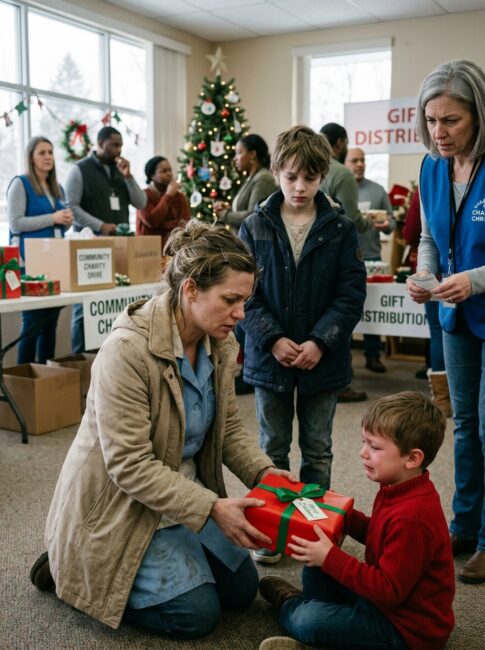
By eight o’clock, the snow had stopped falling.
St. Luke’s Community Center looked different in the morning light. The toy tables had been replaced with folding chairs, aluminum trays of scrambled eggs, and pitchers of orange juice.
Families from the previous night sat together beneath paper decorations made by local elementary school students.
Rachel hurried through the entrance wearing Daniel’s blue scarf and the same damp boots from the night before.
She scanned the room until she saw Noah standing near the small stage.
Beside him was Mr. Alvarez, the gray-haired owner of the pawnshop on Maple Avenue.
Several people recognized Rachel from the toy giveaway.
The same volunteer who had handed Noah the wrapped fire truck walked toward her.
“Your son asked us to make sure you came,” she said.
Rachel looked from the volunteer to Noah.
“What is happening?”
Noah held a small paper bag against his chest.
His cheeks were pink from the cold. His hair looked as though he had tried to comb it with wet fingers and given up halfway through.
“Merry Christmas, Mom,” he said.
He handed her the bag.
Rachel opened it slowly.
Inside was the wooden box from her bedroom drawer.
Her breath caught before she lifted the lid.
Daniel’s watch rested on the faded velvet lining.
The leather strap had been polished. The scratched face had been cleaned. The second hand moved in small, steady steps.
Rachel stared at it without speaking.
For several seconds, the only sound was the clatter of serving spoons near the breakfast tables.
“How did you get this?” she finally asked.
Noah glanced toward Mr. Alvarez.
“I found the ticket.”
Rachel pressed one hand against her mouth.
“I was going to get it back.”
“I know.”
“I only needed money for the electric bill and your inhaler.”
“I know that too.”
Noah had learned more than Rachel realized during the previous month.
He knew her hours at the diner had been reduced after the owner hired two relatives for the holiday season.
He knew the motel laundry where she worked evenings had closed temporarily because of a broken boiler.
He knew she had pawned Daniel’s watch because the pharmacy would not refill his asthma medication without payment.
Rachel had told herself the watch was only an object.
Daniel would have chosen Noah’s breathing over a keepsake without hesitation.
Still, handing the watch across the pawnshop counter had felt like losing one more piece of her husband.
Noah unfolded a small sheet of notebook paper.
On it, he had written a list in careful pencil.
Shovel Mrs. Harper’s sidewalk: $8.
Carry groceries for Mr. Lewis: $4.
Sweep Alvarez Pawn after school: $15.
Stack canned goods at St. Luke’s pantry: $10.
Help clean tables at Rosie’s Diner: $18.
Walk Baxter for Mrs. Callahan: $6.
The amounts continued down the page.
Rachel looked at Mr. Alvarez.
“You let him work at your store?”
“Only small jobs,” he said. “Sweeping. Dusting shelves. Sorting empty boxes. I called the school first and made sure his homework was finished.”
Noah had earned sixty-nine dollars.
The watch cost eighty-three dollars to reclaim after fees.
Rachel looked at the paper again.
“That was not enough.”
Mr. Alvarez nodded.
“Noah knew that.”
The boy lowered his eyes.
“He offered me his winter coat,” Mr. Alvarez said.
Rachel closed her eyes briefly.
“He said he could wear two sweaters until spring.”
A woman near the breakfast table wiped her cheek with a napkin.
Mr. Alvarez continued.
“I did not take the coat.”
The remaining amount had come from a jar kept beside the pawnshop register.
The jar was labeled Small Favors.
Years earlier, Mr. Alvarez had placed it there after Rachel helped his wife, Teresa, during a medical emergency at Rosie’s Diner.
Teresa had collapsed while eating lunch alone.
Rachel stayed beside her until the ambulance arrived, then worked two additional hours because the diner was short-staffed.
She never accepted the money Mr. Alvarez tried to give her afterward.
Instead, he placed it in the jar.
Over time, other people added a few dollars after Rachel quietly helped them.
Mrs. Harper added money when Rachel carried groceries upstairs after her knee surgery.
Mr. Lewis added money when Rachel brought him soup during a week of heavy snow.
The diner cook added money after Rachel covered his shift so he could attend his daughter’s school recital.
Rachel had not known the jar existed.
Mr. Alvarez removed fourteen dollars from it on Christmas Eve.
“Noah earned most of it,” he said. “The rest was already yours in a way.”
Rachel looked around the room.
Several faces were familiar.
They belonged to people she had greeted at the diner, passed in the laundromat hallway, or helped without remembering the details.
The volunteer from the previous night stepped forward.
“I owe you an apology,” she said.
Rachel shook her head.
“You do not.”
“I watched you give away your son’s only present. I thought you were making a choice for him without caring what it cost.”
Rachel looked at Noah.
“So did several people,” the volunteer added quietly.
Noah shifted his weight from one foot to the other.
“I did want the fire truck,” he admitted.
A few people smiled through their tears.
“But the little boy wanted it more.”
Rachel pulled him close.
Until that moment, she had held herself together through every overdue bill, every extra shift, and every lonely night after Daniel’s death.
Now her shoulders trembled.
“I am supposed to take care of you,” she whispered.
Noah wrapped both arms around her waist.
“You do.”
The room remained silent.
Then the entrance doors opened.
The father from the previous night stepped inside with his little boy.
The child carried the red-wrapped box beneath one arm. He had not opened it yet.
His father approached Rachel with the grocery voucher in his hand.
“I cannot take this,” he said.
Rachel started to protest.
The man shook his head.
“My new job begins next week. It will be tight, but we will manage.”
He placed the voucher in Noah’s hand.
“My son asked if the boy who gave him the truck had breakfast.”
The little boy looked at Noah shyly.
Then he held out a small candy cane.
Noah accepted it with a smile.
Rachel looked down at Daniel’s watch.
The second hand continued circling the face as if it had never stopped.
Christmas morning did not suddenly solve everything.
Rachel still had rent due in nine days.
The motel laundry still needed a new boiler.
Her car still made a grinding sound whenever she turned left.
But the apartment felt warmer when she and Noah returned home after breakfast.
The grocery voucher rested inside Rachel’s purse.
This time, she had accepted it.
Noah placed the candy cane beside the aluminum star at the top of their small tree.
Rachel stood at the kitchen counter and opened the wooden watch box again.
“I think this belongs somewhere safer,” she said.
Noah looked up from the pancake batter.
“You should wear it.”
Rachel hesitated.
The watch had always looked too large on her wrist. Daniel had been broad-shouldered, with hands permanently marked by engine grease from years of repairing city buses.
Rachel fastened the strap anyway.
The worn leather circled her wrist loosely.
Noah studied it and nodded.
“It looks good.”
Rachel smiled.
“It looks enormous.”
“It still looks good.”
They made pancakes with water, just as Rachel had promised.
The first one tore when Noah tried to flip it. The second one folded in half. By the third attempt, they were both laughing.
Later that afternoon, someone knocked on the apartment door.
It was the volunteer from St. Luke’s carrying a paper bag.
Inside were eggs, milk, fresh bread, and a small container of cinnamon.
“No speeches,” the woman said. “These were left over from breakfast.”
Rachel glanced inside the bag.
There was more food than two people could finish quickly.
She understood the kindness hidden inside the excuse.
“Thank you,” she said.
The volunteer noticed the watch on Rachel’s wrist.
“I am glad your son found a way to bring it home.”
Rachel looked toward Noah, who was trying to repair a paper snowflake with tape.
“So am I.”
Before leaving, the volunteer handed Rachel a folded note.
The father from the previous night had written it.
My son opened the fire truck after breakfast. He has carried it into every room of our apartment. He asked me to tell Noah that he will take good care of it.
That evening, Rachel read the note aloud.
Noah listened while curled beneath a blanket on the couch.
“Do you miss it?” she asked.
He thought for a moment.
“A little.”
Rachel sat beside him.
“I wish I could have given you more this year.”
Noah leaned against her shoulder.
“You gave me pancakes.”
“They were terrible pancakes.”
“They got better.”
Outside, snowplows moved slowly along the street.
The laundromat sign flickered beneath the apartment window.
Rachel reached for the remote, but Noah stopped her.
“Mom?”
“Yes?”
“Can I hear the watch?”
Rachel held out her wrist.
Noah rested his ear against the watch face and listened to the quiet ticking.
His eyes slowly closed.
For the first time in weeks, Rachel did not look toward the unpaid bills on the refrigerator.
She looked at the silver paper star above the tree, the candy cane beside it, and the small wooden box that no longer needed to hold anything.
Then she gently pulled the blanket over her son’s shoulders.
The watch kept ticking between them, soft and steady, while the apartment settled into the stillness of Christmas night.
For more heartfelt stories about ordinary people whose quiet kindness deserves to be remembered, follow this page.