Part 2: A COP HANDCUFFED A SOOT-COVERED BIKER TO THE BUMPER OF A FIRE TRUCK WHILE A HOUSE BURNED AND THE CROWD BOOED—THEN THE ROOF CAVED IN.
Part 2
The sound of the collapse rolled down Hollis Avenue and then faded into the roar of the fire.
Officer Tom Reardon didn’t let go of the bumper rail.
His hand was shaking.
Beside him, the huge biker stood perfectly still at the end of the handcuff, staring at the ruined house. Then his knees buckled. He slid down the side of the fire engine until he was sitting on the wet pavement with his cuffed arm hanging above him.
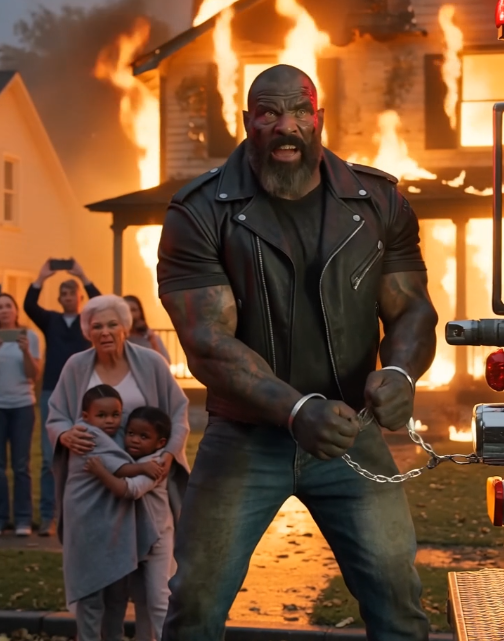
He didn’t make a sound.
He just put his face in his free hand.
The crowd on the sidewalk had gone completely silent. Nobody was booing now.
Tom looked at the man on the ground. He looked at the burned, bloody wrist in his cuff. He knew he should feel relieved.
He didn’t. He felt sick.
Three years ago, on a different street, in a different fire, he’d watched another roof come down.
That time, a man had been underneath it.
“Officer!” a voice yelled from the side yard.
A firefighter in full gear was coming around the corner of the burning house from the backyard. He was moving fast and carrying something in both arms.
It was small, brown, and scruffy. It was squirming.
It was a dog.
“Found him hiding under the deck out back,” the firefighter shouted. “He’s got smoke in his fur, but he’s fine. There’s a dog door off the kitchen. He must have gotten out on his own before any of us got here.”
The little girl on the lawn screamed.
“RASCAL!”
She jumped up, her blanket falling off. The firefighter set the dog down. It ran straight to her and her little brother and knocked them both flat on the grass, licking their faces.
The grandmother put her hands over her mouth and cried.
The crowd broke into applause.
Tom looked down at Grady Pennington.
The big man had lifted his head. He was watching the dog and the children through streaming, soot-black eyes.
Tom pulled his keys from his belt.
He knelt down and unlocked the handcuff. Then he sat down on the wet pavement beside him, his back against the fire engine.
For a long moment, neither of them said anything.
“I’m sorry,” Tom finally said. “About your wrist.”
Grady looked at the blood on his hand.
“You knew,” Grady said hoarsely. “About the roof.”
“I’ve seen that groan before,” Tom said quietly.
Then the paramedics were there. Grady tried to wave them off and started coughing so hard he couldn’t breathe.
They had an oxygen mask on him in ten seconds.
Part 3
Tom Reardon had been a Peoria police officer for nineteen years.
He knew Hollis Avenue. It was a tired working-class street of narrow rental houses. Most of the owners lived somewhere else and didn’t fix much.
He’d gotten the call at 9:24 p.m. Structure fire, possible occupants trapped. He was three blocks away and arrived before the fire engines.
By then, a huge man in a black leather jacket was coming out of the burning front door with a four-year-old boy in his arms.
The man set the boy on the lawn, fell to his knees coughing, and went right back in.
Tom shouted at him to stop.
The man didn’t hear him, or didn’t listen.
He came out a second time with a seven-year-old girl over his shoulder. Then he collapsed on the grass, retching smoke.
The fire engines arrived. The man went in a third time.
He came out with a seventy-eight-year-old woman in a nightgown. He was half-carrying her, half-dragging her. Her arm was around his neck, and both of them were coughing so hard they could barely stand.
That was when Tom learned the man’s name. The grandmother kept saying it.
“Grady. Oh, Grady. Oh, Grady.”
Grady Pennington lived three doors down. He was fifty-one, a master electrician, and an Army veteran. He rode with a motorcycle club called the Prairie Flame Riders. Neighbors said he kept to himself and fixed everybody’s porch lights for free.
After the third trip, he lay on the lawn for maybe twenty seconds.
Then he stood back up and looked at the house.
“Rascal,” the little girl was sobbing. “Where’s Rascal?”
Grady started back toward the door.
That was when Tom saw the roof.
The center of it was sagging. The shingles were bubbling. Smoke was pouring out of the eaves in thick black ropes, the way it does when the attic is fully involved and the trusses are burning through.
Tom had seen that before.
He’d yelled at Grady to stop. He’d grabbed his arm. Grady pulled loose like Tom was a child and kept going.
So Tom tackled him onto the grass and cuffed him to the nearest solid object he could find. It was the bumper of Engine 4.
Now, an hour later, Tom stood in the emergency department hallway at OSF Saint Francis Medical Center, waiting.
A nurse came out of a curtained bay.
“He’s got significant smoke inhalation,” she said. “We’re admitting him. A few days at least.” She hesitated. “His wrist will need stitches.”
Tom nodded.
Then his phone buzzed. It was his sergeant.
“Reardon,” the sergeant said. “Somebody put video of you cuffing that guy online. It’s everywhere. The chief wants you in his office at 8 a.m.”
Part 4
The video was forty-four seconds long.
It had been posted by a neighbor named Clyde Barrett at 10:15 p.m. By the next morning, it had two million views.
It showed a hero biker, black with soot, who had just carried three people out of a burning house. A cop slapped handcuffs on him and locked him to a fire truck. The biker begged to go back in for the family’s dog and fought until his wrist bled. The crowd booed. The cop stood there like a stone.
The video ended right before the roof collapsed.
Clyde Barrett’s caption read:
This is how Peoria PD treats a HERO. This man saved three lives and the cop chained him to a truck like an animal. I own that house and I’m DISGUSTED. #JusticeForGrady
Comments poured in by the tens of thousands.
Fire that cop.
Typical police. Punish the hero.
Find his name and address.
By 8 a.m., the Peoria police chief had placed Officer Tom Reardon on administrative leave pending an internal investigation for excessive force.
Tom sat in his truck in the station parking lot afterward and stared at the steering wheel.
Maybe they were right.
Grady Pennington’s wrist needed eleven stitches. Tom had done that. In front of the man’s neighbors and two children who had just watched him save their lives, Tom had chained him to a truck like a criminal.
What if the roof hadn’t fallen? What if the dog had still been inside, and Grady could have reached him? What if Tom had panicked because of what happened three years ago and taken it out on a good man?
His phone rang. It was a number he didn’t recognize.
“Officer Reardon?” a woman’s voice said. “This is Tanisha Jefferson. It was my house. My mother and my babies.”
Tom closed his eyes. “Ma’am, I’m sorry for—”
“Officer, I saw the video,” Tanisha said. Her voice was shaking. “And I saw who posted it.”
Tom frowned.
“Clyde Barrett,” she said. “He’s my landlord.”
Part 5
Tanisha Jefferson met Tom at a diner on Knoxville Avenue that afternoon.
She was thirty-two and still in her scrubs from a double shift at the nursing home. She’d been at work when the fire started. Her mother, Ida, had been watching the kids.
“Clyde Barrett has been my landlord for two years,” Tanisha said. “He owns eleven houses on Hollis and the streets around it.”
She pulled out her phone.
“Since August, I’ve texted him four times,” she said. “The outlets in the upstairs hallway were buzzing. The lights flickered. One outlet got so hot it melted a nightlight.” She showed Tom the texts. “And I told him the smoke detectors didn’t work. All three of them. The batteries were fine. They were just old.”
Tom read the messages.
Clyde Barrett’s replies were short.
I’ll send somebody.
Busy this week.
Stop texting me about this.
“Nobody ever came,” Tanisha said. “Except once. Grady.”
Tom looked up.
“Mr. Grady lives three doors down,” Tanisha said. “He’s an electrician. My mom asked him to look at the outlets in September. He came over and opened up the wall in the hallway.” She swallowed. “He said somebody had run an extension cord inside the wall to power the upstairs. Cheap cord, not real wiring. He said it was a fire waiting to happen. He wrote it down and told me to give it to the landlord.”
“Did you?”
“I gave Clyde the note myself,” Tanisha said. “He laughed at it. He said Grady was just a biker trying to drum up work.”
Tom sat very still.
“Last night, the fire started upstairs,” Tanisha said. “In the hallway. Right where Grady opened the wall.”
She wiped her eyes.
“And Officer, this morning Clyde called my insurance company,” she said. “He told them the fire started from my mother’s cigarettes. He’s saying it was her fault.” Her voice broke. “My mother hasn’t smoked in eleven years.”
Tom stared at her.
“Then why post the video?” he said slowly. “Why make me the villain?”
“Because everybody’s talking about you,” Tanisha said. “Nobody’s talking about him. And as long as they’re mad at the cop, nobody’s asking why my smoke detectors didn’t go off.”
Part 6
On Saturday, Tom Reardon went to see Grady Pennington in the hospital.
He wasn’t supposed to. He was on leave. He went anyway.
Grady was propped up in bed with an oxygen cannula in his nose. His right wrist was bandaged. His face was still pink and raw where the soot had been scrubbed off.
He looked at Tom in the doorway for a long moment.
“Come on in,” he said hoarsely.
Tom sat down in the plastic chair beside the bed.
“They put you on leave,” Grady said. “Saw it on the news.”
“Yeah.”
“For saving my life.”
“For handcuffing a hero in front of two million people,” Tom said.
Grady was quiet. Then he held up his bandaged wrist.
“You said you’d seen that roof before,” he said. “Tell me.”
Tom looked at the floor for a long time.
“Three years ago,” he said, “house fire on Malone Street. A man named Danny Lucero got his wife and two kids out. Then he turned around to go back in for the family dog.” He swallowed. “I was there. I grabbed his arm. I yelled at him that the roof was going. He shook me off. I let go.”
Grady didn’t say anything.
“The roof came down ninety seconds later,” Tom said quietly. “He was in the upstairs hallway. They found him next to the dog’s bed. The dog had gotten out through the back.”
The room was silent except for the beeping of the monitor.
“Danny had a nine-year-old son,” Tom said. “He stood on the lawn and watched. I was holding him back by the shoulders.” His voice cracked. “I’ve thought about it every day for three years. That I let go of his dad’s arm.”
He looked up at Grady.
“I wasn’t going to let go of yours,” he said.
Grady Pennington looked at him for a long time.
Then he reached over with his good hand and gripped Tom’s forearm.
“You did right,” Grady said. “You hear me? You did right.”
Tom couldn’t speak.
Then someone knocked on the doorframe.
A wiry man in his forties stood there in paint-stained work clothes, holding a ball cap in both hands.
“Mr. Pennington?” he said nervously. “My name’s Rudy Alvarez. I do maintenance for Clyde Barrett.” He looked at the floor. “I’m the one who ran that cord through the wall.”
Part 7
Rudy Alvarez sat on the edge of the second hospital bed and told them everything.
“Clyde bought those eleven houses cheap four years ago,” he said. “Most of them still have old wiring from the fifties. Doing it right costs eight, ten thousand dollars a house.” He twisted his cap. “He told me to just make it work. Extension cords in the walls. Splices behind the drywall. Whatever was cheapest.”
“Smoke detectors?” Tom asked.
“He told me not to replace them unless the city inspector was coming,” Rudy said. “He said the old ones would pass if you pushed the button.”
Grady closed his eyes.
“When your note came in,” Rudy said to Grady, “Clyde showed it to me. He laughed. He said, ‘Biker wants to get paid.’ Then he told me to forget it.”
“Why are you telling us now?” Tom asked.
Rudy pulled out his phone.
“Because last night, Clyde called me,” he said. “Told me to go to the Jefferson house before the fire marshal gets there Monday. Pull what’s left of the cord out of the wall and throw it away.” His hands were shaking. “And then I saw the little girl on the news hugging her dog.”
He held out the phone. There was a voicemail from Clyde Barrett, timestamped 11:42 the night before.
Rudy. Get over to Hollis before Monday. Pull that cord out of the hallway wall. All of it. Nobody needs to see that. The old lady smoked. That’s the story.
Tom took the phone very carefully.
“Rudy,” he said, “would you give this to the fire marshal?”
“Already called him,” Rudy said. “He’s meeting me at the house at four.”
At four o’clock, Illinois State Fire Marshal investigator Karen Doss walked through what was left of the Jefferson house on Hollis Avenue with Rudy Alvarez.
In the charred upstairs hallway, exactly where Grady Pennington had opened the wall in September, she found the melted remains of a cheap extension cord. It was stapled behind the drywall and spliced into the old wiring with electrical tape.
She found the three smoke detectors. None had a working sensor.
She found no evidence of cigarettes anywhere in the house.
By Monday afternoon, the fire marshal’s preliminary report was public.
Cause of fire: improper and illegal electrical wiring installed inside wall cavity. Smoke detection devices nonfunctional.
That evening, Peoria police arrested Clyde Barrett at his home on the north side of town.
Part 8
A week later, Grady Pennington was discharged from the hospital.
The Jefferson family was waiting in the lobby.
Kendra ran to him first. DeShawn came stumbling after her. Rascal pulled at his leash so hard that Miss Ida, walking slowly with a cane, nearly let go.
Grady got down on one knee in the hospital lobby. He let two children and a scruffy dog knock him onto the floor.
“Mr. Grady,” Kendra said seriously, once she could talk. “Rascal says thank you.”
“Tell Rascal he’s welcome,” Grady said. “And tell him next time, use the dog door first.”
Kendra giggled.
Miss Ida stood over him and put her hand on his gray head.
“Three times,” she said quietly. “You came back for us three times.”
“Would’ve been four,” Grady said.
“I know,” Miss Ida said. “Thank God for that policeman.”
Two weeks later, the Peoria Fire Department held a ceremony at Central Fire Station.
Grady Pennington was awarded the department’s Medal of Valor for a Civilian, the highest honor it gives to anyone outside the department.
The station was packed. Thirty members of the Prairie Flame Riders stood in the back in their black leather jackets. The Jefferson family sat in the front row. Rascal had a red bandana around his neck.
Tanisha’s insurance company had already reversed its decision. The claim was paid in full. Clyde Barrett was out on bond, facing charges of reckless conduct, obstruction of justice, and nine counts of building code violations. Investigators found the same illegal wiring in all eleven of his houses.
The police department’s internal investigation had concluded three days earlier. It found that Officer Tom Reardon had acted “reasonably and appropriately to prevent the imminent death of a civilian.” He was returned to duty.
He stood quietly in the back of the room in uniform, beside the bikers.
The fire chief pinned the medal on Grady’s leather jacket.
“Mr. Pennington,” the chief said, “would you like to say a few words?”
Grady stepped to the microphone and looked out at the crowd.
“Before anything else,” he said, “I need to thank somebody.”
He pointed to the back of the room.
“The man who handcuffed me.”
Part 9
Every head in the room turned.
Tom Reardon stood frozen against the back wall.
“Officer Tom Reardon,” Grady said. “Three weeks ago, two million people watched a video of him chaining me to a fire truck. They called him a coward. They called him a bully. They wanted him fired.”
He held up his right wrist. A long pink scar ran across it.
“I fought him so hard I tore my wrist open,” Grady said. “And he didn’t let go.” He paused. “Thirty seconds later, that roof came down right where I’d have been standing.”
The room was silent.
“I wouldn’t listen to words,” Grady said. “He knew that. So he used steel.” He looked straight at Tom. “Three years ago, he let go of a man’s arm at a fire on Malone Street. He’s carried that every day since. And when it was my turn, he held on.”
Somebody in the crowd started to cry.
“I’m alive because a cop was willing to be hated,” Grady said. “Come up here, Tom.”
Tom walked slowly to the front of the room.
Grady took the medal off his own jacket and pinned it on Tom’s uniform.
The room stood up.
Here’s how the rest of it went.
Clyde Barrett pleaded guilty to reckless conduct, obstruction of justice, and building code violations. He was sentenced to two years in prison. The city forced him to sell all eleven of his rental properties. The new owner rewired every one of them before a single tenant moved back in.
Rudy Alvarez testified against him and received immunity. Grady hired him the next month as an apprentice electrician.
The Prairie Flame Riders raised money for new smoke detectors. Then they spent four Saturdays going door to door on Hollis Avenue and the streets around it. They installed six hundred and twelve smoke detectors in rental houses for free.
Kendra helped hand them out. She wore a red bandana that matched Rascal’s.
Tanisha and her family moved into a rewired house on Hollis Avenue, two doors down from Grady.
The police chief asked Tom Reardon to teach a new training course for every officer in the department. It covers recognizing structural collapse at fire scenes, and when to physically stop civilians from going back in.
He calls it “Ninety Seconds.”
Last spring, a young man came to one of Tom’s training sessions as an observer. He was twelve and sat in the back of the room with his mother.
His name was Luis Lucero. His father, Danny, had died in the fire on Malone Street three years earlier.
After the session, Luis walked up to the front of the room.
“Mom said you tried to hold my dad back,” he said quietly. “That day.”
Tom couldn’t answer.
Luis looked at the scar on Grady’s wrist. Grady was sitting in the front row. Then he looked back at Tom.
“I’m glad you held on to him,” Luis said, nodding at Grady. “Maybe next time, you’ll hold on to somebody else’s dad too.”
Tom Reardon knelt down and hugged the boy whose father he couldn’t save. Behind them, a huge biker with a scar on his wrist stood up and put his hand on both their shoulders.
People see a cop chain a soot-covered hero to a fire truck, and they decide he’s a monster before the cuff clicks shut. A whole street booed him. Two million strangers called for his badge. Clyde Barrett was the one who stuffed a cheap cord inside a wall and let the smoke detectors die. Sometimes the person everyone is screaming at is the only one holding on to you while you fight to die for something you love.
If this story stayed with you, follow our page. We share stories like this one every week, about the people who hold on when it matters most. And tonight, push the button on your smoke detectors. Make sure they still work.