She Thought the Biker Was Following Her Home—Until She Heard the Name He Whispered in the Dark
“Keep driving if you want—he’s two cars behind you,” the biker shouted across the gas station lot, revving his engine as a terrified young woman froze under the white lights and everyone around them assumed he was the threat.
At 1:17 a.m. on a wet Thursday in Dayton, Ohio, the city looked half-abandoned and half-awake, which was the most dangerous kind of hour for a woman leaving work alone.
The diner sat off Smithville Road, bright and tired under humming fluorescent lights, with a cracked neon sign that buzzed over the parking lot and threw red streaks across the puddles. Most nights, Emily Harper liked that kind of silence. It meant the rush was over. It meant the drunks had been fed, the coffee pots were clean, and all she had to do was count her tips, lock her car, and get back to the duplex she rented with a coworker on the east side.
That night, the silence felt wrong before she even stepped outside.
She noticed the motorcycle first.
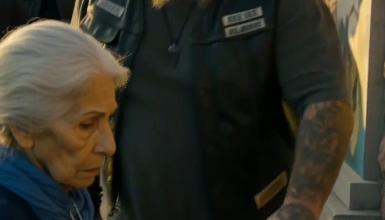
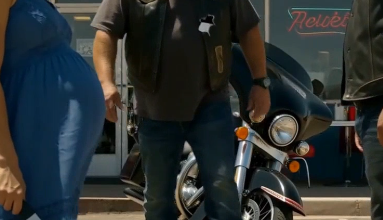
It was parked across the street under the dead glow of a laundromat sign, black and heavy and motionless, with a man sitting on it like he had nowhere else to be. He was big enough to make the bike look smaller than it was. Sleeveless leather jacket. Broad shoulders. Dark beard streaked with gray. Tattooed forearms. Helmet hanging from the handlebar instead of on his head, which somehow made it worse. He wasn’t smoking, wasn’t scrolling, wasn’t doing anything people do when they’re waiting normally.
He was just watching.
Or at least that was how it felt.
Emily stopped with her keys halfway to the car door.
Tasha, one of the cooks, came out behind her carrying a trash bag and followed Emily’s stare. “Nope,” she said instantly. “Absolutely not.”
“What?”
“That guy. He’s been there twenty minutes.”
Emily looked again. The biker didn’t wave. Didn’t move. Didn’t even try to look casual.
“Maybe he’s waiting for somebody.”
Tasha snorted. “At one in the morning? Outside a diner and a closed laundromat?”
A pickup rolled by and sprayed dirty water across the curb. The biker still didn’t move.
Emily felt something small and cold tighten low in her stomach.
She had noticed him once before.
Not clearly. Just enough. Two nights earlier, when she stopped for gas after her shift, she had heard the same low engine somewhere behind her on Wayne Avenue. The night after that, she had caught a black motorcycle reflected in the dark glass of a pharmacy window two blocks from her street. She had told herself it was coincidence because the alternative sounded dramatic, and dramatic gets women laughed at until something happens to them.
Now he was here again.
Tasha dropped the trash harder than necessary into the dumpster. “You want me to call Calvin?”
Calvin was the day manager’s cousin, six foot four and eager for trouble in ways that made Emily nervous for completely different reasons.
“No,” Emily said too quickly.
Inside the diner, two remaining customers had also noticed. An older couple near the window turned in their booth to stare openly. The husband shook his head in that familiar way men do when they’ve already decided the headline. A younger guy at the register smirked and lifted his phone like he might start filming if things got interesting enough.
Emily hated that more than the fear itself. That instant public curiosity. That feeling that if something bad happened, it would become entertainment before it became help.
The biker finally kicked his engine alive.
The sound ripped across the lot.
Tasha cursed under her breath. “Get back inside.”
Emily did. Fast. The bell above the diner door snapped behind her, and the shift manager, Rosa, looked up from the register with immediate alarm.
“What happened?”
Tasha pointed through the glass. “Some biker’s been sitting out there watching Emily.”
Rosa came around the counter. Fifty-three, Puerto Rican, no patience left for nonsense from men or weather or suppliers. She took one look outside and narrowed her eyes. “Call non-emergency.”
“Maybe it’s nothing,” Emily said, though her voice had already betrayed her.
Rosa gave her a flat look. “It stopped being nothing when you said maybe.”
Across the lot, the biker rolled forward ten feet and stopped under a streetlamp. Rainwater glittered on his sleeves—what little fabric there was—and on the metal of the bike. He kept his face turned toward the road, not the diner now, but that somehow made him seem even more deliberate.
The younger customer by the register craned his neck and grinned. “Guy looks like a serial killer.”
Rosa snapped, “Then stop admiring him and pay for your pie.”
That got a nervous laugh. Brief. Thin. No one really relaxed.
Emily’s phone buzzed in her apron pocket. A text from her roommate, Kendra.
You leaving soon?
Emily typed back: Yeah. weird situation outside.
Then erased it.
Then typed: Few more mins.
Because once you tell people you’re scared, it becomes real in a new way.
Outside, a dark sedan turned slowly off the road and idled near the lot entrance without coming in. Emily barely noticed it at first. Just another late-night car with dim headlights and too much patience. But when the biker shifted on his seat and turned his head toward that sedan instead of the diner, something changed in the air.
Subtle. But real.
He wasn’t watching her now.
He was watching them.
Rosa noticed too. “Who’s in that car?”
No one answered.
The sedan stayed where it was.
Then the biker dismounted.
That was when the whole place tipped.
The older man at the booth stood up halfway. The younger customer actually started filming now. Tasha swore and moved in front of Emily instinctively. Rosa grabbed the cordless phone and said, already speaking to dispatch, “I need someone at Mel’s Diner on Smithville. Right now.”
The biker took three slow steps into the edge of the lot, eyes fixed on the sedan. Big man. Controlled. No rush in him at all.
Then he looked toward the diner door and said, not loudly but clearly enough for Emily to hear through the glass:
“Don’t let her leave alone.”
The entire diner went still.
Because there it was.
Not a denial. Not an explanation. Just one sentence that made him sound worse, not better. Like he knew exactly who she was. Like he had already decided she was part of whatever this was.
And across the entrance, the sedan’s headlights clicked off.
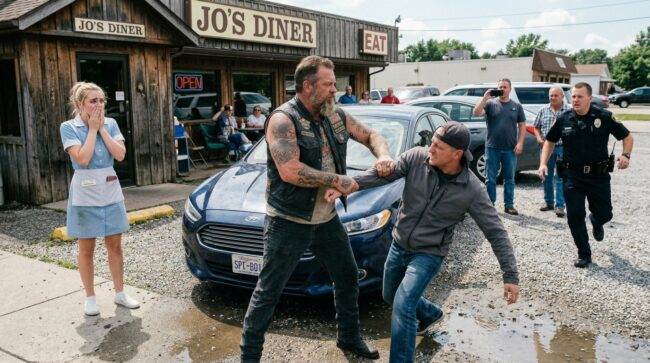
Nobody in the diner thought the biker was helping.
Not at first.
Why would they? He looked like trouble given shape. Forty-five, maybe fifty. White, weathered, built like a man who worked with his hands or had spent years making sure people backed up when he entered a room. His leather jacket had the sleeves cut short at the shoulders, exposing heavy tattoo work down both arms. He carried himself with an eerie stillness, the kind that feels more threatening than aggression because it suggests control.
The older woman from the booth clutched her purse to her chest. “He knows her.”
Her husband muttered, “I told you. He’s been waiting.”
The guy filming whispered, almost excited now, “This is crazy.”
Emily hated the tremor that ran through her hands. She shoved them under her arms and stared through the rain-striped glass. The biker had moved farther into the lot, not toward the diner but slightly sideways, cutting off the cleanest line from the entrance to the street. The sedan still idled at the curb like it had all the time in the world.
Rosa kept one hand on the phone and the other on the deadbolt, as if she could physically hold the whole night in place long enough for somebody official to fix it.
“Emily,” she said without turning, “has anyone been bothering you lately?”
Emily almost said no.
Then she remembered the man from Monday.
Not the biker. Another one.
A regular she didn’t really consider a regular because he never ordered much and never smiled right. Mid-thirties, baseball cap pulled low, clean work boots, jacket zipped to the throat. He had started showing up near closing over the past two weeks, always taking the same booth, always leaving exact change, always asking harmless questions in a voice too soft to challenge.
You heading straight home after this?
You always work Thursdays?
That your car out front?
At the time, each question had felt too small to name as a threat. Together, standing here now, they made her skin crawl.
“There was a guy,” she said slowly. “At the diner. A few times.”
Rosa turned to look at her fully.
“What guy?”
“I don’t know. Brown cap. Gray jacket. He kept asking stuff.”
Tasha’s face changed. “Why didn’t you say that?”
Emily gave the only answer women ever really have for questions like that. “Because it sounded stupid until now.”
Out in the lot, the sedan door opened.
A man stepped out.
Even through rain and distance, Emily recognized the baseball cap first.
Her mouth went dry.
“That’s him.”
Tasha spun. “What?”
“That’s him,” Emily said again, quieter. “From the booth.”
Rosa spoke sharply into the phone. “Update that. The man has exited the vehicle.”
The guy filming near the register stopped smiling.
For the first time, the room’s attention shifted off the biker and onto the sedan.
But not all the way.
Because the biker was moving now too.
He walked toward the man in the cap with measured steps, putting himself between the sedan and the diner entrance. No running. No grand gestures. He looked like a man crossing a street. That was what made it so unnerving. He moved with the calm of someone who had expected this exact moment.
The man in the cap called something out, but the glass swallowed the words.
The biker didn’t answer.
The man took another step.
The biker took one too.
Then the cap-wearing man changed direction and started toward the side of the diner instead, toward the darker strip near the dumpsters where the security light had been flickering for weeks.
“Why is he going that way?” the older woman whispered.
Because that side door didn’t always latch right, Emily thought, and a fresh pulse of terror hit her so fast she had to catch the counter.
Rosa saw it in her face. “Back room. Now.”
“No,” Emily said.
It surprised all of them.
Even her.
But if she disappeared now and the biker really was part of this somehow, if the police arrived to find only moving parts and no witness who could say what she’d seen, the whole thing could blur into somebody else’s version by morning.
So she stayed.
The man in the cap reached into his pocket.
Three people screamed at once.
The guy with the phone shouted, “He’s got something!”
The older man ducked behind the booth. Tasha pulled Emily down instinctively. Rosa cursed into the receiver. And outside, the biker moved for the first time with actual speed.
He cut across the lot, grabbed the stranger’s forearm, and slammed it flat against the hood of the sedan.
Not a punch. Not a wild attack.
A controlled stop.
The object in the man’s hand clattered onto the wet asphalt.
Not a weapon.
A key ring.
That should have relieved everyone.
It didn’t.
Because now it looked even more chaotic. Worse, in a way. One large biker pinning a man to a car in the middle of a nearly empty lot while a terrified waitress watched from behind locked glass. If you arrived at that second, you would assume the biker was the danger.
The cap-wearing man twisted and shouted. The biker said something low in his ear.
The man froze.
Then the stranger looked toward the diner window.
Toward Emily.
And smiled.
It was not a big smile. That was what made it terrible. It was small, private, almost amused, as if he knew something nobody else in that parking lot knew yet.
A patrol car turned into the entrance at that exact moment, lights washing blue across the rain and glass and chrome.
The younger customer let out a shaky breath. “Thank God.”
Maybe.
Maybe not.
Because when the officer stepped out and saw the biker restraining the man, his hand went straight to his belt.
And the first person he ordered to the ground was not the one Emily had been afraid of.
It was the biker.
Everything became noise after that.
Rain ticking on metal. The engine of the motorcycle still rumbling low. Rosa talking too fast. The older woman crying now for no clear reason except nerves. The police radio crackling. The officer shouting commands that made everyone in the diner flinch even through the glass.
“On your knees! Hands where I can see them!”
The biker did not argue.
That was the unsettling part.
He let the stranger go, stepped back, and lowered himself slowly onto one knee on the wet pavement with both hands lifted away from his body. It was the cleanest compliance Emily had ever seen, which somehow made him seem more dangerous, not less. Like this was familiar. Like men who live close to violence learn exactly how to stand when they don’t want to be shot.
The man in the cap stumbled sideways, clutching his wrist theatrically. “He attacked me,” he shouted. “I was just asking if she needed help.”
Emily actually laughed once, sharp and disbelieving, before fear closed over her again.
The officer kept his attention mostly on the biker.
“Do not move.”
The biker didn’t.
Water ran off his beard. His tattoos gleamed dark under the patrol lights. His gaze flicked once—only once—toward the diner door, and Emily felt the strange sick certainty that he was checking whether it was still locked.
A second patrol car pulled in. Then a third vehicle from private security, likely from the strip mall two doors down. Too many people. Too much authority arriving in fragments. That was how nights turned wrong.
Officer number two moved toward the stranger in the cap.
“What happened?”
“That psycho grabbed me for no reason,” the man said, breathless and eager. “He’s been stalking her. Ask anybody.”
Inside the diner, several heads turned reflexively toward Emily.
Because that was the story, wasn’t it?
The biker had been there before. The biker had watched. The biker had followed. Everyone had seen that part.
The cap-wearing man was ordinary enough to be believable. Clean jacket. No visible tattoos. No loud engine. He looked like someone a tired officer might instinctively trust for the first sixty seconds, and sometimes sixty seconds was enough to do lasting damage.
Officer one reached for cuffs.
Emily’s pulse kicked hard.
“No,” she said.
Nobody heard her.
She tried again, louder this time. “No!”
Rosa unlocked the door before anyone could stop her. “Emily—”
But Emily was already outside, cold rain hitting her face in one flat slap, sneakers splashing through shallow water as half the parking lot shouted at her to get back.
“That’s not him,” she yelled.
Everything paused just enough for it to matter.
The officer with the cuffs looked at her. “Ma’am, step back.”
“That’s not him,” Emily repeated, pointing—not at the biker, but at the man in the cap, whose expression changed too slowly to hide it. “He’s the one who’s been inside the diner. He’s the one asking questions.”
The man barked a laugh. “You don’t even know my name.”
“No,” Emily shot back, shaking now, “but you know where I park.”
That line changed the officer’s face.
Small shift. But real.
The cap-wearing man saw it too. He took one careless half-step backward, then another, recalculating in plain sight. Security noticed. So did the biker, still kneeling, still silent, hands spread in the rain.
Officer two moved in. “Sir, keep your hands visible.”
“I haven’t done anything.”
“Then show me your pockets.”
The man hesitated.
There it was again. That same hard knot of almost-certainty.
The officer stepped closer.
And that was when the biker finally spoke.
Only four words.
“Check the trunk first.”
Everyone looked at him.
The officer holding the cuffs looked irritated. “You don’t get to direct this scene.”
The biker lifted his chin slightly toward the sedan. “Then lose the next thirty seconds.”
Something in his tone cut through the chaos. Not panic. Not ego. Urgency without performance.
The cap-wearing man bolted.
Not far.
Officer two caught him against the passenger door before he made three full strides, and the lot erupted again—shouting, shoes slipping, a security guard swearing, Tasha screaming from the doorway for Emily to get inside. The older woman in the diner sobbed louder. The younger man resumed filming because of course he did.
Officer one stayed with the biker a second longer, indecisive now.
Then he signaled to the other unit.
“Pop the trunk.”
The rain seemed to get louder as they moved.
Emily stood halfway between the diner and the patrol car, soaked through, breathing so hard her ribs hurt. The biker remained on one knee in the water, head slightly bowed, as if he didn’t care what anyone thought of him as long as they opened that car.
The officer reached for the sedan.
The latch clicked.
And just before the trunk lifted, Emily saw something small and pale caught in the biker’s gloved hand near the pavement—something he must have picked up in the struggle, something thin enough to be a receipt or folded paper, already running with rain.
He looked down at it once.
Then up at her.
And for the first time all night, she saw grief on his face instead of menace.
The trunk began to rise.
The trunk lifted three inches, then stopped against the pressure of something packed badly inside.
Officer Keating swore under his breath and forced it higher.
At first, nobody understood what they were looking at.
Not because it was hidden well. Because the mind rejects certain images when they appear in the wrong place.
A folded gray blanket. Duct tape. A heavy flashlight. Two bottles of water. A canvas tool bag. Zip ties. A spare license plate. And on top of all that, half tucked beneath a sweatshirt, a printed stack of pages sealed inside a plastic sleeve to keep them dry.
The parking lot went so still that even the diner’s neon hum seemed loud.
Officer Keating reached in carefully and pulled the sleeve free.
Emily didn’t need to see the pages clearly. She knew before he turned the first one.
They were photos.
Her leaving the diner.
Her at the gas station three nights ago.
Her carrying groceries up the porch steps to the duplex.
Her unlocking her car from across the street.
There were times printed at the bottom. Dates. Notes in pen.
One page slipped loose in the rain and plastered against the wet asphalt near Emily’s shoe. On it, under a grainy photo of her outside the laundromat, one sentence had been written in block letters:
THURSDAY—ALONE AFTER 1:00 A.M.
Rosa made a sound Emily would remember for years, somewhere between rage and prayer.
The younger officer grabbed the man in the cap by both arms and shoved him against the sedan harder this time. No more caution. No more benefit of the doubt.
“Hands behind your back.”
“I can explain that.”
“No,” Officer Keating said, voice gone flat and deadly in the way only professional voices can go. “You really can’t.”
The man twisted once, uselessly. “Those aren’t illegal.”
The words hit the lot like filth.
Emily’s stomach turned. For one sick second she thought she might actually collapse right there in the rain beside her own photographs.
Then she remembered the biker.
He was still on one knee.
Still cuff-free, but not yet cleared. Rain ran off his shoulders and darkened the leather across his back. In his gloved hand, he still held that small wet scrap of paper he had found during the struggle.
Officer Keating looked from the trunk to the biker, recalculating fast now, angry at himself and too trained to show it fully.
“What paper is that?”
The biker didn’t rise. He held it out between two fingers.
Keating took it.
It was a receipt from the diner, softened nearly to pulp by rain and handling, but one thing on it was still readable. A handwritten note beneath the printed total:
Blue Hyundai. Plate ends 417. Wait until she leaves.
Emily stopped breathing.
“That’s my car,” she whispered.
Rosa turned toward the window of the diner as if she might see the Hyundai from there, as if checking that it was still real.
The man in the cap shut his eyes once. Tiny movement. Fatal.
Officer Keating gave the receipt to the second officer without comment. Then he looked down at the biker.
“You found this when?”
“On the ground by his hand,” the biker said.
It was the first time Emily had heard his voice without an engine under it or fear around it. Low. Tired. Controlled.
Keating nodded once. “Stay where you are.”
The biker almost smiled at that. Not mockingly. More like a man who understood procedure better than most civilians and had expected nothing less.
The strip-mall security guard, who had been useless until then, hovered near the diner entrance and asked no one in particular, “Did he know?”
Nobody answered him.
Because that was the question now, hanging in the rain.
How much had the biker known? And how?
Emily stared at him while the officers secured the suspect, photographed the trunk, called for detectives, and suddenly treated the scene with the kind of gravity it should have had from the beginning. The biker finally shifted his weight and stood only when Keating told him he could.
He was taller than she had realized.
Not huge in the theatrical way people describe intimidating men. Just solid. Mid-to-late forties. White. Weathered by outdoor work or long roads or both. His beard was darker than she first thought, only touched with gray at the chin. His sleeveless leather jacket was old, not styled. Functional. Under it, a plain black thermal shirt. The tattoo on his right forearm disappeared under a worn leather cuff that looked like it had been repaired by hand.
Emily should have felt relief first.
Instead, she felt confusion sharpen into something stranger.
Why had he been there before the man arrived?
Why had he watched the road instead of her?
Why had his face changed when the trunk began to open?
And why, even now, did he look less triumphant than burdened?
The detectives came fast once they heard what was in the trunk.
One of them, a woman in a wool coat thrown over plainclothes, took Emily inside the diner and sat her in the last booth by the coffee station while uniforms moved in and out of the rain outside. Tasha pressed a mug of hot water into her hands because tea took too long. Rosa paced near the register with the violent stillness of someone containing a future breakdown by scheduling it for later.
Through the fogged glass, Emily could still see the biker.
He didn’t leave.
He stood near his motorcycle with his helmet hanging from two fingers, answering questions without drama. No animated gestures. No attempts to insert himself into the center of the story. He seemed determined, if anything, to take up less space than his body naturally did.
Detective Lena Walsh asked Emily to start from the beginning.
Not tonight. The beginning.
So Emily did.
The diner questions. The gas station. The pharmacy reflection. The sense of being watched. The effort it took to dismiss each piece because each piece alone sounded too small. Walsh took notes without interrupting, except once.
“When did you first notice the biker?”
Emily looked toward the window.
“Two nights ago. Maybe three. Same black motorcycle. Same engine.”
“Following you?”
“I thought so.”
“Now?”
Emily tightened both hands around the mug. “I don’t know what to think.”
That was honest. She stayed there.
Outside, the officers opened the suspect’s glove box and bagged whatever they found inside. The man in the cap was in the back of a cruiser now, face pale and furious in alternating flashes of blue light.
Walsh followed Emily’s gaze. “Do you want to know why the biker was there?”
“Yes.”
Walsh glanced at a uniform near the door, then stood. “Stay here.”
She returned three minutes later with a folded business card and a look Emily couldn’t quite read.
“He says his name is Nathan Crowe,” Walsh said. “Forty-eight. Lives in Kettering. No active warrants. No gang flags. Prior military. Commercial tow operator now.”
Emily frowned. “Why was he following me?”
Walsh didn’t answer immediately. She set the business card down instead.
It was from a towing company Emily had never used.
On the back, written in careful block printing, was an address she knew by heart.
Her duplex.
Beneath it, another line:
Ask her about Laura Harper.
Emily looked up too fast. “That’s my mother.”
Walsh studied her. “Mr. Crowe asked if your mother’s maiden name was Laura Bennett Harper. He was very specific.”
Emily went cold in a completely different way.
“Yes.”
Walsh leaned back slightly. “He says he knew her.”
Emily almost laughed from the shock of it. “My mom died when I was nine.”
“I know.”
“No, I mean—how would he know that?”
“He hasn’t explained much. Yet.”
That “yet” carried weight.
Walsh slid the business card closer. “He saw the man in the cap in your diner earlier this week. Then again near your street. He says the man took photos from a parked car. Crowe ran the plate through a friend in repossession and got a false registration hit. He thought it was bad enough to keep watching until he knew more.”
“That’s insane.”
Walsh gave the slightest shrug. “Maybe. But so far his version keeps matching the evidence.”
Emily stared at the name on the card.
Nathan Crowe.
It meant nothing to her.
Then almost nothing became something.
Not a memory, exactly. More like a forgotten shape in an old room.
A motorcycle sound outside their apartment when she was little. Not often. Once in a while. Her mother checking the blinds and relaxing instead of panicking. A tall man leaving a grocery bag on the porch one winter after Emily had the flu. Her mother saying, almost absentmindedly, “Nate doesn’t stay for thanks.”
The memory came back incomplete and all at once.
Emily looked at Walsh. “Wait.”
Walsh’s eyes sharpened.
“My mom knew someone named Nate.”
Outside, the biker lowered his head slightly while Officer Keating handed him something—probably his ID back. He didn’t pocket it right away. He just held it, as though he had expected this night to cost him more than paperwork.
Walsh nodded slowly. “That would fit.”
Emily’s voice dropped. “Why didn’t he just tell me?”
“Maybe because a large man on a motorcycle telling a woman he’s been watching her for her own safety sounds terrible, even when it’s true.”
That was fair. Emily hated that it was fair.
Walsh looked back toward the lot. “He also said something else.”
“What?”
“He said if he used your mother’s name too early, you’d either panic or think he was lying.”
Emily swallowed.
That was also fair.
The deeper twist arrived quietly, which made it hurt more.
Not from the biker.
From Rosa.
The detective stepped away to take a call, and Rosa finally stopped pacing long enough to sit across from Emily in the booth. She looked older than she had an hour earlier.
“Your mother used to work nights too,” Rosa said.
Emily blinked. “You knew her?”
Rosa gave a tired half-smile. “Not well. Enough.”
That made no sense. Rosa had owned the diner for twelve years. Emily had only worked there eighteen months. Her mother had died long before that.
Rosa saw the confusion.
“This place used to be Harper’s Grill,” she said softly. “Different sign. Same building. Your mother waitressed here when she was pregnant with you.”
Emily stared.
The room seemed to narrow around the words.
“I didn’t know that.”
“Because nobody tells young people the parts of their parents’ lives that were heavy before they were old enough to carry them.”
Rosa looked toward the rain-dark window, toward Nathan’s silhouette beyond it.
“Your mother had a brother,” she said. “Michael Bennett. Army. Came home wrong. Good heart. Bad injuries. Bad pills. Worse company. Nate Crowe rode with him for a while after service. Not club nonsense. Just veterans who kept an eye on each other.”
The small memory in Emily’s head widened.
A garage smell. Her mother laughing once at the doorway with a man she called Mickey. A biker helmet on a kitchen chair. A Christmas gift with no tag.
Rosa continued, each sentence careful. “Your uncle got mixed up with a man who liked control. Small scams. Then bigger ones. The kind that start with favors and end with women getting followed to ATMs or leaned on for money. Your mother testified in one case after Michael died.”
Emily’s throat tightened. “Michael was my uncle?”
Rosa nodded.
“He was killed in a single-vehicle wreck in 2004. That’s the version you were probably given because you were a child. The fuller version was uglier. He was running scared from men he owed. Your mother spent years making sure none of them came near you.”
Emily could barely hear her own breathing.
“And Nate?” she asked.
Rosa’s voice dropped lower. “Nate pulled your mother out of one bad night behind this very building when one of those men waited for her after close. He got there in time because Michael had begged him, before he died, to watch out for Laura if things ever circled back.”
The diner seemed to tilt.
Not because it was unbelievable. Because it was too believable. Too ordinary in the saddest American way. Debts. Men. Fear. Half-buried family history sold to children later as “an accident” because grief gets edited for survival.
Rosa wiped at one eye angrily. “Your mother hated needing help. But she trusted him. Only him.”
Emily looked through the glass at Nathan Crowe again.
He stood alone by the motorcycle, rain dripping from his cuff, head turned slightly away from the cruiser where the suspect sat. Not victorious. Not relieved. Just tired in a way that suggested he had been keeping a promise longer than most people kept marriages.
The final twist landed a minute later when Detective Walsh returned holding a second evidence bag.
Inside was a photograph, older than the others. Faded. Creased.
She set it on the table.
Emily leaned forward.
In the picture, a younger Laura Harper stood outside the original diner sign, holding a toddler on one hip—Emily, maybe two years old. Beside them, half turned away from the camera as if he hadn’t wanted to be in it, stood a younger Nathan Crowe in a denim vest, no beard yet, one hand on a motorcycle helmet. And crouched in front of them, grinning recklessly at the lens, was a man Emily had seen only once before in a box of family photos no one ever explained.
Michael Bennett.
On the back, in Laura’s handwriting, were the words:
For the two men who promised she’d grow up untouched by our mistakes.
Emily covered her mouth.
Walsh spoke gently. “The suspect in the cruiser? He’s the son of one of the men your mother testified against. Different last name now. Records just came back. He’s been asking about your family for months.”
Emily couldn’t speak.
The rain outside kept falling.
Nate Crowe had not been following her because he was a stranger.
He had been following her because twenty years earlier, he had given a dead man and a frightened woman his word.
And he had kept it long after either of them could thank him.
By the time the detectives finished, it was nearly three in the morning.
The rain had softened to mist. The patrol cars were still there, but quieter now, the urgency drained out of the scene and replaced with the dull, administrative aftershock that follows terror once it has finally chosen a shape.
Emily stepped outside wrapped in Rosa’s spare cardigan.
Nate was at his bike, tightening the strap on a worn duffel as if he had somewhere ordinary to be next. He looked up when the diner door opened, then waited without moving toward her.
Up close, under calmer light, he seemed less frightening than exhausted. The lines at the corners of his eyes were deeper than she expected. There was a white scar near his left thumb. His beard had rain still caught in it.
Emily stopped a few feet away.
“You knew my mother,” she said.
He nodded once.
“For how long?”
“Long enough.”
That almost irritated her. Then she realized it was the kind of answer a man gives when the full one contains too many dead people.
“She never told me much about that time.”
“She wouldn’t.”
“Why not?”
Nate glanced toward the street, then back at her. “Because she wanted your childhood cleaner than hers.”
There was no poetry in the line. That was why it stayed.
Emily folded her arms inside Rosa’s cardigan. “You could’ve just told me.”
“I could’ve.” He looked at the diner window, the police tape near the sedan, the dark lane by the dumpsters. “You probably wouldn’t have believed me.”
She thought of the first sight of him across the street. The leather. The engine. The stillness. The panic.
“No,” she admitted. “I wouldn’t have.”
He accepted that without injury.
From the cruiser, the suspect shouted something ugly no one bothered to answer.
Nate reached into his jacket pocket and pulled out a small object wrapped in a dry shop rag. He held it out.
Emily took it carefully.
Inside was a silver key on a faded leather fob, worn smooth with age. Stamped into the leather were the initials L.H.
“My mother’s?”
Nate nodded. “Apartment key. She gave it to me once when you were sick and she got stuck here on a double. Told me if anything ever happened, I was to get you out first and argue later.”
Emily stared at it.
“She never asked for it back?”
“She forgot.” A small pause. “I didn’t.”
That nearly broke her.
Not in the dramatic way stories like to describe. No sudden collapse. No speech. Just a quiet, involuntary bend in the body, as if grief had reached inside her knees and loosened something.
Nate looked away while she recovered. That, more than anything, felt like mercy.
When she finally managed, “Thank you,” he shook his head once.
“Don’t thank me for a promise.”
Then he put on his helmet.
Officer Keating walked past, paused, and gave Nate a look that held apology without making a public show of it. Nate answered with the slightest nod. Matter closed.
Emily looked down at the old key in her palm. “Will I see you again?”
Nate settled onto the bike. The engine turned over low and rough, familiar now in a completely different way.
“If you need to,” he said.
It was the most he had offered her all night.
Then he pulled away from the curb, rode slowly past the edge of the lot, and disappeared into the thinning dark without revving hard, without lingering, without ever once acting like the hero everyone else had almost mistaken for a predator.
Emily stood there until the sound of the motorcycle faded.
Only then did she notice what Rosa had hung quietly on the inside of the diner’s front door while no one was watching: a new handwritten sign below the hours, small enough most customers would miss it.
Walked to your car on request. No questions asked.
Emily touched the old key again, felt the dents worn into the leather by years she had never known about, and for the first time in a long while, the night did not feel empty.
It felt watched over.
By the dead. By the living. By promises that had outlasted fear.
And somewhere beyond the wet neon and the sleeping streets of Dayton, a motorcycle engine moved farther away, leaving behind the only kind of silence that matters—the kind that proves someone stayed until they knew you were safe.