Part 2: She Was Fired for Helping a Stranger — Until the Biker’s Real Name Came Out
I had been driving long-haul for seventeen years by then, and I knew Miller’s Roadside Diner the way truckers know places by bad coffee and clean bathrooms.
Ron Miller owned it. Or acted like he owned the whole highway because his name was painted on the window. He was a white man in his fifties with a red face, thinning blond hair, and a voice that always sounded like he was correcting somebody. He liked rules when they protected him. He hated rules when they applied to him.
Emily had worked there six months.
I knew that because she counted every month like a prisoner scratching marks into a wall. She was saving to move east. Nursing school in Nebraska, she told me once while refilling my coffee. Her mother was dead. Her father had been gone since she was little. She lived with her grandmother in a trailer park behind the old tire shop and drove a rusted Ford Focus that coughed for ten seconds before starting.
She was not soft in the weak way.
She was soft in the expensive way.
The kind of person who still notices pain after the world has charged her for caring.
She gave leftover pancakes to a homeless veteran named Earl who slept behind the laundromat. She wrapped pie slices in napkins for a single mother who worked nights at the motel. She kept a little jar under the counter labeled “bus money,” though nobody was supposed to know.
Ron knew.
He hated it.
“Customers pay,” he told her. “This ain’t church.”
Emily would nod, then do it again.
That night, the biker came in just after eight.
His Harley had rolled into the lot with a low V-twin rumble that made the diner windows vibrate. Not loud in a showy way. Heavy. Tired. Like thunder dragging chains. I remember the sound because the whole place felt it before we saw him.
He cut the engine.
For a few seconds, all we heard was wind pushing against the glass.
Then boots.
Slow. Hard. Wet against concrete.
Inside, the biker took the last stool at the counter. He did not remove his cut. Bikers almost never do. That leather vest is not fashion. It is history, warning, family, grief, all stitched together and carried on the shoulders.
His patch said IRON MERCY MC.
His road name, sewn in white over his heart, said GRIM.
That fit.
Nothing about him looked like mercy.
His beard was streaked gray. His nose had been broken more than once. His left ear was folded at the top. Tattoos disappeared under both sleeves and crawled over his hands. A small black cross sat under one eye. The kind of detail that makes strangers invent crimes.
But there was one thing that didn’t fit.
Pinned inside his vest, half-hidden when he shifted, was a tiny yellow plastic hair clip.
A child’s hair clip.
Butterfly-shaped.
It was cracked down one wing.
I saw Emily see it too.
She didn’t stare. She was polite like that. But her eyes softened, and she poured his coffee without asking again.
“Cream?” she asked.
He shook his head.
His voice came out low. “Black.”
His hands were still shaking.
At first, I thought it was from cold. Then I saw him press two fingers to his ribs and breathe through his teeth.
Emily leaned closer. “Sir, are you hurt?”
Ron heard that from the grill.
“Emily,” he snapped.
She stepped back.
Grim looked toward the kitchen. Then down at his coffee. He did not want trouble. That surprised me. A man that size could have filled the room with fear if he wanted. Instead, he sat hunched over, trying to take up less space.
That was the second thing that didn’t fit.
The third came when two more bikers pulled in outside.
One was a Black American man in his sixties with a silver beard and a limp, wearing the same Iron Mercy patch. The other was a younger white American man, late twenties, shaved head, nervous energy, still a prospect from the small tab on his vest.
They did not come inside.
They stood by their bikes, watching the door.
Like they were waiting for Grim to decide whether he still belonged to the living.
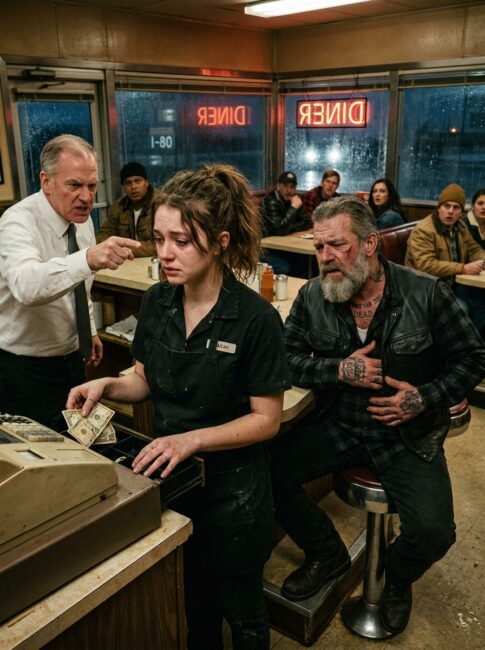
Ron came out of the kitchen wiping his hands on a towel that had probably been dirty since breakfast.
“You paying for that?” he asked Grim.
The diner went still.
Grim reached into one pocket. Then another. His face changed, just a little. Not panic. More like exhaustion finding one more place to sit down.
He pulled out a folded receipt, a key, and a hospital bracelet cut clean through.
No wallet.
“No cash?” Ron said.
Emily moved fast.
Too fast for someone thinking about her job.
“I’ll cover it,” she said.
Ron turned on her. “No, you won’t.”
“It’s coffee and soup.”
“He didn’t order soup.”
“He needs soup.”
That was when Grim looked at her. Really looked.
His eyes were pale blue and bloodshot. They carried something old and wet behind them, but he didn’t let it fall.
“I didn’t ask,” he said.
“No,” Emily said. “You didn’t.”
She pulled the ten from her apron pocket and placed it by the register.
Ron snatched it up, then threw it back on the counter.
“You’re done.”
The words hit the room harder than they should have.
Emily blinked. “What?”
“You heard me. I warned you about giving away food.”
“It’s my money.”
“It’s my diner.”
The young prospect outside stepped toward the door. The older biker caught his arm.
Inside, Grim’s fingers curled around the edge of the counter. His knuckles went white. The tattoos on his hands shifted. For a second, everyone saw what they expected to see.
Violence.
A huge biker. A cruel manager. A girl humiliated in front of strangers. The old script was right there, waiting.
But Grim did not stand.
He closed his eyes.
His jaw worked once.
Then he said, “Don’t.”
One word.
The prospect outside stopped moving, though he could not possibly have heard it through the glass. Maybe brotherhood has its own language. Maybe men who have survived ugly rooms can read a shoulder from fifty feet away.
Emily untied her apron with stiff hands.
Ron pointed toward the back. “Get your stuff.”
“She did right,” Grim said.
Ron laughed. “You don’t get a vote, biker.”
Grim looked at him then.
No anger. That was the scary part. Anger burns hot and leaves. This was colder.
“She did right,” he repeated.
Ron leaned close. “And you can leave too.”
Grim stood.
The stool scraped the tile. Leather creaked. Every fork in the diner stopped moving.
He was bigger standing. Much bigger. His shadow reached across the counter and covered Emily’s ten-dollar bill.
But his left hand went to his ribs again.
This time he swayed.
Emily saw it first.
“Sir?”
Grim took one step, then caught the counter with both hands. The coffee cup fell, shattered, black liquid spreading like oil across the tile.
Ron jumped back. “Oh, come on.”
Emily ran around the counter.
Grim tried to wave her off. Pride, pain, old habit. It all fought across his face.
“I’m fine,” he said.
“You’re bleeding.”
“I said I’m fine.”
Then his knees buckled.
The biggest man in the diner dropped hard enough to shake the stools.
Emily was on the floor beside him before anyone else moved.
She pressed both hands against his side. Her fingers came away red.
“Call 911,” she shouted.
Ron stood frozen with the phone in his hand.
Not dialing.
Just staring at the blood on his floor like it was going to lower his health inspection grade.
I reached for my cell.
Emily looked up at Ron and screamed, “Call them!”
That finally moved him.
Outside, the two bikers came through the door like weather. The older one, Silver, knelt by Grim’s head. The prospect looked ready to break something, but Silver snapped, “Stand down.”
Emily kept pressure on the wound.
Grim looked at her, breathing hard.
“Pocket,” he rasped.
“What?”
“Inside pocket.”
She hesitated.
“Please,” he said.
That word sounded wrong coming from him.
Emily reached inside his vest and pulled out an envelope.
It had her name on it.
Emily Carter.
Her hands went still.
Ron saw the envelope and made the worst mistake of his life.
“What the hell is that?” he said.
Emily stared at her own name written in blue ink. The letters were careful. Old-fashioned. The kind of handwriting people had before phones taught us to hurry.
Grim tried to sit up.
Silver put a hand on his chest. “Don’t, brother.”
Grim pushed him away, not hard, just enough to say he had one thing left to do.
Emily opened the envelope.
Inside was a photograph.
A young white woman in a denim jacket stood beside a motorcycle outside a hospital in Cheyenne. She had the same brown eyes as Emily. Same small chin. Same half-smile that looked like it was hiding worry.
Emily whispered, “That’s my mom.”
The diner seemed to tilt.
I knew Emily’s mother had died when Emily was young. Cancer, she had said once. She never mentioned much else.
Behind the photo was a folded letter.
Emily read the first line out loud before her voice broke.
“If you’re reading this, baby girl, then Mason finally found you.”
Grim closed his eyes.
Mason.
Not Grim.
Not just a biker with a skull patch and a throat tattoo.
Mason Cole.
Emily’s hand flew to her mouth.
Ron muttered, “No way.”
Silver looked at him with disgust. “Way.”
The ambulance siren wailed somewhere far off, small at first, then growing.
Emily looked down at Mason. “Who are you?”
He swallowed through pain.
“Not your father,” he said.
That answer hit harder than if he had said yes.
“Then what are you?”
Mason’s breathing caught. He looked toward the window, where his Harley sat under the gas station lights, rainwater dripping from the chrome.
“Your mother’s ride or die,” he said.
Four words.
But Silver understood them. The prospect understood them. Maybe every biker who had ever buried someone understood them.
Emily didn’t.
Not yet.
Mason’s hand trembled as he pointed toward the letter.
“She saved me,” he said. “Told me to find you.”
Then his eyes rolled back.
Emily shouted his name, though she had only learned it seconds before.
The paramedics came in hard. Boots. Bags. Bright gloves. Questions. Silver gave answers. Knife wound outside a rest stop. Refused transport. Rode anyway. Lost blood. Stubborn fool.
That was twist number two.
He had not come to the diner for food.
He had come bleeding, broke, and half-conscious because he had spent years looking for Emily Carter, and when he finally found her, her manager fired her for helping him.
As they loaded Mason onto the stretcher, his vest slipped open.
The yellow butterfly hair clip caught on the light.
Emily saw it.
Her face changed again.
Not fear this time.
Recognition.
She reached into her pocket and pulled out a tiny broken piece of yellow plastic.
One butterfly wing.
She had carried it since childhood.
At the hospital in Rock Springs, the story came out in pieces.
Bikers don’t tell clean stories. They tell them like men unloading saddlebags in the dark. One thing at a time. A receipt. A photograph. A name. A scar.
Silver told most of it while Mason was in surgery.
Mason Cole had not been a good man when he was young. He had done county time for assault. Ran with men who loved chaos more than brotherhood. Drank too much. Fought too easily. Thought being feared meant being safe.
Then he met Emily’s mother, Laura Carter.
She was a nurse at a free clinic in Cheyenne. White American woman, twenty-six back then, stubborn as barbed wire, the kind who patched up men she should have been afraid of and told them the truth while cleaning their wounds.
Mason came in one night with a split eyebrow and two broken ribs. Laura stitched him up and told him he smelled like bad decisions.
He fell in love before the lidocaine wore off.
She did not.
Not at first.
“She made him get sober before she’d let him take her to dinner,” Silver said.
Emily sat in the hospital hallway with her knees pulled to her chest, still wearing her diner uniform under my old trucker jacket. Her hands were clean now, but she kept looking at them like the blood was still there.
Silver kept talking.
Mason became Iron Mercy after that. Not instantly. Men like him don’t turn around in one clean motion. They skid. They wreck. They crawl. But Laura stayed near enough to make him want better and far enough to make him earn it.
She had a baby girl.
Emily.
Not Mason’s child by blood. The father had left before the first ultrasound and never came back.
Mason wanted to stay.
Laura said no.
“She loved him,” Silver said, “but she knew trouble was still following him. Old crew. Old enemies. She told him love ain’t enough if you bring danger to the porch.”
So Mason left.
Not because he didn’t care.
Because he did.
He rode out with one promise: if Laura ever called, he would come.
Years passed. Mason cleaned up. Built a towing business with the club. Ran charity rides for kids with cancer because Laura asked once and he never forgot. Every December, he sent money to a clinic in Cheyenne under no name.
Then Laura got sick.
Cancer.
She called Mason two weeks before she died.
She gave him the envelope. The photograph. The letter. And a child’s yellow butterfly hair clip Emily had broken when she was four. Laura kept one wing. Emily kept the other.
“She told him not to come right away,” Silver said. “Said the girl had lost enough. Said when Emily was grown and needed help, Mason would know.”
Emily shook her head. “How would he know?”
Silver looked at the floor.
That was twist number three.
“Ron Miller was married to your aunt,” he said. “Your mama didn’t trust him. She said if you ever ended up under his roof or under his paycheck, Mason was to check on you.”
Emily’s mouth opened, but no sound came.
Ron was not just her boss.
He was family by marriage. The kind of family that uses the word to collect favors and dodge blame. After Emily’s grandmother got sick, Ron had given her the diner job and called it charity. He paid her less than minimum wage in cash some weeks. Charged her for broken dishes. Took tips from the jar when he thought no one saw.
Mason had found out three days earlier.
He rode from Cheyenne to Rock Springs with Silver and the prospect, meaning only to watch from a distance. But at a rest stop, one of Ron’s drinking buddies recognized him from old days and tried to stop him from coming.
Mason got cut in the fight.
He still rode.
Not for drama. Not for pride.
For a promise.
Emily looked through the glass at the operating room doors.
The butterfly wing in her palm was shaking.
“He knew my name,” she whispered.
Silver nodded.
“Your mama made sure he did.”
Mason survived.
Barely.
When he woke the next morning, Emily was sitting beside the bed. The yellow hair clip pieces lay on the blanket between them. Two broken wings, almost whole when placed together.
Mason opened his eyes.
Emily asked the only question that mattered.
“Why didn’t you come sooner?”
Mason stared at the ceiling for a long time.
Then he said, “I was still learning how not to ruin things.”
No speech.
No excuse.
Just the truth, ugly and simple.
Emily cried then.
Mason didn’t.
But his eyes turned wet, and he looked away like the wall needed watching.
Ron lost the diner within two months.
Not because Mason threatened him. He didn’t have to.
The story spread faster than diesel gossip at a truck stop. A young waitress fired for buying soup for a bleeding stranger. A biker carrying her dead mother’s letter. A boss who had been stealing tips from a girl he called family.
People stopped coming.
Then the health department came.
Then the wage complaint.
Then the landlord.
By summer, Miller’s Roadside Diner had a new sign.
CARTER’S.
Emily did not buy it alone. She would never say who helped. Silver would not say. Mason would only grunt and change the subject. But every biker in Iron Mercy showed up one Saturday with paint rollers, toolboxes, old ladders, and bad jokes.
The prospect, whose name was Danny, fixed the booths.
Silver repaired the counter.
Mason sat in a chair by the door with stitches still healing under his shirt, pretending he was supervising when everybody knew he had been told not to lift anything heavier than coffee.
Emily kept the old bell above the door.
She changed almost everything else.
There was a shelf near the register with free coffee cards for stranded travelers. A small sign said: PAY WHEN YOU CAN. OR DON’T.
Mason hated the sign.
Said it was too soft.
Every Thursday, he filled the coffee cards himself.
That became the ritual.
Thursday morning. Nine sharp. The low rumble of his Harley-Davidson Road Glide rolling into the lot. Engine off. Metal ticking hot in the quiet. Boots on concrete. Leather creaking. Same stool at the end of the counter.
Emily would pour coffee before he asked.
Black.
She would slide him toast.
He would pretend he didn’t want it.
On the wall behind the register, she hung the photograph of her mother outside the Cheyenne hospital. Beside it, in a tiny frame, were the two halves of the yellow butterfly hair clip.
Customers asked about it sometimes.
Emily would say, “Old family thing.”
Mason never corrected her.
One night, near closing, I watched him stand under that photo with his hand over the inside pocket of his vest. He still carried Laura’s letter there, folded soft from years of being opened and closed.
Emily came up beside him.
“You okay?” she asked.
He nodded.
“You always say that.”
He looked at the photo.
“Still true sometimes.”
That was as much as he could give.
She understood.
I still stop at Carter’s whenever I run I-80 through Rock Springs.
The coffee is better now.
The windows are cleaner.
The sign does not flicker.
Emily made it to nursing school online first, then part-time in person. She still works the counter on weekends because, as she says, some people need soup before they need advice.
Mason still looks like trouble when he walks in.
Huge frame. Gray beard. Tattooed hands. Black leather cut. PRAY FOR THE DEAD across his throat. Men still lower their voices when they see him. Mothers still glance twice. New customers still guess wrong.
Then he sits at the counter and repairs the loose strap on Emily’s apron with hands that once shook too hard to hold coffee.
The club comes through every December for Laura’s ride.
No speeches. No banners with her face. Just engines in the cold morning, coffee in paper cups, and a line of Harleys pulling onto the highway while Emily stands outside in her coat, holding the photograph against her chest.
Last time I saw Mason, he was leaving at dusk.
Emily stood in the diner doorway.
“Ride safe,” she called.
He put on his helmet, then touched two fingers to the butterfly patch she had sewn inside his vest.
The Harley started low and rough.
His taillight moved toward I-80.
Red against the dark.
Still keeping his promise.
Follow the page for more biker stories about the hearts people never see coming.