Part 2: Ten Harleys Came to Her School — Then the Scariest Biker Told the Truth
Jefferson Middle School sat three miles from Route 11, behind a grocery store, a tire shop, and a gas station where the coffee always tasted burned.
Every weekday morning, buses hissed at the curb while parents leaned on their horns in the drop-off lane.
By 8:15, the halls smelled like floor wax, cafeteria biscuits, damp coats, and the strange electrical heat of too many Chromebook chargers plugged into too few outlets.
Emily Parker had been the kind of student adults described as easy.
Quiet. Organized. Never disruptive.
That word bothered me later.
Easy.
Sometimes it means a child has learned how to disappear without inconveniencing anyone.
Emily liked drawing tiny cartoon animals in the margins of her notebooks. She wore the same denim jacket almost every day, even when the weather turned cold. She read fantasy novels beneath her desk after finishing assignments early.
At the beginning of sixth grade, she sat with four girls from her elementary school during lunch.
By November, she sat alone.
The change was gradual enough that teachers noticed pieces but not the whole shape.
One teacher noticed Emily asking to use the restroom during group projects.
Another saw her delete a social media app from her phone, then reinstall it twenty minutes later.
The cafeteria monitor noticed she stopped eating the apples her mother packed.
I noticed her sleeves pulled over her hands.
Her mother noticed everything.
The messages had started after a disagreement in a group chat. Nothing dramatic. One girl posted an embarrassing screenshot. Another added a joke. Somebody created a private group with Emily’s name and the word “hate” in the title.
Then cruelty became entertainment.
Students who barely knew Emily joined because the posts were there.
Because other people were laughing.
Because clicking a heart icon did not feel like walking up to a human being and saying the same words aloud.
When Emily’s mother called me on a Thursday evening, her voice was steady for the first minute.
Then it broke.
“She says she doesn’t want to wake up tomorrow,” she said.
I asked whether Emily was safe at that moment.
Her mother said yes. She was beside her. She would not leave her alone. She had already contacted the appropriate crisis support resources and arranged professional help.
Then she asked a harder question.
“What happens when I send her back into that building?”
The school had procedures. We documented posts. We contacted families. Administrators began disciplinary reviews. Teachers were alerted without broadcasting Emily’s private situation.
Those steps mattered.
But Emily needed something procedures could not provide quickly.
She needed to believe the adults around her understood that invisible wounds were still wounds.
The call to the BACA chapter happened through Emily’s aunt, who worked with a woman named Dani Morales.
Dani rode a black Harley touring bike and worked night shifts as an emergency-room nurse. She was forty-six, compact, tattooed, and impossible to interrupt once she decided a conversation mattered.
She called me Friday morning.
“Our chapter wants to meet,” she said.
I expected two bikers.
Ten arrived at a roadside diner near Salem.
The V-twin engines rolled into the parking lot one after another, shaking rainwater from the diner windows. Boots hit pavement. Leather creaked. A wallet chain clicked against a metal chair leg when one rider sat down.
Bear came in last.
He removed his gloves and folded them carefully beside a mug of coffee.
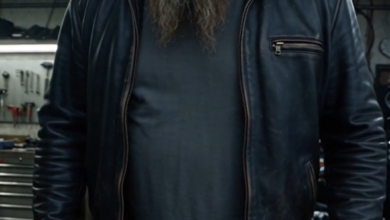
His hands were enormous.
Across the knuckles of his right hand, the letters spelled DEATH.
Across the left, faded ink spelled LIFE.
I noticed one more thing when he reached for the sugar packets.
Inside his leather cut, near the inner pocket, was a piece of notebook paper folded into a square and secured with clear tape.
Old paper.
Soft at the edges.
Handled too many times.
Bear listened while I explained the situation.
He did not interrupt.
When I finished, one rider named Colton cleared his throat.
“We usually enter when there’s direct abuse,” he said carefully. “A person. A threat. A child who needs a physical presence.”
Dani leaned forward.
“The threat is in her pocket,” she said.
Nobody spoke for a few seconds.
Bear tapped one scarred finger against the table.
Then he asked, “Is she hurting?”
I said yes.
He looked around the booth.
“Then vote.”
Ten hands rose.
No speeches.
No hesitation.
Bear nodded once.
“Good,” he said. “Now we figure out how not to make it worse.”
That sentence mattered.
They did not want to surround the students accused of bullying.
They did not want names.
They did not want to confront children, stand outside homes, or create a spectacle that turned Emily into a bigger target.
The club decided to do the opposite.
They would talk about themselves.
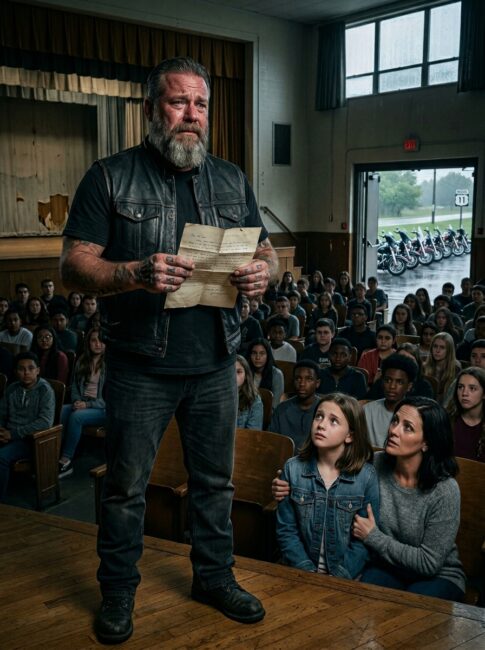
The workshop happened the following Wednesday.
The sky hung low over Roanoke. A gray winter rain followed traffic along Williamson Road and turned the school parking lot into a sheet of reflected headlights.
At 9:05, ten motorcycles entered through the side lot.
They came slowly.
No revving.
No dramatic formation.
Just the uneven pulse of Harley engines settling into idle beneath the gym windows.
Students pressed faces against the glass.
Teachers tried not to do the same thing.
Bear removed his helmet beside the curb. His beard was wet. His boots left dark prints across the tile as the chapter entered the auditorium.
Dani wore her leather cut over a plain black shirt.
Colton had a shaved head, a neck tattoo, and reading glasses he kept pushing up with one finger.
A rider called Preacher limped slightly because of an old construction accident. Another, Moose, had shoulders so wide that the auditorium chair looked like furniture from a dollhouse when he sat down.
Emily arrived with her mother through a side door.
She chose a seat near the aisle.
Her eyes stayed on the floor.
The principal introduced the workshop with the careful language schools use when they are afraid one wrong sentence will become an email chain.
Then he handed me the microphone.
I said, “Today is not about naming students. It is not about public punishment. It is about understanding what words can do when people forget there is a person on the other side of a screen.”
I passed the microphone to Dani.
She did not start with cyberbullying.
She started with seventh grade.
“My family moved four times in three years,” she said. “I smelled like cigarette smoke because every adult in our apartment smoked. Kids noticed. They always notice.”
She shrugged.
“I learned to skip gym class because the locker room was worse than detention.”
She handed the microphone to Colton.
Colton stared at it for a moment.
“My father went to prison when I was nine,” he said. “The whole town knew before I did. Boys in school called me convict junior.”
He rubbed one thumb across the edge of his vest.
“I started acting like the name they gave me. Took years to stop.”
Preacher spoke next.
He had worn secondhand clothes. He was smaller than everybody else until his sophomore year. Two older boys cornered him behind a bus and poured chocolate milk over his shirt because the sleeves were too short.
Moose said he could not read well until he was fourteen.
When teachers asked students to read aloud, he made jokes so nobody would notice his fear.
Then Bear stood.
The auditorium changed.
He did not need the microphone, but he took it anyway.
His boots struck the wooden stage with slow, heavy thuds.
The letters across his knuckles were visible from the front rows.
DEATH.
LIFE.
He looked like the man every student expected to say he had never been afraid of anything.
Bear stared at the microphone.
His jaw tightened.
“I-I-I—”
A few students shifted.
One nervous laugh escaped from somewhere near the back row.
Bear stopped.
The laugh died immediately.
He inhaled through his nose.
Then he tried again.
“I stutter.”
His voice was rough but controlled.
“Always have.”
He held up one hand.
“Tattoos don’t fix it.”
Then the other.
“Getting big doesn’t fix it.”
He glanced toward Emily.
“Getting old doesn’t fix what people said.”
The room was still.
Bear reached inside his leather cut and touched the folded paper taped near his chest.
But he did not remove it yet.
Instead, he faced the students and said, “Before you post something, ask yourself one question.”
He paused.
“If the biggest biker in the room still remembers words from forty years ago, how long do you think an eleven-year-old remembers yours?”
Nobody moved.
For one second, I thought that was the climax.
I thought the workshop had done what we hoped.
Then Bear unfolded the paper.
And I saw his hands begin to shake.
The paper was lined notebook paper.
Blue horizontal lines.
One red margin.
Clear tape reinforcing each fold.
Bear opened it slowly, careful not to tear the corners.
“This isn’t from Emily,” he said.
His stutter grew worse when he became tired or angry. That morning, it returned whenever his voice softened.
“This is mine.”
He looked toward the back of the auditorium, but I do not think he saw the students anymore.
“I was eleven.”
A room full of middle school students watched a man with DEATH tattooed across his knuckles read a letter written by a frightened boy more than four decades earlier.
Bear did not read all of it.
He read only three lines.
A boy asking his mother whether he could change schools.
A boy promising he would stop answering questions in class.
A boy saying he wished he could become invisible.
Bear lowered the page.
“My mother kept it,” he said. “Found it after she died.”
He folded it once.
Then stopped.
“She didn’t know how bad it got.”
His thumb rubbed the soft edge of the paper.
“I didn’t tell her.”
The auditorium remained silent.
Not school-assembly silent.
Not teachers-watching silent.
The deeper kind.
The kind that makes small sounds feel enormous.
Rain tapping the high windows.
A vent rattling near the ceiling.
Bear’s leather cut creaking when he shifted his weight.
Then he said the part none of us expected.
“I almost didn’t come today.”
Dani looked up.
Bear kept speaking.
“When Caroline told us why this girl needed help, I said we should vote. Truth is, I wanted the vote to fail.”
He looked toward his brothers and sister in the front row.
“I didn’t want to stand here.”
The bikers did not interrupt him.
“I can talk to grown men,” Bear said. “I can walk into courtrooms. I can sit beside a kid during a hard night. But standing in front of a school microphone?”
He shook his head.
“That scared me.”
Then Emily lifted her eyes.
Just slightly.
Bear noticed.
He folded the paper along its old creases and returned it to the inner pocket of his vest.
“Still came,” he said.
That was the twist.
The bikers had not entered Jefferson Middle School because they were immune to cruelty.
They came because they were not.
They knew exactly how long a sentence could survive inside a person.
They knew that a joke could outlive the phone that displayed it.
And the largest man in the room had carried proof beside his ribs for forty years.
The workshop lasted another thirty minutes.
No dramatic applause followed Bear’s speech.
That would have ruined it.
Students needed time to sit in the discomfort.
Dani returned to the microphone and explained something simple.
Every comment has a person attached to it.
Every repost adds weight.
Every laughing reaction tells somebody else that cruelty has an audience.
She did not lecture.
She asked questions.
“Have you ever typed something you would not say while standing three feet from the person?”
Hands stayed down.
But faces changed.
“Have you ever shared something because you wanted to be included?”
A few students looked at their shoes.
“Have you ever laughed because staying silent felt risky?”
More eyes dropped.
The chapter did not ask students to confess in public.
They did not demand apologies.
That mattered.
Humiliation does not cure humiliation.
At the end, the principal thanked the bikers and released students row by row.
The auditorium filled with chair legs scraping the floor and the low murmur of voices that sounded different from the chatter before the workshop.
Emily stayed seated.
Her mother kept one hand near hers but did not force contact.
Bear stepped down from the stage and walked toward them.
Up close, he looked even larger.
Wet leather. Cold air. Coffee on his breath. The faint scent of gasoline clinging to his jeans.
He crouched several feet away from Emily rather than entering her space.
For a moment, neither of them spoke.
Then Bear removed the folded letter again.
He held it out.
Emily hesitated.
“You can look,” he said.
She accepted the paper carefully.
Her eyes moved across the three lines he had read aloud.
Then lower.
There was more writing beneath them.
A child’s handwriting. Uneven. Pressed hard enough to leave dents in the paper.
Emily returned the letter.
“You kept it?” she asked.
“Mom did.”
“Why do you carry it?”
Bear thought for a second.
“So I don’t pretend I forgot.”
Emily nodded.
Her voice was barely audible.
“Do people stop being mean?”
Bear did not give her an easy answer.
“Some do.”
“Some don’t?”
“No.”
“What do you do then?”
Bear looked toward his chapter.
Colton was stacking chairs without being asked. Moose was speaking quietly with the custodian. Dani stood near the exit answering a teacher’s question.
“You find people who stay,” Bear said.
That was when three girls appeared near the aisle.
They were eleven and twelve years old.
None looked dangerous.
That was another truth people sometimes miss.
Cruelty does not always arrive wearing the face we expect.
Sometimes it wears a school hoodie and carries a glitter-covered water bottle.
The three girls stood beside the counselor’s office assistant, uncertain whether to approach.
The assistant looked at Emily’s mother.
Emily’s mother looked at Emily.
Emily could have said no.
She had earned the right to say no.
Instead, she nodded once.
The girls came closer.
The first one started speaking too fast.
She had joined the chat but had not created it. She said she was sorry. She said she knew that did not erase anything.
The second admitted she had shared an edited photo because everybody else was sending it.
The third cried before she finished her first sentence.
Emily watched them.
Her shoulders stayed tense.
Her hands remained tucked inside the sleeves of her denim jacket.
She did not hug them.
She did not forgive six months of pain in a perfect sentence.
She said one word.
“Okay.”
Just that.
Okay.
It was not a clean ending.
It was not permission to forget consequences.
It was not proof that every friendship would return.
But Emily’s mother covered her mouth with one hand.
Because it was the first word Emily had spoken directly to another student in months.
Bear stood slowly.
His knees cracked.
Emily looked toward his hands.
“What does the other one say?” she asked.
Bear turned his left fist.
The faded letters showed beneath the fluorescent lights.
LIFE.
He gave a small shrug.
“Needed both.”
The story did not end in the auditorium.
Real recovery rarely does.
The school continued its investigation. Families met with administrators. Consequences followed. Digital-safety lessons became part of advisory periods. Teachers received better guidance on what to notice before a quiet student vanished into the background.
Emily continued seeing a licensed mental-health professional.
Her mother stayed close.
Some mornings remained hard.
But she came back to school.
At first, she entered through the side office.
Then through the main doors.
By spring, she started eating lunch in the library with two students from art club. They drew cartoon animals on sticky notes and hid them between the pages of returned books for other students to find.
Bear did not become a permanent fixture at Jefferson Middle School.
That would have turned a meaningful moment into a performance.
But once a month, usually on a Saturday, his chapter hosted a small community workshop at a diner meeting room near Route 11.
Not just for kids.
Parents came too.
So did teachers.
Sometimes a student asked Bear whether the knuckle tattoos hurt.
“Not as much as getting them removed would,” he said.
Sometimes somebody asked why he still carried the old letter.
Bear never gave a longer answer than necessary.
“Weight keeps you honest.”
Before each workshop, the chapter parked outside the diner.
Engines shut off one after another.
Boots crossed the pavement.
Leather cuts creaked as riders dragged metal chairs into a circle.
Bear always chose the chair closest to the door.
He said it gave him room to stand when his knees stiffened.
Dani knew the real reason.
As a kid, Bear had always needed an exit.
Even at fifty, part of him still did.
One Saturday in May, Emily arrived with her mother carrying a folded square of paper.
She walked directly toward Bear.
He looked surprised.
“This is for you,” she said.
Bear unfolded it.
Inside was a drawing of a huge biker sitting on a tiny school chair. His beard reached his chest. His boots were comically large. Across his knuckles, Emily had drawn the words DEATH and LIFE.
Beside him stood a girl holding a notebook.
Above them, Emily had written:
WORDS STAY. SO DO PEOPLE.
Bear stared at the drawing for a long time.
Then he tucked it into the inner pocket of his leather cut.
Beside the old letter.
Same pocket.
New weight.
At the end of sixth grade, Jefferson Middle School held an art show in the gym.
Emily submitted three drawings.
One showed a rabbit in a leather vest.
One showed ten motorcycles beneath a cloudy Virginia sky.
The last showed two hands resting on a table.
The right hand carried four dark letters.
DEATH.
The left carried four faded ones.
LIFE.
Between the hands sat a folded piece of paper.
No caption.
It did not need one.
Bear came to the art show wearing his leather cut over a clean black shirt. Dani parked beside him. Moose arrived late because his Harley refused to start outside the gas station near Salem.
When Bear entered the gym, a few younger students stared at his tattoos.
One boy whispered something to his mother.
Bear heard him.
He leaned down.
The boy pointed toward his knuckles.
“Is that real?”
Bear held out both fists.
The boy read the words slowly.
“Death. Life.”
“Correct.”
“Which one wins?”
Bear looked across the gym.
Emily stood beside her drawings, talking to two girls from art club. Not loudly. Not confidently.
But talking.
Bear straightened.
“Depends what you feed,” he said.
Outside, the evening air smelled like rain on warm pavement.
The bikers started their engines one by one.
The low V-twin rumble rolled past the school doors, crossed the parking lot, and faded toward Route 11.
Inside his leather cut, two folded papers rested against Bear’s ribs.
One from the boy he had been.
One from the girl who stayed.
The engines disappeared into traffic.
The words stayed.
Follow our page for more stories from behind the leather cuts.