Part 2: The Biker Asked for Braiding Lessons — Then His Daughter Walked Into School Like a Queen
I thought Cole might return the mannequin head after a few days.
He did not.
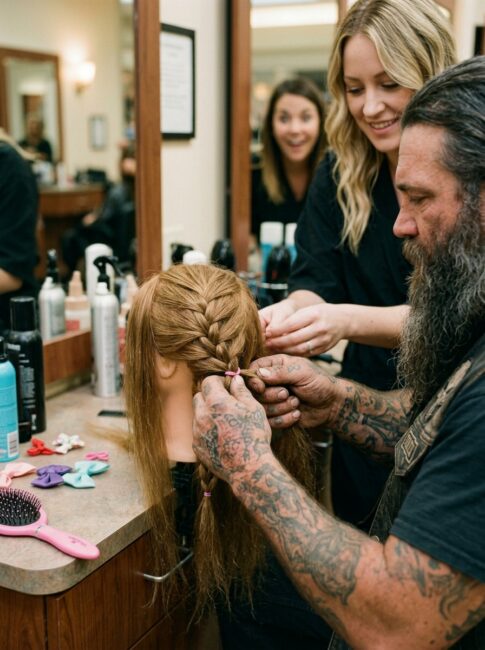
Instead, he sent me a photograph at 4:47 on Wednesday morning. It showed a crooked braid tied with a pink elastic. The mannequin’s synthetic hair was tangled near the crown, and one section was much thicker than the others.
Underneath the picture, Cole wrote four words.
Looks like rope. Help.
I sent back a few instructions.
The next morning, another photograph arrived. Better part. Looser braid. Bow clipped sideways.
Still looks like rope.
By Friday, it looked less like rope and more like something a determined father had made after refusing to sleep.
Cole’s life had always been built around stubbornness.
I learned that gradually, mostly from the people who came into the salon after hearing what he was doing. Tulsa is a city large enough to feel anonymous until a story begins traveling through diner booths, welding shops, and gas stations. Then it becomes a small town with eight hundred thousand witnesses.
Cole had started riding in his twenties, after his younger brother died in a construction accident. His Harley was not a symbol or a costume. It was simply the place he went when the house felt too quiet and the memories became too loud.
He rode with a small local club called the Iron Lanterns. They were mechanics, electricians, roofers, warehouse workers, two veterans, a paramedic, and a retired middle-school janitor named Russell who still carried peppermints in his vest pocket.
No one in the club called Cole sentimental.
They called him Mule.
Partly because he could lift anything. Mostly because once Cole decided to do something, arguing with him was a waste of oxygen.
After his wife Lauren died, the Iron Lanterns began showing up at his house without waiting for invitations. One brother repaired a leaking gutter. Another left groceries on the porch. Russell sat through a second-grade school play even though Evie had only one line and spoke it so softly nobody past the third row heard her.
Cole accepted help with the roof.
He accepted help with the lawn.
He did not accept help raising his daughter.
That line mattered to him.
His own father had vanished when Cole was nine, leaving behind an unpaid electric bill, an empty dresser, and a boy who became very good at pretending he needed nobody. Cole had spent most of his adult life afraid that needing help made him weak.
Lauren understood that about him.
She also understood Evie’s hair.
Before she got sick, Lauren braided it every morning at the small bathroom mirror. Evie sat on a wooden step stool in unicorn pajamas while Lauren worked patiently through the tangles, humming old country songs and fastening a bow at the end.
Cole usually watched from the hallway while drinking coffee before work.
He remembered the image.
He had never learned the steps.
After Lauren died, Evie’s hair became one more thing he tried to solve through force and improvisation. He brushed too hard. He made uneven ponytails. He used too many clips. Once, in desperation, he attempted something he called a “double knot,” which lasted until breakfast and then collapsed into a mess of elastics.
Evie never complained.
That was the first twist nobody noticed.
She smiled at every lopsided ponytail. She thanked him every morning. She told him it looked good even when it clearly did not.
But children at school noticed.
A few girls laughed when Evie wore a purple shirt with red leggings and one bright green sock because the matching sock had disappeared somewhere behind the dryer. A boy asked whether she brushed her hair with a fork.
Evie laughed along with them because seven-year-olds sometimes laugh when they are trying not to cry.
Then she came home and asked for a hat.
Cole bought the brush that same night.
By Saturday morning, the Iron Lanterns knew about the salon lesson because Russell had seen Cole’s motorcycle parked outside the mall and demanded an explanation over coffee at a Route 66 diner.
According to Russell, Cole stared into his mug for a long time before answering.
“Learning braids.”
Nobody laughed.
That surprised Cole.
Russell took a sip of coffee and said, “French braid?”
“Trying.”
“My granddaughter likes Dutch braids,” Russell replied. “More volume.”
Cole looked irritated. “What the hell is a Dutch braid?”
By Sunday afternoon, five bikers were standing in Cole’s garage around a mannequin head clamped to a workbench between a socket set and a box of welding gloves.
The garage smelled like oil, old leather, and sawdust. Rainwater dripped from the edge of the carport. Somewhere nearby, a lawn mower coughed and refused to start.
Russell watched a tutorial on his phone.
A broad-shouldered electrician named Deacon sorted elastics by color.
Another brother held up two ribbons and asked whether rose pink and bubblegum pink were legally different colors.
Cole ignored him.
He practiced.
The men stayed until the braid finally held.
The following Tuesday, Evie Mercer walked into Rosa Parks Elementary wearing a French braid so clean and even that her teacher noticed before the first bell rang.
Her hair was parted carefully. The braid ran down the center of her head without bumps or loose strands. At the end, beneath the final elastic, a small pink bow sat perfectly straight.
Evie wore a denim dress, white sneakers, and two matching socks.
That detail mattered.
Her teacher, Mrs. Collins, knelt beside her desk and said, “Evie, your hair looks beautiful.”
Evie’s entire face changed.
Not dramatically. She did not jump up or announce anything to the class. She simply sat a little straighter, touched the end of the braid, and smiled with the cautious pride of a child who had spent too many mornings hoping nobody would notice her.
“Thank you,” she said.
A girl sitting nearby leaned over.
“Did your grandma do it?”
Evie shook her head.
“Your aunt?”
“No.”
“Who did it?”
Evie smiled wider.
“My dad.”
The other girl stared at her.
“Your dad did that?”
Evie nodded.
“My dad can braid now.”
By lunchtime, half the class knew.
By pickup time, Mrs. Collins had heard several versions of the story, including one suggesting that Evie’s father owned a beauty salon and another claiming he had once braided the tail of a horse.
Mrs. Collins had met Cole only twice. Both times, he arrived directly from work wearing a heavy canvas jacket, boots marked by welding dust, and an expression that made small talk feel dangerous. He was polite. He was also the kind of man who answered questions with as few words as possible.
She called him because she thought Evie might have misunderstood the question.
Cole arrived at the school office twenty minutes later.
The front door swung open. His boots struck the tile with slow, heavy thuds. His leather cut shifted across his shoulders with each step. The faded skull patch was visible from halfway down the hallway.
The school secretary stopped typing.
Two parents near the office window went quiet.
Cole removed his sunglasses.
“Something wrong with Evie?”
Mrs. Collins immediately understood the mistake.
“No. Nothing is wrong.”
His shoulders lowered slightly.
“She told the class you braided her hair this morning,” Mrs. Collins explained. “I just wanted to tell you it looked wonderful.”
Cole glanced toward his daughter, who was standing beside her teacher with a backpack hanging from one shoulder.
He studied the braid.
Then he frowned.
“It’s loose.”
Mrs. Collins blinked. “Excuse me?”
“Near the bottom.”
Before anybody could answer, Cole walked to the reading rug, lowered himself onto one knee, and motioned gently for Evie to turn around.
The classroom had mostly emptied, but a few children waiting for late pickups were still inside. They watched in silence as Cole removed the pink bow, set it carefully on his thigh, and loosened the last section of the braid.
His fingers moved slowly at first.
Left section over center.
Right section over center.
Tighten.
Smooth the loose strand.
Continue.
The hands were enormous compared with Evie’s shoulders. Scarred across the knuckles. Marked by old burns. The thumbnail on his right hand was still dark from a welding injury.
But he never pulled too hard.
Evie stood completely still, trusting him.
Mrs. Collins lifted her phone.
She recorded only forty-seven seconds.
In the video, Cole did not look at the camera. He did not pose. He did not say anything inspirational. He simply fixed the braid, secured the elastic, clipped the bow back into place, and leaned slightly to inspect his work.
Evie turned around.
“Better?” she asked.
Cole nodded.
“Better.”
Then Evie threw both arms around his neck.
Cole froze for half a second, caught off guard by the force of the hug. He placed one hand carefully against the back of her denim dress.
A boy standing near the bookshelf asked the question everybody wanted answered.
“Did you really learn how to do that?”
Cole looked at Evie.
“Still learning.”
Mrs. Collins posted the video that evening with Cole’s permission. Her caption was simple: Her father works nights as a welder. He learned because she needed him.
By breakfast the next morning, the video had crossed one million views.
By lunch, it reached six million.
By the end of the week, twenty-two million people had watched a man with a skull on his back kneel on a second-grade classroom rug and repair a pink bow.
The most repeated comment appeared beneath nearly every repost.
Those hands weld steel during the day and braid hair before school. That is a father.
People called the salon asking whether Cole would appear on local television.
A morning show offered to fly him to New York.
A hair product company asked whether he would film an advertisement.
Cole declined everything.
He never even watched the video.
When Russell showed him the view count at the Route 66 diner, Cole looked at the phone for less than a second and pushed it back across the table.
“Evie eat breakfast yet?” he asked.
That was all.
For most people, that would have been the end of the story.
It was not.
Cole returned to the salon two days later carrying the mannequin head beneath his arm.
The synthetic hair had been brushed so many times it no longer looked new. A pink elastic circled the mannequin’s neck like a bracelet. Several bobby pins were stuck into the Styrofoam near the ear.
“I need the next one,” he said.
“The next what?”
“Hairstyle.”
I smiled. “You mastered the French braid?”
“Good enough for Tuesday.”
“Tuesday?”
He nodded. “She picks one from a picture every Sunday night. Tuesday is French braid. Wednesday is pigtails. Thursday she wants something called a waterfall braid.”
I laughed before I could stop myself.
Cole did not.
“Is that a real thing?”
“It is.”
“Can you teach it?”
I moved a chair beside my station.
“Sit down.”
He lowered himself into the seat and set the mannequin head on the counter. As he removed his cut, the leather folded open again, exposing the small faded pink patch sewn inside the lining.
This time, I asked.
“What does that patch mean?”
Cole did not answer immediately.
He placed the cut across his knees and ran one thumb over the crooked stitching. The letters were uneven, made with the kind of concentration only a child can give to something.
DADDY.
“Evie made it when she was four,” he said.
He turned the cut over, feeling along the seam behind the patch.
Then he looked at me.
“There’s something inside it.”
Cole had discovered it the previous night while repairing a loose thread. The pink patch had been sewn over a narrow opening in the lining, creating a small hidden pocket.
Inside was a folded photograph and a note.
He removed both carefully.
The photograph showed Lauren sitting on the back steps of their old house during the summer before her cancer worsened. Her hair was covered by a scarf. Her face looked thin, but her smile was steady.
Evie sat between Lauren’s knees, wearing pajamas and holding a doll.
Lauren’s hands were captured halfway through a braid.
Cole stood in the background near the garage door, blurred and unaware the photograph was being taken.
On the back, Lauren had written a date.
Below it, she had written six words.
He watches. He will learn eventually.
The note was longer.
Cole did not hand it to me at first. He unfolded it once, stared at the page, then folded it shut again. His jaw tightened. The muscles near his temple moved.
I looked away to give him privacy.
Finally, he passed it across the counter.
Lauren had written the note during one of her last hospital stays. She had addressed it to Cole in plain language, without decoration. She knew him too well for decoration.
She told him there would be mornings when Evie needed help with things he did not understand. There would be dresses, school dances, scraped knees, arguments, questions, and eventually heartbreaks he could not fix with tools.
She told him not to confuse love with knowing the answer.
Then came the line that stopped me.
When you do not know what she needs, ask somebody. Staying is more important than already knowing.
Beneath that, Lauren had added one final instruction.
Do not cut her hair short because you are scared to learn.
I looked up at Cole.
He stared toward the mall corridor beyond the glass storefront. His eyes were wet, but no tears fell. He had the expression of a man standing near a door he had avoided opening for two years.
“I almost did,” he said.
“Cut her hair?”
He nodded.
“Last month. Thought it would be easier.”
He rubbed his thumb across the edge of the photograph.
“Found the note after the video. Patch came loose.”
The timing felt impossible.
Twenty-two million people had watched Cole braid his daughter’s hair. Strangers praised him for learning. Comment sections treated him like a symbol of fatherhood.
But Lauren had predicted the moment years earlier.
Not the video.
Not the salon.
Not the views.
She had predicted the real thing: the morning when Cole would realize he could not solve every problem alone and would finally ask somebody to teach him.
Cole folded the note and slipped it back inside the lining.
“Waterfall braid,” he said.
His voice cracked slightly on the final word.
I placed the mannequin head between us.
“Waterfall braid,” I agreed.
For the next hour, I separated sections of synthetic hair while Cole practiced releasing one strand and picking up another.
His fingers struggled.
The braid collapsed repeatedly.
Each time, Cole started over.
The video changed the way strangers looked at Cole.
It did not change Cole.
That distinction became clearer during the weeks that followed.
People recognized him at gas stations along Route 66. They approached him outside the diner where the Iron Lanterns met on Saturdays. Some asked for photographs. Others told stories about fathers who stayed, fathers who left, husbands who had died, daughters who stopped speaking to them, or sons they were trying to understand before too much time passed.
Cole listened politely.
Then he usually said the same thing.
“I’m just doing her hair.”
The attention embarrassed him because he knew the part nobody else saw.
The first braid took him nearly forty minutes.
Evie sat on the bathroom step stool before sunrise while Cole worked under the yellow light above the mirror. A mug of coffee cooled beside the sink. His welding shift had ended less than an hour earlier. His shoulders hurt. His fingertips were cracked from cold weather and metal dust.
Every few minutes, he paused and checked Evie’s face in the mirror.
“Too tight?”
“No.”
“Pulling?”
“No.”
“You sure?”
Evie nodded.
She never complained because she understood more than adults realized.
One morning, while Cole redid a section for the third time, Evie reached up and touched his wrist.
“You can stop, Daddy.”
Cole met her eyes in the mirror.
“Why?”
“Because it already looks good.”
“It can look better.”
She looked down at her pajama knees.
“I don’t care if people laugh.”
Cole set the comb on the sink.
That was the second twist.
Evie had not asked for the hat because she was ashamed of her father. She asked because she was trying to protect him.
She had heard the children laughing. She had also watched Cole struggle every morning after working all night. She thought wearing a hat would make his life easier.
Seven years old.
Already trying to carry weight that did not belong to her.
Cole crouched beside the stool until they were eye level.
“You don’t cover up because somebody laughs,” he said.
Evie looked uncertain.
“You hear me?”
She nodded.
Cole picked up the comb.
“And you don’t make yourself smaller to protect me.”
Evie’s eyes filled.
Cole turned back toward the mirror before his own face gave too much away.
The braid took another twelve minutes.
It was not perfect.
Evie wore it proudly anyway.
The Iron Lanterns became part of the ritual, although none of them admitted how invested they were.
Every Sunday after breakfast, Evie selected hairstyles from photographs on my phone while Cole took notes on a folded index card. Russell offered opinions. Deacon learned to identify bows by size. The retired janitor discovered he was surprisingly good at fishtail braids and became unbearable about it.
One Saturday, I walked into the Route 66 diner and saw six leather cuts arranged around a booth while grown men debated whether a yellow bow matched a navy-blue dress.
The waitress placed coffee on the table and shook her head.
“You gentlemen planning a bank robbery or a dance recital?”
Russell pointed toward the yellow bow.
“School pictures.”
The waitress examined it seriously.
“Too bright.”
Deacon looked offended.
Cole took the bow from Russell and placed it back into the plastic bag.
“Blue, then.”
The brotherhood had always been present when Cole needed muscle, tools, or a ride home after a hard night.
Now it was being tested by something quieter.
Could these men sit in a diner and care about ribbon colors without turning tenderness into a joke?
They could.
They did.
The small pink patch inside Cole’s cut also made sense now. For years, he had carried Evie’s crooked stitching against his back without knowing Lauren had hidden a message behind it.
From the outside, people saw the skull.
From the inside, closest to his heart, there was one uneven word made by a four-year-old girl.
DADDY.
Cole kept Lauren’s note hidden again after showing it to me. He did not frame it. He did not post it online. He did not use it to explain himself during interviews because he refused every interview.
He simply carried it.
A month after the classroom video went viral, Mrs. Collins invited Cole to return for Career Day. She expected him to talk about welding.
He brought his helmet, a welding mask, two small pieces of steel, and the mannequin head.
The children laughed when he set it on the table.
Cole did not mind.
He showed them how welding required patience, steady hands, and attention to small details. Then he picked up three sections of synthetic hair and explained that braiding required the same things.
A boy in the front row raised his hand.
“Which one is harder?”
Cole considered the question.
“Depends who you’re doing it for.”
That answer spread online too.
Cole never watched that video either.
By spring, the bathroom mirror in Cole’s house had become a calendar of small improvements.
Monday was ponytail day because Mondays were rushed.
Tuesday was French braid.
Wednesday belonged to two Dutch braids, which Cole claimed were unnecessarily complicated but secretly preferred because Evie liked how they looked beneath her bicycle helmet.
Thursday was waterfall braid day.
Friday was Evie’s choice.
Sometimes she asked for something simple. Sometimes she selected a hairstyle from a photograph that made Cole stare at the screen as if she had presented architectural plans for a suspension bridge.
He always tried.
At 4:30 each morning, before waking her, Cole sat alone on the bathroom step stool with the mannequin head resting between his knees. The house remained quiet except for the hum of the refrigerator and the occasional hiss of tires moving along the wet street outside.
His Road King waited beneath the carport.
His work boots rested near the door.
His cut hung from a hook in the hallway, the skull facing outward, the pink patch and Lauren’s note hidden inside.
Cole practiced under the bathroom light until his hands remembered the sequence.
Left.
Right.
Tighten.
Smooth.
Continue.
Some mornings, after a difficult shift, he fell asleep for several minutes sitting upright against the wall. Then the alarm on his phone sounded, and he stood, washed his face, packed Evie’s lunch, and started again.
The viral video slowly moved through the internet and disappeared beneath newer videos.
Cole preferred that.
He had never wanted strangers to admire him.
He wanted one little girl to walk through the doors of Rosa Parks Elementary without reaching for a hat.
The school picture arrived near the end of the semester.
Evie stood in front of a blue background wearing a white dress and a pair of small silver shoes. Her French braid was straight and smooth, finished with a pale pink bow.
Cole carried the picture into the Route 66 diner on a Saturday morning.
He did not make an announcement. He simply placed the photograph on the table beside the sugar dispenser and sat down.
Russell picked it up first.
“That your work?”
Cole poured coffee.
“Mostly.”
Russell studied the braid.
“Bottom section’s a little loose.”
Cole looked at him.
Deacon nearly choked laughing into his mug.
Cole took the photograph back and slipped it carefully into the inside pocket of his cut, behind the patch Lauren had helped Evie sew years earlier.
Later that morning, six Harleys rolled out of the diner parking lot and merged onto Route 66.
Cole rode at the front.
The engines echoed beneath the overpass, deep and uneven, shaking the cold air. His leather cut snapped lightly against his back. His scarred hands rested on the grips.
Inside the lining, hidden behind a skull and a faded pink patch, three things traveled with him.
Lauren’s note.
Evie’s school picture.
And a small plastic bow he kept as a spare.
I still see Cole occasionally.
He comes into the salon when Evie chooses a new hairstyle that defeats him. He arrives after a night shift with welding dust beneath his fingernails, a paper cup of gas-station coffee in one hand, and the mannequin head tucked beneath his arm.
He never asks for special treatment.
He waits his turn.
Last month, Evie came with him. She sat in the chair beside mine reading a library book while Cole practiced a braided bun.
He struggled with one stubborn section until Evie finally looked up.
“Daddy.”
Cole kept working.
“What?”
“You’re doing it too tight.”
He stopped immediately.
“Sorry.”
Evie smiled.
“It’s okay. You’re still learning.”
Cole loosened the section and tried again.
Outside the salon window, shoppers moved through the mall carrying bags and staring at their phones. Most of them did not recognize the man whose hands had appeared on millions of screens.
That was fine.
Cole finished the bun, secured the final pin, and leaned closer to inspect his work.
Evie stood on her toes and studied the mannequin head.
“Better,” she said.
Cole nodded.
“Better.”
Then he lifted the mannequin beneath one arm, held the door open for his daughter, and walked toward the parking lot.
A few seconds later, the Harley’s engine turned over.
The sound rolled across the pavement, rough and familiar, before fading toward Route 66.
The skull faced the road.
The pink patch stayed hidden.
Follow the page for more stories about the people behind the leather cuts.