Part 2: The Biker at Kindergarten — And the Girl Who Ran First
His name was Caleb Rourke.
Most people called him Rooster because of the red patch stitched on the back of his old riding jacket from when he was younger and loud enough to earn it. His club called him Rook now. Shorter. Quieter. Something that sounded like a chess piece, not a man with scars.
I learned all of that later.
That afternoon, I only knew what the other parents thought they knew.
He looked dangerous.
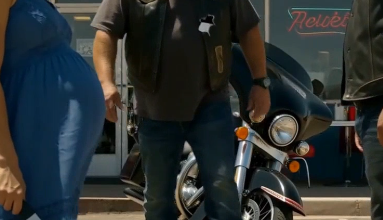
He looked like the kind of man you avoided at a gas station after dark. He had a heavy brow, busted knuckles, a scar through his bottom lip, and the posture of someone who always knew where the exits were. His Harley-Davidson Road King was black, road-dusty, and parked with a child’s booster seat strapped to the passenger backrest.
That booster seat made people more uncomfortable than the skull patch.
Because it asked a question nobody wanted to answer.
What kind of man like that had a little girl like her?
Her name was Daisy.
That was the second thing that didn’t fit.
A little girl named Daisy. A biker with a yellow daisy patch hidden inside his cut. A unicorn backpack. Purple glasses. Light-up sneakers. Small fingers wrapped around tattooed ones.
Daisy was in my daughter Emma’s class. They colored together, traded crackers, and argued once over who got the blue scissors. She was bright, stubborn, too serious when she listened, and the only child I ever saw thank the lunch lady every single day.
For months, nobody knew much about her father.
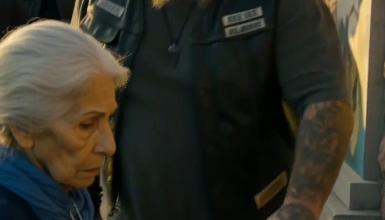
Daisy was usually picked up by her grandmother, a thin woman with tired eyes and a station wagon full of pharmacy receipts. Then one Monday, the grandmother stopped coming, and the biker started appearing at the fence every afternoon at 2:45 sharp.
The first day, parents stared.
The second day, they whispered.
By the end of the week, their fear had organized itself into a story.
Ex-con.
Club trouble.
Custody mess.
Bad influence.
Nobody said it to his face.
People rarely do.
They just moved their children a little closer when he walked by. They smiled too wide at Daisy and not at all at him. They watched his hands when he reached into his vest.
Those hands were rough. Split at the knuckles. Grease under one thumbnail. Tattooed letters across each fist. But every afternoon, before Daisy came out, he took a small pink hairbrush from his saddlebag and wiped it with a clean cloth.
That was the third thing that didn’t fit.
He would sit on the curb beside that big black Harley, holding a hairbrush like a weapon he had not learned to use yet.
One Tuesday, Daisy ran out with one braid falling loose. She shoved the backpack at him and turned around.
“Fix it, Daddy.”
Every parent within ten feet stopped pretending not to watch.
Rook stared at the braid like it was a bomb.
Then he crouched, placed the brush between his teeth, and tried.
His fingers were too big. The rubber band snapped once. Daisy sighed like a disappointed school principal.
“You’re doing it wrong.”
“I know,” he said around the brush.
“You need three pieces.”
“I got two hands.”
“You have to learn.”
He looked at her reflection in the motorcycle mirror.
“Yes, ma’am.”
That was the first time I heard his voice clearly. Low. Gravelly. Gentle because he was forcing it to be.
A week later, he could braid.
Not well.
But well enough that Daisy stopped correcting him in public.
The club came once.
Six bikers rolled in on a cold Wednesday, engines low, leather cuts, gray beards, tattoos, boots hitting pavement in a rhythm that made the preschool director step outside.
Parents panicked without moving.
Rook turned before they even reached the gate.
“Not here.”
One older Black American biker with a white beard raised both hands. “Brother, we brought the papers.”
“Not here,” Rook said again.
The old biker looked past him at the children inside the fence and nodded.
“Understood.”
They waited across the street at the gas station instead, standing beside their bikes, drinking burnt coffee from paper cups.
That was the first time I understood that whatever brotherhood he belonged to, Daisy came before it.
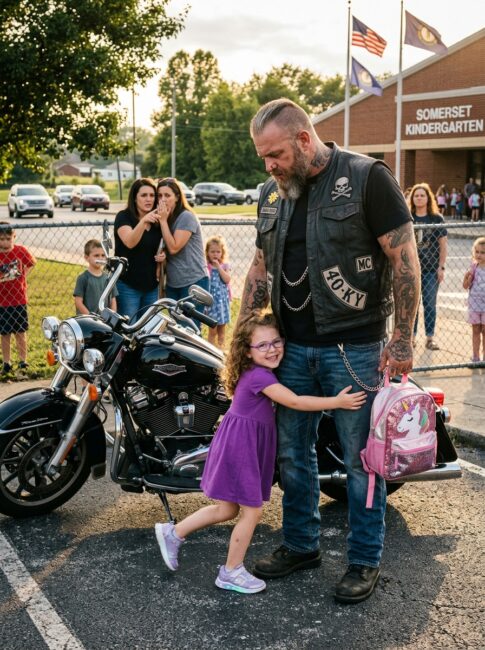
The crisis started with a birthday invitation.
My daughter Emma came home with a purple envelope that had stickers all over it.
“Daisy’s party,” she said. “Can we go?”
The invitation said Saturday, 1 p.m., Shelter Three, Pulaski County Park, near the lake.
I almost said yes.
Then I saw the small handwritten note at the bottom.
My daddy is making hot dogs. Please come.
It should have been sweet.
Instead, I hesitated.
I hate admitting that.
I had watched him for weeks. I had seen him braid hair, carry glitter backpacks, open juice boxes, wipe mud off light-up sneakers with the edge of his own shirt. Still, something in me paused at the idea of taking my child to a biker’s cookout.
That is how prejudice works when it wants to survive.
It dresses itself as caution.
We went anyway.
Emma begged. I gave in. I told myself we would stay thirty minutes.
When we arrived, Rook was already there.
He stood beside a smoking grill in a black T-shirt, tattoos exposed, leather cut hanging from the back of a folding chair. His Harley sat under a tree. Daisy had tied yellow balloons to the handlebars. The little daisy patch inside his vest flashed in the wind every time the leather moved.
There were cupcakes on a table. Paper plates. A cooler of juice boxes. A cheap unicorn piñata swinging from a branch.
And almost no children.
Two came.
My Emma and one boy from class whose father looked like he wished he had made another choice.
Daisy pretended not to notice.
That hurt to watch.
She stood in her purple birthday dress, curls brushed shiny, one front tooth missing, waiting for cars that did not come.
Rook noticed everything.
He did not complain. He did not call anyone. He did not let his face move.
He just turned hot dogs on the grill while his jaw tightened and loosened.
Every few minutes Daisy looked toward the road.
Every time, he looked with her.
By 1:40, the candles were melting in the sun.
Daisy walked to her father and whispered something.
He bent down.
“What?”
She whispered again.
His big hand closed around the spatula so hard the metal handle bent a little.
I saw it.
Then he nodded once.
“You want cake now?”
Daisy nodded.
Her eyes were wet, but she didn’t cry. Kids learn that from somewhere.
We sang.
Four adult voices. Three children. Wind off Lake Cumberland. A piñata twisting slowly like it was embarrassed.
Rook stood behind his daughter with both hands on her shoulders. His eyes were shiny, but nothing fell.
When she blew out the candles, he clapped first.
Loud.
Too loud.
Like he could make one pair of hands sound like twenty families.
After cake, the club arrived.
Not roaring in like a movie. Not trying to scare anyone.
They came slow. One by one. Engines cut at the park entrance. They rolled the last few yards by foot, boots scraping gravel, bikes ticking with heat.
Ten bikers. Then fifteen.
Men and women. White, Black, Latino. Old cuts. Clean cuts. Road-worn faces. Arms full of wrapped gifts.
Rook turned on them fast.
“I told you no club business.”
The older Black biker from the school pickup line stepped forward.
“This ain’t business.”
Rook’s voice dropped. “Preacher.”
The old man held out a gift wrapped in yellow paper.
“This is family.”
Daisy stared.
Every biker knelt or crouched before handing her a present, making themselves smaller the way big people should around little children. One woman with silver hair and tattooed forearms gave Daisy a handmade denim jacket with a tiny daisy sewn on the back.
Daisy put it on and spun once.
For five minutes, the party became what it should have been.
Then the black SUV pulled into the park.
I recognized it immediately.
I had seen it in the school parking lot the day Daisy stopped smiling.
Rook saw it too.
His whole body changed.
Not louder.
Still.
That was worse.
The SUV door opened, and a white American man in a pressed blue shirt stepped out with sunglasses, polished shoes, and a smile that made my stomach tighten before I knew why.
Daisy backed into her father’s leg.
The man smiled wider.
“Hello, princess.”
Rook stepped in front of her.
“You don’t call her that.”
The bikers behind him moved half a step.
Preacher raised one hand.
Nobody touched anyone.
But the air went hard.
The man in the blue shirt lifted a folder.
“I have court papers.”
Daisy gripped the back of Rook’s jeans.
And every parent who had been scared of the biker was about to learn they had feared the wrong man.
The man in the blue shirt was named Evan Mallory.
To most of us, he looked safe.
Clean shave. Nice watch. Smooth voice. County job. Church smile. The kind of man who says “ma’am” while doing something cruel.
He was Daisy’s mother’s husband.
Not Daisy’s father.
That was the first twist.
Rook was her biological father, but he had missed the first four years of her life because he had been in prison for aggravated assault after a bar fight off Route 80. He never denied it. He never polished it up. He had hurt a man badly and paid for it.
But the second twist was worse.
The man he hurt was Evan’s brother.
And the night of that fight, Daisy’s mother had been trying to leave Evan.
Rook had not been some random violent biker swinging at shadows.
He had walked into a gas station diner because his pregnant ex-girlfriend called him crying from the restroom. Evan’s brother had followed her there. Words became shoves. Shoves became fists. Rook ended it the only way he knew how back then.
Badly.
Too badly.
He went to prison. Daisy was born while he was inside. Her mother married Evan under pressure from a family that called stability anything with a paycheck and a clean shirt.
Then Daisy’s mother died in a winter wreck on Highway 27.
And custody became a war.
Evan had the house. The job. The haircut.
Rook had a record, a motorcycle, and a club patch.
You can guess who people believed first.
That folder in Evan’s hand was real enough to scare everyone. Temporary emergency custody hearing. Allegations. Unsafe environment. Criminal associates. Intimidation at school. A child exposed to motorcycle club activity.
He had collected every whisper from the kindergarten fence and turned it into evidence.
That was the third twist.
Our fear had become his weapon.
Rook stood there with his daughter behind his leg, and for the first time since I’d seen him, his hands trembled.
Not because he was afraid of Evan.
Because he was afraid of losing control.
Bikers like him know the cost of one bad second.
Preacher stepped beside him and said quietly, “Breathe, brother.”
Rook’s chest rose once.
Fell once.
Evan smiled.
“Still need handlers, Caleb?”
Rook did not answer.
Daisy looked up at him.
“Daddy?”
That one word did more than Preacher could.
Rook slowly opened both hands.
Empty palms.
No fists.
Then he looked at Evan and said, “Not today.”
Evan held out the papers.
Rook did not take them.
A woman from the club stepped forward instead. Latina, maybe fifty, sharp eyes, leather vest over a white blouse. She reached into her saddlebag and pulled out a business card.
“I’m his attorney.”
The whole park went quiet.
Rook looked at her like he had not expected that.
She glanced at him. “You never ask for help. That’s why brothers ignore you.”
Then she took the folder from Evan.
Her name was Marisol Vega, and she had ridden with the Iron Saints longer than Rook had been sober.
That was another thing nobody at the school fence would have guessed.
The club had welders, nurses, mechanics, two veterans, one retired principal, and a family attorney who could make a courtroom go silent just by clearing her throat.
Marisol read the papers under the park shelter while Daisy sat on Rook’s boot and hugged his leg with both arms.
I stood there holding Emma’s hand, feeling heat climb my neck.
Because I had whispered too.
Not as loudly as some.
But enough.
Enough to feed the thing that had come for him.
Marisol looked up from the folder.
“These allegations mention school pickup.”
Evan’s smile twitched.
“They mention parents feeling intimidated.”
Nobody spoke.
She looked around at us.
“Which parents?”
The father of the little boy at the party stared at the grass.
I stared at the lake.
Rook did not look at any of us. That made it worse.
Preacher finally said, “Folks get scared of leather quicker than they get scared of lies.”
Evan snapped, “This man is a convicted felon.”
Rook nodded once.
“I am.”
No excuse.
No speech.
Just truth.
Then Daisy stood.
She was so small under that park shelter. Purple dress. Denim jacket. Missing tooth. Birthday frosting on her chin.
“He braids my hair,” she said.
Everyone froze.
Evan’s face hardened.
Daisy kept going.
“He makes my lunch. He cuts the crust because I hate it. He reads the pig book wrong, but he tries. He sleeps on the floor when I have bad dreams.”
Rook closed his eyes.
She turned to the rest of us.
“And he waits outside my school because I asked him to.”
That sentence landed strange.
I crouched without thinking. “Why, honey?”
Daisy looked at the black SUV.
“Because Evan came once.”
Rook’s head snapped toward her.
“What?”
She looked down.
“He said if I was good, I could live in Mommy’s old room again. He said Daddy would go back to jail if I cried.”
The park went silent in a way I still remember.
Not peaceful.
Ashamed.
Rook knelt in front of her. His boots hit gravel. His leather creaked. His huge tattooed hands hovered beside her arms, not touching until she leaned into him first.
“When?” he asked.
His voice was so low I barely heard it.
“At school. By the fence. Before Grandma stopped coming.”
His jaw flexed.
Preacher took one step closer, but Rook lifted a hand.
No.
Not that way.
Not anymore.
He pulled Daisy into his chest and held her.
Marisol was already recording notes. “That will be reported.”
Evan’s polished smile disappeared.
“You people are insane.”
That was when I found my voice.
“No,” I said.
Everyone turned.
My throat felt tight, but I kept going.
“I saw the SUV at school. Last Friday. Daisy got scared when it pulled in.”
Another mother stepped forward, the same one who had whispered “poor child.”
“I saw it too.”
Then the grandmother with the grandson raised her hand.
“He never scared the children. We did that.”
It was not enough to fix anything.
But it was something.
Marisol took statements. The club formed a loose wall, not threatening, just present. Rook stayed on one knee with Daisy in his arms while the man in the blue shirt realized the parking lot was no longer built out of whispers.
The hidden daisy patch inside Rook’s vest made sense then.
Daisy had sewn it crooked with her grandmother after her mother died. She told him every daddy needed a flower inside “so his heart wouldn’t look scary.”
The pink hairbrush made sense.
He had bought six of them and practiced braiding on leather straps in his garage because Daisy cried the first time he pulled too hard.
The booster seat on the Harley made sense too.
He never took her on the highway with it. It was for slow rides across the farm road behind Preacher’s place, helmet on, one lap only, because Daisy said she wanted to know what Daddy heard when he came home.
And the club waiting across the street from school?
They weren’t there to intimidate anyone.
They were there because Rook was terrified Evan would show up again, and he knew one wrong move from him would cost Daisy everything.
So his brothers stood where he could see them.
Close enough to hold him back.
Far enough not to scare the kids.
That is brotherhood when it grows up.
Not fists.
Restraint.
The court hearing happened two weeks later.
I was there.
So were five other parents from Bluebell Creek, each of us carrying a little piece of shame and a statement.
Rook wore a button-down shirt that didn’t fit his shoulders and boots polished so hard they looked borrowed. His tattoos still crawled up his neck. The judge still saw them. Everybody did.
Daisy sat beside her grandmother, holding the unicorn backpack.
When the judge asked her where she felt safe, she looked at Rook.
“With Daddy.”
That was it.
No big speech.
No movie ending.
Custody stayed with Rook. Evan got investigated for approaching Daisy at school and for violations tied to the custody case. I don’t know all the legal words. I only know the black SUV stopped coming.
Every Friday after that, Rook still arrived at 2:45.
Same Harley. Same boots. Same leather creak. Same chain tapping his thigh.
But the pickup line changed.
Not all at once.
People are slow when pride is involved.
First, one father nodded.
Then a mother asked where he bought Daisy’s lunchbox.
Then the grandmother who used to pull her grandson away brought Rook a plastic bag full of hair ties because “girls lose these like socks in a dryer.”
He accepted them with a grunt.
“Thanks.”
That was Rook’s long speech.
Daisy kept running to him every afternoon.
Full speed.
Backpack bouncing.
Light-up sneakers flashing.
He always braced like the impact might knock the old life out of him.
On the last day of school, the children made Father’s Day cards.
Daisy’s had a motorcycle, a crooked yellow flower, and one sentence in purple crayon:
My dad looks scary but he makes pancakes shaped like hearts.
Rook read it in the parking lot.
His eyes went wet.
Nothing fell.
He folded the card once, careful as a prayer, and tucked it inside his cut behind the daisy patch.
That became his ritual.
Every afternoon, before starting the Harley, he touched that spot inside his vest.
Not in a dramatic way.
Just two fingers to leather.
Daisy noticed.
So did I.
Then the engine would turn over, low and rough, and Daisy would clap both hands over her ears while laughing.
He never revved it at school.
Not once.
He let it idle soft until they were away from the children.
A monster would have wanted attention.
A father knew better.
I saw them last fall at the diner off Highway 27.
Daisy was older by then, first grade, reading the menu out loud with one finger under each word. Rook sat across from her in the corner booth, leather cut folded beside him, coffee untouched, listening like she was reading law.
A man near the counter stared too long.
Rook noticed.
So did Daisy.
She put down the menu and looked at the stranger.
“That’s my dad,” she said. “He’s nice unless you’re mean.”
Rook coughed into his coffee.
The waitress laughed.
Outside, rain tapped the windows. His Harley waited under the neon sign, black paint beaded with water, yellow daisy sticker on the back of Daisy’s helmet.
When they left, he zipped her jacket to her chin, fixed one curl caught in the zipper, and set the unicorn backpack on her shoulders.
Then he crouched.
She climbed onto his back for a piggyback ride across the wet sidewalk, helmet bouncing against his chest, her laughter cutting through the sound of trucks on the highway.
At the bike, she turned and waved at me.
Rook nodded once.
The engine started low.
Not loud.
Not angry.
Just there.
Daisy wrapped her arms around him like she had at the kindergarten gate.
And the taillight disappeared down Highway 27.
A flower inside leather.
Follow the page for more biker stories that make you look twice before you judge.