Part 2: The Biker Covered a Sleeping Boy — Then the Vest Revealed Who He Was
Tulsa knows how to keep secrets in plain sight.
You can drive down Route 66 and see the neon, the murals, the diners selling nostalgia by the slice, the gas stations turned into photo spots. But two blocks behind the pretty signs, people sleep in cars, kids wait at bus stops too late, and old men sit in laundromats because the dryers are warmer than the shelters.
Grimm knew those streets better than the map did.
He wasn’t from Tulsa originally. Folks said he came from Muskogee, or maybe Fort Smith, or maybe nowhere at all. Bikers collect rumors the way other men collect receipts. Nobody knew what was true unless Grimm said it, and Grimm rarely said more than five words at a time.
His club was the Iron Saints.
They weren’t saints.
They would have laughed at the name if anybody outside the club said it too sweet. They were rough men. Ex-cons. Veterans. Mechanics. Roofers. Men with child support receipts folded in wallets beside bail bonds. Men who had done wrong and didn’t decorate it as wisdom.
But every Thursday night, they ran blankets and socks from Daisy’s Diner to the shelters near Denver Avenue.
Nobody posted pictures.
Nobody took credit.
They just loaded saddlebags and left.
That was Grimm’s rule.
“Help ain’t a billboard,” he told me once.
That was the longest sentence I had heard from him in six months.
I was thirty-two then, divorced, tired, working nights because days made me think too much. Daisy, the owner, had known the Iron Saints for years. She kept a donation bin near the jukebox. Gloves. Hats. Protein bars. Sometimes cash in envelopes with no names.
Whenever the bin got full, Grimm came.
He’d park his Harley by the curb, engine coughing low, heat shimmering above the pipes. Then he’d walk in wearing that black leather cut, patches faded from sun and rain, beard tucked into his collar when winter got sharp.
Most people saw the outside.
I started noticing the little things.
He never let the door slam if a kid was sleeping in a booth. He always asked Daisy if the back steps were salted before ice came. He carried dog food in his saddlebag for the stray pit mix that lived behind the tire shop. His hands looked like they had been built for breaking things, but he could fix a stuck zipper on a little girl’s coat without tearing the fabric.
And he never ate the last biscuit.
If Daisy set a plate in front of him, he’d eat half, wrap the rest in a napkin, and tuck it into his vest pocket.
“Hungry later?” I asked once.
He looked out the window.
“Somebody will be.”
There was a patch inside his vest I saw only twice before that night in the park.
A tiny green button stitched into the lining near his left ribs. Not leather. Not club colors. A cheap plastic button shaped like a dinosaur.
It looked ridiculous against all that black leather and road grime.
I asked Daisy about it.
She stopped wiping the counter.
“You ask him,” she said.
“Sounds like a bad idea.”
“It is.”
So I didn’t.
The Iron Saints treated Grimm like a president, though his patch only said ROAD CAPTAIN. Men listened when he spoke. Younger riders straightened when he walked by. Even a big Native American biker named Bear, six-foot-three and built like a door, dropped his voice around Grimm.
But there was one thing they pushed him on.
The park.
That little park across from Daisy’s had become a problem. Kids waited there for buses. Homeless folks slept under the pavilion. Dealers passed through sometimes, not loud, not stupid, just present enough to change the air.
The Saints wanted to clean it out.
Grimm said no.
“Kids still use it.”
Bear said, “That’s why we need to run off the trash.”
Grimm’s eyes got flat.
“People ain’t trash.”
That ended the meeting.
Or should have.
Because the next week, somebody from the club went there without him.
And that was when the sleeping boy became more than a boy on a bench.
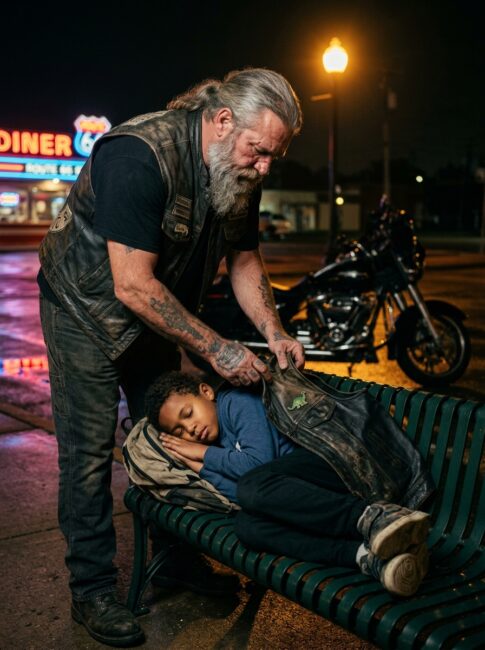
His name was Isaiah Reed.
I learned it from the school ID clipped to his backpack the morning after Grimm covered him with the vest. Ten years old. Black American. Fourth grade. Smile in the photo too big for the face I saw asleep under the streetlamp.
Grimm sat outside with him until dawn.
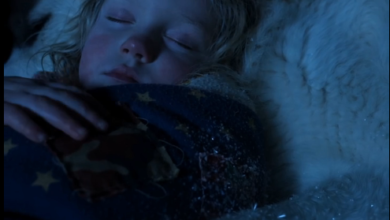
Not touching him. Not waking him. Just sitting on the end of the bench, elbows on knees, vest over the boy, his own arms bare in the cold.
At 5:15, the bus hissed to a stop.
Isaiah woke when the brakes sighed.
He shot upright, grabbed the vest, and almost fell off the bench.
Grimm didn’t move.
“Easy,” he said.
Isaiah stared at him like he expected trouble.
“You put this on me?”
“Cold.”
The boy looked at the vest, then at the skull patch, then at Grimm’s tattooed arms.
“You a gang?”
“No.”
“You look like one.”
“Been told.”
Isaiah held the vest out fast, like giving it back would make the whole thing disappear.
Grimm took it.
The boy grabbed his backpack and ran for the bus.
Halfway there, he stopped.
Turned.
“Thanks.”
Grimm nodded once.
That should have been the end.
It wasn’t.
Two nights later, Isaiah was back at the park.
Same bench.
Same backpack.
Same blue hoodie.
But this time, he was awake.
I saw him from the diner window, sitting with his feet tucked under him, watching the street like a kid who had learned to measure danger by headlights.
Grimm saw him too.
His jaw tightened.
He didn’t go outside right away. He waited. Gave the boy dignity. Let him exist without being questioned.
At midnight, rain started.
Not hard. Just enough to make the pavement shine and the neon smear red and blue in the puddles.
Grimm stood.
Daisy said, “Careful.”
He looked at her.
“Always.”
That was a lie, but a kind one.
He crossed the street with a paper bag in one hand. Biscuit. Apple. Hot coffee for himself. Hot chocolate for the boy.
Isaiah didn’t run this time.
Grimm set the hot chocolate on the bench between them.
“Diner messed up,” he said.
Isaiah looked at the cup.
“That for me?”
“Unless you hate chocolate.”
The boy waited, suspicious.
Then took it.
I couldn’t hear every word through the glass, but I saw enough. Grimm didn’t crowd him. Didn’t ask where his parents were. Didn’t act like a savior. He just sat beside him, rain dotting his beard, steam rising from the cups.
Then headlights turned into the park.
Three motorcycles.
Not Grimm’s.
Iron Saints.
Bear was one. Another was Cutter, a white American biker in his 40s with a shaved head, hard mouth, and the kind of pride that likes an audience. The third was a prospect I didn’t know.
They rolled up loud.
Too loud.
Isaiah flinched so hard he spilled hot chocolate on his jeans.
Grimm stood.
Slow.
Leather creaked as he turned.
Bear killed his engine first.
Cutter didn’t.
He revved once, sharp and mean, like he wanted the park to know who had arrived.
“Grimm,” Bear said, voice careful. “We heard there were folks hanging around again.”
Cutter looked at Isaiah.
“That one yours?”
The air changed.
Even from inside the diner, I felt it.
Grimm stepped between Isaiah and the bikes.
“No.”
Cutter smirked.
“Then why you babysitting him?”
Grimm’s hands hung loose at his sides.
That scared me more than fists.
“Ride away,” he said.
Cutter laughed. “Brother, we’re trying to help you clean up.”
Grimm walked closer.
The V-twin engines rumbled low, shaking puddles at the curb.
Isaiah stood behind the bench, clutching his backpack.
Bear said, “Cutter, shut it down.”
Cutter didn’t.
He pointed at the boy.
“Kids like that bring trouble.”
Grimm hit him with one sentence.
“So did I.”
Nobody moved.
Then Isaiah whispered something I heard only because the motorcycles cut off at once.
“I can go.”
Grimm turned his head just slightly.
“No,” he said. “You can stay.”
I thought that was the climax. A biker standing up to his own club for a homeless kid in the rain.
I was wrong.
The real break came when Isaiah saw the dinosaur button.
It happened the next morning.
Isaiah had fallen asleep in the back booth at Daisy’s. Grimm had carried him in after the storm got worse, not in his arms like a baby, because a ten-year-old boy with pride might hate that, but half-guided, half-supported, with one big hand resting between his shoulder blades.
Daisy made eggs.
Isaiah ate like he was trying not to look hungry.
Grimm sat across from him, black coffee untouched.
His vest hung on the hook by the register, drying. The lining had flipped open.
That tiny green dinosaur button showed.
Isaiah noticed it.
Kids notice what adults think they can hide.
He slid out of the booth, walked to the vest, and touched the button with one finger.
Grimm’s chair scraped back.
Not loud.
But fast.
“Don’t,” he said.
Isaiah froze.
Daisy stopped moving.
I stopped wiping the counter.
Grimm’s face had gone pale under the beard.
Isaiah pulled his hand back.
“Sorry.”
For a second, nobody breathed.
Then Grimm stood, walked to the vest, and took it down.
I thought he was going to leave.
Instead, he sat back in the booth and laid the vest on the table between them, lining up.
The green dinosaur button looked smaller there.
Cheap. Childish. Almost silly.
Grimm stared at it like it could bite.
“My boy sewed that on,” he said.
That was the first time any of us heard him mention a child.
Isaiah looked up.
“You got a son?”
Grimm’s throat moved.
“Had.”
The diner went quiet in the way rooms go quiet when grief takes a seat.
Grimm pulled a folded photograph from the inside pocket of the vest. The edges were soft, handled too many times.
In the picture, a younger Grimm stood beside a little white American boy with blond hair, missing front teeth, and a dinosaur backpack. The boy wore the same green button pinned crooked to his shirt.
“His name was Eli,” Grimm said.
Daisy covered her mouth.
I don’t know if she knew. Maybe part of it. Not all.
Grimm tapped the photo once.
“He was ten.”
Isaiah’s eyes dropped to his own hands.
Same age.
Same small shoulders.
Same need to look older than fear.
Grimm didn’t give us the whole story then. Just pieces.
Eli ran away after an argument. Not far. Just to a park near a bus stop in another town. It was cold. He had no coat because he wanted his father to see he was serious. Grimm was younger then. Angrier. A man who thought discipline meant volume and love meant providing but not bending.
He waited too long to go look.
By the time he found the bench, Eli wasn’t there.
Police found him later that night at a shelter intake center, safe but terrified. That should have been the wake-up call.
It wasn’t.
Grimm and Eli kept fighting. Father and son. Two hard heads. Two scared hearts. A year later, Eli got sick. Fast. Sudden. Hospital lights. Tubes. Words no parent wants.
The last thing Eli told him was, “You always find strangers faster than me.”
Grimm never recovered from that sentence.
The vest was not just a vest.
It was a promise made too late.
Every time Grimm covered someone with it, he was answering a boy who could no longer hear him.
Isaiah touched the table, not the button.
Then he said, very softly, “My mom works nights. I sleep there when her boyfriend comes over.”
Grimm closed his eyes.
Not long.
Just enough for the whole room to see the punch land.
After that, everything made sense.
The way Grimm always faced the window at Daisy’s.
The way he never rode past the park without slowing.
The biscuit in his vest pocket.
The donation runs nobody was allowed to photograph.
The dinosaur button stitched inside black leather like a soft secret under armor.
Even his silence had shape now.
He wasn’t quiet because he had nothing to say.
He was quiet because the one sentence that mattered most had come too late.
Isaiah did not become some miracle overnight. Real kids don’t work that way. He still lied when he was embarrassed. Still snapped when adults asked too much. Still kept one foot pointed toward the door, even indoors.
But he let Daisy pack him breakfast.
He let me call the school counselor.
He let Grimm sit across from him without pretending it wasn’t help.
His mother, Monique Reed, came to the diner three days later. Black American woman in her early 30s, exhausted eyes, nursing-home scrubs, winter coat with a broken zipper. She looked ready to fight the whole room if anyone judged her.
Grimm didn’t.
He stood when she came in.
That alone surprised her.
He said, “Ma’am.”
She looked at the beard, the tattoos, the vest, the boots.
Then at Isaiah.
“What happened?”
Isaiah stared at the table.
Grimm answered without making it worse.
“Kid needed somewhere warm.”
Monique’s face cracked for half a second.
Then hardened again.
“I’m doing my best.”
Grimm nodded.
“Looks heavy.”
That was all.
Not “Where were you?”
Not “How could you?”
Not a single word that would make shame louder than survival.
Monique sat down.
And for the first time, I saw what Grimm’s kind of protection really looked like. It wasn’t taking over. It wasn’t acting like a hero. It was making a little space where people could tell the truth without being crushed by it.
The truth came slowly.
Monique worked double shifts. Her boyfriend, Trent, wasn’t violent in the way police reports like. He didn’t leave marks. He just made the apartment feel unsafe. Yelled. Broke things. Took up all the air. Isaiah slept at the park on nights when the walls got too loud.
Daisy knew a woman who ran a church housing program.
I knew a social worker from my divorce support group.
Bear knew a landlord who owed the club money, though Grimm made it clear nobody was getting threatened. The Iron Saints passed the hat in the back room. Cash, grocery cards, one prepaid phone, three winter coats.
Cutter came too.
The same biker who had called the boy trouble.
He stood near the jukebox with his jaw tight and placed a sealed envelope on the counter.
Grimm looked at it.
Cutter said, “For the kid.”
Grimm waited.
Cutter looked at Isaiah.
“Sorry.”
One word.
Rough.
Real.
Isaiah didn’t answer.
He didn’t have to.
Brotherhood got tested in that diner, and not by fists. By humility. By whether big men could admit smallness. By whether a club built on loyalty could stretch that loyalty around a child none of them owned.
The answer was not perfect.
But it was enough.
Monique and Isaiah moved into a small apartment above a barber shop two weeks later. Not fancy. One bedroom. Radiator noise. Peeling paint. But the lock worked. The windows shut. The hallway light stayed on.
The first night, Grimm rode over with a toolbox strapped to his bike.
He fixed the deadbolt.
Replaced the chain.
Tightened the table legs.
Then he stood awkwardly in the kitchen while Monique tried to thank him.
He hated thanks.
Always did.
Isaiah stood by the door, wearing a new coat two sizes too big.
“You want your vest back?” he asked.
Grimm looked down.
Isaiah had been holding it folded in both arms.
The leather looked huge against him.
Grimm took it.
Then Isaiah pointed to the inside lining.
“Can I ask about the button again?”
Grimm looked at Monique.
She nodded.
He handed the vest back to Isaiah.
“Careful,” he said.
Isaiah touched the green dinosaur button with one finger.
Not grabbing.
Not prying.
Just acknowledging.
Then he said, “He must’ve liked you.”
Grimm’s jaw tightened.
“I was hard to like.”
Isaiah shrugged.
“Kids do it anyway.”
Grimm turned toward the window.
His eyes were wet.
He did not cry.
Not there.
Not in front of the boy.
But when he walked down the stairs, I heard his boots stop halfway.
For almost a minute, there was no sound at all.
Then the Harley started outside, low and broken and alive.
Winter passed.
Then another.
The park changed slowly, the way wounded places do when people stop treating them like lost causes.
The Iron Saints didn’t “take it over.” Grimm wouldn’t allow that.
They fixed the lights.
Repainted the benches.
Put a weatherproof box near the bus stop with gloves, socks, granola bars, and hand warmers. Daisy kept it stocked. Bear built it. Cutter painted it dark green and, without saying anything, added a small dinosaur sticker on the inside of the lid.
Every Thursday night, the club still ran supplies.
But Grimm added one more ritual.
At midnight, before going home, he rode past the park.
Slow.
Never loud.
He’d pull to the curb, kill the engine, and sit for three minutes. Sometimes nobody was there. Sometimes an old man slept under the pavilion. Sometimes a teenager waited for a ride that might or might not come.
If someone looked cold, Grimm left something.
A blanket.
A sandwich.
His gloves once.
But never the vest again.
Except on the coldest nights.
I saw it happen two more times.
Always the same way.
No announcement. No hand on the shoulder. No performance. He’d lay the vest down gently, like leather could apologize, then sit nearby until morning or until somebody safer came.
Isaiah grew.
At eleven, he started doing homework in Daisy’s after school.
At twelve, he helped me refill ketchup bottles and pretended he wasn’t proud when I paid him ten dollars.
At thirteen, he got tall and quiet and started wearing his hair longer.
At fourteen, he asked Grimm if he could ride around the block on the back of the Harley.
Monique said no before Grimm could answer.
Grimm said, “Listen to your mother.”
Isaiah rolled his eyes.
Normal.
That felt like a miracle.
On Eli’s birthday every year, Grimm rode alone to a cemetery outside Sand Springs. He never invited anyone. But one year Isaiah went with him. Not on the bike. Monique drove him.
They stood by the small headstone together.
Eli Harlan.
Beloved Son.
There was a little dinosaur carved beneath the name.
Isaiah left a green button on the grass.
Grimm stood with both hands folded over the handlebars of his parked Harley.
The wind moved through the cemetery trees.
No speeches.
Just the click of cooling pipes, the rustle of leather, and a boy standing beside a man who had once arrived too late and spent the rest of his life arriving early for strangers.
Grimm is older now.
His beard has gone almost white. His cloudy eye is worse. His hands shake when the weather turns, though he’ll glare at anyone who notices. The Road King still sits outside Daisy’s most nights, black paint dull, engine ticking under the neon window sign.
Isaiah is sixteen.
He works weekends at the barber shop under his apartment and still comes to Daisy’s for pancakes after school. He’s taller than his mother now. Not soft. Not hard either. Something better.
Steady.
Last December, a new kid appeared on the park bench.
Small white American boy, maybe nine, red hoodie, backpack under his head, sleeping under the streetlamp while traffic hissed along Route 66.
Grimm saw him from the diner window.
So did Isaiah.
For a second, neither moved.
Then Grimm reached for his vest.
Isaiah stopped him.
“I got it.”
He took off his own coat. Not leather. Just a cheap black winter coat with a torn cuff and a school logo on the sleeve.
He crossed the street while Grimm watched through the glass.
The boy on the bench didn’t wake.
Isaiah laid the coat over him carefully, then sat on the far end of the bench.
Not too close.
Not too far.
Grimm stood inside Daisy’s with one hand against the window.
His leather vest hung on the chair behind him, the green dinosaur button hidden inside where most people would never see it.
Outside, Isaiah looked back once.
Grimm nodded.
One time.
The Harley sat quiet at the curb.
The neon buzzed.
The boy slept warm.
And for once, Grimm didn’t have to cross the street.
Someone else already had.
Follow the page for more biker stories about the rough-looking people who show up quietly when nobody else does.