Part 2: The Biker Gave a Fatherless Girl His Pink Crown — Two Years Later, She Wore It Into Court
My name is Hannah Brooks.
I had worked at Starlight Children’s Home in Memphis for nine years by the time Lily met Grave.
I had learned not to make promises too quickly.
Children in residential care hear promises differently. Adults say things casually. Children carry them for months.
That was why the Princess Ride mattered to us.
It was not a parade built around motorcycles. Not really.
The motorcycles were the noise at the edges.
The children were the center.
The River Kings started the ride after one of their members, a mechanic named Rooster, volunteered to repair a broken playground gate at Starlight. He noticed the girls watching the motorcycles from behind the fence whenever the bikers arrived with tools.
One child asked whether princesses could ride motorcycles.
Rooster said, “Sure. Long as they wear helmets.”
The following spring, the first Princess Ride happened.
The club worked with the city and our staff to create a safe escorted route. The sidecars were inspected. Every child wore a helmet and a seat belt. Nobody raced. Nobody showed off. Engines stayed quiet near the home until staff gave the signal.
The men took the rules seriously.
Bear carried spare ear protection in his saddlebag.
Rooster checked every buckle twice.
A younger member named Finch kept a box of juice pouches in the chase vehicle.
Grave stood apart from the others.
His real name was Daniel Graves, but nobody called him Daniel. He worked nights maintaining freight equipment near the rail yard south of downtown. He lived alone in a narrow brick house off Highway 51 with a garage that smelled like oil, old coffee, and cut metal.
The club knew him as reliable.
Not warm.
Reliable.
If somebody broke down along I-40 at two in the morning, Grave arrived with a trailer before anyone finished explaining the problem. If a brother needed money, he quietly placed folded bills inside an envelope and refused to discuss repayment. When Rooster’s mother died, Grave sat on the porch beside him until sunrise without offering advice.
He had never married.
He had no children.
At least that was what we believed.
The morning of the seventh ride, Lily had been matched with Grave because she preferred quiet adults. Loud friendliness made her nervous. Grave understood silence.
Before the convoy left, he did something I did not notice until later.
He folded Lily’s unused crown and placed it inside the left pocket of his vest.
Then, when she refused to wear one, he gave her his own.
The ride followed Riverside Drive beneath a bright Tennessee sky. The Mississippi River moved brown and steady beside the road. The Harleys rolled in a controlled line, engines pulsing low enough that the children could still hear one another laugh.
Grave wore no crown after giving his to Lily.
That bothered her.
At the first stop near Tom Lee Park, she lifted the crown from her own head and held it toward him.
“You need one too.”
Grave looked at the glittery paper.
Then he reached inside his vest and unfolded the crown he had saved.
It was too small for his head.
He wore it anyway.
The elastic band caught in his beard.
Lily laughed.
Not politely.
Not nervously.
A full laugh.
Grave looked toward her and, for one brief second, smiled.
Rooster nearly dropped his coffee.
Later, a photographer caught the image that traveled across the internet: Grave on the motorcycle with a crooked pink crown above his weathered face, Lily secured safely in the sidecar behind the small windshield, her tiny gloved hand holding the edge of his vest as they rolled past the brick buildings downtown.
People saw the contrast.
Leather and glitter.
Tattoos and ribbons.
A large silent biker and a small girl in a blue dress.
They did not see what happened afterward.
When the ride ended, Lily did not want to give the crown back.
Grave crouched beside her.
“Keep it,” he said.
She looked down at the paper crown.
“You coming next year?”
Grave answered too quickly.
“Yeah.”
Then he paused.
Adults at Starlight learn to recognize the moment someone realizes a promise has weight.
Grave looked at me.
I said nothing.
He looked back at Lily.
“Yeah,” he repeated. “I’ll be here.”
That evening, after the motorcycles rolled away, I found something on the folding table where the bikers had left their coffee cups.
A second paper crown.
Grave’s crown.
On the inside, written in thick black letters, were four words:
LILY — RIDE OR DIE.
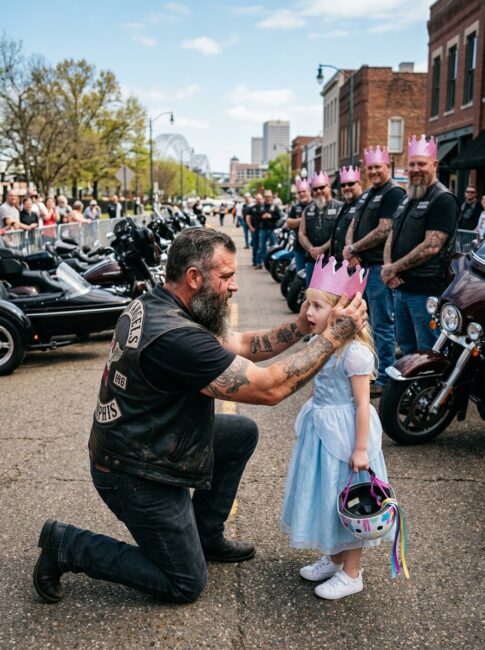
The photograph went viral by Monday morning.
Eight million views.
Thousands of comments.
Local television stations called Starlight. A national page reposted the image with a long caption about kindness. Strangers offered dresses, toys, and money.
Some meant well.
Some wanted content.
We protected Lily’s privacy as much as possible. Her name did not appear in public posts. Grave refused every interview.
When a reporter approached him outside the freight yard, he kept walking.
“No cameras around the kid,” he said.
That was his full statement.
Then ordinary life returned.
That is where most viral stories end.
Ours did not.
The first Saturday after the ride, Grave arrived at Starlight with a cardboard box on the back seat of his truck.
Inside were twenty plastic storage bins with lids.
He had noticed that the princess dresses were stored in old garbage bags between events. Some crowns had been crushed. Several ribbons had tangled together.
He labeled each bin carefully.
DRESSES.
CROWNS.
HELMET DECORATIONS.
EAR PROTECTION.
Then he repaired a broken shelf in our supply room without asking for help.
Lily followed him from a cautious distance.
She did not talk much.
Neither did he.
At noon, she handed him a juice pouch.
Grave took it.
“Thanks.”
“You like apple?”
“Guess I do now.”
The visits continued.
Not every week at first.
Then nearly every week.
Grave never arrived with grand gestures. He brought practical things.
A replacement wheel for a scooter.
A small toolbox for the maintenance closet.
A used bookshelf sanded smooth and repainted.
When Lily had a school project about Tennessee history, Grave sat at a child-sized table and helped her glue pictures of the Mississippi River onto poster board. His fingers stuck together twice. Lily found that hilarious.
One afternoon, I asked why he kept coming.
Grave tightened a loose screw on a chair.
“Gate needed fixing.”
“The gate was fixed months ago.”
He stared at the screw.
“Other stuff breaks.”
That was all.
By winter, Lily started waiting near the front window on Saturdays.
Grave started carrying colored hair bands inside his vest because Lily occasionally forgot hers. He learned which yogurt she liked. He remembered that she hated grape-flavored medicine and loved drawing horses badly.
The River Kings noticed.
The brotherhood was tested when Grave stopped joining some Saturday rides.
At first, a few men joked about him trading highway miles for glitter glue.
Grave let the jokes pass.
Then one Saturday, a club repair project overlapped with Lily’s school holiday performance.
The project mattered. A longtime brother named Finch had lost work after an injury. The club planned to rebuild his porch ramp and repair the roof before winter rain returned.
Grave promised to be there.
He also promised Lily he would watch her sing.
The performance began at ten.
The repair project started at eight.
Grave arrived at Finch’s house before sunrise. He unloaded lumber, measured the damaged boards, and worked without stopping. His boots struck the porch. The drill whined. Cold air carried the smell of sawdust and coffee.
At 9:22, he checked the time.
The porch ramp was unfinished.
Rooster looked toward him.
“Go,” he said.
Grave shook his head.
“Finish first.”
Bear picked up the drill.
“We finish.”
Grave looked at the half-built ramp.
Finch, standing in the doorway with a cane, spoke quietly.
“Brother. Don’t make that girl scan an empty room.”
Grave left.
He entered the school auditorium three minutes before Lily walked onstage.
His leather cut creaked as he sat in the back row. A pink paper crown rested on his knee.
Lily saw him.
Her shoulders relaxed.
She sang louder.
I thought that was the ending.
A man with no children had learned how much an empty chair could hurt.
But after the performance, Lily ran toward Grave and wrapped her arms around his waist. Her hands could not reach each other across his back.
She looked up.
“Can you be my dad again today?”
Grave froze.
His large hands hovered above her shoulders.
For the first time since I had known him, he looked frightened.
Grave did not answer immediately.
The auditorium emptied around us. Folding chairs scraped the floor. Parents gathered coats. Children carried paper snowflakes and half-eaten cookies toward the exits.
Lily kept holding him.
“Can you?” she asked again.
Grave lowered one hand carefully onto her shoulder.
“Today,” he said.
The word sounded smaller than he intended.
Lily accepted it.
Children learn to survive on small pieces of certainty.
That evening, Grave sat in his garage for nearly two hours with the Harley cooling beside him. Rooster told me later that nobody spoke. The club had returned from Finch’s house after finishing the porch. They found Grave holding the pink crown Lily had given him after the performance.
It had bent along one side.
Glitter clung to his glove.
Rooster asked the only question that mattered.
“You gonna keep saying ‘today’?”
Grave looked at the crown.
Then he said, “Don’t know how.”
Rooster understood what he meant.
Becoming a dependable visitor was one thing.
Becoming a parent was another.
There were background checks. Training classes. Home inspections. Court hearings. Paperwork thick enough to discourage anybody searching for an easy emotional ending.
Grave had lived alone for years.
His refrigerator contained coffee, eggs, and hot sauce.
His spare room stored motorcycle parts and old tools.
He worked nights.
He had never packed a school lunch.
There was another reason he hesitated.
When Grave was twelve, his father left.
No dramatic goodbye.
No final argument.
One day his father’s truck was gone. So were half the clothes in the closet.
Grave waited near the window for weeks.
Then months.
He told nobody.
At school, he learned to stop expecting people to return.
Later, he found brotherhood with men who understood promises made in actions rather than speeches. He became the person who arrived with a trailer at two in the morning because he could not tolerate the idea of someone waiting alone beside a road.
But he had never trusted himself with a child’s future.
“What if I mess it up?” he asked Rooster.
Rooster sat beside him on an overturned bucket.
“You will.”
Grave looked toward him.
Rooster shrugged.
“Parents mess up. Then they show up again.”
The following Monday, Grave requested a meeting with our director.
He wore his cleanest black jeans and carried a folder containing documents he had already begun collecting.
Pay stubs.
References.
A copy of his lease.
A list of training courses.
The pink crown remained folded inside the left pocket of his vest.
“I want to apply,” he said.
Our director looked at him carefully.
“For what?”
Grave’s jaw tightened.
He used more words than I had ever heard him use in one breath.
“To be there when ‘today’ turns into tomorrow.”
The process took time.
That mattered.
Lily was not a prize at the end of a viral story. Grave was not approved because strangers liked a photograph of him in a paper crown.
He completed every required step.
He attended parenting classes after overnight shifts at the freight yard. Sometimes he arrived with coffee strong enough to smell across the room. He sat near the back, leather cut folded over his chair, and filled notebooks with blunt questions.
How do you respond when a child tests boundaries because stability feels unfamiliar?
What do you do when a child hides food?
How do you handle nightmares?
How much silence is too much silence?
The instructor told me Grave asked fewer questions than most people.
But the questions he asked had weight.
He converted the spare room into a bedroom.
The River Kings helped.
Bear carried boxes upstairs.
Finch assembled shelves using one hand and more determination than patience.
Rooster argued with a set of curtains for nearly an hour.
Grave painted the walls a soft blue because Lily once pointed toward a crayon and said it looked like the sky after rain.
He placed the princess crown in a clear plastic box on the dresser.
Not as decoration.
As a reminder.
Lily visited the house gradually, supervised at first. She inspected every room with the serious expression of a building inspector.
In the kitchen, she opened the refrigerator.
“You need snacks.”
Grave nodded.
“Write a list.”
She did.
Apples.
Cheese sticks.
Strawberry yogurt.
Crackers shaped like fish.
At the bottom, she added:
CROWN STORAGE.
Grave taped the list to the refrigerator.
The club changed too.
The men who once arrived for a yearly ride began volunteering throughout the year.
Not all at once.
Not perfectly.
Rooster repaired bicycles at Starlight.
Bear organized a quiet reading hour.
Finch built new benches for the playground after his porch healed.
The Princess Ride remained the loudest day of the year, but the quieter Saturdays became the part that mattered most.
That was the brotherhood Grave needed.
Not men cheering from the curb.
Men willing to assemble a child’s bookshelf after working all week.
Men willing to learn that showing up for Lily meant respecting boundaries, schedules, staff, and a process designed to protect her.
Grave passed each inspection.
Then came the setbacks.
A court date moved.
A document needed correction.
A required training session overlapped with a freight-yard emergency.
For one tense week, Grave thought the delay might become permanent.
He did not tell Lily.
But she noticed the change in him.
During a supervised visit, she found him sitting on the front steps of Starlight with both hands wrapped around a paper coffee cup.
His Harley waited near the curb. The engine had gone quiet, but the metal still ticked as it cooled.
Lily sat beside him.
“You sad?”
Grave looked toward the road.
“Worried.”
“About what?”
He considered the answer.
“Waiting.”
Lily nodded as if she understood exactly.
She did.
Then she slipped something beneath his hand.
The old pink crown.
The same one he had placed on her head at the Princess Ride.
One side remained bent. Most of the glitter had worn away. The elastic band had stretched.
“You kept it?” Grave asked.
Lily looked offended by the question.
“You said nobody gets to say different.”
Grave stared at the crown.
His eyes reddened, but he did not cry.
Not then.
He placed it gently on her head.
“Still fits.”
Two years after the first ride, the final hearing took place at the courthouse in downtown Memphis.
Lily wore a yellow dress, white shoes, and the old crown.
Not a new one.
The old one.
Grave wore dark jeans, clean boots, and a black button-down shirt beneath his leather cut. The club waited outside rather than crowding the courtroom. They understood that this moment belonged to Lily.
Only Rooster entered.
He sat in the back row holding a handkerchief he pretended not to need.
The judge reviewed the documents.
Then she looked toward Grave.
“Mr. Graves, before I finalize the adoption, is there anything you would like to say?”
Grave looked at Lily.
She reached for his hand.
His fingers closed around hers.
“I waited my whole life for somebody to call me Dad,” he said.
His voice cracked once.
He continued.
“She gave me that. I didn’t save her.”
He looked down at the bent crown.
“She saved me.”
The courtroom stayed quiet.
Then Lily tugged his sleeve.
“Dad?”
Grave crouched beside her.
She adjusted the crown on his head.
It barely fit.
But he wore it anyway.
The Princess Ride continued.
The following spring, twenty-two girls joined the route.
The city approved the escorted path along Riverside Drive again. Sidecars were inspected. Buckles were checked. Helmets were decorated with ribbons that could be removed safely after the ride.
The Harleys lined up beneath the Memphis morning sun.
Engines pulsed low.
Leather creaked.
Boots crossed pavement.
One by one, the girls handed paper crowns to the bikers assigned to ride with them.
Grave arrived early.
He brought Lily on the back seat of his truck because she was not interested in pretending the day was only about her anymore. She wanted to help.
She carried a plastic bin marked:
EXTRA CROWNS.
The old crown remained at home inside its clear box.
For the ride, she had made Grave a new one.
Pink paper.
Silver glitter.
Crooked handwriting across the front:
DAD.
Grave examined it.
“Little loud.”
Lily placed it on his head.
“Wear it.”
Grave sighed.
“Yes, ma’am.”
That was the longest argument he offered.
Before the convoy departed, Lily noticed another girl standing apart from the group.
The child was new to Starlight. Five years old. Quiet. Nervous.
She held a crown but would not put it on.
Lily walked over.
I stayed close enough to help if needed.
She did not ask the girl why she was afraid.
She simply sat on the curb beside her.
Grave watched from several yards away.
His arms rested at his sides.
He did not interrupt.
After a minute, Lily removed the spare crown from her own head and placed it gently over the girl’s braids.
“You can borrow mine,” she said.
The girl touched the glitter.
“What about you?”
Lily looked toward Grave.
“My dad has extras.”
Grave reached inside his vest.
He did.
Three crowns, carefully folded inside the left pocket.
The same pocket where he had stored Lily’s crown years earlier.
The engines started a few minutes later.
The sound rolled between the downtown buildings and toward the river.
People on the sidewalk stopped to wave.
Grave rode near the front of the line with the glittery DAD crown resting above his weathered face.
Lily rode safely in the sidecar, secured beneath the belt, one gloved hand resting against the edge of his leather cut.
Her fingers had grown.
They almost reached around his side now.
That evening, after the ride, the River Kings gathered near a diner off Highway 51.
The motorcycles cooled in a row outside.
Metal ticked softly.
Inside, the air smelled like coffee, fried potatoes, and rain-damp leather. Crowns rested on the table beside empty plates. Glitter had found its way into Grave’s beard.
Rooster noticed.
He said nothing.
Lily sat beside Grave in the booth, drawing with a purple crayon.
She sketched twenty motorcycles beneath a large crooked sun. Every biker wore a crown. Every sidecar carried a princess.
Near the front of the picture, one figure was larger than the others.
A square body.
A dark beard.
A pink crown.
Beside him, Lily drew herself holding his hand.
She slid the picture across the table.
Grave studied it carefully.
“Need a frame,” he said.
On the drive home, rain softened into a fine mist over Memphis.
Grave parked the truck beside the garage. His Harley stood inside beneath the yellow work light. The old pink crown remained in its clear box on Lily’s dresser, bent along one edge and missing most of its glitter.
Lily changed into pajamas, brushed her teeth, and climbed into bed.
Grave paused near the doorway.
“You need anything?”
She shook her head.
Then, as he turned away, she called after him.
“Dad?”
Grave stopped.
“Yeah?”
“Good night.”
The leather at his shoulders shifted as he nodded.
“Night, princess.”
Later, he sat on the garage steps with a mug of coffee growing cold in his hands.
The street stayed quiet.
No applause.
No cameras.
No engines.
Just a narrow house near an old road, a motorcycle beneath a work light, and one paper crown resting safely upstairs.
This time, somebody came home.
Follow the page for more biker stories about the people beneath the leather.