Part 2: The Biker Never Helped My Son Up — Then I Found the 34 Marks Inside His Vest
My name is Rachel Mercer. At the time, Jamie and I had lived on Calder Street for three years, in a rental with a porch that leaned slightly left and a kitchen faucet that groaned before it gave us hot water.
Our road dead-ended behind a shuttered textile warehouse. At the other end sat the Shell station and the on-ramp that fed traffic toward Knoxville.
Clutch lived in the last house before the warehouse.
His real name was Daniel Harlan, but nobody called him Daniel. He had repaired Harleys for most of his adult life inside a cinder-block garage behind his house. Riders came from two counties over because he could listen to an engine idle for ten seconds and hear the problem hiding inside it.
His garage always smelled like gasoline, hot metal, leather, and the burned coffee he kept in a dented thermos.
The first time Jamie went there, I followed three steps behind him.
A chain rattled somewhere inside. A radio played low. Clutch’s boots scraped across the concrete as he pushed the blue bicycle into the daylight.
Four motorcycles stood beneath hanging shop lights. One black touring bike gleamed near the workbench. Another Harley sat under a canvas cover, its outline dusty and untouched.
Three other bikers were there.
Preacher was a narrow man with a white beard and a faded club patch. Moose was built like a refrigerator. Lena wore her dark hair in one braid and kept a wrench tucked into the back pocket of her jeans.
They looked like the sort of people parents watched from across parking lots.
Moose was pumping air into a bicycle tire.
Lena tightened the left brake lever.
Preacher placed a small black helmet on Jamie’s head and adjusted the strap with hands so careful they looked borrowed from somebody else.
“Too tight?” he asked.
Jamie swallowed. “No, sir.”
Preacher nodded.
“Good. Means you got a brain worth protecting.”
Clutch walked the bicycle into the street. He did not give a speech about courage. He did not explain balance or momentum. He placed one thick hand on the back of the seat and told Jamie to pedal.
For the first twenty yards, Clutch jogged beside him. His vest creaked. The chain on his wallet slapped against his thigh.
Jamie wobbled, overcorrected, and planted both feet on the road.
“Again,” Clutch said.
On the third try, Jamie fell.
He hit his left knee and rolled onto his palms. I stepped off the curb, but Clutch lifted one hand without looking at me.
Not angry. Not commanding.
Just wait.
Then he lowered himself onto the asphalt beside my son. It took effort. One knee popped loudly. He rested his forearms on his thighs and stared at the thin line of blood forming beneath Jamie’s torn jeans.
He did not say, “Be tough.”
He did not say, “Get up.”
He did not say anything.
Cars passed at the far end of Calder Street. Somewhere beyond the houses, a truck downshifted on Route 11.
After maybe twenty seconds, Jamie planted both palms on the road, pushed himself upright, and reached for the handlebars.
Clutch stood when Jamie stood.
“Again,” he said.
Five o’clock. Every afternoon.
That was the routine.
The other bikers drifted in and out, sometimes bringing small things without making a production of it: a brighter rear light, a bottle of cold water, reflective tape, gloves with padded palms.
Nobody clapped. Nobody babied him. Nobody laughed when he wobbled.
I also started noticing things about Clutch that did not fit the picture I had built in my head.
He kept dog biscuits near his garage for a stray hound that wandered the neighborhood. He carried groceries onto Mrs. Alvarez’s porch when her arthritis flared up. Every Thursday, his club rode together to a veterans’ home outside Knoxville and fixed loose rails, broken wheelchairs, and anything else the staff had written on a legal pad.
There was another detail.
Every time Jamie fell, Clutch’s right hand moved to the inside of his vest.
Not over his heart.
Lower. Near the seam.
His fingers pressed there for a second, then released.
By the twelfth fall, I knew something had been sewn into that leather.
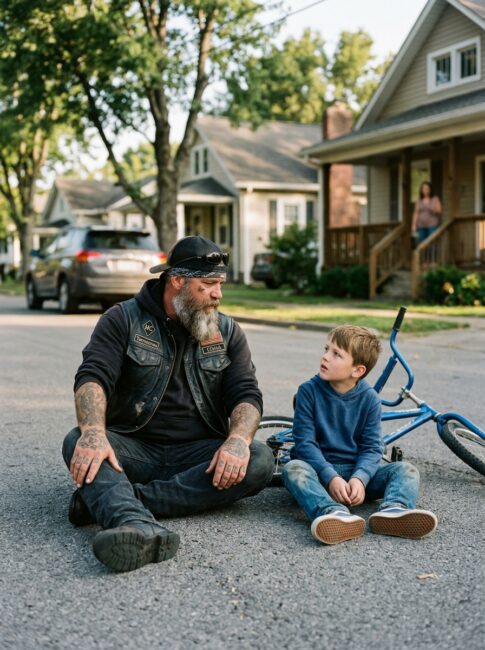
Jamie improved slowly.
That sounds harmless when you say it fast. It was not harmless while it was happening.
He fell on his elbows. He fell on his shoulder. He tipped into a patch of crabgrass and came up with dirt in his hair. Once, he clipped the curb and landed so hard the bicycle bell rang by itself.
That thin silver note made every adult on the street freeze.
It was fall number nineteen.
I started counting because Jamie asked me to. He kept the total in a spiral notebook beside his bed, each fall marked by a crooked line.
He did not hide the number.
He treated it like proof that he was doing something difficult on purpose.
Still, there were days I hated Clutch a little.
On fall twenty-three, Jamie scraped both palms raw. I rushed from the porch with antiseptic and gauze. Clutch sat beside him as always, broad shoulders bent, beard moving slightly with every breath.
“Say something,” I snapped.
Clutch looked up at me.
“He knows I’m here.”
“He is ten.”
“I know.”
“He is bleeding.”
“I know.”
“Then help him.”
For one second, something sharp passed behind Clutch’s eyes.
Not anger at me.
Something older.
Something with teeth.
“If I lift him,” he said quietly, “he learns to wait for hands that might not come.”
I hated that sentence the moment he said it.
It sounded too close to the story of Jamie’s life. His father promised birthday calls and forgot them. He promised weekend visits and canceled at the last minute. Jamie had learned to watch driveways without appearing to watch them.
I knelt and cleaned his palms.
Clutch did not stop me.
But he did not offer Jamie a hand.
Jamie stood on his own.
By the end of the second week, he could ride thirty feet before panic made him jerk the handlebars. By the third, he could make it beyond our mailbox.
The kids from two houses down began waiting near the curb. At first they teased him because children can smell embarrassment faster than adults can.
Then something changed.
They stopped teasing.
They started watching.
Fall thirty-one happened after a summer storm. The road looked dry, but a ribbon of mud had washed from a yard onto the asphalt.
Jamie’s rear tire slipped.
His hip hit first. Then his helmet knocked against the pavement with a hollow sound that turned my stomach cold.
He did not move.
I ran.
Clutch moved faster.
For a big man with an old knee, he crossed those few yards with terrifying speed. He dropped beside Jamie and braced both hands against the road, close enough to touch him but not touching.
“Jamie,” he said.
My son blinked.
“Talk to me.”
“My elbow hurts.”
“Head?”
“No.”
“Neck?”
“No.”
Clutch’s hands trembled.
That was the first time I saw it.
His scarred fingers shook against the asphalt as if the road itself had started vibrating beneath him.
Jamie was bruised but okay. Training ended early.
That night, after Jamie fell asleep, I heard a motorcycle engine start at the end of the street.
It was not the smooth rhythm of Clutch’s Road King.
The sound coughed once, caught, and settled into an uneven idle.
I looked through the curtains.
The canvas cover was off the dusty Harley in Clutch’s garage. Under the streetlight, I could see dark red paint.
Clutch sat on the bike without moving.
Preacher stood beside him. Neither man wore a helmet. Neither appeared to be leaving.
After a minute, Preacher placed one hand on Clutch’s shoulder.
Clutch shut the engine off.
The silence afterward felt heavier than the noise.
On Monday, Jamie got back on the bicycle.
Fall thirty-three left a black streak on his shin and made him swear under his breath. I pretended not to hear. Clutch almost smiled.
Fall thirty-four happened near the warehouse gate.
Jamie had made it farther than ever. His shoulders loosened. His pedaling smoothed out. For three seconds, he looked like every other child on the street.
Then he turned to see whether Clutch was watching.
The front wheel twisted.
Jamie went down.
The blue bicycle skidded sideways. The bell rang once. His notebook flew from the basket and landed open on the asphalt, showing thirty-three penciled lines.
Jamie sat up slowly. Dust streaked his face.
“I can’t do it,” he said.
Clutch lowered himself onto the road beside him.
For a long time, he did not speak.
Then he reached inside his vest.
PHẦN 4 — THE TWIST
I expected a rag. Maybe a photograph. Maybe one of those old military coins veterans carry in their pockets.
Clutch pulled out a narrow strip of faded denim stitched into the inner lining of his leather cut.
Along one edge were thirty-four short marks drawn in black ink.
Jamie stared at them.
So did I.
Clutch ran his thumb over the marks. His hand had stopped shaking, but his voice had not.
“My boy made these,” he said.
That was the first time I heard about Eli.
Seventeen years earlier, before Jamie and I moved to Calder Street, Clutch had a ten-year-old son with skinny knees, a loud laugh, and a stubborn streak that matched his father’s.
Eli had been born with weakness in his left leg. Nothing dramatic enough for strangers to understand. Just enough poor coordination to make every physical milestone harder than it looked for other children.
When Eli decided he wanted to ride a bicycle, Clutch rebuilt one for him.
Blue paint.
Chrome handlebars.
Silver bell.
The same bicycle lying on its side beside my son.
Eli fell thirty-four times while learning to ride it.
Each time, Clutch sat beside him and waited.
“I tried lifting him the first few times,” Clutch said. “Kid got mad. Told me sitting there was enough.”
Jamie looked down at the denim.
“What happened after thirty-four?” he asked.
Clutch swallowed once.
“He rode.”
That should have been the whole twist.
It was not.
Eli died eight months later when a drunk driver crossed the center line on a wet stretch of Route 11.
Clutch had been working late in his garage. He was supposed to ride behind Eli to the diner, where Eli’s mother, Nora, was finishing her shift. The boy wanted to show her he could pedal the entire mile without stopping.
Clutch told him to wait ten minutes.
Eli did not.
The tiny red bicycle reflector on Clutch’s key ring came from Eli’s rear fender.
The denim strip came from the jeans Eli wore on the day he finally learned to ride.
The thirty-four marks had been drawn by Clutch’s own hand, one after every fall.
Jamie stared at the road. Then at the bicycle. Then at Clutch.
“You didn’t fix it for me,” he said.
Clutch’s eyes turned wet, but nothing fell from them.
“No,” he said. “Not at first.”
PHẦN 5 — REVELATION
Later, Clutch told me the rest in pieces.
Bikers rarely hand you their whole history in one clean speech. They drop a sentence while tightening a bolt. They leave a photograph on a workbench and let you find it. They tell another brother something in front of you because saying it directly would feel like standing naked in a parking lot.
I learned that Clutch nearly sold the bicycle three different times.
He could not bear looking at it.
He could not bear letting it go either.
After Eli died, Clutch hung it from hooks in the back of the garage and covered it with an old moving blanket. Dust settled on the handlebars. The tires cracked. The chain stiffened.
Years passed.
Nora stopped riding after the funeral. Her dark red Harley disappeared beneath a canvas cover. When cancer took her six years later, Clutch kept the motorcycle because she asked him to.
For eleven years, it remained silent.
Then Jamie started walking behind the neighborhood kids every afternoon.
Clutch noticed because Clutch noticed children pretending not to want things.
He saw Jamie stop near the Shell station while the others looped through the parking lot. He saw him laugh when they laughed, then stare at the spinning wheels when he thought nobody was watching.
One Thursday night, Clutch took the blanket off Eli’s bicycle.
He stood there for an hour.
Preacher found him because the two men had planned to replace a starter on a club brother’s bike. Clutch had one hand on the blue frame and the other pressed against his mouth.
Preacher did not ask if he was all right.
He knew better.
He picked up a rag and started wiping dust from the wheels.
By midnight, Moose was there with new tubes. Lena arrived with brake cables and a small toolbox. Another brother called Rooster found the right tires at a shop in Knoxville and left them outside Clutch’s garage before sunrise.
Nobody offered a speech.
Nobody suggested a ceremony.
They simply worked.
That was the first thing I had misunderstood.
The bicycle had not come from one feared man at the end of our street.
It had come from a brotherhood willing to sit inside another man’s grief without forcing him to explain it.
The hand-stitched seat came from Nora’s old leather work apron.
The bell was original.
Clutch refused to replace it.
Two days after Jamie’s thirty-fourth fall, I found Clutch alone in the garage. The bicycle stood against the wall. Jamie was inside our house doing homework. I had walked over to return the thermos Clutch left on my porch.
He was turning Eli’s red reflector over in his palm.
“Why now?” I asked.
He looked toward the bicycle.
“Got tired of keeping a kid’s bike like a headstone.”
I sat on an overturned milk crate. The shop light buzzed above us.
“I thought you were teaching Jamie,” I said.
“Was.”
“Only Jamie?”
Clutch rubbed the edge of the reflector with his thumb.
He did not answer.
He did not need to.
That was the second thing I had misunderstood.
Every afternoon Clutch sat beside my son, Jamie was sitting beside him too.
Jamie’s scraped knees gave Clutch somewhere to place his guilt that was not a grave. Every small fall ended with a child standing again. Every five o’clock practice changed the meaning of that old bicycle by a fraction.
Not erased.
Changed.
After fall thirty-four, Jamie remained on the asphalt for nearly a minute. Clutch sat beside him with the denim strip exposed inside his vest.
The neighborhood kids waited near the curb. Moose stood outside the garage. Lena folded her arms. Preacher leaned against the mailbox.
Nobody moved.
Jamie traced the thirty-four marks with one finger.
“Did Eli quit here?” he asked.
Clutch shook his head.
Jamie nodded once.
Then he planted his palms on the road and stood.
Clutch stood with him.
Jamie picked up the bicycle. He checked the handlebars. He wiped his nose on his sleeve and looked down Calder Street toward our house, then toward the highway traffic moving beyond the trees.
“You gonna hold the seat?” he asked.
Clutch looked at him.
“No.”
Jamie took a breath.
“Okay.”
He pushed off.
The first ten feet looked uncertain. The next twenty looked better. At fifty feet, the wobble disappeared. At seventy, Jamie forgot to be afraid.
The old bicycle rolled beneath him as if it remembered what it had been built to do.
He passed our mailbox.
He passed the Alvarez house.
He passed the stretch of road where he had fallen nineteen times.
Nobody cheered yet.
It felt too fragile.
At one hundred meters, near the faded warehouse sign, Jamie slowed and turned carefully.
Clutch stood at the far end of the road with his thumbs hooked into the front pockets of his jeans. His leather vest hung heavy from his shoulders. Eli’s red reflector glinted against his keys.
He did not clap.
He did not shout.
He nodded.
One small dip of the chin.
Jamie looked back from the bicycle.
Then my ten-year-old son nodded too.
It was the same greeting bikers give one another when they pass on a highway.
No speech.
No performance.
Just recognition.
Two riders acknowledging the road each had survived.
One on a battered blue bicycle.
One standing on the sidewalk with oil under his nails and thirty-four marks hidden inside his vest.
PHẦN 6 — ECHO
After that, five o’clock changed.
Jamie still went to Clutch’s garage, but not because he needed lessons. Sometimes he rode slow circles while Clutch worked on a carburetor. Sometimes he handed Lena sockets and learned the difference between the wrench she wanted and the wrench he gave her.
Sometimes he sat on a stool drinking orange soda while Preacher told stories that always began with a flat tire and ended somewhere nobody expected.
The neighborhood changed too.
Children who once hurried past Clutch’s garage began stopping at the edge of the driveway. They came with loose chains, crooked handlebars, squeaky brakes, and training wheels that refused to stay tight.
Clutch never advertised.
He never painted a sign.
But a row of bicycles started appearing beside the Harleys every Saturday morning.
The contrast still made strangers slow down.
Six riders in leather cuts. Touring bikes ticking hot beneath the Tennessee sun. Boots on concrete. The smell of fuel and coffee.
And in the middle of it all, Clutch kneeling beside a pink bicycle while a seven-year-old girl explained that the basket had to stay because her stuffed rabbit needed a seat.
Clutch listened as though she were describing an engine failure on the interstate.
He fixed the basket first.
In late September, I heard the uneven cough of Nora’s dark red Harley from my kitchen window.
The canvas cover lay folded inside the garage. Clutch sat astride the bike with both boots planted on the concrete. Preacher waited beside him on his own motorcycle.
Jamie rolled up on the blue bicycle and stopped.
Clutch looked at him.
Jamie gave the smallest nod.
Clutch returned it.
Then he pulled out of the driveway.
He did not ride far.
Just down Calder Street, right at the Shell station, and along Route 11 to the diner where Nora once worked.
Preacher rode behind him.
The sound of both V-twins faded beneath the evening traffic.
Forty minutes later, they came back.
Clutch parked the dark red Harley at the front of the garage.
He never covered it again.
PHẦN 7 — ENDING
Jamie is fourteen now.
The blue bicycle still hangs in Clutch’s garage, but it is no longer hidden beneath a blanket. It hangs above the workbench where sunlight catches the scratches in the paint.
The silver bell is still crooked.
The hand-stitched seat has darkened with use.
Eli’s red reflector still hangs from Clutch’s key ring.
Jamie outgrew the bicycle two years ago. Clutch found him a larger one and made him rebuild it himself.
No shortcuts.
New chain. Fresh cables. Tires seated properly. Hands dirty. Work checked twice.
Every summer, the club holds a free bicycle day behind the diner off Route 11.
No speeches.
No donation banner.
No photographs unless a parent asks.
They fix brakes, replace tubes, fit helmets, and teach children to ride in the empty stretch behind the building.
When a child falls, somebody sits nearby.
Nobody orders the child to stand.
Nobody rushes the moment.
Last Saturday, I watched Jamie teach a little boy with glasses and a nervous habit of pulling at his sleeves.
The boy tipped over near a painted parking line and looked ready to cry.
Jamie sat on the asphalt beside him.
He did not offer a hand.
Across the lot, Clutch leaned against Nora’s dark red Harley. His beard was nearly white now. His knuckles were still scarred. His leather cut still creaked when he shifted his weight.
The highway hummed beyond the diner.
A truck changed gears.
A bicycle bell rang.
The little boy stood.
Jamie stood too.
Clutch nodded once.
Some roads are only a hundred meters long.
Follow this page for more stories about the people behind the leather.