Part 2: The Biker President Brought No Gift — Then Opened His Wallet and Broke Us
I was twenty-four then, six months into prospecting for the Iron Saints, which meant I carried boxes, cleaned ashtrays, fueled bikes, kept my mouth shut, and learned the difference between a man who wore a patch and a man who earned one.
Graveyard had earned his before I was born.
People outside the club thought he was mean because he looked mean. That was easy math. Big man. Loud bike. Tattoos that disappeared under his sleeves and came back out across his knuckles. The word MERCY inked on one hand and NONE inked on the other.
But the brothers knew better.
Mean men liked noise.
Graveyard liked silence.
At club meetings, he spoke last and shortest. At diners, he tipped too much and left before the waitress could thank him. If a brother’s kid had a school play, Graveyard stood in the back row, arms crossed, looking like a bouncer at a funeral, and clapped once when it ended.
Just once.
Hard enough for everybody to hear.
Nobody knew much about his childhood. He had no old lady. No children anybody knew of. No family pictures on the clubhouse wall. His birthday came and went without cake because he made it clear cake was for people trying to be remembered.
Still, every December, he got strange.
Not sad exactly.
Tight.
Like some invisible wire in him pulled harder the closer Christmas got.
The Iron Saints had been doing the St. Agnes ride for nine years before I joined. The tradition started after a brother named Mule crashed on a frozen bridge and left behind three daughters and a garage full of unpaid bills. The club paid the bills first. Then the next Christmas, Graveyard said, “Kids without people still need people.”
That was it.
No speech.
The ride became law.
Every year, the club met at Rosie’s Diner on Route 2 before sunrise. The place smelled like burnt coffee, bacon grease, wet leather, and winter. We’d hang paper angels on a little fake tree by the register, each angel carrying the name of a kid from St. Agnes and one thing they wanted.
Most kids asked for toys.
Some asked for boots.
One girl asked for batteries because the last toy she got had none.
Graveyard always took the last angel left.
Always.
He never picked. Never looked through the names. He waited until every brother chose, then folded the last slip of paper into his wallet like it was a court document.
That year, the last angel said CALEB, AGE 8.
Under “wish,” the line was blank.
I thought maybe the boy had forgotten to write something.
Rosie, the diner owner, saw me staring and shook her head.
“Some kids quit asking,” she said.
Graveyard heard her.
He didn’t look up from his coffee, but his right hand moved to the inside of his vest.
To that tiny red X.
I saw it again then, stitched crooked into the lining near his ribs.
Later, when we were loading gifts, I asked an older brother named Preacher about it.
“What’s that little patch in Prez’s cut?”
Preacher looked at me like I’d touched a live wire.
“You didn’t see that.”
“I just—”
“You didn’t see it.”
So I shut up.
Prospects who wanted to survive learned fast.
The ride to St. Agnes took forty minutes along the Ohio River. Cold road. Gray water. Bare trees clawing at a white sky. The Harleys rode two by two, exhaust hanging behind us like smoke from a train.
Graveyard led.
He always led that ride slower than any other. Not because of ice. Not because of traffic.
Because, I think now, he was making himself arrive.
Some places are harder to ride toward than away from.
St. Agnes sat on a hill above Moundsville, an old brick building with a cracked statue of Mary out front and a playground that looked too small for all the ghosts around it. The sign by the drive said CHILDREN ARE GIFTS FROM GOD, but half the bulbs were burned out, so from the road it just read CHILDREN ARE GIFTS.
That was enough.
The kids came running when they heard us.
Twenty-four Harleys rolling into a children’s home makes a sound you don’t forget. Windows rattled. Birds lifted from the chapel roof. One little boy covered his ears and laughed at the same time.
The brothers became different men in that lot.
Tiny, who had done nine years for armed robbery before getting clean, carried three Barbie houses like they were made of glass. Dogman, who scared cashiers just by asking for cigarettes, let a six-year-old girl put a paper crown on his bald head. Preacher dropped to one knee so a kid in leg braces could touch the eagle painted on his tank.
Graveyard stood beside his bike.
Empty-handed.
Watching the top floor window.
That was when Sister Mary came outside.
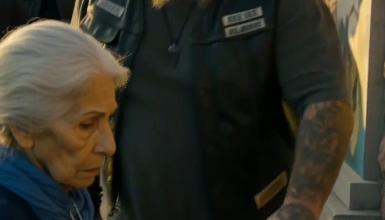
She was small, maybe seventy, with clear eyes and no fear at all. Some women looked at bikers and saw danger. Sister Mary looked at Graveyard like she was checking whether an old wound had opened.
“Walter,” she said.
Not Prez.
Not Mr. Mercer.
Walter.
The lot went quiet in that strange way men go quiet when they realize they don’t know the story.
Graveyard nodded.
“Sister.”
“You came back.”
“Every year.”
“I mean all the way back.”
His jaw worked once.
Then he looked toward the building and said, “Where’s the boy?”
The common room looked like Christmas had exploded.
Wrapping paper everywhere. Kids yelling. Bikers laughing too loud because they didn’t know what else to do with tenderness. The radiator hissed under the window. Somebody had a little speaker playing “Jingle Bell Rock,” but the song kept cutting out every time the Wi-Fi dropped.
I should’ve been happy.
Most of me was.
But I couldn’t stop watching Graveyard.
He stood in the doorway like a man at the edge of a grave, eyes moving across the room and seeing something behind it. Not memories. Memories are soft around the edges.
Whatever he saw had teeth.
Sister Mary touched his arm.
“He’s down the hall.”
Graveyard walked without waiting for anyone.
I followed because I was carrying the extra box of gloves and because prospects follow until told to disappear.
The hallway stretched longer than it should have. Old tile. Yellow walls. Children’s drawings taped up in crooked rows. Reindeer with too many legs. Snowmen with angry eyebrows. A paper chain sagging from the ceiling.
At the very end was a half-open door.
Room 17.
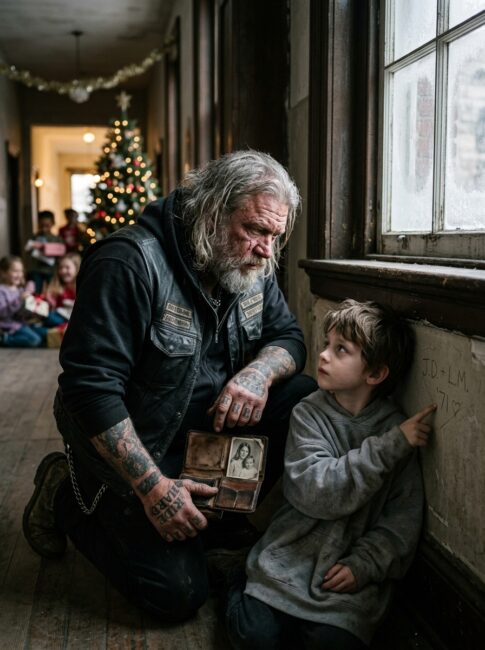
Caleb sat on the floor beneath a window that looked out over the back lot and the frozen swing set. He was a skinny white kid with brown hair cut badly around the ears, wearing a gray sweatshirt too big for him and socks with no shoes. His knees were pulled tight to his chest.
No crying.
That almost made it worse.
Crying means a kid still expects somebody to answer.
Caleb looked up when Graveyard filled the doorway.
His eyes went straight to the tattoos. Then the beard. Then the cut. His fingers gripped the fabric at his knees.
I expected Graveyard to soften his voice or crouch slow, the way adults do when they’re trying not to scare children.
He didn’t.
He just stepped in, crossed the room, and lowered himself to the floor with a grunt. His bad knee popped loud enough for me to hear.
Then he sat beside Caleb.
Not too close.
Not too far.
The kind of distance only lonely people understand.
Caleb stared at him.
Graveyard stared out the window.
The room held its breath.
After a while, I said, “Prez, I’ve got gloves if he—”
Graveyard lifted one finger.
I shut up.
Five minutes passed.
Then ten.
From the common room came squeals and ripping paper. A brother yelled, “No, sweetheart, the beard is real.” Somebody laughed so hard they coughed.
Room 17 stayed still.
Caleb finally moved. He reached out one small finger and touched the floor between them. There were old scratches in the wood near the baseboard. A messy shape. Maybe a motorcycle. Maybe a horse. Maybe just a kid pressing too hard with something sharp because nobody was watching.
“This was here before me,” Caleb said.
His voice sounded rusty.
Graveyard did not turn his head.
“I know.”
Caleb looked at him then.
“You know who made it?”
Graveyard’s throat moved.
“No.”
It was the first lie I ever heard him tell.
And I knew it was a lie because his hands started shaking.
Not big. Not dramatic. Just a tremor through those scarred fingers resting on his knees. Hands that had held handlebars through storms, hands that had thrown punches, fixed engines, carried coffins, signed hospital papers for brothers with no kin.
Hands that now couldn’t stay still beside a child’s drawing on the floor.
Sister Mary stood behind us in the hallway.
She saw it too.
Her eyes filled, but she didn’t speak.
After an hour, the club started drifting by the door. One by one, big men with leather cuts and tattooed necks peeked in, then backed away without a word.
Nobody asked what he was doing.
Brotherhood is not always charging through fire.
Sometimes it is recognizing the door you should not open.
At the two-hour mark, Caleb’s shoulder touched Graveyard’s sleeve.
Just barely.
The president of the Iron Saints looked down at that tiny contact like it weighed more than any patch on his back.
Then the boy whispered, “They always leave after Christmas.”
Graveyard said, “Yeah.”
“You leaving?”
“Yeah.”
Caleb nodded.
His face closed again.
And I thought that was the heartbreak. I thought the whole story was about a hard old biker who didn’t know how to comfort a boy and a boy who knew better than to hope.
Then Caleb pointed at the scratched mark by the baseboard.
“I pretend the kid who made that got out.”
Graveyard shut his eyes.
Just once.
“He did,” he said.
We left St. Agnes a little after three.
The sky had gone the color of dirty wool. Snow started falling in small, mean flakes that melted as soon as they hit the bikes. The kids stood on the porch waving, some wearing new hats, one dragging a stuffed dinosaur by its tail.
Caleb was not on the porch.
Graveyard looked at the last window on the second floor.
For one second, a small hand appeared against the glass.
Then vanished.
Nobody said anything as we loaded the empty boxes. Bikers can make a lot of noise when they’re comfortable. That afternoon, all you heard was leather shifting, straps tightening, boots crunching gravel, engines coughing awake one at a time.
I made it to my bike before the question burned through my common sense.
“Prez?”
Graveyard was pulling on his gloves.
He didn’t answer, which meant I had one chance to decide whether being stupid was worth it.
I took it.
“Why didn’t you give him anything?”
The nearest brothers went still.
Preacher muttered, “Kid.”
But I kept going because I was young and because some questions don’t care about rank.
“Everybody got something. He got you sitting there and then leaving. I’m not saying you were wrong. I just don’t get it.”
Graveyard’s eyes lifted.
I had seen men flinch from those eyes.
That day, they looked tired.
He stepped closer. Snow gathered in his beard. The tiny red X inside his vest flashed when the wind caught his cut.
“You ever been left in a room?” he asked.
I swallowed. “No.”
“Then don’t guess what a kid in one needs.”
That should’ve ended it.
It didn’t.
Because he reached into his inside pocket and pulled out an old leather wallet, cracked at the fold, soft from years of being carried close to the body.
He opened it.
Not to money.
Not to a license.
To a black-and-white photograph.
The edges were worn white. The picture showed a small boy sitting on the floor of Room 17 at St. Agnes Children’s Home. Same window. Same radiator. Same baseboard. Same narrow bed pushed against the wall.
On the back, written in faded blue ink, was:
WALTER M., CHRISTMAS 1978.
My mouth went dry.
In the photo, the boy had dark hair, hollow cheeks, and eyes too old for his face. He sat with his knees pulled to his chest.
Just like Caleb.
But that wasn’t what made the world tilt.
On the wall behind him, near the baseboard, was the same scratched drawing Caleb had pointed to.
Same crooked lines.
Same hard little X beside it.
Graveyard tapped the photograph once with a thick finger.
“I was him,” he said.
Then he folded the wallet shut.
The brothers around us didn’t move.
Even the engines seemed quieter.
Preacher took off his glasses and rubbed his face.
Sister Mary stood on the porch, watching from under the yellow light, her hands tucked into her sleeves.
Graveyard looked back up at Room 17.
“I didn’t need a present,” he said. “I needed somebody to sit beside me until I remembered I existed.”
Then he put his helmet on.
And the president of the Iron Saints rode out first, slow as a funeral.
I didn’t learn the rest that day.
Men like Graveyard don’t hand you their history just because your heart is open. They give you one piece, then make you earn the silence around it.
The rest came in scraps over the next year.
Some from Preacher. Some from Sister Mary. Some from Graveyard himself, usually at two in the morning in the clubhouse garage, when the heater clicked and the smell of oil made truth easier.
Walter Mercer came to St. Agnes in 1977 at nine years old.
His father had disappeared into a coal town bar and never came back. His mother tried for a while. Then pills took what poverty hadn’t. The state found Walter in a trailer outside Benwood with no heat, two cans of beans, and a dog that wouldn’t leave his side.
They brought him to St. Agnes three days before Christmas.
Room 17.
He didn’t speak for six weeks.
Not one word.
He scratched that drawing near the baseboard with a broken pencil he stole from the schoolroom. Not a motorcycle, like I thought. Not a horse.
A road.
A bad drawing of a road with one X at the end.
Because he believed if he could mark a place on the wall, maybe that meant he had somewhere to go.
The tiny red X inside Graveyard’s vest?
Sister Mary stitched it for him when he was eleven, after he tore his only coat in a fight behind the chapel. He had asked her to sew an X near the heart because, in his words, “That’s where the road ends.”
She kept the coat after he ran away at thirteen.
Years later, after prison, after rehab, after the Army refused him for his record, after a motorcycle club took him in when no family would, she mailed him that little piece of cloth.
He sewed it inside every cut he ever wore.
Not for show.
For direction.
The “MERCY” and “NONE” on his hands had a story too. He got MERCY first, after a judge gave him five years instead of ten. He got NONE later, in a county jail, after deciding the world had none for boys like him.
He told me he regretted the second one.
Not enough to cover it.
Just enough to spend the rest of his life proving it wrong.
That was why the Iron Saints Christmas ride existed.
Not charity.
Debt.
Graveyard hated that word “charity.” Said it made the giver too tall and the receiver too small. What the club brought to St. Agnes wasn’t charity. It was proof.
Proof that the world could still knock on the door.
Proof that leather and chrome and old criminal records could carry warm coats and batteries and pink bicycles.
Proof that a man could come from Room 17 and still return standing.
And Caleb?
Caleb had arrived at St. Agnes that October after being passed through three foster homes in fourteen months. He broke a lamp in the first. Ran away from the second. Bit a man in the third after the man grabbed his arm too hard.
The report called him “difficult.”
Graveyard read that word and laughed once.
Not because it was funny.
Because it was lazy.
“Difficult,” he said, “is what adults call a kid who quit pretending pain is polite.”
The blank wish line on Caleb’s angel tree slip wasn’t a mistake. Sister Mary told me Caleb had stared at the paper for twenty minutes, then pushed it back.
“What do you want?” she asked.
He said, “Nothing that stays.”
That was the line that made Graveyard take him.
That was why there was no wrapped gift.
A present would have proven Caleb right.
It would arrive, shine for a day, break, disappear, get taken, get lost.
A man sitting beside him for two hours without asking him to perform gratitude?
That was different.
That was harder to throw away.
Three days after Christmas, a package arrived at St. Agnes addressed to Caleb. No return name. Inside was a pair of winter boots, a heavy coat, and a small wooden box.
In the box was a dull carpenter’s pencil.
And a note with five words.
Make the road go farther.
Sister Mary said Caleb carried that pencil everywhere.
He did not draw toys.
He did not draw Santa.
He went back to Room 17 and extended the scratched road along the baseboard, careful line by careful line, past the old X.
When Sister Mary told Graveyard, he nodded like he had been waiting fifty years to hear that.
Then he went outside, sat on his Harley in the snow, and didn’t start it for a long time.
The next Christmas, we rode to St. Agnes again.
Same route along the Ohio River. Same cold. Same diner coffee that tasted like burnt rope. Same paper angel tree by Rosie’s register.
Only this time, Caleb’s angel had writing on it.
BOOTS FOR JASON, AGE 6.
Not for himself.
For another boy.
Graveyard read the slip twice.
Then he folded it into his wallet beside the photograph.
When we arrived, Caleb did not come running. He wasn’t that kind of kid yet. Maybe never would be. But he stood in the common room doorway, wearing the coat from the package and boots that had scuffs on both toes.
Graveyard walked in empty-handed again.
Caleb looked at him.
Then, without saying hello, he turned and walked down the hallway.
Room 17.
Graveyard followed.
This time, I did not.
No one did.
Brotherhood learns.
While the kids opened gifts, Graveyard and Caleb sat at the end of the hall for forty-three minutes. Not two hours. Less time. That mattered. Healing, I learned, is not a straight road. But sometimes the stops get shorter.
When they came back, Caleb held something in his fist.
He walked to Jason, a six-year-old Black kid with a runny nose and shoes splitting at the sides, and handed him a pair of boots from under the tree.
“Try them,” Caleb said.
Jason did.
Too big.
Caleb shrugged. “You’ll grow.”
Graveyard turned away before anyone could look at his face.
After that, the ritual changed.
Every year, the Iron Saints still brought gifts. But Graveyard also brought a pencil. Always unwrapped. Always placed on the windowsill in Room 17.
Some years, a kid used it.
Some years, nobody touched it.
He never asked.
He just left it there.
By the time I earned my patch, there were roads drawn in three rooms at St. Agnes. Not vandalism. Not damage. Sister Mary called them maps.
The new director tried to paint over them once.
Sister Mary, who was eighty by then and weighed maybe ninety pounds with wet shoes, stood in front of Room 17 with both hands on her cane and said, “You touch that wall, and I call the bikers.”
The wall stayed.
Graveyard got older.
His beard went more white than gray. His hands stiffened in winter. He rode with a brace on his knee and pretended nobody noticed. The Road King needed help starting on cold mornings, but he refused to replace it.
“That bike knows the way,” he said.
Every Christmas, when we turned off Route 2 and climbed the hill toward St. Agnes, Graveyard slowed down.
Every Christmas, he looked at the last window.
Every Christmas, the club let him have that silence.
Caleb got adopted when he was twelve.
Not by Graveyard. This isn’t that kind of clean story.
He went home with a quiet couple from Parkersburg who had lost a son years before and didn’t need a child to be cheerful to love him. Before he left, he asked Sister Mary for one thing.
A photograph.
She took it in Room 17.
Caleb sat on the floor beneath the window, knees bent, one hand resting on the long pencil road that now stretched almost the whole wall.
Graveyard sat beside him.
Not too close.
Not too far.
The same distance as the first day.
On the back of the photo, Caleb wrote:
WALTER AND ME, CHRISTMAS 2022.
Graveyard kept that picture in his wallet behind the old black-and-white one from 1978.
Two boys in the same room.
Forty-four years apart.
Both pretending they didn’t need anyone.
Both wrong.
The last time I saw Graveyard ride to St. Agnes, he was seventy-one and moving slower than he’d admit. Caleb was nineteen by then, tall and serious, riding in a pickup behind us with boxes of coats in the bed.
When the kids ran outside, they didn’t stare at Graveyard first.
They stared at Caleb.
He carried no wrapped gift.
Just a carpenter’s pencil.
He walked down the hallway to Room 17.
Graveyard stayed outside by his bike, one hand on the seat, listening.
From somewhere inside the building came the soft scratch of pencil against old wood.
Graveyard smiled.
Small.
Almost nothing.
Then the Road King coughed, caught, and rumbled under the gray December sky.
He looked at me and said, “Road went farther.”
Then he rode away.
Slow.
Steady.
Like thunder learning to be gentle.
Follow the page for more true-feeling biker stories about the people behind the leather, the scars, and the road.