Part 2: The Biker Waited Outside Her School Every Morning — Three Months Later, the Teacher Called Him “Dad”
My name is Elena Ramirez.
At the time, Mia and I lived in a small rented house on the west side of Flagstaff, where the pavement cracked from winter freeze and the freight trains groaned through the darkness before dawn.
Our street was not dangerous. It was simply tired.
Most of the houses needed paint. Most of the cars needed repairs. Most of the adults were doing math in their heads every time they walked into a grocery store.
Brick had lived at the end of the block for six years, and I knew almost nothing about him.
His real name was Thomas Brennan. Nobody called him Thomas.
The first time I saw him, he was backing his Harley into the garage while three other bikers waited in the driveway. They wore leather cuts, old jeans, and boots that struck the concrete like hammers. The air smelled like gasoline and exhaust. One of them laughed so loudly that Mia grabbed my hand.
Brick noticed.
He lowered his voice immediately.
That tiny detail stayed with me.
He looked intimidating, but he was never careless around children.
In the summer, he fixed Mrs. Caldwell’s broken porch rail without telling her. When snow covered the street, he cleared the sidewalk in front of the house where an elderly Vietnam veteran lived alone. Once, when Mia’s bicycle chain fell off, she found the bike leaning against our fence the next morning with a new chain and a small note taped to the seat.
Keep the tires full.
No signature.
Just five words in thick block letters.
After Brick began waiting outside the school, the morning routine became strangely normal.
At 7:18, I heard the garage door rumble upward.
At 7:20, the Road King coughed once, then settled into its heavy, uneven rhythm.
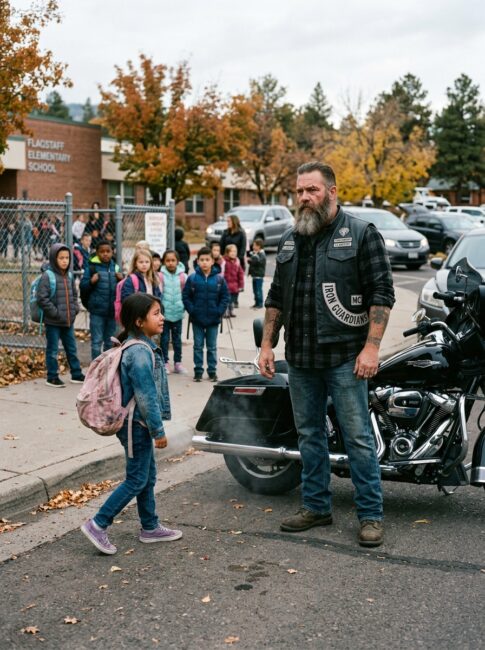
At 7:32, he parked across from Coconino Elementary.
He always chose the same spot near a cottonwood tree. He stood beside the motorcycle with a gas-station coffee in one hand. When Mia arrived, he nodded. When she disappeared through the gate, he climbed back onto the Harley and rode to the welding shop near Route 66.
He never made a scene.
That mattered.
When I thanked him, he shrugged.
“Standing still is free.”
The second week, two motorcycles joined him.
One belonged to a lean, white-bearded biker named Rooster. The other belonged to a Navajo man everyone called Bear, who wore an old canvas jacket beneath his vest and spoke even less than Brick.
I panicked.
“I don’t want Mia’s school surrounded by a motorcycle club,” I told Brick after work. “I appreciate what you’re doing. But I don’t want anyone scared.”
Brick nodded once.
“You’re right.”
The next morning, he was alone again.
Later, Rooster explained what had happened.
The club brothers had heard about Mia. They wanted to ride over together. Brick stopped them at the garage.
“She needs one steady thing,” he told them. “Not a show.”
That was my first glimpse of the way his club worked.
Brotherhood was not always forty engines shaking the street.
Sometimes it was knowing when not to ride.
A few days later, the principal called me.
My stomach tightened when I saw the school number on my phone. I was wiping down a table at the Route 66 diner between the breakfast rush and lunch.
But the principal was not angry.
She told me Mia had begun raising her hand again. She had eaten lunch in the cafeteria instead of hiding in the nurse’s office. She had even volunteered to read aloud.
Then the principal paused.
“There is one thing,” she said carefully. “Some children believe Mr. Brennan is Mia’s father.”
I closed my eyes.
“I know.”
“Is he?”
“No.”
The line stayed quiet.
“I’ll talk to Mia,” I said.
That evening, I found her sitting on our front steps while the sunset turned the San Francisco Peaks orange.
“Baby, you cannot tell people Brick is your dad.”
Her face crumpled.
“I didn’t think it was bad.”
“It isn’t bad to like him. But it isn’t true.”
She twisted the frayed cuff of her jacket.
“They stopped being mean when I said it.”
I sat beside her.
That answer hurt more than I expected.
Across the street, Brick was tightening something on his Harley. The metallic click of the wrench stopped.
He had heard us.
For a second, he stood perfectly still.
Then he walked into his garage and returned with a needle, black thread, and a small metal tin.
Without saying a word, he crouched beside Mia and repaired the torn cuff of her denim jacket.
His huge scarred hands moved slowly, almost carefully enough to make me cry.
Inside the tin was a tiny purple hair tie.
It looked old.
He noticed me looking at it and closed the lid.
By October, the morning air had sharpened.
Mia wore a secondhand coat over her patched denim jacket. Brick started wearing leather gloves when he rode. The cottonwood leaves gathered along the curb in dry yellow piles, skittering whenever a truck passed.
For almost two months, nothing happened.
The bullying seemed to be over.
Then one Thursday, I received another call from school.
Mia had been crying in the restroom.
I left the diner early and drove there with my apron still tied around my waist. My manager was kind enough to let me go, but I knew the missing hours would show up later in the electric bill.
When I arrived, Mia sat in the counselor’s office with her arms folded tightly over her chest.
Her jacket was on the floor.
Someone had written across the back with a permanent marker.
LIAR.
Underneath it, in smaller letters:
THAT BIKER ISN’T YOUR DAD.
I picked up the jacket and stared at the words until they blurred.
Mia’s voice came out thin.
“They found out.”
The school counselor started talking about incident reports, restorative conversations, and a meeting with the families involved.
I heard the words, but my mind was somewhere else.
I was angry with the children.
Then I was angry with myself for being angry with children.
Then I was angry with Brick.
That part was not fair. I knew it even as I felt it.
But I had spent weeks pretending his presence was a solution. It had only covered the wound. Underneath, Mia was still afraid.
When Brick arrived outside the school the following morning, I walked straight toward him.
The Road King idled beside the curb, its pipes pulsing against the cold.
I held up the jacket.
His eyes moved over the black letters.
The engine cut off.
Silence rushed into the space where the sound had been.
Brick removed his gloves one finger at a time. His hands were shaking.
Not much.
Just enough for me to notice.
“I told her not to lie,” I said.
He kept looking at the jacket.
“She is eight years old,” I continued. “She was scared. But this cannot be the answer. You standing here like some threat every morning. People are talking. The principal is asking questions. Mia thinks she needs a giant biker outside the gate just to walk into school.”
Brick finally looked at me.
His eyes were red around the edges, but he did not cry.
“I know.”
I expected him to defend himself.
He did not.
“I made it worse,” he said.
The words came rough, like they scraped his throat on the way out.
“No,” I said, softer now. “You helped. But I don’t know what happens next.”
Brick folded the ruined jacket and placed it carefully on the seat of his Harley.
Then he crouched in front of Mia.
He did not tell her to be brave.
He did not say children could be cruel or that things would get better.
He simply asked, “Want me here tomorrow?”
Mia looked at him for a long moment.
Then she shook her head.
“I think I can go in.”
Brick nodded.
“All right.”
She took three steps toward the gate. Then she turned back.
“But can you stay until I get inside?”
He sat down on the curb.
“Yeah.”
Mia walked through the entrance alone.
That should have been the ending.
For the next week, Brick did not park outside the school. He rode directly to work. The Road King passed our house at 7:20 and disappeared toward Route 66.
Mia kept going to class.
Some mornings were harder than others, but she went.
The school handled the children who had damaged her jacket. Their parents were called. Apologies were written. Meetings were scheduled.
I assumed Brick’s part in our story had ended.
Then the principal announced an evening parent gathering about bullying, school culture, and the way adults respond when children feel unsafe.
At the bottom of the email was one sentence:
We invite families to attend with any trusted adult who has helped their child feel supported.
Mia read it over my shoulder.
“Can Brick come?”
I hesitated.
Then I walked to the house at the end of the road.
The meeting took place in the school library on a Tuesday night.
The room smelled like dry-erase markers, old books, and coffee poured from a silver dispenser. Tiny paper leaves made by the students hung from the walls. Adults shifted awkwardly in plastic chairs designed for children.
Brick arrived two minutes before the meeting began.
His boots struck the linoleum in slow, heavy steps.
Conversation faded as he entered.
He wore the same leather vest and black jeans he wore almost every day. His beard was trimmed. His gray hair was pulled back at his neck. In one hand, he carried Mia’s denim jacket.
The marker stains were gone.
The jacket looked cleaner than it had when I bought it.
He had replaced the torn lining. The frayed cuffs were reinforced with neat rows of dark thread. On the inside, where nobody else would see it, he had sewn a small square of purple fabric over the damaged spot.
Mia ran to him.
“You fixed it.”
Brick handed it over.
“Rooster knows a guy.”
That was all he said.
The meeting began.
The principal spoke about the damage caused by humiliation. A counselor explained that bullying often grows in silence. Several parents shared stories. Some sounded defensive. Others sounded ashamed.
Then Mia’s teacher looked toward our row.
“Mia,” she said gently, “would your dad like to say anything?”
The entire room changed.
I opened my mouth.
Mia froze beside me.
Before I could explain, Brick stood.
Leather creaked as he straightened his shoulders.
He did not look angry. He looked tired.
“My name is Thomas Brennan,” he said. “Most people call me Brick.”
His voice was low, but it reached every corner of the library.
“I’m not Mia’s father.”
A few parents glanced at one another.
Brick continued.
“I live down the street. I heard her crying in the mornings when I started my bike. Asked her why. She told me.”
He rested both hands on the back of the chair in front of him.
“I stood outside the gate because no kid should walk into school scared.”
Nobody moved.
“I was a Marine for twenty years. Stood watch in places where I didn’t know the language. Protected people whose names I never learned.”
He paused.
His thumb rubbed the edge of one tattooed knuckle.
“Figured I could stand watch for a neighbor.”
The library stayed silent.
Then a father near the back began clapping.
Slowly.
One clap.
Then another.
A woman beside him joined in. Then the teacher. Then the counselor.
Within seconds, the whole room was on its feet.
Brick looked uncomfortable enough to leave.
But Mia grabbed his hand.
His rough fingers closed around hers.
She lifted their joined hands slightly, as though introducing him to the room.
For the first time since she had started at that school, my daughter smiled without checking whether anyone was laughing.
That was the twist everyone in the room saw.
It was not the only one.
After the meeting, I expected Brick to escape as fast as possible.
Instead, he waited until the library emptied.
The applause had embarrassed him. I could tell by the way he kept adjusting the edge of his vest. Brick knew what to do with a welding torch, a broken porch rail, or a frightened child sitting on a curb.
Praise made him restless.
Mia was tracing the new stitches inside her jacket when she noticed the purple fabric patch.
“It matches this,” she said.
She reached toward Brick’s open sewing tin, which he had placed on the table.
Inside was the old purple hair tie.
Brick went still.
I thought he might close the tin again.
Instead, he picked up the hair tie and rolled it between his fingers.
“My daughter wore these,” he said.
It was the first time he had mentioned having a child.
Her name was Kayla.
She was thirty-two now and living in Oregon with a husband Brick had never met and a little boy whose birthday cards he mailed every year without knowing whether they were opened.
Brick did not give us a speech.
He gave us fragments.
Enough to understand.
After his final deployment, he came home carrying more anger than luggage. He drank too much. Slept too little. Jumped at ordinary sounds. He could stand watch all night in a place full of danger, but he could not sit through breakfast with his own family without finding a reason to leave the table.
Kayla was eleven when her mother took her away.
Brick signed the divorce papers and told himself distance was safer for everyone.
Years passed.
Sobriety came later.
Then the welding job. Then the club. Then the house at the end of our street.
But the years he had missed stayed missed.
The purple hair tie had once been looped around the handlebar of his first Harley. Kayla had tied it there before a short ride around the neighborhood when she was eight.
The same age as Mia.
“I kept thinking I’d give it back when I got myself straight,” Brick said.
His mouth tightened.
“By the time I did, she didn’t want it.”
Mia looked at the hair tie and then at Brick.
“Maybe she still wants you to call.”
Brick’s eyes lowered.
“Maybe.”
He packed the sewing tin and walked us home beneath a sky already dark with the first promise of snow.
At his driveway, three motorcycles waited.
Rooster leaned against the fence with a paper cup in his hand. Bear stood beside him. Another biker I did not recognize was unloading cardboard boxes from the back of an old pickup truck.
“What is all this?” I asked.
Brick sighed.
That was when Rooster grinned.
The club had wanted to help Mia from the beginning. Brick refused to let them swarm the school, so they found another way.
Inside the boxes were winter coats, gloves, backpacks, socks, notebooks, and gift cards for shoes.
No club logos.
No photographs.
No social media post.
The following morning, the boxes appeared in the counselor’s office as the beginning of a school clothing closet. Children could take what they needed without explaining themselves. Parents could donate anonymously. Teachers could quietly point families toward it.
The school called it the Cottonwood Closet.
Brick hated the name because it sounded too sentimental.
Rooster loved it for exactly the same reason.
I later learned that the replacement lining in Mia’s jacket came from a tailor near downtown Flagstaff whose son had served with Brick overseas. The tailor refused payment. The purple square inside the jacket came from an old bandana Brick had kept in his garage.
Each little detail led back to someone else.
That was the part I had misunderstood about the men at the end of our road.
Their brotherhood was not built only on motorcycles or patches or the sound of engines moving together along the highway.
It was built on small debts of mercy.
A porch rail repaired before sunrise.
A bicycle chain replaced without a signature.
A box of winter gloves left outside a counselor’s door.
A jacket cleaned after someone tried to turn it into a weapon.
And sometimes, one scarred man standing beside a Harley until a child felt safe enough to walk through a gate alone.
Two days after the parent meeting, I saw Brick sitting in his garage after work.
The overhead bulb cast a yellow circle across the concrete. His Road King stood beside him. A mug of black coffee steamed on his tool bench.
He held his phone in both hands.
For almost a minute, he did not move.
Then he pressed a number and lifted the phone to his ear.
I started walking away because I knew the moment was not mine.
Behind me, I heard his voice.
“Kayla?”
A pause.
“It’s Dad.”
Another pause.
Longer this time.
Then Brick sat down hard on the wooden stool near his workbench.
His shoulders dropped.
He did not speak for several seconds.
When he finally did, his voice was barely above a whisper.
“Yeah. I know. I should’ve called sooner.”
Winter settled over Flagstaff.
Snow gathered along the curb where Brick had first sat beside Mia. On cold mornings, the Road King took an extra second to turn over before the engine caught and rolled through the street like distant thunder.
Brick no longer waited outside the school every day.
He did not need to.
But each Monday, he left home ten minutes early.
He parked near the cottonwood tree, drank his gas-station coffee, and watched the children cross through the gate. Sometimes Mia waved. Sometimes she was too busy talking to her new friend Ava, a quiet girl from her class who had selected a red coat from the Cottonwood Closet.
Brick never seemed offended when Mia forgot to look back.
I think that was the point.
The first time Kayla visited, she arrived in a dusty blue Subaru with her six-year-old son in the back seat.
Brick stood in his driveway holding a wrench, pretending he had not been checking the road every thirty seconds.
Kayla looked like him around the eyes.
She did not hug him immediately.
There were too many years between them for that.
They talked in the garage with the door open. At first, their voices were cautious. Then they grew sharper. Then quiet again.
Healing did not arrive like applause in a school library.
It came in awkward pauses, unfinished sentences, and coffee that went cold on a workbench.
Near sunset, Kayla’s son asked whether he could sit on the Harley.
Brick looked at Kayla before answering.
She nodded.
He lifted the boy carefully onto the seat.
From my porch, I watched Brick show him where to place his hands. The boy laughed when Brick made a low engine sound with his mouth.
Kayla laughed too.
Brick looked down quickly and rubbed one gloved hand across his beard.
The following Monday, he returned to the cottonwood tree.
This time, Mia walked toward him before entering school.
She held out something small.
A new purple hair tie.
“For your bike,” she said.
Brick stared at it for a moment.
Then he looped it around the handlebar of the Road King.
“Looks right,” he said.
By spring, the Cottonwood Closet filled an entire storage room.
Parents donated jackets their children had outgrown. The diner placed a jar beside the register. The welding shop covered the cost of new shelves. Rooster delivered boxes every other Friday and complained loudly whenever anyone thanked him.
Mia’s old denim jacket still hangs by our front door.
The black marker is gone, but the purple square remains stitched inside the lining.
Nobody sees it when she wears the jacket.
That is why she likes it.
One morning in April, I stepped outside as Brick prepared to leave for work.
The sun had barely reached the rooftops. The air still carried the bite of the mountains. His Harley idled beneath him, shaking softly, the purple hair tie fluttering against the handlebar.
Mia ran down the steps with her backpack bouncing against her shoulders.
“Brick!”
He turned his head.
“Are you going to the school today?”
He looked toward the road.
“Monday.”
“It’s Wednesday.”
“I know.”
Mia grinned.
She did not ask him to come anyway.
She no longer needed him outside the gate.
Brick gave her the same slow nod he had given her on that first morning.
Then he pulled onto the street and headed toward Route 66.
The engine grew smaller in the distance.
Mia watched until the red taillight disappeared.
Then she turned toward the school bus, wearing thrift-store sneakers and a patched denim jacket, and climbed aboard without looking back.
Some men stand watch quietly.
Follow the page for more biker stories that reveal the people beneath the leather.