Part 2: The Biker Who Took the Baby — And the Lawyer Who Came Back
I was twenty-two when Cole found me.
That sounds strange because I was the baby.
But stories like mine are built from what other people remembered before I could.
My name is Mara Maddox now.
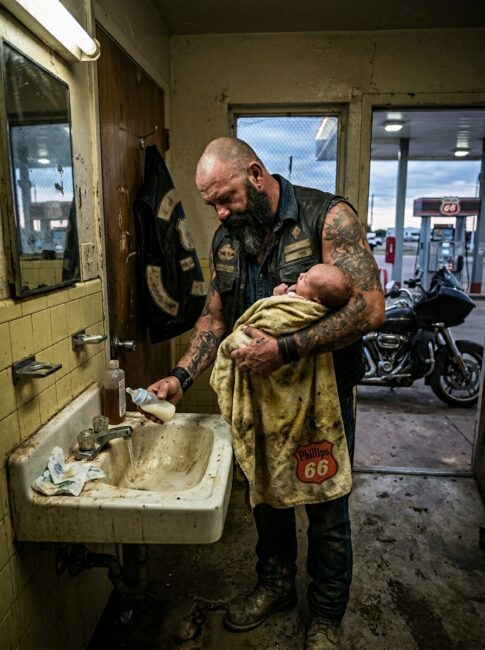
It was not written on any birth certificate when I was left behind the ice machine at that Phillips 66.
The cashier called 911. A highway patrolman arrived first. Then a county deputy. Then an ambulance that did not hurry, because everybody thought I was already gone until Cole put one rough finger under my nose and said, “She’s breathing.”
That was the first thing he ever said about me.
Not “poor thing.”
Not “who would do this?”
Just the fact that mattered.
“She’s breathing.”
Cole had been riding with the Gravel Saints that day. Twelve men coming back from Amarillo after delivering parts to a brother whose bike had broken down near the Texas line. They stopped for gas, coffee, and cigarettes.
Then they heard me cry.
The old stories say three men walked toward the sound and two walked away because it felt like trouble.
Cole didn’t.
He found me wedged between the ice machine and a stack of windshield fluid, wrapped in a towel that smelled like bleach and gasoline.
When the EMT tried to take me, I screamed so hard my lips went blue.
When Cole held me, I stopped.
The deputy noticed.
So did everyone else.
That did not make him my father. Not legally. Not yet.
Cole had a record. Assault. One prison term. A divorce he never talked about. No stable address except a rented trailer behind a repair shop off Route 66. He was exactly the kind of man every social worker has been trained to distrust.
But he showed up anyway.
Court hearings. Foster meetings. Parenting classes.
He sat in plastic chairs too small for his body, leather vest folded across his knees, boots planted flat, saying yes ma’am to women who looked at him like he was a mistake waiting to happen.
The Gravel Saints showed up too.
That was my first family.
Uncle Preacher, who had a red beard and always smelled like peppermint gum.
Aunt Jo, a white woman in her fifties with silver braids, tattooed hands, and the cleanest kitchen in Custer County.
Tiny, who was not tiny and cried every time I got shots.
They built a nursery in Cole’s trailer before the judge said yes.
Painted the walls yellow.
Bought a crib secondhand.
Installed smoke detectors.
Washed every leather vest before coming near me because the social worker said babies should not smell like cigarettes.
Cole quit smoking that week.
No speech.
No big promise.
He just crushed the pack in his fist and threw it into a diner trash can.
When the adoption finally went through, Cole did not cry.
He stood outside the courthouse holding me against his chest while the Gravel Saints fired their Harleys one by one. The sound rolled over the square and rattled the old windows.
Cole looked down at me and said, “You’re home, kid.”
I grew up with engine noise as weather.
The garage doors opening before sunrise. Boots on concrete. Chains clinking. Coffee perking in an old metal pot. The smell of oil, leather, baby powder, and burnt toast because Cole could rebuild a transmission but could not cook eggs without violence.
He was not soft in the way people expected fathers to be.
He did not use baby talk.
He did not call me princess.
He taught me to check locks, read people’s hands, and never stand behind a running motorcycle.
But he braided my hair before school by watching videos on an old laptop. Badly at first. Then better.
He kept my silver rattle in his vest pocket for years.
“Lucky piece,” he said whenever I asked.
It was shaped like a motorcycle, dented on one side, with two tiny screws in the handle.
I thought he kept it because it was mine.
I did not know he kept it because of what was inside.
Fifteen years later, I graduated from the University of Oklahoma College of Law.
Cole wore a suit jacket over his leather vest because he said, “I made a deal with the dress code, not a surrender.”
He looked terrifying in the auditorium.
Older now. Beard almost white. Hands scarred. Neck thick. The same prison ink faded blue across his knuckles. The same Gravel Saints patch on his back. Parents gave him space in the rows.
Then I walked across the stage.
And the biggest man in the room stood up with both hands over his mouth like he was holding something in.
He did not clap first.
He waited until they said my full name.
“Mara Jo Maddox.”
Then the whole row of bikers stood.
Boots thumped.
Leather creaked.
Hands hit together like thunder in a church.
The dean looked nervous.
I looked at Cole.
He nodded once.
That was his version of falling apart.
I thought that would be the big day.
It wasn’t.
Two weeks later, Preacher got arrested for murder.
His real name was Daniel Pike, but nobody used it. He had been with Cole the day they found me. He was the one who gave me peppermint sticks when I was teething. He drove me to debate tournaments in a pickup that smelled like gasoline and old paper maps.
The victim was a man named Owen Rusk.
A local dealer. Thief. Small-time predator with big-time enemies.
He was found behind a closed motel off Route 66, beaten and left beside the dumpsters.
A witness said they saw Preacher’s bike nearby.
Another said they heard him threaten Owen at a diner the night before.
Preacher admitted the threat.
He said Owen had stolen pain pills from an old veteran with one leg and a fixed income.
“I told him I’d put him through a wall,” Preacher said.
The sheriff wrote that down like a confession.
The town decided fast.
Biker. Record. Threat. Dead man.
Easy story.
Cole called me at 5:12 in the morning.
I remember the time because the phone buzzed on my nightstand while the sky outside my apartment was still black.
“Preacher’s in county,” he said.
I sat up.
“What happened?”
“They say murder.”
I heard the V-twin in the background. Cole was already outside. Already moving.
“Did he do it?”
“No.”
No hesitation.
Cole trusted very few people with that kind of certainty.
By noon, I was standing in the Custer County jail across from the man who once held me while I slept through thunderstorms.
Preacher looked smaller in orange.
His red beard had gone mostly white. His left eye was still cloudy. His hands trembled, not from fear, but from Parkinson’s he had been hiding from most of the club.
“Mara,” he said, voice rough.
“You need a lawyer.”
He tried to smile.
“You are a lawyer.”
“Not officially until my bar results come in.”
“Then I need a miracle with student loans.”
I took the case anyway under supervision from a public defender who thought I was insane.
The evidence looked bad.
Preacher’s fingerprints were on Owen’s jacket.
His tire tracks were near the motel.
Security footage from the gas station showed him arguing with Owen at 8:47 p.m.
The medical examiner put death around 9:30.
The sheriff said the case was clean.
Too clean.
Cole sat through every hearing.
He did not threaten anyone.
Did not glare at the judge.
Did not bring the club into the courtroom at first because he knew how it would look.
But his hands gave him away.
Every time the prosecutor said “violent biker gang,” Cole’s fingers curled against his knees.
His eyes went wet once when they showed Preacher’s mugshot on the screen.
No tears fell.
Bikers do not give the room that much.
The false climax came at the preliminary hearing.
The judge said there was enough evidence to proceed.
Preacher would stand trial.
The prosecutor offered a deal.
Thirty years if he pled.
Life if he lost.
Preacher looked at Cole.
Cole looked at me.
For the first time in my life, my father seemed afraid.
Not of prison.
Of being unable to stop someone he loved from going there.
The twist began with something small.
A sound.
We were reviewing the gas station footage again, the same footage from the night Owen died. Preacher arguing near pump three. Owen shoving him. Preacher stepping close. The cashier running outside. Cole watching from a few feet away, arms folded.
Then I heard it.
A baby crying.
I paused the video.
The public defender frowned.
“What?”
“Nothing.”
But it wasn’t nothing.
The security camera had captured sound badly, mostly wind and highway noise. Still, under the argument, faint and thin, there it was.
A cry.
Not from that night.
From an old memory.
My body knew it before my brain did.
I asked for every archived file from the gas station.
The owner laughed until I told him I had a subpoena ready.
He had changed systems twice since I was found there, but the old manager had kept a box of VHS tapes and burned CDs in a storage closet because, in Oklahoma, people throw away vegetables before they throw away possible evidence.
We found the footage from the day I was abandoned.
Fifteen years old.
Grainy. Time-stamped. Half-corrupted.
Cole in the parking lot. Younger. Dark beard. Same shoulders. Same boots.
Preacher entering the frame.
A woman near the ice machine.
Her face hidden by a hood.
She looked over her shoulder.
Then she placed the towel bundle down and walked away.
I stopped breathing.
The public defender whispered, “Mara.”
The woman got into a white pickup.
There was a dent near the rear fender.
A sticker on the back window.
Not a band sticker.
Not a sports team.
A law enforcement memorial decal.
I leaned closer.
The driver came around the truck.
A younger man in a deputy’s uniform.
Not the sheriff now.
But close.
Too close.
His face hit the camera for one second.
Sheriff Alan Rusk.
Owen Rusk’s older brother.
The man prosecuting Preacher through his office’s investigation.
The man who had told reporters the Gravel Saints were “a stain on Custer County.”
I felt the room tilt.
Cole had kept the silver rattle because inside the handle was a folded strip of paper. He brought it that night after I called.
He placed it on the table between us.
“Should’ve told you,” he said.
His voice sounded scraped raw.
I unscrewed the tiny handle.
Inside was a note, brittle with age.
Three words.
Alan knows why.
That was all.
Cole stared at it.
“I found it when you were two,” he said.
“Why didn’t you report it?”
“I did.”
“To who?”
Cole did not answer.
He didn’t have to.
The sheriff.
Alan Rusk had taken the report, kept the rattle, then returned it weeks later saying it meant nothing. Cole, distrustful by nature and trained by life, had copied the note before handing it over.
But the original stayed hidden.
Not by Cole.
By whoever abandoned me.
The murder case was not about Preacher.
It was about burying a past that had started at the same gas station fifteen years earlier.
Owen Rusk had not died because Preacher threatened him.
He died because he had started telling people he knew who left the baby.
Me.
And why.
Everything changed after that, but not quickly.
Courtrooms do not care about drama.
They care about admissibility.
Chain of custody.
Authentication.
Motive.
Proof.
So we built it piece by piece, the way Cole had raised me.
No speeches.
Just work.
We tracked the white pickup through old registration records. It had belonged to Alan Rusk’s father, later sold for scrap after a “farm accident” bent the rear fender further.
We found the old gas station manager in Elk City, retired and half-deaf, who remembered the night Cole came back furious because the sheriff had dismissed the note.
“Biker scared me near to death,” she said. “But he was right. That deputy looked guilty as sin.”
We found hospital records for a woman named Lydia Vance.
She was my birth mother.
Twenty years old when I was born.
She had died six months after leaving me, officially from an overdose.
Unofficially, nobody looked too hard.
She had worked as a waitress at a diner off Route 66 where Alan Rusk and his brother Owen both spent too much time.
Owen had been bragging fifteen years later because he wanted money. He told someone at the bar that Alan had “a daughter with a biker name” and “a grave he never paid for.”
The night Owen died, Preacher did threaten him.
That was true.
But after Preacher left, Alan Rusk arrived.
We found him on a traffic camera two blocks from the motel at 9:18 p.m.
We found Owen’s blood on a flashlight in Alan’s garage after the state investigators took over.
And we found one more thing.
A hospital bracelet.
Mine.
Cut halfway off.
Kept in an envelope inside Alan’s lockbox.
The trial moved like a storm.
The prosecutor was replaced.
The sheriff resigned, then got arrested.
Preacher’s case was dismissed before the jury ever sat.
But the moment everyone remembers happened in the first hearing after the evidence broke.
Preacher stood in shackles.
Cole sat behind me in the front row, wearing his leather cut over a white shirt because he said court deserved clean clothes but not a costume.
The Gravel Saints filled the benches.
No noise.
No posturing.
Just leather creaking when they breathed.
The judge looked at me over her glasses.
“Ms. Maddox, you understand the gravity of these allegations?”
“Yes, Your Honor.”
“And your relationship to the accused?”
“He helped raise me.”
The courtroom murmured.
The judge glanced at Preacher.
“And your relationship to Mr. Maddox?”
I looked back at Cole.
His face was stone, except for his hands.
They were shaking.
“He’s my father.”
Someone behind me whispered, “Adoptive father.”
I turned just enough to hear myself say it clearly.
“My father.”
Cole lowered his head.
One tear dropped onto his knuckle.
Just one.
He wiped it away before anybody could own it.
Later, outside the courthouse, reporters shoved microphones toward him.
“Mr. Maddox, did you know the sheriff may have been connected to your daughter’s abandonment?”
Cole looked at them like they had asked the wrong question.
“She wasn’t abandoned,” he said.
They blinked.
He put one scarred hand on my shoulder.
“She was found.”
That was all he gave them.
Then the Gravel Saints started their engines.
The sound rolled across the courthouse square, deep and steady, not a threat.
A witness.
Preacher came home on a Tuesday.
Not to applause.
Not to a party.
Just to the repair shop behind Route 66 where the Gravel Saints had gathered before sunrise with coffee, biscuits, and the kind of silence men use when feelings get too close.
Cole rode at the front.
Preacher rode behind him.
His hands shook on the grips, but he made it.
When they pulled in, nobody hugged him at first.
They let him put the kickstand down.
Let him take off his helmet.
Let him stand on his own two feet.
Then Tiny grabbed him so hard I thought he’d crack a rib.
The club put a new patch on the wall that day.
Not on a vest.
On the garage wall.
A small silver motorcycle rattle, painted by Aunt Jo, with three words underneath:
SHE CAME BACK
Cole pretended to hate it.
He stared at it for ten minutes.
Then he asked if the silver paint was weatherproof.
Life did not become clean after that.
Alan Rusk went to trial. The truth about Lydia came out in pieces ugly enough that I sometimes wished I had not asked for it.
But I never wished I had stayed ignorant.
Cole sat beside me through every hearing.
He did not tell me how to feel.
He only put coffee in my hand when mine went cold.
Sometimes, after court, we rode back to Weatherford without talking. I drove my car. He rode his Harley ahead of me, taillight steady in the dusk.
At the Phillips 66, we always stopped.
Same ice machine.
New paint.
Different cashier.
Cole would stand there with his hands in his pockets, looking at the spot where my life had split into before and after.
One evening, I asked him, “Did you ever regret it?”
He frowned.
“Regret what?”
“Taking me.”
He looked offended.
Like I had insulted his motorcycle, his club, and his dead mother in one sentence.
“I didn’t take you,” he said.
His boots scraped the concrete as he turned toward his Harley.
“I answered.”
Every year on my birthday, he still leaves the silver rattle on the kitchen table.
Not wrapped.
No card.
Just the rattle, polished bright, with the tiny screws tightened.
Then he makes pancakes.
Badly.
I eat them anyway.
The day I passed the bar, Cole rode to the courthouse alone.
He parked under the same cottonwood tree where he had once stood holding me after the adoption hearing. His Harley ticked hot beside the curb. The smell of gasoline and leather mixed with summer dust.
I walked down the courthouse steps in a navy suit, carrying my license envelope.
The Gravel Saints were waiting across the street.
Preacher. Aunt Jo. Tiny. Men and women the town used to cross the road to avoid.
Cole stood apart from them.
Big shoulders.
White beard.
Old ink.
Same hard face.
I handed him the envelope.
He didn’t open it.
Instead, he reached into his vest and pulled out the silver rattle.
For the first time, he placed it in my hand and left it there.
“Yours,” he said.
I looked at the dented little thing that had carried my first secret longer than any person in my life.
Then I looked at the man who had carried me.
“What now?” I asked.
Cole put on his helmet.
Across the square, the Gravel Saints started their engines one by one. The windows trembled. Pigeons lifted from the courthouse roof. People stopped on the sidewalk, not scared this time.
Just watching.
Cole swung one leg over the Harley and looked back at me.
“Now,” he said, “you ride your own case.”
Then he pulled out toward Route 66.
The taillight went small.
The rattle stayed warm in my hand.
Follow the page for more biker stories that reveal the heart beneath the leather.