Part 2: The Biker Wore a Suit for Her Prom — Then She Asked Him Not to Leave
I should explain how Grace entered our lives.
It was not through some dramatic rescue on a highway shoulder. Mike did not find her crying beside a gas station. Nobody pulled her from a burning car. There was no television camera, no siren, no moment built for applause.
It began with pancakes.
Every second Saturday, our chapter ate breakfast at Darlene’s Route 66 Diner before riding out toward Carthage, Webb City, or whichever back road needed our attention that weekend. Sometimes we raised money for veterans. Sometimes we delivered groceries to families who would rather go hungry than ask for help. Sometimes we simply sat in the same cracked vinyl booth, drinking coffee strong enough to peel paint.
Grace worked weekend mornings at the diner.
She was fifteen when she started, quiet and careful, with a habit of apologizing whenever she placed a plate on the table, even when nothing was wrong.
“Sorry, sir.”
“Sorry, ma’am.”
“Sorry, I’ll get that.”
Mike noticed before the rest of us did.
He always noticed people trying to disappear.
One morning, Grace dropped a glass near our booth. The sound made her jump so hard she backed into the counter. The diner owner, Darlene, told her gently that it was only a glass.
Grace nodded too quickly.
“I know. Sorry.”
Mike looked at the broken pieces scattered near her shoes.
“Don’t move,” he said.
Grace froze.
Mike stood, pulled a folded shop rag from his pocket, and crouched beside the shattered glass. His leather cut creaked across his shoulders as he picked up the larger pieces one at a time.
Darlene brought a broom.
Mike swept the floor.
Grace watched him with the expression people often wore when Mike did something kind before they had decided whether they were supposed to be afraid of him.
“You okay?” he asked.
Grace nodded.
“Then quit apologizing.”
She looked down at the floor.
Mike softened his voice.
“Glass breaks. Nobody died.”
That was the first conversation they had.
After that, Grace began leaving Mike’s coffee on the table before he asked. Black. No sugar. She brought extra syrup for Russell, our vice president, because he always forgot to request it. She learned that Deacon wanted crispy bacon and that I hated orange juice with pulp.
We learned smaller things about her too.
She liked old country music because one foster mother had played it while cleaning the house.
She drew flowers on receipt paper during slow shifts.
She wanted to attend community college and study nursing.
She had never learned to drive.
She did not mention family.
Mike never pushed.
That restraint mattered. Grace had lived around adults who asked questions because they wanted explanations, reports, proof, or a story they could carry away and repeat. Mike understood that some people only speak when silence has stopped feeling dangerous.
Our club had a rule about kids.
Help quietly.
Do not make promises you cannot keep.
Do not become another adult who disappears.
Mike had written that rule years earlier after one of our brothers volunteered at a youth shelter, grew attached to a boy there, then stopped showing up when his work schedule changed. The boy had waited at the shelter window for three Saturdays before he understood.
Mike never forgot it.
By the time Grace turned sixteen, she had been living with a foster mother named Sharon for almost a year. Sharon was decent. Better than decent, actually. She worked double shifts at a rehabilitation center and stretched every paycheck until it had nothing left to give.
Prom season arrived in April.
The diner filled with girls talking about dresses, boys pretending not to care, and mothers comparing prices while scrolling through photographs on their phones.
Grace worked around them.
She smiled.
She refilled coffee.
She never mentioned going.
Then Darlene found a folded flyer in the trash behind the counter.
The flyer announced Joplin High School’s spring prom.
Across the bottom, Grace had written two words in blue ink.
Maybe someday.
Darlene showed it to Mike.
Mike stared at the paper for a long time.
Then he reached into his wallet, removed twenty dollars, and placed it inside an empty coffee can near the register.
“What’s that?” I asked.
“Dress fund.”
“For Grace?”
Mike nodded.
Russell added a ten.
I added twenty.
By the end of breakfast, the coffee can was half full.
By the following Saturday, it was overflowing.
Buying the dress should have been the simple part.
It was not.
Grace refused the money the first time Darlene mentioned it.
“No,” she said immediately. “I can’t take that.”
“You’re not taking anything,” Darlene replied. “You’re letting people do something nice.”
Grace shook her head.
“I don’t need a dress.”
Mike was sitting at the counter with his back turned, drinking coffee. He did not interrupt.
Darlene leaned closer.
“Do you want to go to prom?”
Grace’s answer took several seconds.
“That doesn’t matter.”
Mike set down his mug.
The ceramic clicked softly against the counter.
“It matters if you want it,” he said.
Grace looked at him.
Her face closed slightly, the way it always did when somebody came too close to the truth.
“I don’t have anybody to take pictures,” she said. “I don’t have a dad driving me there. I don’t have people waiting at home. It’s easier if I just work.”
Nobody answered quickly.
There are moments when a room becomes aware of everything it cannot fix.
Mike studied the steam lifting from his coffee.
Then he turned around.
“You want to go?”
Grace shrugged.
“Grace.”
She looked at him.
“Do you want to go?”
Her eyes filled before she could stop them.
“Yes.”
Mike nodded once.
“Then you’re going.”
The dress shopping happened the following Sunday in a department store near the mall.
Grace expected Darlene to take her alone.
Instead, eleven bikers arrived.
We parked the Harleys in a row near the far edge of the lot, where the engines ticked as they cooled beneath the spring sun. Mike removed his sunglasses and looked toward the glass doors with the concern of a man preparing to enter enemy territory.
Russell glanced at him.
“You scared?”
“No.”
“You look scared.”
“I’ve rebuilt a transmission in freezing rain.”
Russell nodded toward the store.
“Not the same.”
Inside, our boots struck the polished floor harder than necessary. Shoppers moved aside. A security guard watched us carefully until Darlene walked in front holding the coffee can filled with dress money.
Grace tried on seven dresses.
The first was too bright.
The second made her uncomfortable.
The third was beautiful, but she stared at the price tag and changed out of it before anybody could object.
The fourth was deep blue.
When Grace stepped through the curtain, the entire group fell silent.
The dress was modest, long, and simple, with a fitted waist and a skirt that moved gently around her shoes.
Grace looked toward the mirror.
For a moment, the guarded girl from the diner disappeared.
She looked sixteen.
Nothing more complicated than that.
Darlene smiled.
“That one.”
Grace looked at the price tag.
“No.”
Mike stood near a display of handbags with his arms folded.
“That one,” he said.
“It’s too much.”
Mike shrugged.
“Can has enough.”
“I don’t want you spending all that on me.”
Russell spoke from behind him.
“Too late, kid.”
The clerk wiped her eyes and pretended to adjust a clothing rack.
Grace turned toward the mirror again.
Then she asked the question nobody had prepared for.
“Who drives me there?”
The room changed.
Everyone had focused on the dress because the dress was a problem we understood. Raise money. Buy dress. Done.
But Grace was right.
Prom was not only a room and a ticket.
It was the arrival.
It was the front steps.
It was photographs.
It was somebody opening the door.
It was somebody standing beside you so the moment did not feel borrowed from everybody else.
Russell looked toward Mike.
I looked toward Mike.
Darlene looked toward Mike.
Mike noticed.
“No,” he said.
Grace blinked.
“No?”
Mike rubbed one hand across his beard.
“No bikes.”
Darlene smiled.
“You could borrow a car.”
Mike stared at her.
Russell grinned.
“You own a suit?”
Mike looked offended.
“I own clothes.”
“That was not the question.”
Grace laughed.
It was a small laugh.
But Mike heard it.
He looked at her, then at the dress, then at the row of brothers watching him suffer.
Finally, he exhaled.
“I’ll find a suit.”
The club cheered so loudly that the security guard came closer.
Mike pointed at all of us.
“Not one picture.”
That promise lasted less than twenty-four hours.
The week before prom turned Mike into the most uncomfortable man in Jasper County.
He borrowed a Buick sedan from Stan, a funeral director who owed our club a favor after Deacon repaired the electrical wiring in his garage.
He took the car to a wash bay off Route 66 and cleaned it twice.
He vacuumed the seats.
He wiped the dashboard.
He bought a small bottle of air freshener, disliked the smell immediately, and threw it away.
The suit created a different problem.
Mike had not worn one in nearly thirty years.
The last time had been his mother’s funeral.
He did not tell Grace that.
He did not tell us either, at least not at first. We figured it out when he stood in the back room of Darlene’s diner wearing Stan’s charcoal jacket while Russell adjusted the shoulders.
Mike stared into the mirror.
“You hate it?” I asked.
He kept looking at himself.
“Feels like that day.”
Nobody needed clarification.
His mother had raised him alone after his father left. She worked nights at a nursing home and cleaned motel rooms on weekends. When she died, Mike was twenty-nine and angry at the world in ways he had not yet learned to name.
He rode for three days after the funeral.
No plan.
No destination.
Just gas stations, rain, cheap coffee, and the mechanical rumble beneath him.
When he finally returned to Joplin, he placed the suit in the back of his closet and never touched it again.
Now he wore another one for Grace.
Darlene straightened his tie.
“Different day,” she said.
Mike looked down at the polished boots.
“Yeah.”
“Different reason.”
He nodded.
The haircut happened Friday afternoon at a barbershop near Main Street.
The barber, a broad Black man named Terrence who had known Mike since the nineties, stared when Mike sat in the chair.
“How much?”
Mike looked at his reflection.
“Clean it up.”
Terrence lifted the beard gently with one hand.
“The beard too?”
Mike hesitated.
The beard had been there longer than some friendships.
It hid scars along his jaw from a motorcycle accident in his twenties. It hid the shape of his mouth when emotions came too close. It gave strangers a reason not to ask questions.
“Off,” Mike said.
Terrence met his eyes in the mirror.
“You sure?”
Mike looked toward the window.
“Kid deserves pictures where I don’t look like I crawled out from under a bridge.”
The clippers started.
Silver hair fell onto the cape.
When Terrence finished, Mike stared at his reflection like a man encountering a relative he had not seen in years.
He touched the bare jaw.
“Face still there,” Terrence said.
“Unfortunately.”
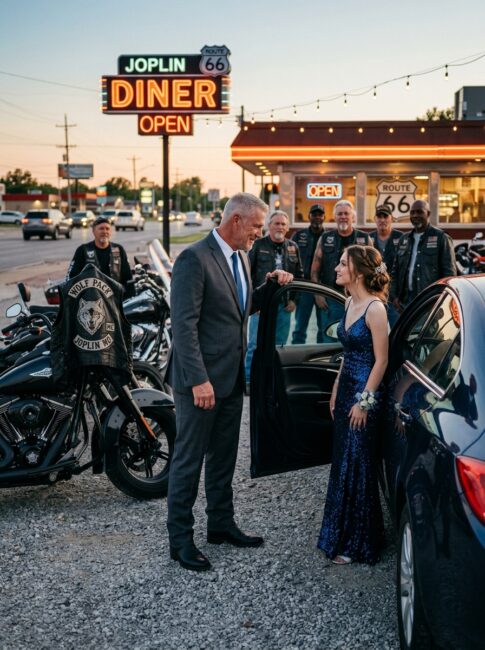
On prom night, the club gathered at Darlene’s before Grace arrived.
Nobody wore cuts inside the diner except me, and even I felt overdressed in leather beside Mike’s suit.
The Harley engines cooled outside in a line beneath the neon sign. Their ticking metal mixed with the low buzz from the diner lights.
Grace arrived with Sharon, her foster mother.
That was when she asked Mike who he was.
That was when everybody laughed.
That was when Mike opened the Buick door and drove her toward the school.
The rest of us followed from a distance, but not on the bikes. Darlene drove her minivan, and several brothers squeezed inside with the discomfort of large men traveling in a vehicle filled with grocery bags and children’s booster seats.
We parked across the street from Joplin High School.
We did not want to crowd Grace.
Mike pulled the Buick beside the curb.
The gym entrance glowed beneath strings of warm lights. Teenagers in dresses and suits crossed the sidewalk while parents stood nearby taking photographs.
Mike stepped out.
He walked around the front of the car.
He opened Grace’s door.
She placed one hand in his.
For a second, Mike simply stood there, his broad shoulders stiff beneath the borrowed suit, while Grace gathered the hem of her dress and stepped onto the sidewalk.
Several parents looked toward them.
Some recognized Mike.
Most did not.
Grace looked up at him.
“You ready?” Mike asked.
She nodded.
They walked toward the gym doors together.
We thought that was the ending.
It was only the beginning.Mike planned to leave after he walked Grace inside.
That had always been the arrangement.
He would open the door.
Take photographs.
Make sure she found her friends.
Return to Darlene’s.
The club had already ordered pie.
But when they reached the entrance, Grace stopped.
Music drifted through the gym doors, muffled by conversation and the sharp squeak of dress shoes against the polished floor. Paper stars hung from the ceiling. A balloon arch framed the entrance. Students laughed in groups that had formed years before Grace entered the school.
Grace held Mike’s hand tighter.
He noticed.
“You okay?”
She looked through the doorway.
The confidence she had worn while stepping out of the Buick disappeared.
“I don’t know anybody here.”
“You know kids from school.”
“Not like that.”
Mike waited.
Grace swallowed.
Then she asked the question.
“Uncle Mike, can you stay?”
Mike blinked.
Grace looked embarrassed immediately.
“You don’t have to. I know it’s boring. You probably have stuff to do. I just thought maybe you could sit somewhere until I know where to go.”
Mike stared at her.
For several seconds, the man who could make an entire clubhouse silent by lowering his voice did not answer at all.
Then he looked toward the folding tables arranged along the side of the gym for parents and chaperones.
“Yeah,” he said.
Grace searched his face.
“You’ll stay?”
Mike nodded.
“I’ll stay.”
He sat at a small table beneath a paper moon decoration between a father checking baseball scores on his phone and a mother arranging photographs on social media.
Someone offered him coffee.
Mike chose soda because coffee made his hands shake after dark.
He did not know anybody.
He did not start conversations.
He did not complain.
For four hours, Mike sat beneath those paper stars in a borrowed suit and watched Grace learn how to belong inside one evening.
At first, she stayed near the wall.
Then a girl from her English class waved her over.
Grace hesitated.
Mike lifted his chin slightly.
Go ahead.
Grace crossed the floor.
Twenty minutes later, she was laughing.
An hour later, she joined a group dancing badly to a song Mike did not recognize.
Every so often, she looked toward the side of the gym.
Every time, Mike was still there.
He did not wave.
He did not draw attention.
He simply stayed.
Near midnight, Grace returned to the table with flushed cheeks and several loose strands falling from her bun.
She sat beside Mike.
“Are you bored?”
“No.”
“You’ve been sitting here forever.”
Mike took a sip of soda.
“I’ve sat in worse places.”
Grace smiled.
For a while, neither of them spoke. The music softened as the night moved toward its final song.
Then Grace leaned closer.
“Uncle Mike?”
“Yeah?”
“This is the best prom I’ve ever had.”
Mike looked at her.
“You’ve only had one.”
“I know.”
He smiled.
Grace rested her hands in her lap.
“Still the best.”
Mike looked toward the dance floor, then toward the paper stars hanging from fishing line above the gym.
His voice changed slightly when he answered.
“Best night I’ve had too.”
Grace laughed because she thought he was being kind.
He was not.
That was the twist none of us understood until later.
Mike Donnelly had spent fifty-eight years being useful.
He had shown up with tools when roofs leaked.
He had hauled motorcycles from ditches.
He had stood beside hospital beds.
He had ridden through storms to bring medication to an old brother after surgery.
People called when they needed muscle.
They called when they needed a truck.
They called when they needed somebody intimidating to stand nearby and make trouble reconsider its choices.
But nobody had ever asked Mike to stay simply because his presence made a room less frightening.
Nobody had ever needed him to do nothing.
Grace was the first.
After prom, the Buick returned to Darlene’s just after midnight.
The neon sign was still glowing.
A thin layer of mist had settled over the parking lot, softening the headlights of passing cars along Route 66. Our Harleys waited beneath the diner windows, chrome damp beneath the night air.
Mike walked around the car and opened Grace’s door again.
She stepped out carrying her shoes in one hand.
Her feet hurt.
Her bun had mostly collapsed.
Her smile remained.
Darlene opened the diner door before they reached it.
Everybody inside stood up.
Grace stopped.
The brothers clapped.
Not loudly.
Not enough to embarrass her.
Just enough.
Grace looked toward Mike.
He looked irritated by the attention.
“It was prom,” he muttered. “Not a moon landing.”
Darlene handed Grace a slice of pie.
Russell handed Mike coffee.
I watched him reach for the mug.
His hand shook slightly.
Not from caffeine.
Not from age.
Something in him had moved during those four hours inside the gym, and Mike did not have language for it.
He rarely did.
Grace sat inside the booth wearing her blue dress and eating pie while the men argued about music, cars, and whether Mike’s clean-shaven face made him look younger or merely more suspicious.
Mike sat across from her.
Every few minutes, Grace looked up to make sure he was still there.
Every time, he was.
Later, after Sharon drove Grace home, Mike walked toward his Road King.
He folded the suit jacket carefully and placed it inside the Buick.
His leather cut waited on the Harley seat where I had left it for him.
Mike picked it up.
The leather was worn soft at the edges. The wolf patch across the back had faded after years of rain, heat, road grime, and gas station parking lots.
He slipped it on.
The familiar creak returned.
Mike stood beside the motorcycle with one hand resting on the handlebar.
“You good?” I asked.
He nodded.
Then he reached into the inside pocket of his cut and removed something small.
It was the paper wristband from the prom.
Blue.
Cheap.
Slightly torn near the edge.
Mike turned it over in his fingers.
“Keeping that?” I asked.
He placed it back inside the pocket.
“Maybe.”
That wristband stayed there.
I know because I saw it months later when Mike removed his cut during a clubhouse meeting. The paper had softened along the folds, but he had protected it inside a clear plastic sleeve.
The following year, Grace asked Mike to attend her high school graduation.
He wore the suit again.
The beard had grown back by then, although he trimmed it shorter.
At graduation, he sat beside Sharon in the bleachers and clapped when Grace crossed the stage.
Afterward, Grace found him near the parking lot.
She handed him an envelope.
Inside was a printed photograph from prom night.
The picture showed Grace stepping out of the Buick in her blue dress while Mike held the door open, his broad frame slightly bent so he could keep the hem from catching near the pavement.
On the back, Grace had written one sentence.
Thank you for staying when you could have left.
Mike read it once.
Then again.
He did not say much.
He folded the note carefully and placed it inside the same pocket as the prom wristband.
Mike still rides the Road King along Route 66 most Saturday mornings.
The beard is back.
The leather cut still creaks when he walks into Darlene’s diner.
The wolf patch still makes strangers glance toward the door before deciding whether to return to their coffee.
Not much has changed.
But every April, Mike pulls the charcoal suit from the back of his closet and takes it to the dry cleaner.
He does not always have somewhere to wear it.
That is not the point.
Grace is nineteen now.
She studies nursing at a community college outside Joplin and works part-time at the same diner where she once apologized for broken glasses.
She still brings Mike black coffee before he asks.
Sometimes, when the diner is quiet, she sits across from him and talks about exams, bills, difficult patients, and the ordinary fears that come with building a life after spending years expecting each home to be temporary.
Mike listens.
He does not interrupt.
He does not offer advice unless she asks.
He simply stays.
Last spring, I saw Grace hand him another envelope near the diner counter.
Inside was an invitation to a nursing-school pinning ceremony.
Mike read it twice.
“You want me there?” he asked.
Grace looked confused by the question.
“Of course.”
Mike nodded once.
He folded the invitation and placed it inside his cut.
Same pocket.
Prom wristband.
Graduation photograph.
Invitation.
Outside, the Harleys waited in a row beneath the Route 66 sign.
Mike finished his coffee, stood, and walked toward the door.
The engine turned over.
The low rumble rolled across the parking lot and faded into the Missouri morning.
Some men are asked to fight.
Some are asked to fix things.
Mike was asked to stay.
He stayed.
Follow the page for more stories about the people behind the leather cuts.