Part 2: The Boy Wanted To Fly — A Biker Built Him Wings On Route 66
My name is Annie Brooks, and I owned Maggie’s Route 66 Diner because my mother owned it before me and because some places do not really get sold. They get inherited with unpaid invoices, cracked vinyl booths, and regulars who think the last waitress was better.
Flagstaff is not a big town when you live near the road. Everybody passes through, but the same people stay. Truckers. College kids. Snowbirds. Tourists chasing old highway signs. Bikers who smell like gas, sunblock, road dust, and black coffee.
Hank’s club came every second Saturday.
They called themselves the Cinder Saints, which sounded tougher than they were and softer than they wanted anyone to know. Most were veterans, mechanics, welders, roofers, one retired school bus driver, and a woman named Joanie who could rebuild an engine while telling a man exactly how stupid he sounded.
Hank was their road captain.
Fifty-eight years old. White American. Six-foot-four, maybe 260 pounds, with shoulders like a garage door and a face people crossed streets to avoid. His knuckles were scarred. His left cheek had a white line from his ear to his jaw. He wore a chain wallet, heavy rings, and a black leather cut with faded patches from memorial rides, cancer benefits, veterans’ escorts, and one small blue feather stitched inside the collar where most people would never see it.
That feather was the thing that did not fit.
I noticed it one morning when he bent down to pick up Caleb’s dropped straw. The leather opened, and there it was. Blue thread. Careful stitches. Not club colors. Not rank. Not road miles.
A feather.
When I asked, Hank closed his cut.
“Old promise,” he said.
That was Hank. Two words where other men needed twenty.
Caleb liked that about him.
People talked too much around my son. Doctors. Therapists. Teachers. Family members who visited twice a year and said things like, “You’re getting so big,” because they had nothing real to offer. Caleb had learned to answer with nods, shrugs, and sarcasm.
But Hank did not fill silence.
He sat across from Caleb at the diner counter and let the boy talk when he wanted.
The first real conversation happened over cherry pie.
Caleb asked, “Does it feel different on a bike?”
Hank said, “Everything feels different.”
“Like what?”
“Rain hurts more.”
Caleb grinned.
“What else?”
“Bugs taste bad.”
Caleb laughed so hard he nearly choked on soda.
That laugh changed Hank’s face. Not much. Just enough. A crack in old concrete.
Over the next month, Hank started showing up alone on weekdays. He fixed the loose ramp by the diner door without asking. He adjusted Caleb’s chair brake when it stuck. He brought a pair of riding goggles and put them on the table like it was nothing.
“They’re old,” he said.
Caleb put them on and refused to take them off for dinner.
The club noticed.
Brotherhood is not always big speeches and arms around shoulders. Sometimes it is six men pretending not to watch their road captain get attached to a kid in a wheelchair. Sometimes it is Joanie sliding a notebook across the diner table with sketches of a sidecar frame. Sometimes it is a prospect named Luis measuring Caleb’s chair twice because Hank told him once was how people got hurt.
They argued over the build before the first bolt was cut.
Hank wanted it low, stable, and open enough for wind.
Joanie wanted more safety restraints.
Luis wanted a removable ramp.
A veteran named Smokey wanted a roll bar, and everyone told him it would look ridiculous, and he said, “Good. Ridiculous keeps children alive.”
Caleb wanted only one thing.
“No glass box,” he said. “I don’t want to watch flying through a window.”
So they designed a sidecar with an openable windshield. Strong frame. Custom seat. Chest harness that did not look medical. Padded armrests. Quick-release mount for emergencies. A small place for his folded chair behind it.
It took money nobody had.
That was the first test.
The Cinder Saints kept a fund for funeral rides, members in trouble, and winter repairs. Some wanted to use it. Others hesitated. Not because they did not care. Because caring costs different when the receipt lands on the table.
Hank did not argue.
He took off his rings and set them beside his coffee.
“Sell these first,” he said.
Nobody touched them.
Joanie swore under her breath.
Smokey pulled out a hundred-dollar bill.
Then Luis.
Then the prospect.
Then a waitress.
Then me.
By closing time, there was a coffee can by the register with duct tape on it that said: CALEB’S WIND.
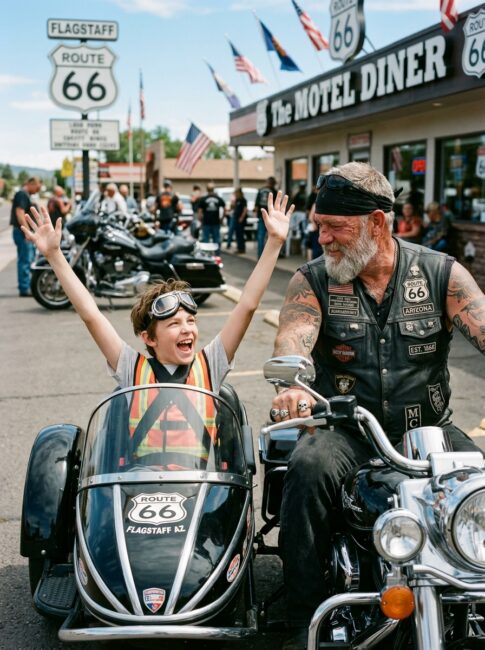
The morning of the first ride, Flagstaff smelled like pine, hot asphalt, and breakfast grease.
Half the town seemed to know something was happening. Not officially. Nobody put up flyers. Bikers hate making kindness look like an event. But word travels on Route 66 faster than weather.
By nine, the diner lot was full.
Harleys lined the curb, pipes ticking as they cooled. Leather creaked. Chains jingled. Boots scraped gravel. The Cinder Saints stood around Hank’s Road King like a wall of tattooed uncles nobody had ordered but everyone suddenly needed.
The sidecar was matte black, low and wide, with the little windshield tilted open.
Caleb saw it and stopped breathing.
That scared me.
His hands went still in his lap. His mouth opened, but no sound came out. For a second, I thought we had made a mistake. Maybe wanting something is safer than getting it. Maybe the dream had been easier before it had bolts and wheels and a seat waiting for him.
Hank crouched beside him.
That big man dropped down in the gravel, knees popping, face level with my son’s.
“No ride today if you don’t want,” he said.
Caleb stared at the sidecar.
“What if I look stupid?”
Hank looked over his shoulder at twenty bikers in leather vests, gray beards, tattoos, bandanas, scars, and one man wearing a pink helmet because his granddaughter had decorated it.
“Kid,” Hank said, “look around.”
Caleb smiled, but his eyes were wet.
Getting him into the sidecar took time. That part nobody shows in pretty videos. The awkward lifting. The careful placing of legs that do not answer. The harness check. The second harness check. My fingers shaking so badly Joanie had to take over.
Hank’s hands shook too.
Not much.
Enough for me to see.
“You okay?” I asked him.
He did not look up.
“No.”
Then he tightened the last strap.
Caleb looked small inside that machine built by men who were used to fixing things with force. There was nothing force could do for my boy’s spine. Nothing chrome could undo. Nothing an engine could repair.
For one awful second, I hated the whole idea.
Then Hank swung his leg over the Road King.
The bike settled under him. He turned the key. The engine coughed once, then caught with a deep, heavy sound that moved through my ribs.
Caleb flinched.
Then laughed.
The parking lot went quiet after that. Strange quiet. A hundred people holding their breath.
Hank looked down at him.
“You say stop, we stop.”
Caleb nodded.
“You say slow, we slow.”
Caleb nodded again.
“You say home, we turn around.”
Caleb swallowed.
“What if I say faster?”
Hank’s mouth twitched.
“Your mother kills me.”
That got the laugh the whole lot needed.
They rolled out slow. Painfully slow. The kind of slow that made every biker there respect Hank more than any reckless throttle ever could. Down the diner driveway. Onto the access road. Toward the old Route 66 sign where tourists always stopped for pictures.
I followed in Joanie’s pickup, both hands locked together in my lap.
Caleb’s shoulders were tight at first.
Then the road opened.
Hank lifted one hand, palm down, telling the line behind him to hold steady. The sidecar windshield was open. Wind hit Caleb’s face full on. His hair snapped back. His goggles pressed against his cheeks.
His hands rose from the armrests.
One inch.
Then higher.
Then both arms out.
He tilted his face up to the Arizona sky and screamed so loud I heard him over the engine.
“I CAN FLY!”
Every biker behind him hit their horns.
I cried so hard I could not see the road.
That should have been the whole story.
It was not.
The clip went viral by dinner.
Three million views in two days.
Local news called. Morning shows emailed. A company offered to sponsor a second ride if Caleb wore their logo. Hank said no to all of it before I even finished reading the messages.
“He ain’t a billboard,” he said.
The video itself was shaky. Shot from near the Route 66 sign. You could see Caleb’s arms up, Hank’s gray beard moving in the wind, the Cinder Saints rolling behind them like a leather storm. You could hear my son screaming, “I can fly!” and then my ugly sob from somewhere off camera.
I thought Joanie filmed it.
She thought Luis did.
Luis thought I did.
Nobody knew.
Then Caleb’s phone rang.
It was an old number. One I had deleted from my contacts but never from memory.
His father.
Derek.
He had left when Caleb was six, two months after the paralysis became permanent. He did not leave dramatically. Men like Derek rarely do. He packed during a therapy appointment, left his wedding ring in a cereal bowl, and sent a text that said he “couldn’t do hospitals anymore.”
No goodbye to Caleb.
No explanation a child could hold.
For seven years, he sent birthday cards three times, money twice, and silence every day between.
Caleb saw the name on the screen.
His whole face changed.
Not happy. Not angry.
Older.
The phone buzzed in his lap until it stopped.
Then buzzed again.
And again.
He did not answer.
Hank was sitting at the counter with black coffee, still wearing his cut. He watched Caleb’s hands tighten around the phone.
“Want me to shut it off?” I asked.
Caleb shook his head.
The phone rang a fourth time.
This time, Caleb held it out to Hank.
The diner noise died.
Spatulas stopped. Coffee stopped pouring. Even the bikers in the back booth went still.
Hank looked at the phone.
Then at Caleb.
“You sure?”
Caleb nodded.
Hank took it. His scarred thumb hit answer. He did not say hello.
I could hear Derek’s voice through the speaker, small and thin.
“Caleb? Buddy? I saw the video. I just wanted to talk. I didn’t know—”
Hank’s face did not move.
He listened for maybe five seconds.
Then he said one sentence.
“If you want to talk to your son, you come here. Face to face. Not through a phone.”
Silence.
Then Derek said something I could not make out.
Hank ended the call.
He set the phone gently back in Caleb’s lap.
Nobody clapped. Nobody spoke.
Caleb stared at the screen.
Then he whispered, “He won’t come.”
Hank looked at him.
“No,” he said.
Just that.
Not comfort. Not lies.
The truth, plain and heavy.
Derek did not come.
Not that day. Not that week. Not after the second viral clip. Not after the local news ran the story without Caleb’s full medical details because Hank stood behind the reporter with his arms crossed until they understood boundaries.
But something else came out.
The person who filmed the first clip was Derek.
That was the twist that made my stomach turn.
He had been in Flagstaff for work, passing through. He had seen the crowd near the Route 66 sign. Saw the motorcycles. Saw the boy in the sidecar. He did not know it was Caleb until the sidecar passed close and the boy screamed.
Instead of stepping out.
Instead of saying his son’s name.
He filmed.
Later, he uploaded the clip to a social account he barely used, with a caption about “a beautiful moment on Route 66.” He did not mention Caleb was his son. Maybe shame stopped him. Maybe cowardice. Maybe both. When the clip exploded, people praised the “unknown man who captured a miracle.”
Derek saw the comments.
Then he called.
Caleb found out because someone tagged the account, and the name was there.
Derek Brooks.
His father had been ten yards away from him on the best day of his life and chose a camera over his voice.
That could have broken Caleb.
Maybe it did, for a little while.
The next Saturday, he refused to go to the diner. Refused the sidecar. Refused breakfast. He sat by the window at home with the riding goggles in his lap, turning them over and over until the strap twisted.
Hank came by at noon.
Not on the Harley.
In his old pickup.
That mattered. He was not there to perform the ride. He was there for the boy.
He knocked once and came in smelling like metal dust and coffee.
Caleb did not look at him.
“He saw me,” Caleb said.
Hank stood in the doorway.
“Yeah.”
“He was right there.”
“Yeah.”
“He didn’t want me.”
Hank’s jaw worked. His eyes got wet, but biker men like Hank do not let tears fall easy. They hold grief in their throat until it changes their voice.
“He wanted easy,” Hank said. “That ain’t the same thing.”
Caleb turned then.
The room was so quiet I heard the refrigerator kick on.
“What if nobody stays when it gets hard?”
Hank reached inside his leather cut and touched that small blue feather stitched under the collar.
The old promise.
Later, Joanie told me what it meant.
Hank had a daughter once. Her name was Blue, not legally, but that was what he called her because she collected feathers and taped them to her bedroom wall. Hank lost custody when he was drinking and fighting and living like consequences were for other men. By the time he got sober, she was seventeen and wanted nothing from him.
He did not chase her with speeches.
He sent one letter every birthday.
No excuses. No demands.
Just: I’m here if you ever want me. Dad.
The blue feather inside his cut was from the last birthday card she sent back unopened. It had been tucked under the tape. He kept it not as a wound, but as a rule.
Do not disappear.
That is why Hank answered Derek’s call the way he did.
That is why he built the sidecar.
Not because motorcycles fix fatherlessness. They do not. Not because the club could replace blood. They could not.
But when a boy asked for wind, Hank knew the answer could not be another adult saying “maybe someday.”
The Cinder Saints showed up the next morning without being asked.
No engines at first. Just trucks. Tools. Donuts. Coffee. Smokey fixed a porch rail that had been loose for two years. Luis adjusted Caleb’s ramp. Joanie sat on the floor and cleaned the goggles.
Then Hank rolled the Road King into the driveway.
The sidecar waited there, windshield open.
Caleb came outside after twenty minutes.
He looked at Hank and said, “If I say home?”
Hank nodded.
“We turn around.”
“If I say stop?”
“We stop.”
“If I don’t say anything?”
Hank handed him the goggles.
“Then we listen.”
That was the first ride after Derek.
Short. Four miles. Maybe less.
No cameras.
Hank made sure of that.
When they came back, Caleb did not scream. He did not raise his arms.
He just sat in the sidecar while the engine ticked hot beside him and said, “Again next week?”
Hank nodded once.
“Every week you want.”
Sunday became ride day.
Not because of views. Not because of charity pages. Not because strangers online called Caleb inspiring and filled comments with things they would never say to his face.
Sunday was for wind.
At 8:30 every Sunday morning, Hank rolled the Road King into our driveway. Not loud. Not showing off. Just that low engine pulse, steady as a second heartbeat. Caleb would be waiting by the window pretending he had not been watching since eight.
The ritual never changed.
Hank checked the sidecar frame with his hand. Luis had installed a small brass plate near the seat that read CALEB’S WIND, but Hank never pointed it out. He checked the harness. Checked the windshield. Checked the chair mount. Checked Caleb’s gloves. Checked my face, because mothers have weather too.
Then he would ask, “What’s the word?”
Caleb always answered, “Fly.”
They rode through Flagstaff, past pine trees and gas stations, out toward the old stretches of Route 66 where the road still remembered being important. Sometimes the Cinder Saints followed. Sometimes only Hank. Sometimes I followed in the pickup. Sometimes I stayed behind and listened for the engine to come back.
People still filmed now and then.
Hank got good at ruining their shot.
He would angle his body. Move the bike. Park between Caleb and strangers. One time, at a gas station in Williams, a man lifted his phone too close, and Hank simply looked at him until the man lowered it.
No threat.
No drama.
Just a father-shaped silence from a man who was not Caleb’s father but kept doing the work anyway.
Derek called twice more.
Caleb did not answer.
The third time, he deleted the voicemail without listening.
Then one Sunday, months later, Caleb asked Hank to stop at the Route 66 sign where the first clip had been filmed. I felt my chest tighten, but Hank did not question him.
They parked.
The engine shut off.
For a moment, there was only wind moving through dry grass and the soft tick of hot pipes cooling.
Caleb sat in the sidecar, goggles on his forehead, looking at the spot where his father had stood with a phone instead of open arms.
Then he raised both hands.
Not high.
Just enough.
“Okay,” he said.
Hank heard him.
So did I.
That was not forgiveness. Not exactly. It was something quieter. A door closing without being slammed.
After that, Caleb started helping with the sidecar. He could not weld, but he learned tools. Socket sizes. Cable ties. Tire pressure. He kept a rag in the sidecar pocket and wiped dust from the brass plate before every ride.
Hank pretended not to notice.
The club noticed everything.
Brotherhood changed around Caleb. The prospects learned patience before throttle. The old men learned that showing up was harder than acting tough. Joanie started a sidecar fund for other disabled kids who wanted wind. She named it No Glass Box.
Hank hated the name.
Caleb loved it.
So the name stayed.
Caleb is sixteen now.
Taller. Broader in the shoulders. Still in the chair. Still sharp with words. Still allergic to pity. He helps run the No Glass Box fund from a laptop at the diner booth where he first said bikers looked like they were flying.
The sidecar has scratches now.
Good ones.
Desert dust in the seams. A faded sticker from Williams. A small dent from when Smokey dropped a wrench and blamed gravity like gravity cared.
Hank is sixty-one. Beard whiter. Knees worse. Hands still steady when the harness clicks. He still looks like trouble walking into a diner. Mothers still pull children closer sometimes before they understand.
Then they see him kneel.
They always change after that.
Derek never came.
I used to think that was the wound in the story. The missing man. The unanswered call. The father who stood ten yards away and chose to film what he was too ashamed to join.
But last Sunday, Caleb corrected me without knowing it.
A little boy at the gas station stared at the sidecar and asked if Caleb was scared.
Caleb looked at Hank.
Hank looked down at the road.
The Harley idled between them, low and patient.
Caleb smiled and said, “Only before the engine starts.”
Then Hank gave the throttle one small twist. The V-twin answered. Leather creaked. Boots lifted. The sidecar windshield opened toward the morning.
Caleb put on his goggles.
Hank looked over.
“What’s the word?”
Caleb raised both hands before they even moved.
“Fly.”
The old Road King rolled west, past the pumps, past the diner, past the Route 66 sign where one man failed him and a whole club chose not to.
This time, nobody filmed.
The road kept it.
Follow this page for more biker stories about the people behind the leather, the scars, and the engines.