Part 2: The Boy Was Turned Away From a Birthday Party for Being Poor — Then His Gift Made the Birthday Mother Cry
Nobody noticed Ethan come back.
That was the first thing Mrs. Parker kept saying later.
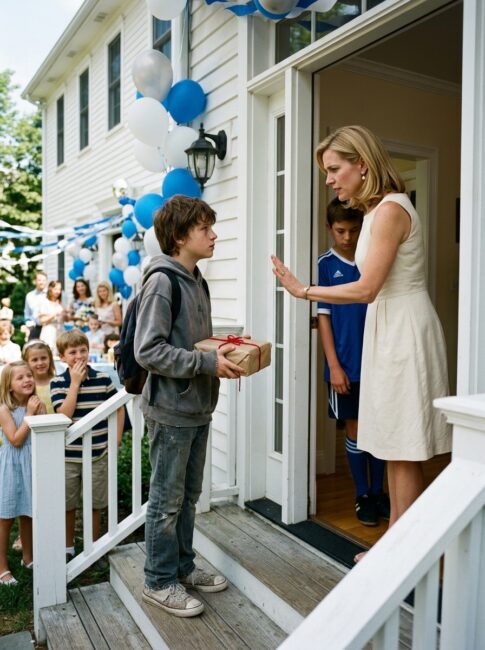
The neighborhood was too busy being cheerful. Parents stood near the kitchen island holding paper cups of lemonade. Children ran through the backyard, chasing a rented foam-ball soccer game set up on the lawn. The photographer asked everyone to smile near the balloon arch.
Even the house seemed too bright to allow anything uncomfortable inside.
So when the blue gift bag appeared, most people assumed a late guest had dropped it off.
Mrs. Parker noticed it only because Caleb’s little sister, Sophie, nearly tripped over it.
“Mom,” Sophie said, holding it up. “This one doesn’t have tissue paper.”
The bag was thin, the kind sold in packs at a discount store. One corner had been taped where it had torn. The handles were made from twisted blue string, one side darker than the other, as if someone had repaired it with whatever was available.
Mrs. Parker almost set it aside.
Then she saw Caleb’s name written on the card.
The handwriting was careful, with letters pressed deep into the paper.
To Caleb. Happy birthday.
No last name.
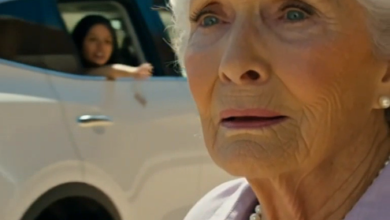
Mrs. Parker opened the card standing near the front hall, expecting something awkward, maybe an apology. She was already preparing the small polite smile adults use when they want to move past a problem without looking at it.
But the first line stopped her.
I am sorry I came to your house today.
She read it twice.
Her fingers tightened around the card.
Behind her, a few mothers continued talking about soccer camps and summer rentals by the lake. Nobody noticed the way Mrs. Parker’s shoulders stiffened.
The note continued.
I thought Caleb invited me because we are partners in science class. He said I could come if I wanted. I did not know it was only for family friends.
Mrs. Parker looked through the glass beside the door.
The driveway was empty.
Down the street, heat shimmered above the pavement. A lawn sprinkler clicked in a slow rhythm across the sidewalk.
She swallowed and kept reading.
I did not want Caleb to feel bad in front of everyone, so I left. Please do not tell him his mom made me go. He looked sad.
That was the first twist that made her chest tighten.
Ethan had protected Caleb.
Not himself.
Mrs. Parker glanced toward the backyard.
Caleb was sitting near the fence instead of playing, a soccer ball resting near his feet. His friends were shouting around him, but he was not shouting back. He kept looking toward the side gate.
Mrs. Parker lowered her eyes to the card again.
The next line was written smaller.
I still wanted him to have the gift because he told me once his grandpa used to watch games with him.
Her hand trembled.
Caleb’s grandfather, Robert Parker, had died the previous winter.
He had not been famous, not even close. He had been a retired postal worker who loved local soccer, old baseball caps, and sitting beside Caleb on Saturday mornings while pretending not to nap.
Mrs. Parker had never mentioned him to Ethan.
She had never spoken to Ethan before that day.
Inside the bag was a small box wrapped in brown paper. Not gift wrap. Grocery bag paper, flattened and folded neatly. A piece of red yarn held it together.
One of the mothers, Dana, finally noticed Mrs. Parker standing still.
“Everything okay?” she asked.
Mrs. Parker did not answer.
She untied the yarn.
Inside the box was an old wooden picture frame, sanded by hand and polished until the edges shone softly. It held a pencil drawing of a man and a boy sitting on a porch, watching a soccer ball roll across grass.
The man wore a postal jacket.
The boy wore Caleb’s number seven jersey.
Mrs. Parker pressed one hand over her mouth.
Dana stepped closer.
“Is that Robert?” she whispered.
Mrs. Parker nodded, but her eyes had already moved to a folded sheet beneath the frame.
It was a second note.
This one was addressed to Caleb.
Your grandpa’s hands were hard to draw, so I looked at the picture on the school memorial board. I hope it is okay. My dad says hands are important because they show what a person did for other people.
Mrs. Parker remembered the school memorial board.
There had been one photo of Robert Parker at the fall fundraiser, helping carry boxes of canned food into the gym. Caleb had stood beside him, laughing, with one hand on the soccer ball.
Ethan had studied that photo.
Not because anyone paid him.
Not because anyone asked.
Because Caleb had once mentioned missing his grandfather.
Mrs. Parker’s face warmed with shame, but the reveal was not finished.
At the bottom of the bag was a small envelope.
Inside was a five-dollar bill, folded into a square.
A third note came with it.
I used the money I saved for the party arcade card. Please use it for Caleb’s team fund if there is one. He said some kids cannot pay for the fall league. I know that feels bad.
Mrs. Parker sat down on the stairs.
The house noise faded behind her.
She remembered Ethan’s shoes.
She remembered the way the other boy laughed.
She remembered her own words, soft and polite and cruel enough to pass as manners.
Mostly for family friends.
Then Caleb appeared at the hallway entrance.
“Mom?” he asked.
Mrs. Parker looked up with wet eyes, holding the drawing in both hands.
Caleb saw the frame.
His face went pale.
“Where did you get that?” he whispered.
Mrs. Parker could not answer.
Caleb walked closer, took the note, and read it in silence.
His lips began to shake before he reached the end.
Then he said something that turned every adult in the hallway cold.
“I told him Grandpa used to say nobody should eat cake alone.”
Mrs. Parker did not move for several seconds.
Caleb’s sentence landed gently, but it broke something open.
Nobody should eat cake alone.
It sounded like Robert Parker. Plain. Kind. The sort of thing he would say while handing a plate to a neighbor he barely knew.
Caleb looked at the front door.
“Mom, why did Ethan leave?”
Mrs. Parker stared at him.
A dozen answers moved through her mind, and none of them were clean.
Because she had judged him by his shoes.
Because she had worried what other parents would think.
Because the party photographer was near the porch.
Because Ethan looked like a reminder of things she wanted her perfect afternoon to hide.
Instead, she said, “I made a mistake.”
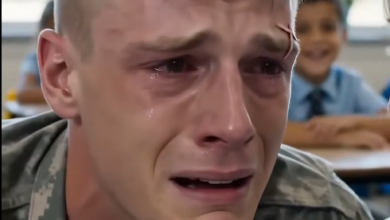
Caleb’s eyes filled.
“You told him he couldn’t come?”
The hallway grew quiet.
Dana stepped back. Another mother pretended to check her phone. A father near the kitchen stopped pouring lemonade.
Mrs. Parker nodded once.
Caleb turned away from her so fast the frame almost slipped from his hands.
“He made this for me,” he said. “He worked on it for three weeks.”
That was the next twist.
Three weeks.
Caleb explained in pieces, his voice tight and embarrassed. Ethan had asked about Caleb’s grandfather after seeing him quiet during a school art period. Caleb had told him small things: that Grandpa Robert delivered mail for thirty-two years, that he whistled during games, that he called Caleb “Number Seven” even when he wore regular clothes.
Ethan had listened.
Quietly.
The way poor children often listen when they know they cannot offer much else.
“He asked what Grandpa’s hands looked like,” Caleb said. “I thought it was weird.”
Mrs. Parker looked at the drawing again.
Robert’s hands were not perfect. The fingers were slightly too large, and the knuckles were drawn darker than the rest. But somehow, they were the most alive part of the picture.
Working hands.
Patient hands.
Hands that looked like they had carried groceries, mailbags, boxes, sleeping children, and grief.
“Where does Ethan live?” Mrs. Parker asked.
Caleb wiped his cheek with his sleeve.
“Behind the laundromat. In the apartments.”
The words struck her harder than she expected.
Behind the laundromat.
That was six blocks away, past the grocery store, across from the bus depot where people waited with plastic bags at their feet.
Mrs. Parker stood.
“I’m going to bring him back.”
Caleb shook his head.
“He won’t come now.”
There was no anger in his voice.
That made it worse.
Mrs. Parker looked toward the living room, where children were still eating cupcakes beneath a banner that said Happy 12th Birthday, Caleb. The party looked untouched from a distance. Bright plates. Bright balloons. Bright smiles.
But the middle of it had changed.
She took the gift card and walked into the backyard.
“Everyone,” she said.
Her voice was not loud, but parents turned because something in it had lost its polish.
The children slowed.
Caleb stood beside her, holding the frame against his chest.
Mrs. Parker looked at the boy who had laughed earlier.
Then at his mother.
Then at the photographer, who lowered her camera.
“I need to say something,” Mrs. Parker said. “A boy came here today with a birthday gift for Caleb. I turned him away.”
A few adults shifted uncomfortably.
“He was invited,” she continued. “He was kind. He brought something handmade. I decided he did not belong before I knew anything about him.”
No one spoke.
Not because the confession was dramatic.
Because it was specific.
The kind of truth people cannot dodge with polite coughing.
Caleb lifted the drawing for everyone to see.
The children gathered closer.
At first, they stared because it was good. Then they stared because Caleb began to cry.
“That’s my grandpa,” he said. “Ethan drew him.”
The boy who had made the dollar-store comment looked down at his sneakers.
His mother touched his shoulder, but she did not defend him.
Mrs. Parker turned to Dana.
“Please watch the younger kids for a few minutes.”
Then she looked at Caleb.
“Come with me.”
They left the party through the side gate.
Mrs. Parker did not change shoes. She walked in her cream dress and summer sandals down the sidewalk while Caleb held the frame like something breakable and sacred.
The walk to the apartments behind the laundromat took twelve minutes.
Long enough for Mrs. Parker to notice things she usually passed without seeing.
A woman pushing a stroller with one broken wheel.
A man sitting outside the bus depot eating from a paper tray.
A laundromat window full of spinning clothes, the glass reflecting pieces of sky.
The apartment building behind it was low and brown, with peeling railings and a soda machine that had not worked in years.
Caleb pointed to the second floor.
“Apartment 214.”
They climbed the stairs.
At the door, Mrs. Parker raised her hand, then lowered it.
For the first time that day, she was afraid of being seen clearly.
Caleb knocked.
No answer.
He knocked again.
A woman opened the door a few inches.
She looked tired in a way makeup could not hide. Her name tag read Maria’s Laundry Service, though she was not at work now. Her hair was pulled back, and her eyes moved from Caleb to Mrs. Parker with careful caution.
“Mrs. Miller?” Caleb asked. “Is Ethan home?”
The woman looked down the hall before answering.
“He’s not feeling well.”
Mrs. Parker stepped forward.
“I’m Anna Parker,” she said. “Caleb’s mother.”
Mrs. Miller’s face changed, but only slightly.
Not surprise.
Recognition.
Ethan had told her.
“I’m sorry to bother you,” Mrs. Parker said. “I came because I did something wrong.”
Behind Mrs. Miller, the apartment was small and clean. A folding table stood near the window. On it lay pencil shavings, a cheap lamp, and several rejected sketches of Robert Parker’s hands.
Mrs. Parker saw them.
Her throat tightened again.
Mrs. Miller followed her gaze.
“He wanted it to be right,” she said quietly.
That was another twist.
The gift had not been a last-minute gesture.
It had taken evenings, sacrifice, and the kind of attention most adults only pretend to give.
Ethan appeared behind his mother.
His hoodie was gone. He wore a plain T-shirt with a stretched collar. His eyes were red, but he tried to look calm when he saw Caleb.
“I didn’t want you to get in trouble,” Ethan said.
Caleb stepped forward.
“I didn’t invite you because I felt sorry for you,” he said. “I invited you because you’re my friend.”
Ethan stared at him.
The word seemed to reach him slowly.
Friend.
Mrs. Parker crouched, though her knees pressed hard against the hallway floor.
“Ethan,” she said, “I was wrong.”
He looked at his mother first, as if asking whether adults were allowed to say that.
Mrs. Parker continued.
“I looked at your clothes and your shoes, and I decided something about you that was not true. You gave my son the most thoughtful gift anyone brought today.”
Ethan’s face tightened.
He did not smile.
That was important.
Forgiveness does not always arrive just because someone asks for it.
Mrs. Parker reached into her purse and took out the five-dollar bill.
“I can’t take this,” she said.
Ethan shook his head.
“It’s for the team fund.”
Mrs. Parker glanced at Caleb, then back at Ethan.
“Then we’ll use it exactly that way. But only if your name is the first one on the envelope.”
Ethan frowned.
“My name?”
“Yes,” she said. “Because you were the first person at that party who remembered some kids get left out.”
Mrs. Miller turned away toward the kitchen sink.
Her shoulders moved once.
Only once.
But Mrs. Parker saw it.
Caleb held out the frame.
“Will you come back?” he asked. “Please.”
Ethan looked past him to Mrs. Parker.
She did not rush him.
She did not fill the silence with excuses.
At last, Ethan said, “I don’t want people laughing at my shoes.”
Caleb looked down.
Then he did something no one expected.
He sat on the hallway floor and pulled off his own new sneakers.
“These hurt anyway,” he said.
Ethan blinked.
Mrs. Parker almost told him to get up, then stopped herself.
Mrs. Miller laughed once through tears.
It was small, but it changed the hallway.
Ethan looked at Caleb’s socked feet. Then he looked at Mrs. Parker’s embarrassed face. Then, for the first time that afternoon, he smiled.
Not fully.
Just enough.
“Okay,” he said. “But I’m not singing.”
Caleb wiped his nose.
“You can stand there and look miserable. That still counts.”
When Ethan returned to the party, he did not come through the front door.
He came through the side gate beside Caleb, with Mrs. Parker and Mrs. Miller walking behind them.
The backyard quieted in layers.
First the parents stopped talking.
Then the children stopped running.
Then even the hired photographer lowered her camera, as if the moment did not belong to her lens.
Ethan saw the boy who had laughed at his gift.
The boy opened his mouth, then closed it.
His mother nudged him gently.
“I’m sorry,” the boy said.
Ethan nodded.
He did not make it easy.
He did not make it cruel.
He simply accepted the apology the way children do when they have already learned that dignity is something you carry yourself.
Mrs. Parker placed Ethan’s five-dollar bill into a clean white envelope and wrote on the front: Fall League Fund — Started by Ethan Miller.
Then she set the envelope beside the birthday cake.
Not hidden.
Not explained away.
Beside it, Caleb placed the drawing of his grandfather.
For the first time all afternoon, the party stopped looking like a perfect event and started looking like a room full of people trying to become better in real time.
When it was time to cut the cake, Caleb took the first slice and carried it to Ethan.
Ethan looked confused.
Caleb shrugged.
“Grandpa’s rule,” he said.
Nobody should eat cake alone.
Ethan took the plate.
Mrs. Miller stood near the fence, holding her purse in both hands. She looked like someone prepared to leave before anyone could decide she did not belong.
Mrs. Parker walked over and stood beside her.
For a while, neither woman spoke.
Children began eating cake again. A few parents came to look at the drawing. One father asked quietly whether Ethan took art classes.
Mrs. Miller shook her head.
“No,” she said. “He draws after homework. When the light bill is friendly.”
The father looked away, ashamed by how easily people speak of opportunities as if everyone begins in the same room.
Later, Mrs. Parker did not announce a grand charity fund. She did not post a public apology online. She did not turn Ethan into a lesson for other people to admire.
She did something smaller.
The next Monday, she went to the school office and paid the overdue balance on the art club supplies account. Not under her name. Not under Ethan’s.
Under Robert Parker’s.
Then she asked the school counselor to make sure the fall soccer fund could accept anonymous help for any child who needed it.
The first five dollars stayed in the envelope.
Ethan’s five dollars.
Caleb insisted on that.
By autumn, Ethan was not only in art club. He had drawn the cover for the school’s fundraiser program. The picture showed a long table with different kinds of shoes underneath it: polished dress shoes, muddy work boots, small sneakers, sandals with cracked straps, and one pair of socks without shoes at all.
Above the table were plates of cake.
No faces.
Just room for everyone.
At the bottom, in tiny pencil letters, Ethan had written one line.
Nobody should eat cake alone.
Mrs. Parker kept the birthday drawing in the hallway of her house, not in the living room where guests might praise it, but near the front door where she would see it before answering anyone.
Robert Parker’s drawn hands rested on Caleb’s shoulder forever.
Sometimes, when the doorbell rang, Mrs. Parker looked at those hands first.
Then she opened the door differently.
Follow this page for more heartfelt stories about the quiet moments that change how we see one another.