Part 2: The Bride’s Father Asked to Say a Few Words — Then His Story Made the Groom Break Down in Tears
The microphone squealed once before settling into a low hum.
Nobody laughed.
Martin looked down at the receipt again, though he did not seem to be reading it. His thumb moved over the faded paper in small circles, the way a person touches something that still hurts.
Emily’s mother, Claire, sat at the front table with her new husband, her pearls bright against her black dress. She leaned back as if distance could protect her from whatever Martin was about to say.
For years, Claire had told a simple version of the story.
Martin was stubborn. Martin was cheap. Martin loved his work more than his family.
It was easy to believe because Martin never defended himself.
He had missed birthdays because a tow truck call came in. He had arrived late to Emily’s high school graduation with dirt on his cheek. He had walked into her college send-off party carrying a toolbox instead of flowers.
He looked, from the outside, like a man who always chose something else.
That afternoon, he had nearly proved everyone right again.
The ceremony had been delayed seven minutes because he was not in his seat. Emily had stood at the double doors with her bouquet shaking in both hands, trying not to cry while the wedding planner murmured into a headset.
When Martin finally appeared, he was breathless.
There was a small tear near the shoulder of his suit jacket.
His left hand was wrapped in white gauze.
“Traffic,” he had said.
Claire had rolled her eyes.
Even Emily had looked away.
Now, at the reception, the room watched him as if waiting for one final disappointment.
Martin cleared his throat.
“This receipt is from Miller’s Market,” he said. “It’s dated March 17, 2004. It says I bought a loaf of bread, a carton of milk, strawberry jam, and a pack of birthday candles.”
Emily lowered her gaze.
Daniel blinked, confused.
“That was Emily’s ninth birthday,” Martin continued. “I was supposed to bring home a cake.”
A murmur moved through the tables.
Claire’s expression tightened.
Martin gave a small nod, as if he deserved every sound in the room.
“I didn’t bring the cake,” he said. “I came home with this instead.”
He held up the receipt.
A cousin at the side table whispered, “Why would he bring that up today?”
Martin heard it.
His eyes flickered, but he did not stop.
He looked at Emily, and for the first time all evening, his voice nearly broke.
“You cried that night,” he said. “You sat at the kitchen table in your yellow pajamas, and you asked why your daddy forgot you.”
Emily pressed her napkin to her mouth.
Daniel looked from her to Martin, suddenly uneasy.
Martin’s hand shook harder around the microphone.
“I told you I was sorry. That was all I said.”
Claire placed her glass down with a sharp click.
“Martin,” she warned, quietly but clearly.
He turned his head toward her.
It was not anger in his face. It was something worse. It was exhaustion from carrying a truth too long.
“I’m not here to shame anyone,” he said.
Then he looked back at Daniel.
“I’m here because a man should know what love looks like before he promises it.”
The groom’s father shifted in his chair.
The best man stopped smiling.
Martin reached into his jacket pocket and pulled out a second item.
It was a small pink hair clip, chipped at one corner.
Emily stood up halfway.
“Dad,” she whispered.
Martin held it between two fingers.
“You lost this in the emergency room that night,” he said.
A strange silence fell. The kind that does not come from confusion, but from the first cold sense that a room has misunderstood something important.
Emily’s eyes filled fast.
Daniel’s voice lowered.
“What emergency room?”
Martin looked at him.
Then, instead of answering, he folded the hair clip into his palm and said, “Not yet.”
The room leaned in without meaning to.
For all the years people had thought Martin had nothing to say, it turned out he had learned how to make silence speak.
He glanced toward the double doors of the ballroom, where a young server stood with a tray of coffee cups. The server had stopped moving.
Martin smiled at her sadly.
“That night,” he continued, “I left work early. I had forty-three dollars in my wallet. The cake Emily wanted cost twenty-four. I remember because I counted the money three times in my truck.”
Emily’s shoulders trembled.
“I stopped at Miller’s Market first because the bakery was next door. I bought the candles because I thought that part mattered most.”
He paused, swallowing hard.
“Then I saw Claire’s car.”
The room shifted again.
Claire’s face went pale beneath her makeup.
Martin did not look at her this time.
“It was parked outside the urgent care clinic across the street.”
Emily turned toward her mother.
Claire stared down at the tablecloth.
Martin continued carefully, as if stepping over broken glass.
“I thought maybe she was sick. I ran over. I didn’t call. I didn’t think. I just ran.”
His voice became rough.
“And through the glass doors, I saw Emily.”
Emily’s breath caught.
Martin closed his eyes once.
“She was lying on a little bed with blue paper under her. Her lips were turning the wrong color.”
Daniel’s mouth opened.
“What happened?” he asked.
Martin looked at Emily again, softer now.
“You had an allergic reaction,” he said. “A bad one. Claire had taken you out for cupcakes after school, and one had almond extract in it. Nobody knew yet how serious your allergy was.”
Emily slowly sat back down.
Her hand moved to her throat, as if the nine-year-old version of herself still lived somewhere inside it.
“I didn’t forget your cake,” Martin said. “I left it behind.”
Another murmur swept the ballroom, but this one was different.
This one carried shame.
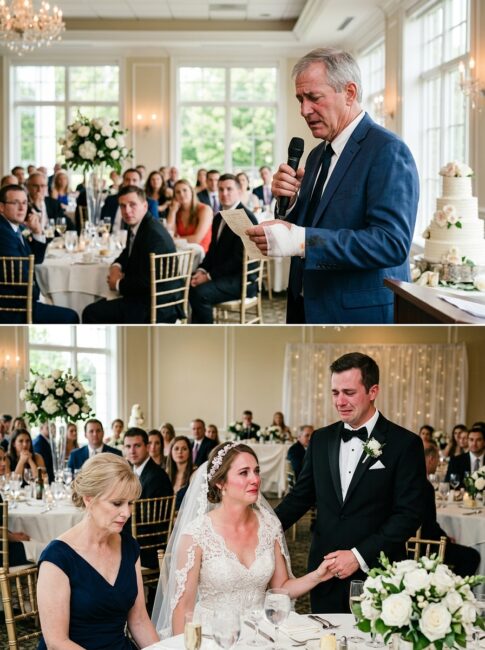
Martin stood beneath the chandelier with the receipt in one hand and the microphone in the other, and for a moment he looked smaller than he had at the beginning.
Not weak.
Just tired of being misunderstood.
“I drove behind the ambulance,” he said. “Claire rode with Emily. I remember the back doors swinging shut, and I remember thinking the candles were still on the passenger seat.”
Claire’s new husband stared at her.
Emily’s eyes never left her father.
“At the hospital, the doctor told us she would be all right. But there were papers to sign. Insurance forms. Medication costs. Follow-up visits.”
Martin gave a small breath that was almost a laugh.
“That was the first time I realized forty-three dollars could feel like nothing.”
Daniel sat down slowly.
He had heard pieces of Emily’s childhood before. He knew her father had worked long hours. He knew holidays had been complicated. He knew Emily kept a distance from him that she never fully explained.
But he had never heard this.
No one had.
Martin looked around the room.
“I’m not telling this because I was perfect. I wasn’t. I missed things. I missed too many things.”
His eyes moved to Emily.
“I missed the school play where you were a tree. I missed the father-daughter breakfast in seventh grade. I missed your first college tour because a man’s truck broke down on I-95, and I needed the extra cash.”
Emily covered her face.
“I hated myself for every one of those days,” he said.
The room softened, but Martin did not ask for forgiveness. That seemed to be the point. He was not begging to be restored in the eyes of strangers.
He was simply putting down a weight.
“After that night at the hospital,” he said, “the bills came. Then the divorce came. Then the house needed to be sold. Then your mother and I agreed on one thing.”
Claire looked up sharply.
Martin nodded toward her, not cruelly.
“We agreed Emily should not know how bad things got.”
Claire’s lips trembled, but she said nothing.
“For a while, I thought that was kindness,” Martin continued. “Maybe it was. Maybe it wasn’t.”
He turned to Daniel.
“Your bride grew up thinking I cared more about work than her. The truth is, I took every job I could because I did not want her choosing between medicine and field trips.”
Emily shook her head slowly, tears running down both cheeks.
“No,” she whispered.
Martin’s voice became even quieter.
“Yes, honey.”
He reached into his jacket again.
This time, he pulled out a folded envelope.
It was old, yellowed at the edges, and sealed with tape that had gone cloudy.
“I was not invited to help choose this venue,” he said. “That’s all right. I understand why.”
Emily flinched.
“I was told the father of the bride usually contributes. I also understand that.”
A few guests looked down at their plates.
Martin held up the envelope.
“I didn’t have a check big enough to impress anyone. So I brought this.”
Daniel wiped his eyes with the heel of his hand.
Martin opened the envelope and removed several small things.
A ticket stub from a middle school concert.
A newspaper clipping about Emily receiving a nursing scholarship.
A photograph of a little girl missing two front teeth, holding a handmade sign that said, “Dad fixed my bike.”
And then, last, a cashier’s check.
Emily stared at it.
Martin placed it gently on the table in front of Daniel.
“It’s not for the wedding,” he said. “It’s for the two of you.”
Daniel looked down.
The check was for $18,732.
The exactness of the number made it more startling than any round figure could have been.
Martin explained before anyone asked.
“That is what I saved by working Sunday calls for eleven years,” he said. “Every Sunday I could. Not all of it at once. Some months it was twenty dollars. Some months it was nothing.”
Emily began to sob.
“I wanted to give it to you when you bought a house,” Martin said. “But last month, Daniel called me.”
The groom looked up, startled.
Emily turned toward him.
“You called my dad?”
Daniel’s chin shook.
“I didn’t want to worry you,” he said.
Martin nodded.
“He told me the two of you were postponing your honeymoon because of your student loans and hospital bills.”
Emily looked at Daniel with a stunned tenderness.
Daniel pressed his lips together, trying to hold himself together.
“I asked him not to tell you,” he said.
Martin turned back to the guests.
“That was when I knew he loved her.”
The ballroom seemed to exhale.
“He wasn’t asking me for money,” Martin said. “He was asking what kind of second job wouldn’t interfere with taking Emily to her appointments after the wedding.”
Emily reached for Daniel’s hand.
Daniel broke then.
Not dramatically. Not loudly.
He bent forward, covered his face with both hands, and cried like a man who had been seen in the one place he thought he was hiding.
Martin watched him with deep, quiet compassion.
“That is why I asked to speak,” he said. “Because I heard people joking today that Daniel was marrying up. I heard someone say Emily was lucky to have found a man from a good family.”
The groom’s mother lowered her eyes.
Martin’s voice stayed gentle, which somehow made it heavier.
“I believe she did find a good man,” he said. “But not because of his family’s name. Not because of this room. Not because of the flowers or the suits or the plated salmon.”
He looked at Daniel.
“She found a good man because he was willing to be tired for her.”
Daniel cried harder.
Emily stood, gathered the front of her wedding dress in both hands, and walked around the table.
For one terrible second, Martin seemed to think she was coming to take the microphone away.
Instead, she stepped into him.
She wrapped both arms around her father’s neck, the way a little girl might have done before pride and pain taught her to stand farther away.
The microphone caught her words against his shoulder.
“You should have told me,” she cried.
Martin closed his eyes and held her carefully, as if the dress were made of glass.
“I thought protecting you meant letting you hate me,” he said.
That sentence moved through the room like a wind no one could stop.
Claire began to cry silently.
Not because she had been exposed as a villain. She had not been. Life had been harder than any one person’s version of it.
But because she knew, as Martin knew, that silence can save a child for a season and wound her for years.
Emily pulled back and looked at the gauze around his hand.
“What happened today?” she asked.
Martin smiled faintly.
“Your caterer’s delivery van died two blocks from here.”
The wedding planner gasped.
Daniel stared at him.
Martin shrugged, embarrassed.
“I saw them on my way in. The driver said the cold trays were stuck, and the ceremony was starting. I helped push the van and got the liftgate open. Cut my hand on a latch.”
The best man whispered, “That’s why the food came on time.”
Martin looked down.
“I didn’t want Emily worrying about appetizers on her wedding day.”
A small laugh broke through the tears around the room.
It was not amusement exactly.
It was relief.
A dozen small judgments collapsed at once.
The late arrival. The torn suit. The wrapped hand. The smell of engine oil. The man everyone had mistaken for careless had been, once again, fixing something in the background.
Daniel stood and walked to Martin.
For a second, he seemed unsure what a groom was allowed to do in front of so many people.
Then he hugged him.
Not quickly.
Not politely.
He held him like a son holds a man who has just handed him a map for the road ahead.
Into Martin’s shoulder, Daniel said, “I’ll be tired for her. I promise.”
Martin’s face crumpled.
He nodded once.
“That’s all I wanted to know.”
The reception did not become loud again right away.
Music resumed, but softly, as if even the band understood that something sacred had happened without warning. Forks moved carefully. People spoke in lower voices. A few guests stood and crossed the room to shake Martin’s hand, though most did not know what to say when they reached him.
That was all right.
Martin did not need speeches.
He had used up the one he came to give.
Claire approached him near the cake table while Emily and Daniel greeted an older aunt. For a long moment, the former husband and wife stood beside three tiers of white frosting and sugared roses.
“I should have told her more,” Claire said.
Martin looked at the cake, then at her.
“We both did what scared people do,” he replied.
Claire wiped beneath one eye.
“You let me blame you.”
Martin’s mouth lifted in a tired half-smile.
“You let me.”
There was no cruelty in it. Only history.
Across the room, Emily watched them. She did not run over. She did not demand an explanation for every year she had carried the wrong story.
Some things take longer than a wedding night to mend.
But something had shifted.
When the father-daughter dance was announced, Martin froze.
He had not expected it.
Emily had chosen, months earlier, to skip that tradition. She had told the DJ there was no need. It would make everyone uncomfortable, and besides, her father probably would not care.
Now she walked toward him while the first notes of an old country song filled the ballroom.
Martin looked down at his shoes.
They were polished, but not new. One lace was slightly darker than the other.
Emily held out her hand.
“Dad,” she said, “will you dance with me?”
The room watched, but this time the watching felt different.
Martin took her hand.
He moved stiffly at first, counting steps under his breath. Emily laughed through tears when he nearly stepped on the edge of her gown.
“I’m rusty,” he said.
“You were always rusty,” she whispered.
He smiled.
They turned slowly beneath the lights.
Near the edge of the dance floor, Daniel stood with both hands folded in front of him. His eyes were still red. In his jacket pocket was the cashier’s check Martin had tried to give them quietly, before the truth forced itself into the open.
Emily rested her cheek against her father’s shoulder.
“I really thought you forgot me,” she said.
Martin looked over her head, toward the dark windows where the reflection of the ballroom floated against the night.
“I know.”
“I was so angry.”
“I know that too.”
She held him tighter.
“What do we do now?”
Martin breathed in slowly.
There were a hundred answers he could have given. He could have explained more. He could have asked for forgiveness. He could have tried to fit twenty years into one perfect sentence.
Instead, he placed one rough hand against the back of her wedding dress and kept moving with the music.
“Now,” he said, “we don’t miss the next dance.”
Emily closed her eyes.
At the head table, the faded grocery receipt lay beside the pink hair clip and the old envelope. No one had cleared them away.
They looked out of place among the crystal glasses and white roses.
But later, when the wedding photos came back, Emily would ask the photographer for one picture nobody else noticed.
Not the kiss.
Not the cake.
Not the grand exit beneath sparklers.
She would ask for the image of that little receipt on the table, beside a birthday candle that had never been lit.
Because sometimes love does not arrive looking clean and perfect.
Sometimes it shows up late, with a torn jacket, a bleeding hand, and years of silence it never knew how to explain.
And if this story stayed with you, follow this page for more heartfelt stories that remind us to look twice before judging someone’s heart.