THE CHARITY CHAIR CUT A CRANE FROM A BIKER’S CEILING—THEN HIS TEN-YEAR-OLD DAUGHTER POINTED AT THE CROOKED WING AND SAID, “TURN IT OVER.”
THE CHARITY CHAIR CUT A PAPER CRANE FROM THE BIKER’S CEILING, AND HIS DAUGHTER WATCHED THE CROOKED BLUE BIRD FALL.
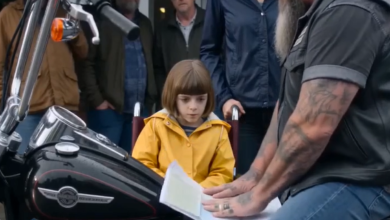
At six on a Friday in October, Lauren Keller set a grocery-store sheet cake on a folding table in her husband’s garage in Mill Crossing, Ohio. The mechanics had swept twice, and there was still a dark crescent of grease by the service door. Brian had parked his old cruiser beside the open bay to make room for visitors. Ten-year-old Abby stood by the cake in a lilac sweatshirt, rolling a blank square of yellow paper between her fingers.
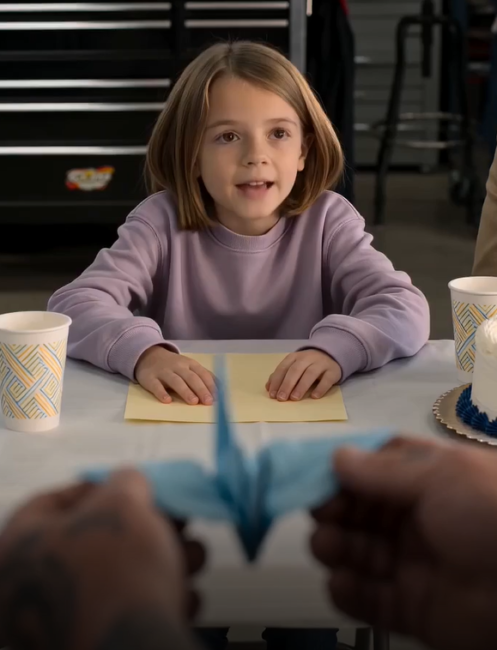
Grant Mercer stepped up to the low end of a display line over the table. He chaired the town’s hospital travel fund and wore a tan blazer Lauren recognized from every fundraiser photograph she’d ever seen. He took a pair of scissors from the table, caught the blue bird’s thread between two fingers, and cut it. The paper crane landed on the tablecloth. Abby stopped rolling the paper.
“Donors paid to take one home,” Grant said. “Tell your dad he can stop guarding them.”
A man in a fleece jacket put his wallet away. Somebody near the open bay raised a phone.
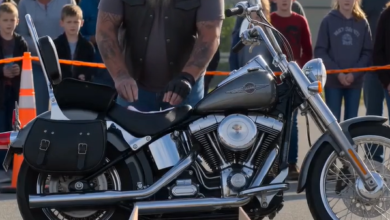
Brian stayed where he was, a few feet from the table, in the short-sleeved black leather jacket he wore when he rode. The old V-twin made little ticking sounds behind him as it cooled. Lauren knew what his hands looked like underneath the worn riding gloves. She could tell by the way the leather pulled across his knuckles that he’d closed them.
Grant said he’d asked Brian three times to move aside. He turned so the phone could get his face and said that volunteers shouldn’t have to be scared to do their jobs. A woman near the cake asked whether the money would have to be refunded. Lauren had invited people in for cake and a donation jar. For a second she wondered what Brian had agreed to while she was at work.
He slipped off his right glove, tugging the fingertips loose one at a time. As he turned toward the table, the pair of crossed brass wrenches stitched on his back caught the light. He set the glove down and lifted the little bird between both hands, supporting its bent wings. One wing was shorter than the other. There was a cloudy bit of tape where the neck had split. Lauren saw Grant look up at the rows of birds over the workbenches, then back down at the one in Brian’s hands. The man with the wallet took a step away from the table.
Abby had helped Lauren put out paper plates. She’d asked whether they had enough for people from the clinic and then gone back to counting empty spaces on the display line. Lauren had thought she was looking for somewhere to hang the yellow square after it was folded.
“That’s the first one,” Abby said.
Brian lowered the bird so she could see it. Abby leaned in, holding the yellow paper flat between her palms now. Her eyes went straight to the bent wing, and Lauren saw her take a breath through her nose the way she did when she meant to get a whole sentence out.
“Dad. Turn it over.”
Part 2
Brian turned it over. Beneath the short wing, in the blocky handwriting Abby had used in second grade, was a crooked number 1. Beside it she’d written Dad made this one. Please give it back.
Lauren had known about the number. The second sentence was new to her.
“When did you write that?” she asked.
“Yesterday.” Abby looked at Grant. “I put it on the ones I could reach.”
Grant set the scissors beside the paper plates. “Why would you do that?”
“Because you told the lady from the newspaper people could pick one.”
A few feet away, a woman in a quilted coat lifted a cream-colored card. “I thought your family wanted us to take them. That’s what it says here.”
Lauren held out her hand. Across the top was a photograph of the shop ceiling, taken from beneath the first service lift. She knew the picture. Brian had sent it to their family group after he’d hung the first hundred. There was a fingerprint on the corner of the lens that made one group of blue birds look as if they were moving.
Below the photograph were two lines about Abby’s cancer treatment and a place to write the number of the crane you wanted. The last line said the birds had been donated by the Keller family.
The card had a blank for a dollar amount.
“How many of these are there?” Lauren asked.
“We mailed them with the fall appeal,” Grant said.
“You mailed them?”
“People respond to something they can hold. We were trying to help.”
Lauren understood exactly how hard it was to raise money for mileage. Nearly three years earlier, when Abby was diagnosed at seven, Grant had met her in the hospital parking garage with an envelope of gas cards. Lauren had been on the second level with no idea which exit would take her toward home. Grant drew her a map on the back of the envelope. She’d kept it in the glove compartment until the ink wore off.
“You could have called me,” she said.
“I talked to Brian.”
Lauren turned toward her husband. He laid the blue crane down on a clean plate and took a folded sheet out of his jacket pocket. The envelope of gas cards had once felt like the kindest thing anyone could give her. She still remembered the amount on the first card. Twenty-five dollars.
Brian smoothed the sheet on the table with the heel of his hand. It was the email he’d sent when the fund offered to help with tonight’s gathering. Lauren could see their names and the sentence Brian had underlined in pen.
Abby asked for cake with the people who got her through treatment. You’re welcome to put out the travel jar. The cranes stay here.
Grant looked at the date on the printout. “We’d already sent the first batch of cards.”
Brian raised his eyes. “Then you knew when I asked you to stop sending them.”
One of the guests near the door put his phone down. The woman in the quilted coat turned her card over. She looked ready to ask Lauren something, then changed her mind and asked Abby.
“Do you want me to give you this back, too?”
Abby took the card. For several seconds she studied the photograph.
“Mom,” she said, “how did he get the one where I’m on the ladder?”
Lauren leaned over. At the bottom edge of the picture, below a row of purple cranes, she could see two small hands on the ladder rail. Then she remembered where Brian had sent that photograph after he sent it to their family.
Part 3
It had gone to Denise, the travel fund’s volunteer coordinator, with a thank-you note. Lauren had attached it herself. She’d written that Brian was up to a hundred and that Abby liked to stand on the bottom rung while he tied the birds above her. Denise had written back to say the picture had made her day.
“Did you give Grant the photo?” Lauren asked.
Denise was standing by the coffee urn. She’d brought the big blue thermos from home because Brian’s shop coffee, she liked to say, could take the paint off a car. She turned the spigot off halfway through filling a cup.
“He asked me for pictures we had permission to use,” she said. “I forwarded your note.”
“Why did you think we’d given permission?”
“He said you’d signed a release.”
Lauren had signed plenty of releases. One allowed the hospital to talk to the travel fund about appointment dates. Another let the fund reimburse Brian for trips he drove when Lauren was at work. There had been a photograph once, too. It showed Lauren and Brian accepting the first set of gas cards. Abby had been at home with her aunt.
“What exactly did you see?” Lauren asked.
“An old photo form. Your name was on it.” Denise put the half-filled cup on the counter. “I should’ve read the whole thing.”
Abby ran her thumb along the edge of the card. “Did you send it to my school?”
“No,” Grant said. “Just people who give money.”
“Some of those people have kids at my school.”
Lauren had been so busy looking at the photograph that she hadn’t thought about the sentence beneath it. Abby had told her classroom teacher and two friends about treatment. She hated coming back from an appointment and having the other children ask why she’d missed a spelling test. She’d practiced saying, “I had something to do with my mom,” until she could say it without looking at the floor.
“Give me a minute,” Lauren told her.
“Can I have the blue one while you do?”
Brian slid the plate across. Abby picked up the crane and carried it to the workbench. She set it beneath a lamp with a green shade, then drew the yellow square back out of her pocket. Lauren could see her thumb pressing hard against a crease that hadn’t been there before.
“Where did the twenty-five dollars go?” asked the man in the fleece jacket.
Grant said, “Into the travel fund.”
“Then the fund can keep my twenty-five dollars. I came for gas money for somebody. I don’t need a bird.”
The woman with the quilted coat reached into her purse and took out a receipt. She held it close to her face. “Mine says purchase.”
Lauren looked over her shoulder. It did. Beneath the amount, the receipt listed paper crane, one unit. A pickup slip at the bottom said that unclaimed birds would be removed from the garage on Monday.
Brian came up beside her. With one glove off, his two hands looked like they belonged to different men. He held the receipt at the corner, careful of the woman’s fingers.
“Removed by who?” he asked.
Denise looked at Grant.
Grant picked up the scissors and took a step toward the end of the table. Lauren thought he meant to put them back in the supply box. Instead he opened the lid of a cardboard carton that had been sitting beside his coat.
Inside were stacks of small white boxes, already numbered.
Part 4
There was a box marked 1 in the top row.
Lauren looked from the box to the blue bird under the green lamp. She wondered how many people had paid before anybody thought to ask Abby which ones she could bear to let go.
“I had a plan to keep the fund open through winter,” Grant said. “The business that paid for most of our mileage pulled out in August. We had families driving twice a week and a balance that wasn’t going to last until Christmas.”
“You could’ve told the board,” Denise said.
“I told the board we needed a fall appeal.”
“You told us a sponsor was matching it.”
“The match came with a minimum.”
Lauren waited.
“A hundred items sold by the end of the month,” he said. “It had to look like an actual campaign.”
“A hundred of ours?” she asked.
Grant straightened one of the boxes. “I told them they could have the whole run. I figured most of the people would leave theirs here anyway.”
Brian looked at the box Grant had straightened. “How many did you sell?”
“Eighty-six.”
A woman Lauren recognized from the garage’s Saturday oil changes came through the side door carrying a foil-covered casserole dish. Behind her came two men in leather, then three more. The first man Lauren knew was Walt, who picked up tires in Dayton and always brought Brian back a bag of pretzels. He glanced at the boxes, then at Brian’s face, and carried the casserole into the break room.
The others followed him in and came back empty-handed. They stood along the wall, making a clear aisle to the door.
Grant watched them. “If we can’t fulfill what people paid for, I’ll have to put out a statement explaining why.”
“What would you say?” Lauren asked.
“That the family withdrew its permission and the garage made it impossible to complete the pickup.”
Her first thought was that he might do it before they had a chance to get home. The page would post it, somebody would send it to a parent in Abby’s class, and by Monday a ten-year-old would be answering for a dispute involving eighty-six credit card receipts. Lauren reached for her phone. She was already composing a statement in her head and could feel how angry it was going to sound.
Abby called from the workbench. “Are people here for cake anymore?”
Lauren put her phone down. “Some of them came for you, honey.”
“Then can they have some?”
“Go ahead and get the plates.”
Brian got a knife out of the cake box and wiped it with a clean napkin. Abby asked him to start with the corner without frosting. He cut that piece first and slid the cake knife back into the box before he went over to Walt.
Lauren followed. “Did you all know about this?”
“About the sale? A couple of us got cards.”
“Why didn’t anyone tell me?”
Walt glanced at Brian. “We thought he had. He told us last week he’d already written Grant twice. He wanted tonight to be Abby’s.”
Brian rubbed his thumb across a shallow notch in the workbench.
“What did you bring?” Lauren asked Walt.
“Dinner.” He looked back at the men along the wall. “And the blue mileage book. Miriam asked for it.”
Lauren knew Miriam Price as a quiet woman who sorted receipts for the fund on the first Tuesday of every month. She’d never seen Miriam at an event. Before she could ask why she wanted the book, a voice came from the bay.
“Grant,” Miriam called. “Can you show me what account those eighty-six payments went into?”
Part 5
Grant took the carton off the table and set it on the floor. “The payment company is holding some of it,” he said. “I can show you the balance on Monday.”
Miriam set her bag beside the carton. “I asked which account.”
“The campaign account.”
“Whose name is on it?”
“The fund’s.”
Miriam waited without reaching for her bag again.
“And mine, as the organizer,” he said.
“Then you can pull up the report tonight.”
Lauren had watched Miriam spend forty minutes sorting a pile of fuel receipts once because a penciled-in eight looked like a three. She’d thought Miriam was the sort of person who liked making papers line up. Listening to her now, Lauren realized how often that patience made people answer questions they’d expected to get past.
Grant said the report would take a few minutes. Miriam told him she’d wait.
In the break room, Walt found the mileage book beneath the foil pan. Its corners had gone soft. He handed it to Miriam, who opened it flat to a page marked with a red grocery coupon.
“What is this?” Lauren asked.
“The trips the shop has been covering,” Miriam said.
Lauren expected to see their last name. Instead she recognized a street one block over from the elementary school, a trailer park off the county road, and a little town where she used to drive to buy apples. The book had departure times, odometer readings and initials. Brian’s name appeared only in a box marked shop contact.
“Who was driving?” she asked.
“Whoever could,” Walt said. “I do Wednesdays. Brian does the early ones.”
Lauren looked at Brian. “You told me you had a standing parts run on Tuesdays.”
“I moved the parts pickup to Tuesdays.”
“After the hospital?”
“On the way back.”
He’d built those trips into his workday so carefully that Lauren had never known to ask. She’d thought the empty coffee cups stacked in his truck meant he kept forgetting to throw them out. Now she pictured him leaving before dawn with somebody else’s child in the back seat, coming back with a box of filters so he could honestly say he’d made the parts run.
“Why do you have your own book?” she asked.
Miriam turned it so Lauren could see the red marks in the margin. “These are requests the fund couldn’t cover. I asked Brian if his club could take two. He said send him the dates.”
“How many?”
“Since August? Thirty-one trips. And the shop’s been putting gas in the vehicles.”
Lauren looked at the crossed brass wrenches on Brian’s jacket as he turned to let Abby past. She’d seen the patch at charity rides and cookouts for years. Now she recognized the little uneven notch in the handle of one wrench. It matched the doodle Brian put beside a car repair when he intended to finish it himself.
“I thought those guys mostly rode on Sundays,” she said.
Walt smiled. “These days we mostly argue about who has a clean car seat.”
Grant put his phone on the table. Miriam brought it closer, checked the campaign balance and nodded once. Then she asked him for the sponsor email.
He said, “You can read it later.”
“I’ve already read it,” said a young woman at the bay door.
Lauren recognized Grant’s niece, Paige, who’d been taking tickets at the fund’s pancake breakfast since she was fourteen. She was still wearing the polo from her shift at the grocery store. She held up a sheet of paper, her thumb bent over its edge.
“Uncle Grant,” she said, “you told me you were going to show them both pages.”
Part 6
Paige had printed the two pages at the grocery store. The second was the sponsor’s reply. Lauren could see a coffee ring on it and a little chain of purple ink where Paige had tested a pen.
The reply said the sponsor would match direct donations or proceeds from a sale. The minimum was a hundred individual contributions. A short line at the end asked whether the family had reviewed the use of Abby’s photograph and story.
Below it was the answer Paige had sent from the campaign inbox.
Grant confirmed we have family permission.
“He told me the family had already signed,” Paige said. “I was the one who clicked send. I need you to know that.”
Grant stared at the first page. “Do you know how many people read a letter asking for gas money and put it down?”
Paige looked at him. “You had an answer for that. You could have asked Abby.”
A strip of light from the bay door reached under the table. Lauren could see Abby’s sneakers moving back and forth on the rung of the stool where she sat with her cake. She’d eaten a straight line down the middle and left both ends.
Naomi Sato arrived a little after seven. Lauren recognized the sound of her keys before she saw her. Naomi had been Abby’s nurse through some of the longest clinic days. Her key ring had an absurd number of keys because she kept ones she couldn’t remember the purpose of.
“I brought napkins,” Naomi said. “I figured nobody remembers napkins.”
Abby slid off the stool. She took Naomi to the green lamp and showed her the blue crane. Naomi cupped her hands below it without lifting it from the plate.
“I remember that tape,” she said.
“Did you put it there?” Lauren asked.
“I handed it to him. He spent most of a week trying to get that first one right.”
Lauren knew Brian had started folding soon after the diagnosis. She’d come home one night to find the side of a cereal box cut into four squares and a pair of pliers on the kitchen table. She hadn’t known why he chose a crane. Whenever she asked, he’d say he was working on it, and she’d assumed he meant the folds.
“I told him an old Japanese story,” Naomi said. “My grandma used to tell it to me. Fold a thousand paper cranes and you get a wish.”
“Dad said his fingers were the size of sausages,” Abby told her.
“His first attempt looked like he’d chewed it.”
Across the shop, Brian heard her. “It was the paper from the copy machine. Too thick.”
Naomi smiled. “That was the excuse, yes.”
Lauren had seen him fold after midnight, still in his work jeans, his phone faceup on the kitchen table. Some nights he folded at the shop before driving home. Once, on Christmas Eve, Abby had fallen asleep under his jacket in a waiting room while he made one from a plain sheet torn out of a notebook. Lauren had forgotten that until she saw him look down at the little blue bird.
“How many did you get to?” Naomi asked.
“Nine hundred ninety-nine,” Abby said.
She held up her yellow square. “This is for tonight. But I wanted to ask him something first.”
Brian came over, wiping his bare palm on his jeans.
Before Abby could speak, Miriam called Lauren back to the table. She had Grant’s phone in one hand and her own in the other.
“The board can meet right now,” Miriam said. “And there’s one more thing you need to see before anybody speaks for this family again.”
Part 7
It was a scheduled post, set to go live at eight. Lauren read it beside Brian, standing close enough for their sleeves to touch.
It said Abby would come to the garage the next morning to hand the first cranes to donors. There was a photograph of an empty folding chair next to the one with the blue bird. The caption invited people to bring their own children for pictures.
Brian took out his phone. “Who has the login?”
“Grant and me,” Paige said.
“Can you stop it?”
She did it at the table, where Lauren could watch. Afterward she turned the screen around and asked Lauren to check. The post was in drafts.
Miriam brought two board members into the break room on a call. Lauren heard the ice maker fill while Paige read the sponsor’s second page. Denise explained how the picture had left her inbox. Grant said he had believed the old form was enough. One of the board members asked him when Brian had told him to stop. Miriam read the date aloud. After that, Grant was quiet for most of the call.
When he came back to the garage, he stood by the cake table with his hands on the edge.
“If you bought a crane, you’re getting your money back,” he told the guests. “The family didn’t donate the birds. Brian told me that before tonight. I kept the sale open anyway.”
The man in the fleece jacket said, “And the part about him scaring people?”
Grant looked at Brian. “He asked me to leave the line alone. He didn’t threaten anybody.”
Abby had gone back to the green lamp. Grant carried the cardboard carton over and took out the box marked 1. For a second Lauren thought he was going to offer it to her. He looked at the bird, put the empty box back with the others, and shut the lid.
“I’m sorry I cut it down,” he said.
“I wrote to give it back,” Abby said.
“I know. I see it now.”
Grant left the scissors on the table and carried the carton out to his car.
The guests who stayed had cake. The men from the club ate casserole off paper plates with tiny forks. Lauren found a spool of thread in the drawer where Brian kept spare fuses and helped Abby tie a new loop onto the blue bird. Brian hung it at the low end of the line, where Abby could reach if she stood on her toes.
Then she handed him the yellow square.
“Do I get to know what you wished for?” she asked.
Brian looked at Lauren first. Then he said, “More regular days.”
“Like school?”
“School. Saturday breakfast. You getting mad because I bought the wrong cereal.”
“You do buy the wrong cereal.”
“I know.”
He folded the paper in half. Abby held one corner flat when he asked. Lauren watched the same big fingers that could work a frozen bolt loose press the last crease with the side of a thumbnail. Brian lifted one wing. Abby lifted the other.
The phone in Lauren’s pocket buzzed.
The clinic number was on the screen. They’d been told the doctor might call that evening once she’d had a chance to look at Abby’s final follow-up results with the team. Lauren had checked the volume twice before they left the house. Now she had to try twice to get the phone out of her pocket.
“Can I hear too?” Abby asked.
Lauren put the phone on the table, beside the thousandth crane, and touched the speaker button.
Part 8
“Hi, Abby,” the doctor said.
Abby looked at Lauren. “How’d she know I was here?”
“Your mom told me you were having cake,” the doctor said. “Did I miss it?”
“There’s a piece left.”
Lauren held on to the edge of the table. Brian had set his bare hand down beside hers. One of the small cuts on his knuckles had opened while he was folding, and she could see him keeping that finger tucked away from the paper.
The doctor told them she’d reviewed the results with the team. They were clear. She explained what appointments would come next, and Lauren found herself nodding at the phone. Then the doctor said, “We believe the treatment cured your cancer, Abby.”
Abby looked up at her father. Brian had been holding his shoulders so still all evening that Lauren noticed the instant they dropped.
“Do I still have to come in and see you?” Abby asked.
“Sometimes,” the doctor said. “We’ll want to see how you’re doing.”
“Can I bring you a piece of cake then?”
“Maybe a fresh one.”
After they hung up, nobody moved until Abby picked up the yellow crane. “Does this one go by the blue one?”
Brian got the spool.
Lauren went to the bay door while he tied the loop. The temperature had fallen enough that she could see a little of her breath. She could still remember what the first gas card had felt like in her hand in the hospital parking garage, thin and warm from Grant’s envelope. She was glad he’d been there that day. She was also glad Abby had made him look under the wing.
Behind her, Brian asked for the step stool. Abby dragged it across the concrete, and he hung the last crane beside the first. Lauren could see the blue one lean sharply on its new thread. The yellow one turned slowly in the air coming through the bay. One thousand cranes hung above the garage, including the one with the taped neck that Brian had almost thrown away.
The fund refunded the crane purchases. Its board voted to remove Grant as chair and sent donors a correction that left Abby’s medical information out. Paige and Denise contacted the families whose photos had been used in the appeal. Miriam told Lauren later that several of the people who got refunds sent back the same amounts as straight donations. The man in the fleece jacket put his twenty-five dollars in an envelope and brought it to the shop himself.
A week after the call, Lauren found Abby at the workbench beside a pile of small squares. The paper was purple on one side and white on the other. Brian was cleaning a socket with an old rag, his leather jacket still on from the ride home.
“Are you starting another thousand?” Lauren asked.
Abby shook her head. “Naomi said there’s a dad who asked where to buy the paper.”
“What did you tell her?”
“That he could have mine. I’m making him one he can take apart to see the folds.”
Brian put the socket down. He held the paper steady while Abby worked the point through. Lauren watched his tattooed hand ease out of the way as soon as her daughter had the fold under control. She thought of how quickly she’d looked at Brian’s closed fists that night and wondered whether he owed the room an explanation. She wished she’d looked at what he was doing with his hands a little sooner.
Abby set the purple crane on the bench. It had one wing a little higher than the other.
“What should I put under it?” she asked.
Brian handed her a pencil.
Abby turned the bird over. In small block letters she wrote, You can keep this one.
Follow this page for more stories like Abby’s.