Part 2: The Delivery Driver Brought Groceries to an Elderly Woman Every Week — When Her Orders Stopped for Three Weeks, What He Found Changed the Entire Neighborhood
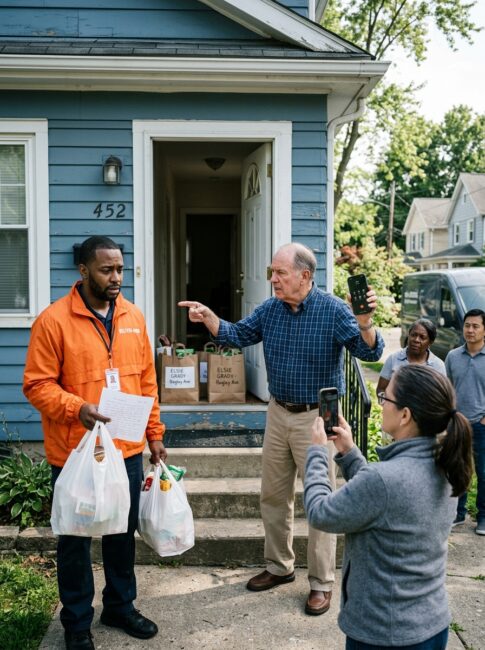
The police arrived before Marcus had time to explain.
Officer Daniel Ruiz stepped carefully over the broken glass and asked Marcus to remain near the front door. Two neighbors stood outside with their arms folded, watching through the open doorway.
From the sidewalk, the scene looked simple.
A delivery driver had broken into an elderly woman’s home.
Inside, nothing made sense.
The living room was tidy. A knitted blanket lay folded across the back of the sofa. A half-finished crossword puzzle rested on the coffee table beside a pair of reading glasses.
There were no overturned chairs.
No sign of a struggle.
The kitchen clock was still running.
Officer Ruiz checked the bedrooms while Marcus remained in the hallway, staring at the grocery bags.
There were seven of them.
Each bag was folded at the top and labeled in Evelyn’s careful handwriting.
For Mr. Alvarez — low-sodium soup.
For Keisha and the twins — formula is underneath the cereal.
For Linda — please take the tea even if you say you do not need anything.
One bag contained dog food and a small packet of arthritis medication for an aging beagle named Franklin.
Another held canned peaches, bread, and instant coffee.
Marcus recognized every item.
He had delivered them week after week.
He had assumed Evelyn was stocking her pantry because leaving the house had become difficult. She always ordered more than one elderly woman could reasonably eat, but Marcus never asked questions.
Some weeks, Evelyn met him on the porch wearing a soft gray cardigan and slippers.
Other weeks, she called through the screen door and asked him to leave the boxes near the kitchen.
She rarely spoke for long.
Yet she always remembered something about him.
“Your daughter’s science fair is next week, isn’t it?”
“Your mother’s appointment went well?”
“Take one of those oranges for the road, Marcus. You look tired.”
Marcus had thought the groceries were hers.
Officer Ruiz returned from upstairs.
“No one is inside,” he said. “Her bed has not been slept in recently.”
The officer opened the refrigerator.
A carton of milk had expired two weeks earlier.
Beside it sat a covered bowl of soup and a handwritten note.
For Walter. He will pretend he already ate. Do not believe him.
Walter Mills, the man who had yelled from across the street, was standing just outside the doorway.
His expression changed when Marcus read the note aloud.
“I don’t know what that means,” Walter said quickly.
But his voice had softened.
Officer Ruiz examined the counter and found Evelyn’s phone connected to a charger. Several missed calls appeared on the screen, including repeated calls from the hospital.
Marcus felt a chill move through him.
“She would never leave her phone behind,” he said.
Ruiz looked at him.
“You know her well?”
Marcus hesitated.
“I deliver groceries.”
It sounded smaller than it felt.
The officer called the number listed in the recent calls. After several minutes, he stepped away from the kitchen and spoke in a quieter voice.
Evelyn was alive.
She had been admitted to St. Joseph’s Hospital nineteen days earlier after collapsing near a bus stop several blocks from home.
She had no family listed in the hospital records.
No one had known who to contact.
A nurse had called her phone repeatedly, but the phone remained on the kitchen counter.
Walter lowered himself onto the porch railing.
“Nineteen days?” he whispered.
Marcus looked again at the grocery bags.
Some of the food was spoiled. Some remained unopened. All of it had been sorted before Evelyn left the house.
Then Officer Ruiz noticed a notebook beneath the fruit bowl.
Its pages were filled with names, dates, and brief reminders.
The final entry had been written in a shaky hand.
Bring soup to Walter. Ask Marcus if he can leave Keisha’s bag quietly. She is proud. Do not embarrass her.
Marcus stared at the final sentence.
He had believed Evelyn was simply lonely.
He was beginning to understand that loneliness was the one thing she had been quietly trying to prevent for everyone else.
Evelyn had collapsed while carrying a container of homemade chicken soup toward Walter’s house.
That was the first detail the hospital social worker shared when Marcus visited the next morning.
She had taken the bus because her car had stopped running months earlier. The bus driver found her slumped against the shelter bench with the soup container sealed carefully inside a canvas shopping bag.
Doctors discovered pneumonia and severe dehydration.
Evelyn had also been skipping meals.
Marcus sat beside her hospital bed, unsure how to begin.
The woman he knew from weekly deliveries looked smaller beneath the white blankets. Her silver hair had been combed back from her face. Her hands rested against the sheets, thin and pale.
When she opened her eyes, she recognized him immediately.
“You missed your route,” she said.
Marcus gave a tired laugh.
“So did you.”
Evelyn looked toward the window.
“I suppose you found the bags.”
Marcus nodded.
For a moment, neither of them spoke.
Then Evelyn closed her eyes again.
“I was going to deliver them after lunch.”
“You were sick.”
“Walter had not answered his phone in two days.”
“You should have asked someone for help.”
Evelyn turned her head toward him.
“I did.”
Marcus frowned.
“You came every Thursday.”
The answer settled quietly between them.
For nearly a year, Marcus had carried boxes into Evelyn’s kitchen without realizing that her grocery orders were not merely deliveries.
They were a system.
Evelyn bought soup for Walter, a seventy-four-year-old widower who had become withdrawn after his wife died. She ordered formula and diapers for Keisha Monroe, a young mother living two houses away with infant twins and an unreliable work schedule.
She left tea and crackers for Linda Park, a retired teacher recovering from chemotherapy.
She bought dog food for Franklin because the dog belonged to a veteran whose disability check rarely lasted until the end of the month.
She never called it charity.
She simply placed each bag near the hallway and delivered it quietly after Marcus left.
Sometimes, she asked Marcus to place a smaller bag near a neighbor’s porch, claiming it belonged to someone who had forgotten part of an order.
He had never questioned her.
Evelyn preferred it that way.
“People accept kindness more easily when no one is watching,” she said.
Marcus looked down at his hands.
“You were paying for all of it?”
Evelyn smiled faintly.
“My pension is modest. My needs are smaller.”
The answer was not entirely true.
When Officer Ruiz returned to the house to secure the broken window, he found a stack of unpaid utility bills beneath Evelyn’s notebook.
Her heating bill was overdue.
A notice from the city warned that her water could be disconnected.
The pantry contained little more than oatmeal, crackers, and a single jar of peanut butter.
The groceries were for everyone except Evelyn.
By noon, the truth had traveled through Brookfield faster than any neighborhood rumor.
The same group chat that had accused Marcus of breaking into Evelyn’s house filled with questions.
Why had no one noticed?
How could an eighty-one-year-old woman disappear for nearly three weeks without anyone knocking on her door?
Walter did not respond to the messages.
Instead, he walked to Evelyn’s house carrying a toolbox and repaired the window Marcus had broken. Then he replaced the loose porch step Evelyn had been avoiding for months.
Keisha arrived with her twins asleep in a double stroller. She placed a handwritten card on the porch and stood beside Walter without saying anything.
Linda brought a pot of coffee.
One by one, neighbors appeared.
Some had received Evelyn’s bags.
Others had never spoken to her beyond a polite wave.
Marcus returned after his shift and found nearly twenty people gathered near the blue house.
For a second, the sight made him uncomfortable. He remembered the phones raised toward him the previous afternoon and the certainty in people’s voices before anyone understood what was happening.
Walter walked toward him.
“I owe you an apology,” he said.
Marcus shook his head.
“You were protecting her house.”
“No,” Walter said. “I was watching her house. There is a difference.”
Walter stared at the repaired window.
“I sat twenty yards away for three weeks and never noticed she was gone.”
No one answered.
The following Saturday, the neighbors met in Evelyn’s living room with folding chairs borrowed from the church hall.
There were no speeches.
They made a list.
Walter would check on Evelyn’s house each morning while she recovered. Linda would handle the neighborhood group chat and create a private phone tree for anyone living alone.
Keisha volunteered to organize grocery deliveries.
A teenager named Caleb offered to walk Franklin after school.
A retired electrician inspected Evelyn’s home and replaced an unsafe heater before winter worsened.
Marcus listened from the corner of the room.
He had not planned to stay long, but Linda placed Evelyn’s notebook in front of him.
Tucked between the pages was an envelope bearing his name.
Inside was a grocery store gift card and a short note written several months earlier.
Marcus, you always knock twice and wait long enough for me to answer. You may think that is a small thing. It is not. Buy something good for your daughter.
Marcus read the note twice.
He had spent years racing through deliveries, watching timers on his phone and calculating how many minutes he could afford to lose.
Yet Evelyn had noticed the extra seconds.
She had noticed everyone.
At the hospital, Evelyn resisted the idea of returning home.
“I cannot manage the stairs anymore,” she admitted quietly. “And I cannot be anyone’s project.”
Marcus brought her notebook to the hospital and placed it on the bedside table.
“No one is making you a project,” he said.
He showed her a photograph from her porch.
Walter stood beside the repaired railing. Keisha held one of her twins. Caleb had Franklin on a leash. Linda was laughing with two neighbors Evelyn had never managed to introduce properly.
A small wooden cabinet had been installed near the sidewalk.
Its shelves held canned food, toiletries, diapers, and handwritten cards.
A sign above the door read:
Take what you need. Leave what you can. No explanations required.
Evelyn studied the photograph for a long time.
Then she touched one finger to the edge of the image.
“Who built that?”
“Walter.”
“He hates woodworking.”
Marcus smiled.
“He complained the entire time.”
Evelyn laughed softly, then pressed a tissue beneath her eyes.
A week later, she agreed to return home with a visiting nurse and a temporary bedroom arranged downstairs.
When Marcus brought her back, the neighbors did not crowd the sidewalk.
They understood she would have hated that.
Only Walter waited on the porch.
He carried the same soup container Evelyn had been holding when she collapsed.
“I washed it,” he said.
Evelyn looked at him.
“You finally answered your phone?”
Walter nodded.
“From now on, I will.”
The cabinet near Evelyn’s sidewalk became part of the neighborhood slowly.
It did not solve every problem.
Some days, its shelves were almost empty. Other mornings, cans of soup appeared beside baby wipes, pasta, coffee, and dog treats for Franklin.
No one kept track of who took what.
That was Evelyn’s rule.
The neighborhood changed in quieter ways too.
Porch lights began carrying simple meanings. A light left on during the morning meant someone wanted a visitor. A light flicked twice in the evening meant everything was fine.
Linda organized a weekly call list but refused to name it after Evelyn.
“She would delete the entire spreadsheet,” Linda said.
Marcus continued delivering groceries every Thursday.
Evelyn’s orders were smaller now because several neighbors shared the responsibility. Yet she still ordered extra oranges and always insisted Marcus take one for the road.
Some afternoons, Sophie from the corner house stocked the cabinet after school.
Walter delivered soup on Tuesdays, though he never admitted using Evelyn’s recipe.
Keisha returned the kindness carefully. She dropped off fresh bread while pretending she had accidentally baked too much.
By spring, Evelyn could sit outside again.
Her porch railing had been painted white. Small yellow flowers appeared inside the pots that had once stood empty.
Marcus sometimes stayed for five minutes after his deliveries.
He told Evelyn about his daughter’s report card, the traffic on the interstate, and the way his supervisor still scheduled too many stops before lunch.
Evelyn listened as though none of it was ordinary.
One Thursday, Marcus arrived to find a new note taped inside the cabinet.
The handwriting belonged to Walter.
Thank you to whoever left the coffee. I had forgotten how much better mornings feel when someone expects you to wake up for them.
Marcus did not mention the note when he carried Evelyn’s groceries onto the porch.
She had already seen it.
Her eyes rested on the cabinet while a breeze moved gently through the maple branches above the street.
“You know,” Marcus said, “I thought I was delivering groceries all those months.”
Evelyn adjusted the blanket across her knees.
“You were.”
Marcus smiled.
Then Evelyn looked toward Walter’s house, where the porch light flicked twice behind a curtain.
She lifted her hand and switched her own lamp on in reply.
Marcus walked back toward his van as the afternoon sun settled across Brookfield. One by one, porch lights glowed behind the windows of houses that had always stood close together.
For years, the neighbors had lived only a few yards apart.
Now, they had begun to notice when a light was missing.
Follow the page for more heartfelt stories about the quiet acts of kindness that can change an entire community.