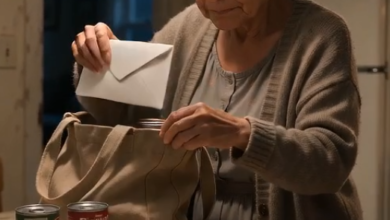
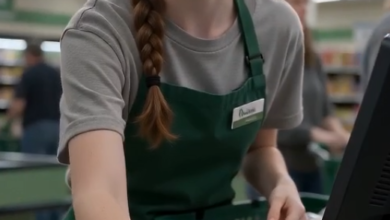
The diner refused to serve the old man in a torn coat — the single mom waitress paid for his meal and lost her job by morning.
On March 14th, I spent $11.40 of my tip money on an old man’s coffee and pie. By midnight, I’d lost my job. By sunrise, I knew the truth about the night my father died.
I didn’t know any of that when he walked in.
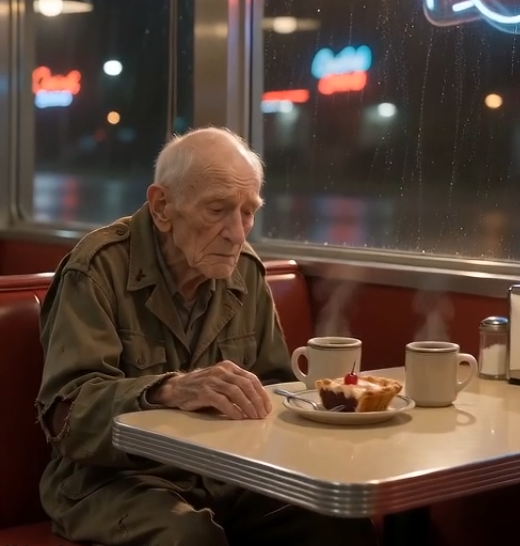
It was raining, the cold, sideways Pennsylvania kind. The bell over the door rang at 9:15, and a man in an army-green coat came in with water dripping off his shoulders. He moved slowly, one hand on the counter, one hand on the booths, like he was counting them.
He stopped at booth six. The window booth. He sat down facing the door and left the other side empty.
“Two black coffees,” he said when I came over. “One slice of cherry pie. Two forks, please.”
I looked at the empty seat. Then I looked at him.
He didn’t explain. He just smiled at me, a small, sad smile, and folded his hands on the table.
PART 2
My name is Jenna Price. I’m thirty-five. I have two kids: Lily, who’s nine and has asthma, and Ben, who’s six and has opinions about everything.
I work nights at Rosie’s Diner on Route 9 in Harmon. Pie case, jukebox, coffee that tastes like it’s been on the burner since 1985. I’d been there four months. The tips are bad, but my neighbor watches the kids for free until midnight, and that makes it the best job in the world.
On a good night, I clear forty-six dollars. That night I had forty-one in my apron, which was exactly what Lily’s inhaler copay would be at the pharmacy in the morning. I’d counted it three times.
Rent was four days late. My car only started if I pumped the gas twice and said please.
My mom used to say I had my father’s stubbornness. I never met him. He died in the Gulf War, five months before I was born. All I have of him is a photo, a folded flag, and a tiny tattoo on my wrist: a dog tag with the date 2-26-91.
Mom remarried when I was four. I took my stepdad’s last name. She passed three years ago. She almost never talked about my father, except for one thing she’d say whenever I wanted to give up on something.
“Your daddy never left anybody behind. Not once.”
PART 3
The old man in booth six took off his coat slowly. The left sleeve was torn at the elbow and stitched badly, like he’d done it himself. His shirt underneath was clean and pressed.
I brought two coffees and the pie.
He pushed one cup across the table to the empty side. Then he asked for cream.
“For you?” I asked.
“For her,” he said, and nodded at the empty seat. “She takes cream.”
Behind the counter, Manny, our line cook, leaned through the kitchen window and lowered his voice.
“He comes once a year,” Manny said. “Same booth. Same order. Every March fourteenth. Been coming since before I worked here.”
“Why?”
Manny shrugged. “Never asked.”
Rick asked, though. Rick was our manager. He’d been there six months, and he treated every customer like they were trying to rob him.
He came out of the back, took one look at the torn coat, and pulled me by the elbow into the hallway by the restrooms.
“He’s not paying,” Rick said.
“You don’t know that.”
“Jenna. Look at him. That coat. He’s sleeping in a car somewhere. He’ll sit there for three hours on one coffee and scare off every regular we’ve got. Get him out.”
Through the little window in the door, I could see the old man. He had heard. I could tell from the way he set down his fork and looked at his hands.
PART 4
I stood in that hallway for a long time.
Forty-one dollars in my apron. Lily’s inhaler. Rent four days late. Rick staring at me like I was the problem.
It would have been so easy. Walk over. Say, “Sir, I’m sorry, my manager says…” He’d go. He’d probably even apologize to me.
And then I heard my mom’s voice.
Your daddy never left anybody behind.
I don’t know why that sentence came back right then. Maybe because he was alone. Maybe because of that empty seat with the cream in the coffee.
I walked to the register and rang up booth six myself. Two coffees, one cherry pie. Eleven dollars and forty cents.
I paid it out of my apron. Lily’s inhaler money.
Rick watched me do it. He didn’t say a word. He didn’t have to.
PART 5
I set the receipt face-down on the table, marked PAID.
The old man looked at it. Then at me. His eyes filled up so fast it startled me.
“You didn’t have to do that,” he said.
“I know.”
He reached out and covered my hand with his. His fingers were cold and rough and shaking.
“Thank you, young lady,” he said. “Thank you.”
That was it. That was the whole thing. A kind moment in a crappy diner on a rainy night. I went back to wiping down the counter. I figured I’d be short on the inhaler and I’d figure it out like I always did.
I thought the story was over.
It was just getting started.
PART 6
When I came back with the coffee pot, he was looking at my wrist.
At the tattoo.
His cup slipped. Coffee splashed across the table and onto his pressed shirt, and he didn’t even notice.
“Where did you get that?” he whispered.
“It’s… my dad’s date. When he died.”
He didn’t say anything. He just kept staring at it.
“What year were you born?” he asked.
“Ninety-one. July.”
He closed his eyes, like the number hurt.
“And your mother,” he said carefully. “What was her name?”
“Carol.”
His face went gray. Completely gray. I actually reached for the phone, thinking he was having a heart attack.
“I’m fine,” he said. “I’m fine.” But his hands weren’t.
He put a five on the table, even though it was paid. He put his torn coat back on. And on his way to the door, he stopped at the old framed photos by the register, the ones nobody ever looks at.
He stood in front of one for almost a full minute.
Then he walked out into the rain without looking back.
I went over to see what he’d been staring at.
It was a faded photo from 1991. A big crowd crammed into this exact diner, a banner across the counter: WELCOME HOME, 2ND PLATOON. Young soldiers in uniforms. An older waitress with silver hair in the middle, beaming.
And in the corner, a young woman. Very pregnant. Holding a coffee pot.
It was my mother.
My mother had worked at Rosie’s. She’d never once told me that.
At midnight, Rick took my apron.
“Don’t come back tomorrow,” he said.
I nodded. I didn’t even fight it.
I went to clear booth six one last time. When I lifted the saucer of the untouched coffee, the one with the cream, something heavy slid out from under the napkin.
A medal. A bronze star on a red, white, and blue ribbon. Under it, a napkin with shaky handwriting:
I’ve been looking for you for twenty years.
I turned the medal over.
Engraved on the back: SPC DANIEL R. COLE.
My father.
My name was Cole before it was Price.
PART 7
I don’t remember running out of the diner.
I remember the rain. I remember my sneakers soaked through. And I remember the bus shelter at the end of the lot, where a small old man in a torn green coat was sitting all alone.
I sat down next to him with the medal in my fist.
“Who are you?” I asked.
He didn’t look at me. He looked at the road.
“Staff Sergeant Walter Hayes,” he said. “I was your father’s platoon sergeant.”
Then he told me.
February 26th, 1991. Southern Iraq. Their unit got cut off and took fire. My father was twenty-two, the youngest man in the platoon. He drove a truck back into it. Then again. Then again. He pulled fourteen men out.
On the fourth trip, he didn’t come back.
“I was the fourteenth man,” Walter said. “He came back for me.”
I couldn’t breathe.
“They gave him the Silver Star,” Walter said. “I brought it to your mother. She was nineteen and seven months pregnant. She threw it at me. She said, ‘You keep it. You came home. He didn’t.’”
He wiped his face with his torn sleeve.
“My wife, Ruth, worked at Rosie’s. She was the first waitress they ever hired, back in ’74. She gave your mother a job. Fed her. Sat with her. And then one day your mother was just gone. No address. Ruth wrote letters to every Carol Cole in three states.”
“Mom remarried,” I whispered. “She changed her name. Mine too.”
He nodded slowly. “Ruth died on March fourteenth, 2006. Her last words to me were, ‘Find Danny’s girl.’”
The second coffee. The cream. The empty seat.
“Every year I come back,” he said. “I order her coffee. I sit where she worked. And I hope that maybe Carol walks through that door one day.”
He finally looked at me.
“I never imagined it would be you who walked up to my table.”
I fell apart right there in that bus shelter. Thirty-five years of a photo and a folded flag, and here was a man who had seen my father’s face the day he died. A man my father had died for.
“He told me something,” Walter said quietly. “Right at the end. He said, ‘Sarge, if it’s a girl, make sure somebody’s looking out for her.’”
His voice broke.
“I’m sorry it took me so long.”
PART 8
I drove him home that night. His house was ten minutes from mine. Ten minutes, for thirty-five years.
I got back to my apartment at 2 a.m. I checked on Lily and Ben, both asleep, then lay awake on the couch with my father’s medal on my chest until the sky turned gray.
At 6:40, my phone rang.
It was Rick.
I almost didn’t pick up. When I did, I didn’t recognize his voice. He wasn’t angry. He wasn’t smug.
He was shaking.
“Jenna,” he said. “There are men standing outside the diner. Old men. Fourteen of them. Some are in uniform. They’re just… standing there in the parking lot. In the rain.”
I sat up.
“And there’s a lawyer here,” Rick said. “He says the man from booth six owns this building. He’s owned it since 2006.”
A long, terrible silence.
“Jenna,” Rick whispered. “Who did you serve yesterday?”