Part 2: The Disciplined Student Took the Stage — And One Sentence Left His Teachers Looking at Each Other in Silence
Principal Whitmore moved first.
“Marcus,” she said carefully, keeping her voice low enough that only the front rows heard it. “This is not the time.”
But the microphone caught enough.
It always catches enough when adults are trying to keep things quiet.
Marcus did not step away.
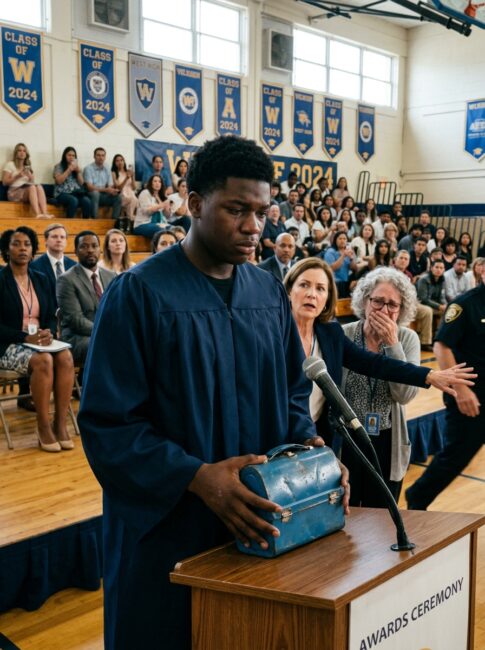
The gym smelled like floor polish, carnations, and the hot plastic scent of old bleachers. Seniors sat in rows of folding chairs, wearing Sunday shirts and borrowed dresses beneath their graduation gowns. Parents filled the bleachers with phones already raised.
This was supposed to be the clean part of the year.
Scholarships. Perfect attendance. Teacher appreciation. A slideshow with soft piano music.
Marcus had not been part of that story.
He had missed too many mornings. He had worn the same black hoodie until the cuffs frayed. He had sat in the back of English class and said almost nothing after the January incident.
The incident had a simple shape when people told it.
A teacher left her classroom for two minutes.
Money went missing from her desk drawer.
Marcus was found alone inside the room.
He refused to explain.
Suspension followed.
A warning letter went home.
A college counselor quietly removed his name from a recommendation list.
That was what people knew.
Now he stood under the basketball scoreboard with a lunchbox that looked twenty years old.
Mrs. Caldwell’s face had gone pale.
She was a white American woman in her early sixties, close to retirement, with soft gray hair and reading glasses hanging from a chain. For thirty-eight years, she had taught English in the same room near the west stairwell. Students called her strict, but they also knew she kept granola bars in her bottom drawer.
Marcus lifted the lunchbox by the handle.
The metal was faded blue, scratched along the sides, with a red sticker peeling from one corner.
“This belonged to my little brother,” Marcus said.
A few students glanced at each other.
Most people did not know he had a brother.
“My brother, Isaiah, was nine,” Marcus continued. “He liked dinosaurs, peanut butter sandwiches, and telling people he was going to be a scientist before he learned to spell the word.”
His voice stayed flat, but his thumb rubbed the dented corner of the lunchbox again and again.
A woman in the bleachers stopped recording.
Marcus looked down, not at the crowd, but at the lunchbox.
“When Isaiah got sick last fall, my mom started working nights at the hospital laundry. I started taking him to school before my first bell.”
Principal Whitmore lowered her hand, the one she had raised toward the security officer.
The officer stopped halfway down the aisle.
Marcus continued.
“On January 18th, I came into Mrs. Caldwell’s room during lunch because I thought she had left something for me.”
Mrs. Caldwell closed her eyes.
That was the first crack in the story everyone believed.
Marcus looked toward her, and for a moment, his expression softened.
“She used to leave food in her desk,” he said. “Not for everyone. Not officially. Just for kids who pretended they were not hungry.”
A small silence moved through the teachers seated onstage.
Several of them knew.
Several had done the same.
Marcus opened the lunchbox, but he did not show what was inside yet.
“My brother’s lunchbox had been missing for two days,” he said. “I thought he had lost it on the bus.”
He swallowed.
“But that day, I saw it under Mrs. Caldwell’s desk.”
Now the gym changed again.
Students leaned forward.
Parents looked from Marcus to Mrs. Caldwell.
Mrs. Caldwell whispered, “I was going to return it.”
The microphone did not catch that, but Marcus did.
He nodded once.
“I know.”
That was stranger than an accusation.
It made people listen harder.
Marcus placed one hand inside the lunchbox and took out a folded piece of notebook paper.
He held it carefully, like something that might fall apart if the air touched it wrong.
“This was inside,” he said.
No one breathed loudly.
“It was a note from my brother.”
A mother in the front row pressed her fingertips to her lips.
Marcus unfolded the paper.
The handwriting was uneven, childish, full of backward letters.
He did not read it yet.
Instead, he looked toward the teachers.
“When Mrs. Caldwell walked back in, she saw me with her desk drawer open. She saw me holding the lunchbox. She asked what I was doing.”
He paused.
“I said nothing.”
The principal’s eyes lowered.
“I said nothing because behind her, in the hallway, there were three boys watching.”
Several seniors went still.
They knew who he meant before he said their names.
Marcus did not name them.
That made the silence worse.
“They had taken Isaiah’s lunchbox,” he said. “They had put it under her desk. They wanted me to get caught taking it.”
A hard, quiet sound came from somewhere in the bleachers.
Marcus folded the note again.
“And it worked.”
The air in the gym felt heavier than before, as if every person had suddenly realized how easy it was to be certain about the wrong thing.
Principal Whitmore stepped toward the microphone, then stopped.
Mrs. Caldwell remained seated, her hands clenched together in her lap. Her glasses had slipped low on her nose, but she did not fix them.
Marcus kept speaking.
“At first, I thought if I explained, it would be simple,” he said. “I would say the lunchbox was my brother’s. I would say they planted it there. I would say I had not touched her money.”
He looked toward the senior section.
“But one of those boys was already on probation.”
A row of students stiffened.
“One was the son of a man who had just donated uniforms for the baseball team.”
The school board member near the front turned his face away.
“And one had been sitting with my brother in the cafeteria for two months because his own family was falling apart.”
That was the twist nobody expected.
The third boy, the one Marcus would not name, had not been cruel in the usual way. He had been angry, scared, and desperate to belong to someone stronger. Isaiah had liked him. Isaiah had called him his “big cafeteria friend.”
Marcus had seen the boy once slipping his own apple onto Isaiah’s tray when he thought nobody was looking.
That made the betrayal harder, not easier.
“So I stayed quiet,” Marcus said.
A murmur moved through the gym.
He knew how it sounded.
He had sounded foolish to himself every day since January.
“I stayed quiet because my brother was sick, and he had begged me not to make trouble at school. He said people already looked at him like a patient instead of a kid.”
Marcus’s jaw tightened.
“He did not want everyone knowing his lunchbox had been used as a joke.”
He turned the lunchbox slightly, showing the dent.
“He had dropped it outside the clinic the week before. He cried because he said it looked ugly now.”
Several parents wiped their eyes.
“But he still packed it every morning,” Marcus said. “Because my mom put his medicine inside with his sandwich, and he said it made him feel normal.”
Mrs. Caldwell began to cry silently.
Marcus looked at her.
“She did not know that.”
The sentence was not blame. It was mercy.
“When she saw me in her drawer, she thought what everyone else thought.”
He looked across the gym.
“That I was the kind of kid who would steal.”
No one wanted to hold his gaze.
Marcus took out another item from the lunchbox.
A small orange pill bottle.
The label had been peeled away.
“My brother’s medicine was inside when they took it,” he said. “By the time I found the lunchbox, the medicine was gone.”
A gasp moved through the bleachers.
“That is what I was looking for in Mrs. Caldwell’s desk.”
His voice shook now.
“Not money.”
The gym was painfully quiet.
“I thought maybe they had hidden the bottle there too. I opened the drawer because I was scared. I knew Isaiah needed his dose before the bus home.”
Principal Whitmore covered her mouth.
Marcus pressed on because stopping would have broken him.
“Mrs. Caldwell walked in. She saw the open drawer. She saw me holding the lunchbox. The office found cash missing later that day.”
He looked at the floor.
“I did not take it.”
Mrs. Caldwell stood.
Her chair scraped loudly across the stage.
Every head turned.
She walked to the microphone slowly, looking older than she had ten minutes earlier.
“Marcus,” she said, but her voice failed.
He stepped aside.
She did not take his place. She stood beside him.
“I found the money,” she said.
A sharp stillness followed.
“I found it two days later, behind the drawer runner. It had slipped down inside the desk.”
The principal’s face went white.
Mrs. Caldwell’s hands trembled.
“I told the office I had found it,” she continued. “I said the theft might have been a misunderstanding.”
Marcus closed his eyes.
“But I did not say enough.”
Her voice broke.
“I did not stand in front of everyone who had heard the rumor and say I was wrong.”
The gym listened to an adult confess in public, and it sounded different from every speech on the program.
“I thought giving you an apology in private would protect your dignity,” Mrs. Caldwell said. “But really, it protected mine.”
Marcus looked at her.
There was no triumph in his face.
That made it harder to watch.
Mrs. Caldwell turned to the crowd.
“He never stole from me,” she said. “I let this school believe he did.”
The words seemed to pass through the teachers first.
They looked at one another the way people do when a locked door opens and shows the room they avoided.
But Marcus still had one truth left.
He reached into the lunchbox and took out the note.
“My brother wrote this the morning before he passed.”
A soft cry came from the bleachers.
“He gave it to Mrs. Caldwell because he wanted her to fix the spelling before he gave it to me.”
Mrs. Caldwell put a hand to her chest.
“I did not know it was the last thing he wrote.”
Marcus unfolded the paper.
His voice became smaller.
“Dear Marcus, thank you for walking slow when I get tired. When I get better, I will walk fast for you.”
No one moved.
Even the students who had once laughed at Marcus sat with their heads lowered.
“He did not get better,” Marcus said.
He looked at the lunchbox.
“And after he died, I did not care if people thought I was guilty. I was too tired to explain why I had been trying to save a bottle of medicine no one bothered to ask about.”
The security officer backed away from the aisle.
Principal Whitmore stepped to the microphone, but no words came.
Marcus looked at the teachers seated behind her.
“I came up here because some of you are going to meet another kid like me next year,” he said. “Quiet. Angry. Late. Wearing the same hoodie. Standing in the wrong place at the wrong time.”
His voice steadied.
“Before you decide what he is, ask what he is carrying.”
That was the sentence that made the teachers look at one another in silence.
Not because it was clever.
Because it had arrived too late for one boy, and maybe just in time for another.
No one clapped at first.
The gym was too full of things people had not said when they should have.
Marcus closed the lunchbox and stepped back from the microphone. For a moment, he looked like he might walk off the stage alone, the way he had walked through the hallways all semester.
Then Mrs. Caldwell reached for his hand.
He let her take it.
It was not forgiveness, not exactly. Forgiveness was too large and too private for a gym full of strangers. But it was something.
Principal Whitmore came forward next.
She looked at Marcus, then at the crowd, then at the program in her hand. His name was not printed anywhere on it.
“I owe you more than an apology,” she said.
Marcus did not answer.
He only nodded once.
That was enough for the moment.
From the senior section, a girl named Hannah stood first. She had sat beside Marcus in biology and never asked why he stopped turning in labs for two weeks. Then a boy from the basketball team stood. Then two teachers. Then the entire front row of parents.
The applause began softly, with shame woven through it.
Marcus looked uncomfortable beneath it.
He had not come to be honored.
He had come to return a shape to the truth.
At the edge of the stage, Mrs. Caldwell handed him something from her pocket.
It was a laminated hall pass.
Room 118. English.
The same room where everything had gone wrong.
“I kept this because your brother drew on the back,” she said.
Marcus turned it over.
A small dinosaur, drawn in green marker, marched across the plastic with uneven legs and a crooked smile.
For the first time all afternoon, Marcus’s face changed completely.
He laughed once.
It hurt to hear.
It helped too.
After the ceremony ended, people moved differently around him. Some approached him with apologies. Some stayed away because shame had made them clumsy. A few students from the senior class stood near the exit, looking like they wanted to say something but did not deserve the chance.
Marcus did not force anything.
He walked outside into the late spring light, carrying the lunchbox in one hand and the hall pass in the other.
His mother waited near the flagpole.
She was a tired Black American woman in hospital scrubs, her badge still clipped to her pocket. She had come straight from work, her eyes red from more than lack of sleep.
She had heard every word.
When Marcus reached her, she touched the dent in Isaiah’s lunchbox with two fingers.
“You opened it,” she said.
Marcus nodded.
“I had to.”
She looked toward the gym doors, where teachers stood in quiet clusters.
“You did good,” she said.
He shook his head.
“I just told it.”
His mother placed her hand on his cheek.
“Sometimes that is the hard part.”
Across the parking lot, Mrs. Caldwell stood by her car holding a box of classroom books. Retirement would come in three weeks. Before getting in, she looked back at Marcus and raised one hand.
He raised the lunchbox slightly in return.
Not a wave.
Not quite.
But she understood it.
Years later, Jefferson High would place a small table outside Room 118. On it sat snacks, notebooks, bus passes, and a sign that read, Take what you need. No questions first.
Most students never knew why it started.
They only knew the drawer was always full.
And every spring, when the senior awards assembly came around, one teacher would remind the staff to check the stories they had already written in their heads.
Marcus kept Isaiah’s lunchbox on a shelf in his room.
Not polished. Not repaired.
Still dented.
Still blue.
Still holding the note with crooked letters.
On difficult mornings, before work or community college classes, he would tap the lid once and hear that soft metal click from the podium.
Then he would remember the moment a room full of people finally stopped looking at him and started seeing him.
Follow the page for more heartfelt stories about quiet courage, hidden pain, and the truths people carry in silence.