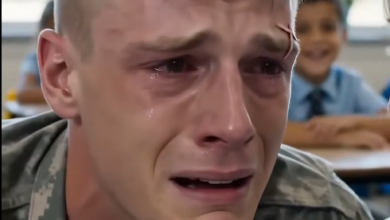
Part 2: The Famous Strict Coach Apologized to a Student in Front of the Entire Team — The Reason Left Every Parent Silent
For a moment, nobody moved.
The wind pushed across the practice field, carrying the smell of cut grass, rubber turf, and the distant smoke from someone’s backyard grill. The boys stood rigid in their pads, pretending not to watch Ethan too closely.
Parents had seen Coach Cole yell before. That was part of the bargain. You sent your son to play for him, and you understood there would be no soft treatment.
But this felt different.
Laura Miller’s hands shook around the strap of her purse. She had worked a double shift at the hospital cafeteria that day and had come straight to practice still wearing her black non-slip shoes. Her hair was pinned badly, and her face carried the tired look of a woman who had been holding things together with tape.
She knew Ethan had been late. She knew he had missed the bus. She knew he had been quieter than usual for weeks.
But she did not know why Coach Cole had to humiliate him like this.
Ethan picked up the helmet.
Coach Cole stared at him for a long second, then turned to the rest of the team.
“Line up,” he said.
The boys moved quickly.
Ethan tried to slip back into position, but Cole stopped him with one raised hand.
“No. You stay right there.”
That was when the first small thing happened.
Cole looked down at Ethan’s cleats.
They were not team-issued shoes. They were old, black, and slightly too large, with one lace tied in a knot where it had snapped. On the right shoe, a strip of silver duct tape wrapped around the side.
Cole’s jaw tightened.
It lasted less than a second, but Laura saw it.
So did Mrs. Hanley, whose son played quarterback. She leaned toward another mother and whispered, “Why is he looking at the boy’s feet?”
Cole turned away too quickly.
“Again,” he shouted to the team. “Run the last play.”
The boys ran the drill. The quarterback called the signal. The receivers broke out. The linemen shifted. Everything moved with polished rhythm.
Except there was an empty place where Ethan should have been.
Cole watched without blinking.
When the play ended, he said, “Again.”
They ran it again.
Then again.
By the fourth time, the boys were breathing hard. Sweat rolled down their faces. A few parents started checking their watches, uncomfortable but unwilling to leave.
Ethan remained at midfield.
He did not cry. That somehow made it worse.
Laura could feel judgment building around her. She had lived long enough to know how silence could accuse a person. People were not only judging Coach Cole now. They were judging her son.
Maybe he had done something bad.
Maybe he had quit on the team.
Maybe he was one of those kids who made excuses.
Then Cole reached into the pocket of his windbreaker and pulled out a folded sheet of paper.
Ethan saw it and went pale.
Not embarrassed pale.
Afraid pale.
Laura noticed immediately because mothers recognize fear before anyone names it.
Coach Cole unfolded the paper, then stopped.
His hand trembled.
It was slight, almost hidden by the whistle cord around his wrist, but it was there. This was a man who could stare down referees, school boards, and angry fathers in parking lots. Yet now, holding one wrinkled sheet of notebook paper, his fingers moved like he had touched something hot.
He folded the paper again without reading it.
That was the second small thing.
“Coach?” asked Tyler Hanley, the quarterback.
Cole did not answer him.
Instead, he walked toward Ethan, stopped a few feet away, and lowered his voice.
Nobody could hear what he said, but Ethan’s face changed.
His chin lifted a little.
Not much.
Just enough for Laura to notice.
Cole stepped back and cleared his throat.
“Parents,” he called, louder now. “Stay where you are.”
A nervous laugh moved through the bleachers, but it died quickly.
Coach Cole looked at the team, then at Ethan, then at the folded paper in his hand.
“For two weeks,” he said, “I thought I was looking at laziness.”
Ethan closed his eyes.
“I thought I was looking at disrespect. I thought I was looking at a player who believed the rules applied to everyone but him.”
Laura’s stomach sank.
Cole’s voice grew rougher.
“And because I thought that, I made him run after practice. I benched him. I called him out in film study. I told him that talent without character was useless.”
One of the boys stared at the grass.
Another rubbed his face with his glove.
Something was shifting.
The parents could feel it, but they did not understand it yet.
Coach Cole turned the folded paper over in his hand.
“Then this morning,” he said, “I found something in my office.”
Ethan whispered, “Coach, please.”
That was the third small thing.
Not “I’m sorry.”
Not “Don’t tell them.”
Please.
A word that sounded less like guilt and more like protection.
Cole looked at the boy, and for the first time all afternoon, the famous strict coach seemed uncertain.
Then he said, “No, Ethan. I already failed you once by staying blind. I’m not going to fail you again by staying quiet.”
The field went still.
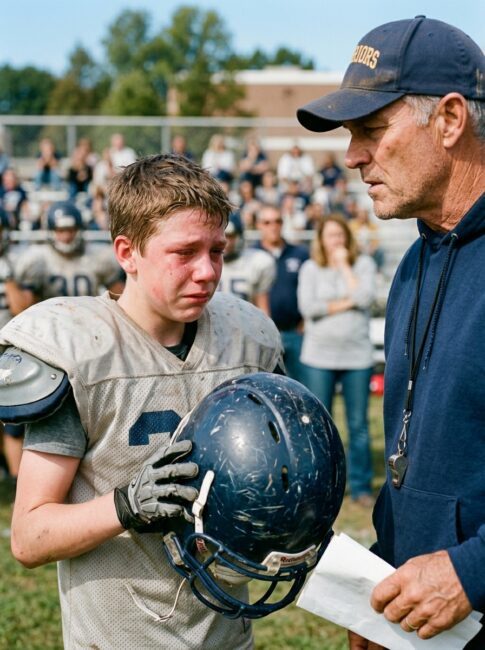
Coach Cole unfolded the paper.
Nobody breathed loudly.
“This was tucked under my office door,” he said. “No name on it. Just three sentences.”
He glanced down, then read slowly.
“Coach, please don’t punish Ethan anymore. He isn’t lazy. He walks home with my little brother every day because some boys from the middle school have been following him.”
A murmur moved through the parents.
Cole continued.
“He misses the late bus because he waits until my brother gets inside our apartment building. He told me not to say anything because he didn’t want anyone thinking my brother was scared.”
Ethan stared at the ground again.
Laura’s hand went to her chest.
Coach Cole lowered the paper. His face had changed completely. The hardness was still there, but it no longer pointed at Ethan. It pointed inward.
He looked like a man standing in front of a locked door, realizing he had been the one holding the key.
“The note came from Marcus Bell,” Cole said.
A small seventh grader near the bleachers stiffened. His mother, Angela Bell, grabbed his shoulder as if the whole world had suddenly turned toward him.
Marcus was not on the team. He was small for his age, with thick glasses and a backpack nearly as wide as his body. He had come to practice because his older cousin played defense.
Angela’s eyes filled before anyone asked a question.
Cole looked at Marcus gently.
“You don’t have to say anything,” he said.
But Marcus stepped forward anyway.
His voice shook. “Ethan told them he’d fight them if they touched me.”
A father near the fence muttered, “Who?”
Marcus swallowed.
“Three eighth graders. They waited by the corner store. They pushed me into the trash cans once. Ethan saw it.”
Laura turned toward her son.
Ethan did not look at her.
That hurt more than if he had.
Coach Cole nodded slowly, like each word was a weight being placed into his hands.
“He was late last Friday because he walked Marcus home after those boys followed them six blocks,” Cole said. “He missed the bus because he stayed outside the building until Marcus’s mom got off work.”
Angela covered her mouth.
Laura whispered, “Ethan…”
But the boy stayed silent.
Cole looked at the players.
“And the missed block?” he asked.
No one answered.
Cole pointed toward Ethan’s left arm. “Show them.”
Ethan shook his head.
Cole’s expression softened. “Son, they need to see what I refused to see.”
For a long moment, Ethan did not move.
Then he slowly pulled up his sleeve.
A dark bruise covered the side of his forearm, fading yellow at the edges. It was shaped like fingers.
The parents gasped quietly.
“He got that last week,” Marcus said, crying now. “One of them grabbed me, and Ethan pulled him off.”
Tyler Hanley, the quarterback, took one step backward as if the field had moved beneath him.
“I yelled at him for missing my signal,” Tyler said, barely above a whisper.
Coach Cole nodded. “So did I.”
He turned back to Ethan.
“And when I asked why your arm was wrapped in the locker room, you said you fell.”
Ethan’s voice finally came out. It was small but steady.
“I didn’t want Marcus to get called a snitch.”
A silence fell so deep that even the younger kids near the bleachers stopped moving.
Laura had spent weeks wondering why her son came home tired, why he ate dinner without talking, why his shoes had worn down so fast. She had thought maybe football was too much for him. She had worried that he was being lazy, distracted, or careless.
She had not imagined him walking six extra blocks after school, every day, with a scared child beside him.
She had not imagined him carrying someone else’s fear in silence.
Coach Cole took off his cap.
That was something no player had ever seen during practice.
He held it against his chest.
“Ethan Miller,” he said, and his voice cracked slightly, “I owe you an apology.”
The boy looked up.
Not fully.
Just enough.
“I judged you by what I could measure,” Cole continued. “A missed bus. A late arrival. A bad drill. A mistake on film.”
He paused.
“I did not ask the right question.”
The parents were silent now. Not uncomfortable silent. Ashamed silent.
Cole stepped closer to Ethan.
“I made you run when you were already tired. I called you selfish when you were protecting someone. I treated your silence like disrespect when it was actually loyalty.”
Ethan’s lips pressed together.
“And I did it in front of your teammates,” Cole said. “So I am apologizing in front of your teammates.”
Then Raymond Cole, the man who never bent for anyone, lowered himself to one knee on the grass.
The boys stared.
The parents stared.
Laura began to cry without making a sound.
Cole looked up at Ethan.
“I was wrong.”
Ethan’s shoulders trembled.
Cole did not reach for him. He did not force a hug or turn the moment into a speech. He only stayed there, one knee in the grass, cap against his chest, letting the apology stand without decoration.
That was when another twist arrived.
Tyler Hanley slowly removed his helmet.
“Coach,” he said, “I knew Ethan was walking somewhere after school.”
Cole turned.
Tyler’s face was red. “I thought he was skipping workouts. I told two guys he didn’t care about the team.”
A few players looked down.
Another boy spoke from the line. “I laughed when his shoe split.”
Someone else whispered, “I called him charity case.”
Laura flinched.
Ethan heard it too, but he did not look angry. He looked tired in a way that made the adults seem smaller.
Coach Cole stood.
“Then you owe him something too,” he said.
No one moved at first.
Then Tyler crossed the grass and stood in front of Ethan.
“I’m sorry,” he said. “I should have asked.”
One by one, the boys stepped forward.
Not all with perfect words. Not all gracefully. Some mumbled. Some stared at their shoes. Some looked like they wanted to escape their own shame.
But they came.
And Ethan stood there receiving apologies he had never asked for.
Then Marcus walked onto the field.
He stopped beside Ethan and held out something from his backpack.
It was a small roll of black athletic tape.
“I brought this,” Marcus said. “For your shoe.”
Ethan looked at the tape.
For the first time all afternoon, he almost smiled.
The parents broke then.
Not with applause. That would have felt wrong.
They broke into tears, into lowered heads, into mothers gripping fathers’ sleeves, into quiet apologies whispered to no one in particular.
Coach Cole took the tape from Marcus and knelt again, this time at Ethan’s feet.
“May I?” he asked.
Ethan nodded.
The famous coach, who had once shouted at college scouts and stared down championship opponents, carefully wrapped tape around a freshman boy’s torn cleat.
No one spoke.
The whole field watched a man repair a shoe he had almost mistaken for an excuse.
The next morning, the Westbridge football team met before school.
There were no reporters. No announcement. No polished statement from the athletic department.
Just a team sitting on metal benches in a locker room that smelled like soap, old leather, and rain from the coats dripping near the door.
Coach Cole stood in front of them with a cardboard box at his feet.
Inside were pairs of cleats.
Some were new. Some were nearly new. Some had been donated overnight by parents who had gone home and looked in closets with different eyes.
Cole did not make a long speech.
He picked up a pair and said, “No player on this team will have to prove he deserves help.”
Then he looked at Ethan.
“And no player will be punished for carrying something the rest of us failed to notice.”
The boys listened differently now.
That was the thing Laura noticed from the hallway, where she stood holding a paper cup of coffee she had forgotten to drink. The same boys who had once filled every silence with jokes now sat still enough to hear the hum of the lights.
Ethan sat near the end of the bench with Marcus beside him.
Marcus was wearing Ethan’s old team hoodie. It swallowed him whole.
A week later, three eighth graders were suspended after the school reviewed security footage from the corner store. Their parents came to the school angry at first, then left quiet after seeing the videos.
But the story people remembered was not about punishment.
They remembered Friday night.
Westbridge played under bright lights, with half the town in the stands and cold air rolling across the field. Ethan did not start. He was still a backup, still too thin, still learning the routes.
Late in the fourth quarter, with Westbridge ahead by two touchdowns, Coach Cole turned and called his name.
Ethan froze.
“Helmet,” Cole said.
Ethan put it on.
Laura stood in the bleachers with both hands clasped at her mouth.
On the first play, Ethan ran the wrong route.
The old Coach Cole might have shouted.
This Coach Cole only called him back and said, “Again. Breathe first.”
On the second play, Ethan caught a short pass near the sideline and was tackled almost immediately. It was not a touchdown. It was not even a big gain.
But when he stood, the team cheered like something had been won.
Ethan jogged back to the sideline, trying not to smile too much.
Coach Cole handed him water.
No speech.
No grand moment.
Just water.
After the game, as families crossed the field, Laura found Coach Cole standing alone near the fifty-yard line. The stadium lights made the grass shine silver around his shoes.
She wanted to thank him.
She wanted to ask why he had been so hard, why he had not seen sooner, why her boy had carried all of that without telling her.
But when she reached him, Coach Cole spoke first.
“My father was a hard man,” he said quietly. “I spent half my life thinking hard meant strong.”
Laura looked toward Ethan.
He was kneeling beside Marcus, showing him how to tie a football cleat so it would not loosen.
Cole followed her gaze.
“I’m still learning the difference,” he said.
Laura did not answer for a while.
Then she said, “So is he.”
Across the field, Ethan finished tying the shoe and tapped Marcus lightly on the ankle.
Marcus stood and took a few careful steps, testing the knot like it was something precious.
Coach Cole watched them, cap in hand, while the crowd slowly disappeared into the parking lot.
Later, long after the lights clicked off, one small thing remained on the bench near midfield.
A strip of black athletic tape.
Folded once.
Pressed flat by someone’s thumb.
And if this story stayed with you, follow this page for more heartfelt stories about the quiet truths people carry.