Part 2: The Famous TED Talk Speaker Invited a Homeless Woman on Stage — 18 Minutes Later, the Audience Rose in Tears
For a few seconds, the theater seemed to forget how to breathe.
The woman stood beside Caleb Monroe on the red circle, blinking against the stage lights. They made every tear on her face visible. They made the frayed cuffs of her brown coat look even more worn. They made the paper coffee cup in her hands look painfully small.
Caleb turned toward her.
“What is your name?” he asked.
His voice was gentle now, but the room did not trust it yet.
The woman stared at him.
Her lips moved once before sound came out.
“Ruth,” she said.
Caleb nodded as if he had expected another name and feared this one.
“Ruth what?”
She looked down.
“Ruth Mallory.”
Something changed in Caleb’s face.
Not enough for the balcony to notice, but enough for the people in the first rows to lean forward. His jaw tightened. His right hand, the one holding the remote clicker, began to tremble.
On the screen behind them, his opening slide vanished.
The title disappeared.
In its place appeared a black-and-white photograph of a small roadside diner.
The sign read Mallory’s Kitchen.
Ruth turned and saw it.
The coffee cup slipped from her fingers, bounced once, and rolled across the stage.
No one laughed.
Caleb bent to pick it up, but Ruth reached first. Their hands nearly touched. He pulled his back as if burned.
“I wasn’t sure it was you,” he said quietly.
Ruth’s eyes narrowed.
The audience, still restless, began to sense that something had gone wrong with the performance.
Or maybe something had gone right in a way nobody had planned.
Caleb faced the crowd.
“I was seventeen years old when I first walked into that diner,” he said. “I had sixty-three cents, a fake name, and a face swollen from sleeping behind a bus station.”
The theater grew still.
This was not in the program bio.
His public story began differently. It began with hardship, yes, but polished hardship. A father who drank too much. A mother who left. A scholarship. A mentor. A climb.
Not a bus station.
Not a fake name.
Ruth hugged her coat around herself.
Caleb glanced at her.
“She gave me breakfast,” he said. “Two eggs, toast, coffee with too much sugar, and bacon I did not order because I could not pay for it.”
A few people smiled softly.
Ruth did not.
“She told me I looked like trouble,” Caleb continued.
Ruth’s mouth twitched.
“You did,” she said.
A ripple of surprised laughter moved through the theater, then faded quickly.
Caleb looked relieved by the sound of her voice.
“I came back the next day. And the next. And the day after that. She kept feeding me. She said every town had one boy too proud to ask and too hungry to lie well.”
Ruth stared at the floor.
A woman in the second row wiped her eyes, though she did not yet know why.
Caleb pressed the clicker again.
Another image appeared.
A faded handwritten note on yellow paper.
Ruth’s handwriting was large and slanted.
You can wash dishes after school. Don’t steal from the tip jar again.
A murmur moved through the audience.
Caleb did not smile.
“I stole twelve dollars from her counter.”
Ruth closed her eyes.
The image changed again.
A grainy photo of a teenage boy in an apron, scowling beside a back door. He was thin, dark-haired, and angry at the camera.
Caleb.
No one would have recognized him without being told.
“She hired me anyway,” he said. “Not because I deserved it. Because she said a hungry boy with no work becomes a desperate man with no witness.”
That sentence landed strangely.
Like it belonged to Ruth, not him.
Caleb looked at the audience.
“Every principle I have ever been paid to explain started in that diner.”
The crowd shifted.
Some faces softened.
Others remained guarded.
Because Ruth still looked uncomfortable.
Because Caleb still had not explained why he had called a homeless woman onto a stage in front of strangers.
Ruth whispered, “You shouldn’t have done this.”
The microphone caught it.
Caleb turned to her.
“I know.”
That surprised the room most.
He did not defend himself.
He did not say this was for awareness, or advocacy, or courage, or any of the clean words people use when they want discomfort to feel planned.
“I know,” he repeated. “But I saw you outside this theater thirty minutes ago, and I realized I had spent twenty years speaking about mercy while walking past the woman who taught it to me.”
Ruth shook her head.
“You didn’t walk past me,” she said.
Caleb froze.
Ruth looked at him fully for the first time.
“You looked right at me.”
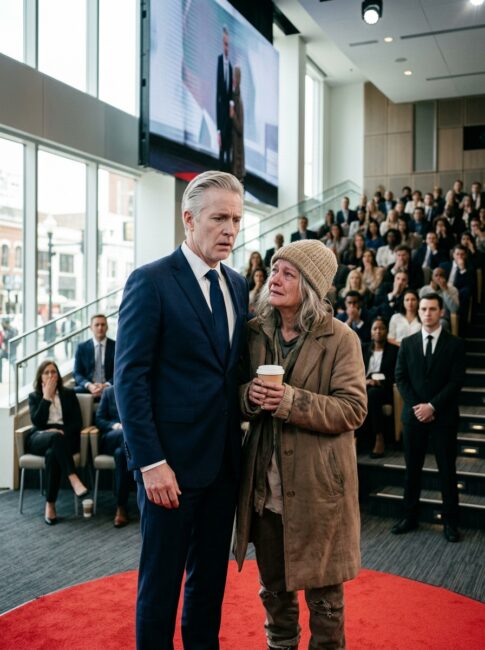
The sentence struck harder than any accusation.
Caleb Monroe, the man who had made a career out of helping people find language for pain, had none ready for his own.
The room watched him absorb it.
He did not perform sadness. He did not step closer to Ruth or reach for a dramatic embrace. He simply stood under the white stage lights while the woman in the brown coat held him still with the truth.
“You looked right at me,” Ruth said again, quieter this time. “At the west entrance. Near the donor line.”
Caleb nodded slowly.
“I did.”
“And you looked away.”
“Yes.”
A whisper rose through the audience, then died.
That was the second twist, and it made people uneasy because it did not belong to the past. It had happened that evening, while they were drinking sparkling water in the lobby and admiring the banners.
Caleb turned to the crowd.
“This is where I would usually tell a story about transformation,” he said. “I would make you comfortable by proving I learned something long ago.”
He looked back at Ruth.
“But tonight I failed the simplest test before I ever walked on stage.”
Ruth’s eyes filled again, though her face remained guarded.
Caleb placed the clicker on the floor.
“I want to tell you what Ruth did not tell you,” he said. “Because she never told anyone.”
Ruth’s expression changed.
“Caleb,” she warned.
He nodded, accepting the warning, then continued more carefully.
“When I was eighteen, I was arrested behind a pharmacy three towns over. I had broken a window. I was drunk. I was carrying pills I did not have a prescription for. I told the officer my name was Nathan Reid because I thought Caleb Monroe was already ruined.”
The theater was motionless.
“Ruth drove two hours in a snowstorm to get me.”
Ruth looked away.
“She was not my mother. She was not family. She was a diner owner with two kids, a mortgage, and a husband who thought she wasted too much kindness on strays.”
A muscle moved in Ruth’s cheek.
“She used the money she had saved for her daughter’s dental surgery to pay a lawyer.”
Ruth looked sharply at him.
“You were supposed to leave that part out.”
“I know.”
“Then why didn’t you?”
“Because I turned your sacrifice into my origin story and left you out of it.”
The words were plain.
No poetry.
That made them worse.
Caleb continued.
“The charges were reduced. I entered a program. I finished school. A judge said I had potential. A guidance counselor called me resilient. A foundation later wrote that I was self-made.”
He laughed once, without humor.
“People love that phrase when they don’t want to count the hands.”
Several heads bowed.
Ruth stood very still.
“My first scholarship essay was about hunger,” Caleb said. “My second was about resilience. My third was about a woman who believed in me when nobody else did.”
He looked at her.
“I did not use your name.”
Ruth’s face softened, then hardened again.
“Because I asked you not to.”
“That was not the only reason.”
Caleb’s voice broke for the first time.
“I was ashamed. Not of you. Of needing you. I wanted to become someone so respectable that no one could see the boy who stole from your counter.”
The third twist arrived quietly.
He had not erased Ruth because she was unworthy.
He had erased her because gratitude would have exposed him.
Ruth lowered her eyes.
The screen changed again, though Caleb had not touched the clicker. Someone backstage must have followed the rehearsed order.
A magazine cover appeared.
Caleb at thirty-five, smiling beneath the headline: THE MAN WHO BUILT MERCY INTO A MOVEMENT.
The room seemed to recoil from the image.
Caleb turned and looked at it.
“That movement raised millions,” he said. “It funded shelters, clinics, school programs. It helped people I will never meet.”
He faced Ruth again.
“But the diner closed.”
Ruth’s fingers tightened around her coat.
“After my husband got sick,” she said.
Caleb’s eyes closed briefly.
“I didn’t know.”
Ruth gave a tired smile.
“You didn’t ask.”
That was the fourth twist.
It was not that Caleb had refused to help.
It was that he had become famous for seeing people while failing to look for the one person who had seen him first.
Ruth spoke now, not to wound him, but because the room had finally become honest enough to hold her voice.
“Mallory’s Kitchen lasted thirty-one years. My husband’s treatment took the savings first. Then the second mortgage. Then the building.”
She paused.
“My daughter stopped speaking to me for a while. She said I had spent my life rescuing other people and leaving my own family in the waiting room.”
Caleb opened his mouth, but Ruth raised one hand.
“Don’t fix that sentence. It’s partly true.”
The audience sat with that.
No clean villain.
No perfect saint.
Just a woman whose kindness had cost more than applause could repay.
Caleb slowly removed the small earpiece from his ear and placed it beside the clicker.
“This talk was supposed to be eighteen minutes,” he said. “I was supposed to tell you mercy is a design principle, not a feeling.”
He shook his head.
“I don’t believe that sentence anymore. Not tonight.”
He reached into his jacket and pulled out a folded paper.
Ruth recognized it before he opened it.
“You kept that?” she whispered.
Caleb nodded.
It was another note from the diner.
If you ever become somebody, don’t become somebody who forgets the door he came through.
Ruth covered her mouth.
“I carried this in every suit I wore on every stage,” Caleb said.
The auditorium’s silence turned heavy.
“Which makes what happened tonight worse, not better.”
He looked toward the front row of sponsors, donors, and journalists.
“I invited Ruth up here because I thought naming my failure in public might be the beginning of paying a debt. But even that was selfish if it only made her pain useful to my speech.”
Ruth studied him.
“What are you asking for?”
Caleb swallowed.
“Not forgiveness.”
His voice was almost gone.
“I’m asking you to sit down if you want to sit down, leave if you want to leave, or take this microphone if there is anything you want said in a room that once would not have let you through the front door.”
Ruth looked at the microphone.
Then at the audience.
Then at the side aisle, where an usher who had nearly asked her to leave earlier now stood crying with both hands folded.
Ruth took the microphone.
She did not face Caleb.
She faced the crowd.
“I am not an example,” she said.
The room listened.
“I am not a lesson. I am not proof that kindness always comes back. Sometimes it doesn’t. Sometimes you help somebody climb out, and years later they pass you on the sidewalk because your face has changed and your coat is dirty.”
Caleb flinched, but he remained still.
Ruth’s voice trembled.
“But sometimes a person turns around.”
She looked at him then.
“Late is not nothing.”
Those four words broke something open.
Caleb lowered his head, and the tears he had been holding finally fell.
Ruth handed the microphone back, but he did not take it right away.
Instead, he stepped off the red circle.
He walked to the edge of the stage and sat down on the floor, beneath her.
It was a small gesture.
No music swelled.
No screen changed.
A famous man in an expensive suit sat lower than the woman in the old brown coat because, for once, the room did not need him above her.
Then Ruth sat beside him.
Not because everything was healed.
Because standing had become too much.
For the last minute of the talk, neither of them spoke.
And somehow, it became the most honest part.
The applause did not start immediately.
People were still crying too quietly for that. Some were wiping their faces with programs. Some stared at their shoes. A few simply sat with their hands folded, as if afraid to disturb what had settled in the room.
Then one woman in the balcony stood.
She was not a sponsor or a journalist. She looked like a retired teacher, with a red scarf looped twice around her neck and a program pressed to her chest.
Then a man near the aisle stood.
Then a row.
Then another.
Within seconds, the Grand Harbor Theater rose to its feet.
Ruth looked frightened by the sound.
Caleb did not stand to receive it.
He remained seated beside her at the edge of the stage, his head bowed, his hands open on his knees.
The applause was not for the speech he had prepared.
It was for the one that had survived him.
Afterward, backstage, everything was quieter than expected.
The event staff moved carefully around Ruth, offering water, a chair, a private room, a ride, too many options at once. She accepted the water and refused the private room.
Caleb stood several feet away, not crowding her.
For once, he seemed unsure of his place.
Ruth noticed.
“You always stood like that in the diner,” she said.
“Like what?”
“Like you were ready to run if someone reached for the check.”
He laughed softly, and it hurt.
A young woman appeared near the curtain. She was in her early thirties, with Ruth’s eyes and a guarded face.
Caleb recognized her from an old photograph behind the diner register.
“Emily,” Ruth whispered.
Her daughter crossed the room slowly.
For a moment, neither woman moved. Then Emily wrapped her arms around her mother with the kind of force that comes from years of wanting and refusing the same thing.
Caleb turned away.
That reunion was not his to watch.
A producer approached him with a pale expression.
“The video is already everywhere,” she said. “We need a statement.”
Caleb looked toward Ruth and Emily.
“No statement tonight.”
“Caleb, the press is waiting.”
“Then let them wait.”
Later, after most people had left, Ruth found him in the empty auditorium. The red circle on the stage looked smaller without the lights.
She stood in the aisle, holding the folded diner note.
“You forgot this,” she said.
Caleb shook his head.
“No. I think it belongs to you now.”
Ruth looked at the paper.
“If I keep it, what will you carry?”
Caleb glanced around the theater.
The velvet seats. The darkened balcony. The doorway where he had first seen her and looked away.
“Maybe the memory,” he said.
Ruth studied him for a long time.
Then she folded the note and placed it back in his jacket pocket herself.
“Memory fades,” she said. “Paper nags.”
He smiled through tears.
Outside, the rain had stopped. The sidewalk shone under the streetlights. Caleb walked Ruth and Emily to the waiting car, but he did not offer grand promises in front of cameras.
He asked where Ruth was staying.
He asked what she needed before morning.
He asked Emily what help would not feel like another performance.
Ruth answered some questions and ignored others.
That, too, was her right.
Before she got in the car, she turned back.
“I don’t know if I forgive you yet.”
Caleb nodded.
“I understand.”
“No,” Ruth said, gently. “You don’t. But you might someday.”
Then she reached out and straightened the collar of his navy suit, the way she might have done for the angry boy in the diner apron twenty-eight years before.
“There,” she said. “Now you look less expensive.”
He laughed once, and so did she.
It was small.
It was not enough.
But it was real.
As the car pulled away, Caleb stood on the curb until the taillights disappeared. In his jacket pocket, the old note pressed against his chest.
Behind him, the theater marquee still displayed his name in bright white letters.
But on the sidewalk below it, where Ruth had stood in the rain before the talk, someone had left a paper coffee cup beside the door.
Empty.
Upright.
Seen.
And if this story stayed with you, follow this page for more heartfelt stories about the quiet truths people carry for years.