Part 2: The Father His Daughter Didn’t Let Speak at Her Wedding — Until She Handed Him the Microphone and the Whole Room Fell Silent
Emily Hale had spent nine months planning a wedding that looked effortless.
White roses climbed the arch outside the chapel. Linen napkins were folded like soft wings. The band had been asked to avoid anything too loud before dinner because her grandmother hated shouting over music. Every detail had been chosen with the kind of care that made guests sigh before they even reached their seats.
But there was one detail Emily had not discussed with anyone outside the family.
Her father would attend.
He would not participate.
That was the agreement.
When Robert arrived that afternoon, the parking lot attendant did not know where to send him. He drove an old blue pickup with a dented passenger door, the kind of truck that looked more suited for hauling lumber than arriving at a country club wedding.
He wore a suit that had clearly been brushed clean, though the sleeves hung slightly too short. His shoes had been polished with care, but no amount of polish could hide the cracks near the soles.
A few guests noticed.
They always did.
Robert stepped out slowly, one hand pressed against his lower back. In his other hand, he carried a plain white envelope, sealed and bent at the corner.
Inside the chapel, Emily was standing in a side room, surrounded by bridesmaids in satin robes, when her mother, Diane, checked her phone and stiffened.
“He’s here,” Diane said.
Emily did not ask who.
Her hands tightened around her bouquet.
Her maid of honor, Claire, touched her shoulder. “You okay?”
Emily smiled the way brides learn to smile when someone has just stepped on their train. “I’m fine.”
But she wasn’t fine.
Not because she hated her father. Hate would have been easier. Hate had clean edges. What Emily felt was older and more tangled.
At fifteen, she had watched him leave their house with a suitcase and a cardboard box of clothes. He had kissed the top of her head and said, “Take care of your mom.”
Then he disappeared from the family photograph.
He called sometimes. Sent cards sometimes. Showed up for birthdays late, smelling like machine oil and cold air. He never explained why he was gone. Diane always said, “Your father made his choices.”
Emily believed her.
Children usually believe the parent who stays.
By the time Emily graduated high school, Martin had entered their lives with calm manners, a reliable car, and a checkbook that never trembled. He helped with college applications. He bought Emily her first laptop. He walked into every room as if he knew exactly where to stand.
Robert, meanwhile, stood at the edges.
In pictures, if he appeared at all, he was half hidden behind someone’s shoulder.
So when the wedding coordinator asked who would walk Emily down the aisle, Emily did not hesitate long enough to make the answer painful.
“My brother,” she said.
Robert had been told two weeks before the wedding.
Emily called him on a Tuesday evening after work. She rehearsed the words in her car before dialing.
“Dad, I hope you understand,” she said. “I don’t want things to feel complicated.”
There was silence on the line.
Then Robert said, “Of course, honey.”
That was all.
Of course.
Not “Why?”
Not “I’m hurt.”
Not even “I understand.”
Just those two words, soft as dust.
On the wedding day, he sat alone through the ceremony. When Emily walked down the aisle on her brother Daniel’s arm, Robert stood with everyone else. He did not wipe his eyes dramatically. He did not reach for attention. He simply pressed his palms together in front of him and watched his daughter become someone’s wife.
During the vows, Emily glanced once toward the back rows.
She did not mean to.
She just did.
Robert was staring at the floor.
Not crying.
Not smiling.
Just looking down, as though the carpet held something he had lost.
That small sight followed Emily into the reception.
At dinner, he barely touched his plate. When servers came around with salmon and roasted vegetables, Robert thanked them by name after reading their badges. He moved his untouched bread roll onto the small plate beside him and wrapped it carefully in a napkin when he thought no one was looking.
Claire noticed.
“That’s sad,” she whispered to Daniel.
Daniel’s jaw tightened. “Don’t start.”
At the head table, Emily watched her mother laugh too loudly at Martin’s speech. Martin told the guests how proud he was to have “helped raise this incredible woman.” People clapped. Diane dabbed at her eyes.
Robert clapped too.
That was the first moment Emily felt something shift.
It was not guilt yet.
It was confusion.
Because Robert clapped like he meant it.
No bitterness. No performance. Just a tired man in a cheap suit applauding another man for standing in the place he had once occupied.
Then came the speeches.
Claire spoke about childhood sleepovers and Emily’s impossible standards for pancakes. Daniel spoke about threatening every boy who came near his sister, including the groom, Adam. Diane spoke about motherhood, resilience, and second chances.
Martin’s speech came last.
He raised his champagne glass and said, “Emily, I may not have been there when you were born, but I was there when it mattered.”
The room warmed with applause.
Robert’s hand froze around his water glass.
Emily saw it.
Only for a second.
His fingers tightened until the knuckles turned white, then relaxed again.
He looked down at his lap.
There, beneath the table, he unfolded the yellowed piece of paper from his pocket.
Emily could not see what it was.
But she saw his thumb move over the creases as if he had read it a thousand times.
A few minutes later, when the band began to set up for the first dance, the wedding coordinator leaned toward Emily.
“We’re moving into father-daughter dance after your first dance with Adam,” she whispered. “You still want to do it with Martin?”
Emily nodded.
From the back of the room, Robert stood.
Not abruptly.
Not angrily.
He rose like a man answering a bell no one else could hear.
And that was when the whispers began.
“Is he going to say something?”
“Oh no.”
“After all these years?”
Diane’s face sharpened. Daniel half stood from his chair. Martin’s smile hardened into something polished and cold.
Robert did not walk toward the stage.
He walked toward the exit.
That should have been the end of it.
But as he passed the gift table, the white envelope slipped from his jacket pocket and landed beside a basket of cards.
Emily saw it fall.
So did Claire.
Claire picked it up before Robert realized it was gone.
On the front, written in Robert’s careful block letters, were five words.
For Emily, when she knows.
Claire looked at the envelope.
Then at Emily.
And for the first time all day, Emily felt the wedding she had built so carefully begin to tilt.
Emily should have ignored the envelope.
A bride is supposed to keep moving. Smile for photos. Cut the cake. Dance under soft lights while guests believe love has fixed everything.
But the words would not leave her.
For Emily, when she knows.
When she knows what?
Claire brought it to her quietly during the first dance. Adam had just spun Emily beneath his arm when Claire appeared near the edge of the dance floor, holding the envelope like it might break.
“I think you need this,” Claire whispered.
Emily looked toward the back doors.
Robert was gone.
The room kept moving around her. The band played. Guests lifted phones. Adam’s hand rested at her waist.
“What is it?” he asked.
Emily shook her head, but her fingers had already reached for the envelope.
She did not open it immediately.
She tucked it into the side of her dress, near the hidden pocket her seamstress had insisted every modern bride needed.
Then Martin stepped onto the floor.
The father-daughter dance.
The song began, gentle and familiar. Martin opened his arms. The guests sighed, ready for a tender moment.
Emily took one step toward him.
Then stopped.
Across the ballroom, through the glass doors leading to the terrace, she saw Robert outside.
He was not leaving.
He was standing under a string of patio lights, beside a stone fountain, speaking to one of the kitchen workers. The young woman wore a server’s apron and held a tray against her hip. She was crying.
Robert reached into his pocket, pulled out folded bills, and placed them in her hand.
The server shook her head.
Robert closed her fingers around the money anyway.
Then he said something Emily could not hear.
The young woman wiped her cheek and hugged him.
Emily stood frozen in the center of the dance floor.
Martin followed her gaze and frowned.
“Emily,” he murmured. “Everyone’s watching.”
They were.
The entire room had gone soft with confusion.
Emily looked down at her dress.
Then at the envelope.
She opened it with trembling hands.
Inside was a letter.
Not long.
Not dramatic.
Just one page, written in the same careful block letters.
At the top was a date.
Fifteen years ago.
The year Robert left.
Emily read the first line.
My sweet girl, if you are reading this, it means somebody finally told you the part I promised not to say.
Her breath caught.
The band continued playing for three more measures before the lead singer noticed nobody was dancing.
Emily read faster.
The letter did not accuse Diane. It did not beg for forgiveness. It did not defend Robert with anger.
It told a story in fragments.
Diane had been sick when Emily was fifteen.
Not the kind of sickness people announce at dinner. Not something visible under makeup and Sunday dresses. She had suffered a breakdown after years of hiding bills, fear, and a quiet dependence on pills prescribed after Daniel’s difficult birth.
Robert had found the unpaid mortgage notices first.
Then the emptied college savings.
Then Diane in the garage one winter morning, sitting in the car with the engine off and both hands over her face.
Emily’s eyes blurred.
Robert had made a choice.
He took the blame.
Not because he was noble in a way people write songs about, but because Diane’s doctor said shame might push her over the edge. The children needed stability. Diane needed treatment. And the family needed one villain, not two broken parents.
So Robert became the villain.
He moved out and told relatives the separation was his fault. He worked night shifts at a packaging plant and weekend repairs at a bus depot to keep sending money through Diane, so the children would think she was managing everything.
Emily’s college application fees, the laptop Martin claimed he bought, Daniel’s braces, the furnace replacement, even part of the wedding deposit.
Robert had paid for pieces of their lives from the shadows.
Emily read one line three times.
Your mother asked me not to tell you until she was ready. Then years passed, and every year made the truth harder to hand back.
Emily lowered the letter.
Diane was standing now.
Her face had lost all color.
Daniel looked from his mother to his sister, confused, angry, afraid.
Martin said, too quietly, “This is not the time.”
Emily turned to him.
Something about his tone opened another door.
“What did you know?” she asked.
The microphone near the band stand picked up her voice just enough for the front tables to hear.
Martin’s expression changed.
Not much.
Just enough.
Diane covered her mouth.
“Martin,” Emily said.
He set his glass down slowly. “I knew your father helped. That doesn’t change who was here.”
A murmur moved through the room.
Robert was still outside, unaware that the life he had buried was being dug up under chandeliers.
Emily looked back at the letter.
There was one more folded paper behind it.
A receipt.
No, several receipts.
Old hospital payments. Tuition installments. Repair invoices. A cashier’s check stub made out to Willow Creek Events.
The wedding venue.
Emily’s hand shook so hard the papers rustled.
At the bottom of the letter, Robert had written:
I was proud to sit anywhere in the room, Em. Back row, side table, doorway, parking lot. A father does not need a chair of honor to love his child.
That was when Emily began to cry.
Not the delicate bridal tears people photograph.
These were the tears that bend a person forward.
Adam took the papers from her before they slipped to the floor. He read just enough for his face to change. Then he looked toward the terrace and said, “Go get him.”
Daniel was already moving.
He reached the glass doors and stepped outside. For a moment, brother and father stood beneath the patio lights, both stiff, both carrying years neither knew how to hold.
Then Daniel said something.
Robert shook his head.
Daniel said it again.
Robert looked through the glass and saw Emily.
The ballroom had gone silent.
No forks. No laughter. No music.
Only the soft hum of the air conditioning and the distant splash of the fountain outside.
Robert entered like a man walking into court.
He did not look at Diane. He did not look at Martin. He looked only at Emily, and even then, he kept his eyes lowered at first, as if asking permission to be seen.
Emily crossed the dance floor.
The train of her gown dragged behind her. One of her bridesmaids reached to lift it, then stopped. Some moments do not need arranging.
When Emily reached him, she held up the letter.
“Is it true?” she asked.
Robert’s mouth opened, but no sound came.
“Dad,” she said, and the word broke in the middle. “Is it true?”
Diane sobbed once.
That was answer enough.
Robert closed his eyes.
“I didn’t want this tonight,” he said. “Not on your wedding day.”
The microphone near the band stand carried his words farther than he intended.
Emily looked at her mother.
Diane was crying now, but not from performance. Something in her face had collapsed. The perfect mother, the survivor, the woman who had held the family story in both hands for fifteen years, suddenly looked old and frightened.
“I was ashamed,” Diane whispered. “I thought if you knew, you would hate me.”
Emily’s tears fell silently.
Robert turned toward Diane with the same tired kindness that had made him clap for Martin.
“No,” he said softly. “They would have loved you through it.”
The room broke.
Not loudly.
It was worse than loud.
People covered their mouths. Claire bent her head. Daniel pressed both fists against his eyes. Adam stood behind Emily, holding the old receipts as if they were pieces of a map to a country he had never known existed.
Martin did not speak.
Maybe because there was nothing left polished enough to say.
Emily turned back to her father.
“All these years,” she whispered. “You let me think you left because you didn’t care.”
Robert’s eyes filled.
“I cared too much to make you choose between us.”
That was the line that did it.
The one no speechwriter could have made clean enough.
Emily stepped into him.
For a moment, Robert seemed not to understand. His hands hovered at his sides, uncertain, almost afraid to touch the white dress. Then he folded his arms around his daughter with the gentleness of a man holding something returned after being lost for half a lifetime.
No one clapped.
No one dared.
Emily pulled back and looked toward the band stand.
The microphone waited in its stand, black and ordinary, the same microphone that had carried jokes, blessings, and comfortable truths.
She walked to it.
For a second, everyone thought she might speak.
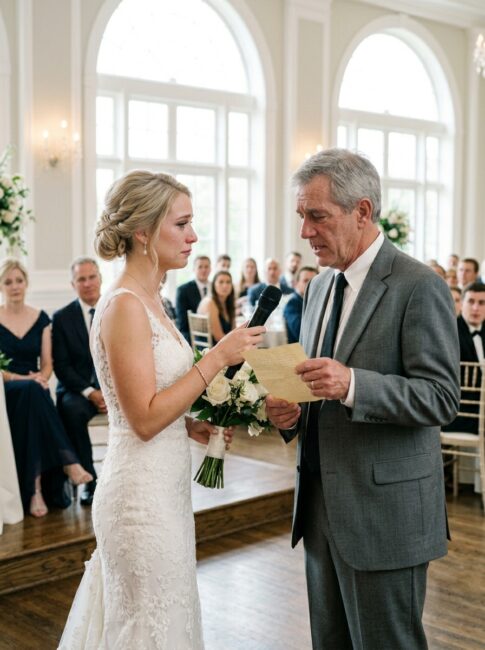
Instead, she lifted it, turned, and placed it in her father’s hands.
Robert stared at it.
Then at her.
Emily nodded.
“Please,” she said. “Say what you came here not to say.”
Robert held the microphone as if it belonged to someone else.
His fingers were rough around it, scarred from work nobody in that ballroom had ever pictured when looking at him. He glanced at the tables, the flowers, the candles floating in glass bowls, then at his daughter in her wedding dress.
“I had a speech,” he said.
A faint ripple moved through the room. Not laughter. Something softer.
Robert reached into his jacket pocket again and pulled out the yellowed folded paper Emily had seen earlier. He unfolded it carefully.
“My hands were steadier when I wrote this,” he said.
Emily pressed her lips together.
Robert looked at the page.
Then he folded it back up.
“But I don’t think I need it.”
He swallowed.
“When Emily was little, she used to fall asleep in the truck before we even made it home from the grocery store. She would hold a bag of apples in her lap like it was treasure. Every time I tried to carry her inside, she would wake up just enough to say, ‘Don’t drop me, Daddy.’”
His voice shook, but he stayed with it.
“And I would always say, ‘Never.’”
Emily covered her mouth.
Robert looked at her now.
“I didn’t keep that promise the way I wanted to. Maybe nobody can. Sometimes you don’t drop someone with your hands. Sometimes you drop them by staying silent too long.”
Diane wept into a napkin. Daniel stood behind her, one hand on her shoulder, his own face wet.
Robert continued.
“I’m not here to take anyone’s place. I’m not here to rewrite your life or make this room decide who loved you best. Love isn’t a contest, and children should never be the prize.”
His eyes moved briefly to Martin, then away.
“I only want to say what I should have said a long time ago. Emily, I was there in every way I knew how to be. I was in the tuition envelopes. I was in the car repair you never got billed for. I was in the porch light I fixed after midnight because your mom said you were scared coming home from work.”
Emily’s shoulders trembled.
“I was in the back row because I thought the back row was better than being absent. And today, when I saw you walk down that aisle, I did not feel robbed. I felt grateful. Because even from the back, I got to see my little girl take another step forward.”
A guest near the front began crying openly.
Robert looked down, embarrassed by the attention, and that made it hurt even more.
Then he turned to Adam.
“You married a woman who notices everything, even when she pretends not to. Be careful with that. It means she will see the best in you when you don’t deserve it, and she will remember the worst if you make her carry it alone.”
Adam nodded, wiping his eyes.
“I love her,” he said.
“I know,” Robert replied. “I saw how you held her elbow when she was reading. A man’s character shows up in small places first.”
The room stayed silent.
Robert looked back at Emily.
“I don’t need a dance,” he said. “I don’t need a front seat. I don’t need my name corrected in anybody’s story tonight.”
Emily shook her head through tears.
“Yes, you do.”
She turned to the band.
“Play it again,” she said.
The lead singer did not ask which song.
Everyone knew.
The father-daughter song began from the top, soft and hesitant at first, then steady.
Robert tried to hand back the microphone, but Emily took his hand instead.
“I might step on your dress,” he whispered.
“You paid for part of it,” she whispered back, crying and laughing at the same time. “You’re allowed.”
For the first time that night, the room exhaled.
Robert and Emily moved slowly in the center of the dance floor. He was not graceful. She did not care. His hand barely touched her back, careful of the lace, careful of everything. She leaned her forehead against his shoulder like the grown woman she was and the little girl she had once been.
Around them, people watched without phones raised.
Some moments ask not to be recorded.
Diane stood beside Daniel, broken open by shame and relief. After a long while, she walked to the edge of the dance floor. Robert saw her and gave the smallest nod. It was not forgiveness wrapped in ribbon. It was only an opening. But sometimes an opening is the first mercy anyone can manage.
Martin left before the cake was cut.
Most people noticed.
Nobody followed.
Later, after the guests had eaten and the flowers had begun to droop in the warm ballroom air, Emily found Robert outside by his truck. He had removed his tie and folded it over one arm.
“You were leaving without saying goodbye?” she asked.
He looked guilty, like a boy caught stealing cookies.
“I didn’t want to take up more room.”
Emily walked to him and placed something in his hand.
The boutonniere meant for the father of the bride.
It had been sitting unused in the bridal suite all day.
Robert stared at the little white rose.
Then he pinned it to his old gray suit with clumsy fingers.
Emily helped him straighten it.
Neither of them spoke for a moment.
From inside, the band began another song. Laughter drifted across the parking lot, softer now, kinder somehow.
Robert opened the truck door.
Emily stopped him.
“Dad?”
He turned.
“When I was little,” she said, “did I really say that thing about not dropping me?”
Robert smiled, and it changed his whole face.
“Every time.”
Emily nodded, holding the door with one hand.
Then she stepped forward and hugged him again, not for the room, not for the story, not for anyone watching from the windows.
Just because he was there.
And this time, when she whispered, “Don’t disappear again,” Robert closed his eyes and answered with the simplest promise he had left.
“Never.”
For more heartfelt stories about love, family, and the quiet truths people carry, follow this page for the next story.