Part 2: The Garbage Collector Father His Daughter Was Ashamed to Introduce — Until She Saw What He Did Every Morning
For the rest of Career Day, Lily pretended nothing had happened.
She sat in the auditorium beside her best friend, Madison Price, while parents walked across the stage and described careers that sounded important under bright lights.
A surgeon spoke about saving lives.
A software executive talked about changing the future.
Madison’s mother, a financial consultant with blonde hair and a cream suit, explained how confidence could open any room.
Lily clapped when everyone else clapped.
She smiled when people looked her way.
But each time the auditorium doors opened, she felt her body tighten.
She imagined her father walking in with his orange vest, rough hands, and the smell of the route clinging to him. She imagined the whispers. She imagined someone taking a picture and sending it around before lunch.
By noon, the principal called the final parent speaker.
Lily exhaled.
Frank had listened.
He had stayed outside.
That should have made her feel relieved.
Instead, relief felt strangely heavy.
When the bell rang, Lily hurried toward the side exit, hoping to avoid the parking lot. She heard the sanitation truck start somewhere behind the gym. Its engine rumbled low, familiar from childhood mornings when she used to run to the window and wave.
She did not wave anymore.
At lunch, Madison slid into the seat across from her.
“So,” Madison said, smiling in a way that was not kind, “was that really your dad?”
Lily looked down at her salad.
“He works for the city.”
“Yeah,” Madison said. “Collecting garbage.”
A few girls at the table went quiet, waiting to see whether Lily would defend him or laugh with them.
Lily chose the easier shame.
“It’s just a job,” she said, trying to sound bored. “He wasn’t supposed to come today.”
Madison lifted her eyebrows.
“Good call.”
Lily laughed once, but the sound tasted wrong.
After school, she found her father’s truck gone. Her mother had died three years earlier, so Frank usually arranged his route to pick Lily up when he could. That day, he did not text. He did not call. He did not wait.
She took the bus home.
Their small blue house sat at the end of Maple Street, with peeling paint on the porch railing and marigolds planted in coffee cans. Frank’s work boots were by the door, but the house was quiet.
On the kitchen table sat the dented thermos and paper bag lunch.
Untouched.
Beside them was a small object wrapped in a napkin.
Lily stared at it.
Then she carefully unfolded the paper.
Inside was a tiny silver pin shaped like a star.
The back was bent. The metal was scratched. It looked old, almost childish.
A folded note sat beneath it in her father’s careful block handwriting.
For your jacket today. Your mom wore it when she got her first job at the diner. Thought it might bring you luck.
Lily sat down slowly.
The room seemed to shift around her.
She had thought he had been hiding something embarrassing.
He had been hiding a gift.
That was the first crack.
The next morning, Lily woke before sunrise because of a sound outside her window. Not thunder. Not traffic. Something lighter.
Metal against concrete.
She pushed aside the curtain.
Her father’s sanitation truck was parked at the curb under a pale gray sky. Frank stood beside Mrs. Alvarez’s trash cans across the street, but he was not dumping them yet.
He was kneeling.
Lily frowned.
Mrs. Alvarez was eighty-one and lived alone. Her hands shook badly in cold weather. Lily had seen her struggle with the heavy bins before.
Frank opened one lid, pulled out a stack of flattened cardboard, tied it with twine, then set a small grocery bag on the woman’s porch.
Mrs. Alvarez opened the door in her robe.
Frank stepped back quickly, as if he did not want to be caught doing something tender.
The old woman pressed her hand to her chest.
Frank only nodded, lifted her trash can as if it weighed nothing, and rolled it carefully to the truck.
Lily stayed behind the curtain.
Then something else happened.
A young boy from two houses down ran toward the curb, waving a crumpled sheet of paper. He was Black, maybe nine, wearing a backpack with one broken strap.
Frank stopped the truck.
The boy handed him the paper.
Frank read it, smiled, and pulled a clean plastic folder from inside the cab. He tucked the paper into it with surprising care.
The boy hugged him quickly.
Frank patted his shoulder, then looked around the quiet street as if embarrassed.
Lily stepped back from the window.
Her father was not just collecting trash.
Something was happening every morning before the world had enough light to judge him.
For the next three mornings, Lily woke early and watched.
She told herself she was only curious.
But curiosity did not explain the tightness in her throat.
On Tuesday, Frank stopped in front of the Henderson house. Mr. Henderson had been laid off from the factory two months before. Lily knew because his wife had cried in the grocery store parking lot, and everyone in town had pretended not to see.
Frank lifted their trash lid, then paused.
A box of canned food sat beside the bin, wrapped in a black bag so it looked like garbage from the street. He did not throw it into the truck. He carried it to the side porch and set it beside the back door.
Mrs. Henderson opened the curtain.
Frank raised two fingers in a small greeting and kept moving.
On Wednesday, he stopped behind the elementary school before students arrived. Lily had never noticed that part of his route. She watched from the bus window as he climbed down, opened the truck’s side compartment, and took out three backpacks.
They were not new.
One had a patch on it. Another had a zipper repaired with wire. But they were clean.
He handed them to the school custodian, Mr. Bell, a seventy-year-old Black American man with a gray beard and a limp. Mr. Bell shook Frank’s hand with both of his.
Lily pressed her forehead to the bus window.
No one else noticed.
On Thursday, rain came hard.
Lily woke at 5:12 because the gutters rattled. She almost stayed in bed, but something pulled her to the window.
Frank stood in the rain outside the Carters’ house, wearing his orange vest over a soaked sweatshirt. Their youngest daughter, Emma, had leukemia. A pink sign on the porch asked delivery drivers not to knock because the child was sleeping.
Frank took their bins quietly, even lifting the wheels over a crack in the driveway so they would not bang.
Then he reached into the cab and pulled out a small stuffed rabbit sealed in a clear plastic bag.
He left it on the porch chair.
Not on camera.
Not with a note.
Just there.
Lily’s chest hurt.
That afternoon at school, Madison leaned over during history.
“My mom saw your dad’s truck again,” she whispered. “Does your house smell like garbage all the time?”
Lily looked at her.
The old Lily would have smiled weakly.
The old Lily would have swallowed the insult and called it humor.
This time, she said, “Don’t talk about him like that.”
Madison blinked.
“What?”
Lily turned back to her notebook, but her hand shook.
After school, she did something she had avoided for years.
She went to the city sanitation yard.
The office was a low brick building behind chain-link fencing. Trucks sat in rows like tired animals. Men and women in reflective vests drank coffee from paper cups, laughing in the damp afternoon air.
A white American woman with gray curls at the front desk looked up.
“Can I help you?”
“I’m Frank Morgan’s daughter,” Lily said.
The room changed.
Not dramatically. Not loudly.
But enough.
A man near the vending machine smiled. Another removed his cap. The woman at the desk softened.
“You’re Lily,” she said.
Lily nodded, surprised they knew her.
The woman reached beneath the counter and pulled out a cardboard box.
“Your dad keeps this here,” she said. “Says home is too crowded.”
Inside were letters.
Dozens of them.
Thank-you cards. Children’s drawings. Photographs. Newspaper clippings yellowed at the edges.
Lily picked up one drawing.
It showed a sanitation truck under a rainbow. A stick figure in an orange vest stood beside it with the words: Mr. Frank found my hearing aid.
Another card read: Thank you for finding Mom’s wedding ring before the truck crushed the bag.
Another: Because of you, my son has a winter coat.
Lily’s vision blurred.
The woman at the desk spoke gently.
“He started after your mom passed. Said grief needed somewhere to go before it turned bitter.”
Lily looked up.
“What do you mean?”
The woman hesitated.
Then she pointed to a photograph taped inside the box lid.
It showed Frank and Lily’s mother, Grace, standing beside a line of donated bicycles. Grace wore the same silver star pin Lily had found on the kitchen table.
“They used to run the morning kindness route together,” the woman said. “Before cancer took her.”
Lily sat down hard in a plastic chair.
Her mother had not just known.
Her mother had begun it with him.
The next morning, Lily did not watch from behind the curtain.
She waited on the porch in jeans, a hoodie, and old sneakers.
Frank stepped out of the house at 4:45, carrying his lunch bag and thermos. He stopped when he saw her.
“You’re up early,” he said.
“I want to come with you.”
His face closed carefully.
“It’s not pretty work.”
Lily looked at his hands, cracked from cold and chemicals, scarred around the knuckles, still gentle enough to leave stuffed rabbits on porches.
“I know.”
Frank studied her for a long moment.
Then he handed her a spare reflective vest.
For the first hour, they barely spoke.
She learned the route had rhythms. The lonely houses first, because older people woke early. The families with babies next, because Frank avoided the loud hydraulic lift there. The elementary school before sunrise, because children without supplies could receive them without being seen.
At 6:20, they stopped at the small apartment building near Pine Avenue.
Frank lifted a trash bag and froze.
A faint sound came from inside.
Not crying.
Scratching.
He carefully opened the bag and found a cardboard shoebox with air holes poked in the top. Inside was a trembling kitten, wet and silent with fear.
Lily gasped.
Frank did not curse. He did not make a speech about cruelty.
He wrapped the kitten in his spare sweatshirt and placed it near the heater vent inside the cab.
“Grace used to say nothing helpless belongs in the trash,” he said.
Lily looked at him.
It was the first time he had said her mother’s name all morning.
At the next stop, an elderly white man named Mr. Callahan waited by the curb with a cane. His trash can was empty. He had only come outside to hand Frank an envelope.
“For the coat fund,” he said.
Frank tried to refuse.
Mr. Callahan pushed it against his chest.
“You bought my groceries in March and pretended the store made a delivery mistake. Take it.”
Lily stared at her father.
Frank sighed, pocketed the envelope, and looked uncomfortable.
“You talk too much, Mr. C.”
The old man laughed.
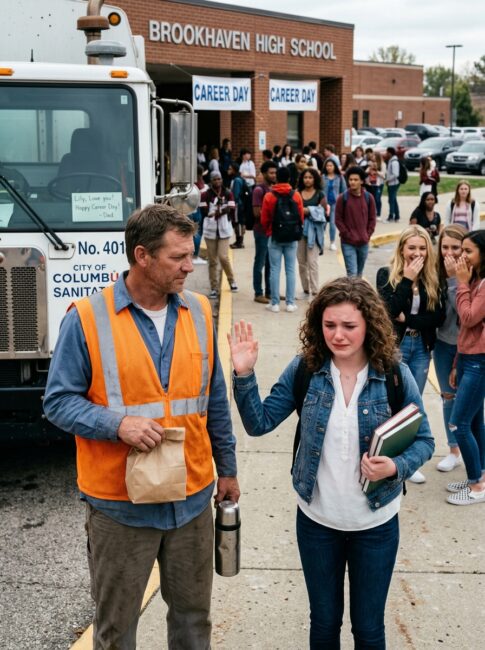
By the time they reached Brookhaven High, Lily’s shoes were wet and her hands smelled like metal and rain. Students were arriving under umbrellas. Madison stood near the front entrance with two girls from lunch.
She saw Lily climb down from the sanitation truck.
Her eyes widened.
Frank noticed and slowed.
“You can go in from the side door,” he said softly.
That sentence struck harder than any insult Madison had ever made.
He was still trying to protect her from him.
Lily took the silver star pin from her backpack and clipped it to her hoodie.
Then she walked around the truck, took her father’s rough hand in front of the whole entrance, and said, “Can you come inside with me?”
Frank looked at the school doors.
Then at the students watching.
Then at his daughter.
“Are you sure?”
Lily swallowed.
“No,” she said. “But I should have been a long time ago.”
Madison said nothing.
Neither did anyone else.
Inside, the principal was standing near the main office, reviewing morning announcements. Lily walked up to him before fear could change her mind.
“Mr. Dawson,” she said, “my father should have spoken on Career Day.”
The principal looked at Frank’s vest, then at Lily’s face.
Frank began to shake his head.
“It’s all right.”
But Lily squeezed his hand.
“No, Dad. It isn’t.”
By noon, the school auditorium was full again.
Not for a scheduled event.
For an announcement.
Frank stood at the edge of the stage, clearly wishing he were anywhere else. His hair was damp from rain. His hands were folded in front of him. The orange vest looked brighter under the lights than any blazer had looked the week before.
Lily stepped to the microphone.
“My father collects trash,” she said.
A few students shifted.
Lily continued.
“He also collects lost rings, lost hearing aids, lost homework, old backpacks, cold people, hungry families, and things other people throw away too quickly.”
Frank looked down.
She held up the tiny silver star pin.
“This was my mother’s. I was ashamed to wear it because I thought people would laugh at where my father worked.”
Her voice cracked.
“But every morning, before most of us wake up, he protects more dignity on one street than I knew how to protect in one hallway.”
The auditorium was silent.
Then Mr. Bell, the elementary school custodian, stood from the back row. Nobody had seen him come in.
He raised one hand.
“Frank Morgan brought my grandson a backpack when I couldn’t afford one,” he said.
Mrs. Alvarez stood next, leaning on her cane.
“He brings my bins back to the house so I don’t fall.”
Mr. Henderson stood near the aisle.
“He fed my family when I was too proud to ask.”
One by one, people rose.
Not with applause at first.
With witness.
Frank covered his mouth with one hand.
The whole school finally saw what Lily had only seen through a window.
Her father had never been small.
They had simply been looking from too far away.
After that day, things did not become perfect.
Madison did not suddenly become Lily’s best friend again, and Lily did not want her to. Some apologies arrive late, and some friendships reveal what they were built from.
But Madison did stop her near the lockers.
Her voice was quiet.
“I’m sorry about what I said.”
Lily looked at her for a long moment.
Then she nodded.
“Don’t say it about anyone else.”
Madison’s eyes fell.
“I won’t.”
It was not dramatic forgiveness. It was better than that.
It was a boundary with a door left open.
The following Saturday, Lily rode the morning route again.
Frank did not ask why. He only handed her gloves and placed the dented thermos between them. The truck smelled like coffee, rain, old paper, and the faint sweetness of the orange peels Mrs. Alvarez always tied in a separate bag.
At 5:30, they stopped by the Carters’ house.
The stuffed rabbit was gone from the porch chair.
In its place was a small drawing taped to the door. It showed a girl in a hospital bed holding a rabbit, with a garbage truck outside the window and a man in an orange vest waving.
Underneath, in crooked purple marker, it said: Thank you, Mr. Frank.
Lily took a picture, but Frank gently lowered her phone.
“Some things don’t need to be posted,” he said.
She felt embarrassed for a second, then understood.
He had lived for years inside the quiet space between kindness and recognition. He did not hate being thanked. He simply did not need every act to become proof.
Later that morning, they stopped at a dumpster behind a bakery. The owner, a middle-aged Korean American woman named Mrs. Park, came outside with a box of warm day-old rolls.
“For your houses,” she said.
Frank accepted them with both hands.
Lily watched as he separated the rolls into smaller bags, already knowing which porch would receive which one.
At home, the silver star pin stayed on Lily’s backpack.
Not hidden inside a pocket.
Not saved for special days.
It hung where everyone could see it, scratched and bent, catching light when she walked through the school hallway.
The following spring, Brookhaven High held Career Day again.
This time Lily signed her father up herself.
Frank arrived in a clean work shirt, the same cracked boots, and the same hands that made him look like he had wrestled the world before breakfast. When he stepped into the auditorium, some students clapped before the principal introduced him.
Frank looked deeply uncomfortable.
Lily smiled from the front row.
He stood behind the microphone and unfolded a sheet of paper. Then he folded it again without reading.
“I pick up what people leave behind,” he said. “Most days, that means trash. Some days, it means something else.”
He paused and looked at Lily.
She nodded once.
His voice softened.
“So I try to look twice.”
That was all he said at first.
No grand speech.
No polished story.
Just a man who knew the weight of things people carried to the curb.
When the event ended, Lily walked out beside him in front of everyone. He reached for his keys, but she stopped him.
“Dad?”
He turned.
She held out the dented thermos he had forgotten on the stage.
“You left something behind.”
Frank took it, smiling.
“Wouldn’t be the first time.”
Lily slipped her arm through his.
The hallway was full of students, parents, teachers, and noise.
This time, she did not let go.
Follow the page for more emotional stories about dignity, quiet kindness, and the people we often misunderstand.