Part 2: The Girl Called the Biker a Villain — Eight Years Later, He Still Carried Her Drawing
My name is Claire Bennett.
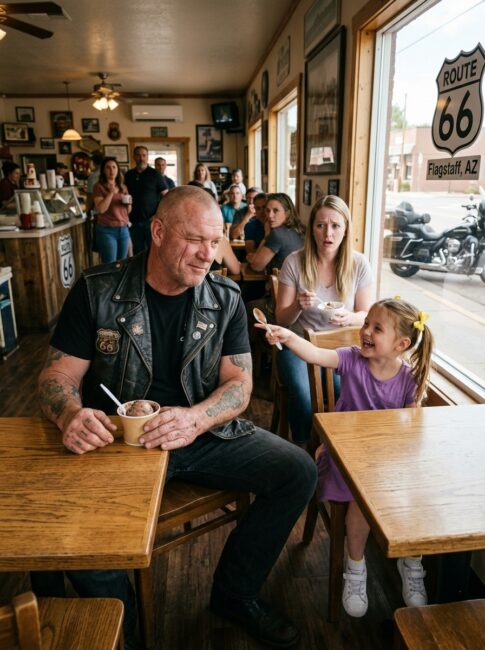
I have owned the Copper Cone Ice Cream Shop on Route 66 for almost eighteen years. The building is narrow, the freezer is older than some of my employees, and the neon sign above the window flickers whenever the weather turns cold.
That does not stop people from coming.
Tourists stop for photographs beneath the Route 66 sign.
Local families stop after soccer games.
Truck drivers stop because coffee from the diner next door tastes better with one scoop of vanilla melting inside the cup.
The biker returned every few weeks.
His real name was Vincent Marlowe.
Most people called him Graves.
The nickname came from the scar, the shaved head, and his habit of sitting quietly enough to make nervous people invent stories about him.
Some assumed he had earned the scar in a fight.
He had not.
A drunk driver had crossed the center line on a wet road outside Winslow eighteen years earlier. The impact threw Vincent from his motorcycle and dragged him across the pavement before the bike stopped moving.
He spent two weeks in a hospital.
The scar remained.
So did the assumptions.
Vincent rarely corrected strangers.
He was fifty-five when Emma met him. He worked as a diesel mechanic at a garage near Interstate 40 and rode with a local club called the Iron Kings.
The club name sounded more dramatic than the men themselves.
Most were mechanics, roofers, electricians, veterans, warehouse workers, and men whose knees hurt before rain arrived. They rode Harleys because they understood the machines and because the rhythm of a V-twin engine left less room inside the head for certain memories.
Vincent was not the club president.
He was not the loudest.
He did not make speeches.
He was simply the man other brothers called when something went wrong.
A bike stranded near Holbrook.
A roof leaking over a widow’s kitchen.
A veteran sleeping inside his truck after losing his apartment.
A young prospect too proud to admit he had relapsed.
Vincent arrived.
Usually without announcing himself.
He carried tools in one saddlebag and a small first-aid kit in the other. He drank black coffee. He tipped too much. He never asked for recognition.
I learned these details slowly.
Vincent did not volunteer information. Talking to him required patience and the willingness to let silence remain silent.
The first time he returned after Emma gave him the drawing, he ordered chocolate ice cream.
Two scoops.
Same table near the window.
I remembered the napkin.
“Still got your crown?” I asked.
Vincent looked toward me.
For one second, I worried I had pushed too far.
Then he opened his wallet.
The folded napkin sat behind his driver’s license inside a small clear sleeve. He had trimmed a piece of plastic from an old document protector to keep the paper from tearing.
“You laminated it?” I asked.
“Protected it.”
“That is almost the same thing.”
“No.”
I smiled.
Vincent closed the wallet.
“Important paperwork,” he said.
That became our joke.
Whenever he stopped for ice cream, I asked whether his important paperwork remained safe.
He always tapped the pocket near his hip.
“Still there.”
The detail did not fit the man strangers saw.
That was why it mattered.
Vincent’s brothers learned about the drawing months later when a younger rider named Marco tried to borrow cash at the diner next door. Vincent opened his wallet. The napkin slipped partly from the plastic sleeve.
Marco caught sight of the crooked crown.
“What is that?”
Vincent folded the wallet shut.
“Nothing.”
Marco leaned closer.
“That looked like a drawing.”
Vincent stared at him.
Marco smiled.
“Brother, is somebody giving you artwork now?”
Vincent placed a twenty-dollar bill on the table.
“Eat your breakfast.”
The men laughed.
Vincent did not.
But he also did not throw away the napkin.
He carried it.
Week after week.
Month after month.
The crown remained behind his license.
Nobody understood why a man like Vincent protected a child’s drawing more carefully than the registration papers for his motorcycle.
The answer began twenty-eight years earlier, before the scar, before the club, and before anybody called him Graves.
Back then, Vincent Marlowe had a daughter of his own.
Her name was Lily.
Lily was six years old when Vincent first left.
That was the way he described it.
Not when the marriage ended.
Not when the court signed the papers.
Not when he packed a duffel bag and moved into a one-bedroom apartment behind a tire shop.
When he first left.
The wording mattered.
Vincent had grown up with a father who solved problems by disappearing. Sometimes for a weekend. Sometimes for a month. Once for almost a year.
When Vincent became a father at twenty-seven, he promised himself he would be different.
For a while, he was.
He worked long shifts repairing trucks. He came home smelling like diesel fuel, hot metal, and sweat. He sat on the kitchen floor assembling plastic tea sets because Lily insisted every stuffed animal needed a cup.
He learned how to brush hair badly.
He attended a kindergarten play where Lily stood near the back dressed as a cloud and forgot every line.
He loved her.
That part was never in doubt.
But love does not automatically make a person reliable.
Vincent drank too much after work.
He grew quiet when he should have spoken.
He grew angry when he felt ashamed.
He never hit Lily.
He never hit his wife.
But anger does not need to become violence before children learn to listen for it.
They heard the cabinet doors.
They heard the boots.
They heard the long silences after arguments.
Vincent’s wife finally asked him to leave.
He agreed because part of him knew she was right and another part was relieved to escape the evidence of his own failure.
The first weekend after moving out, Vincent promised to pick Lily up on Saturday morning.
He overslept.
The second weekend, he arrived two hours late.
The third weekend, Lily refused to put on her shoes.
Vincent remembered kneeling near the apartment door while his daughter stood behind her mother.
“Come on, bug,” he said. “We can get pancakes.”
Lily held the hem of her mother’s shirt.
“No.”
Vincent forced a smile.
“You mad at me?”
Lily looked toward the floor.
Then she said something he carried longer than any scar.
“You look like you leave.”
Children do not always use the correct words.
Sometimes they use better ones.
Vincent did look like he left.
He looked tired.
He looked unreliable.
He looked like a man asking a child to trust a promise he had already broken several times.
Vincent did not argue.
He returned to his truck.
He drove until the city disappeared behind him.
That should have frightened him into changing immediately.
It did not.
Real change is rarely that clean.
He drank harder for another year.
Lost jobs.
Missed birthdays.
Stopped answering calls because every call reminded him of the person he had become.
When Lily turned eight, Vincent entered treatment after waking inside his truck behind a gas station with no memory of the previous night.
He stayed sober.
One day.
Then another.
Then a week.
Then a year.
By then, too much damage had settled between him and Lily.
Her mother moved to Nevada.
Lily grew older.
Vincent sent birthday cards and rarely received replies.
He paid child support even during months when the payment left almost nothing behind.
He did not demand forgiveness.
He had learned that an apology is not a key. It does not automatically unlock the door from the outside.
He kept riding.
He repaired trucks.
He joined the Iron Kings after one of their older members found him changing a tire beside Interstate 40 during a winter storm.
The club gave him structure.
Breakfast on Saturdays.
A garage full of tools.
Men who understood that sobriety sometimes required somebody answering the phone at 2:00 a.m. without making a speech about it.
Years passed.
Lily became an adult.
Vincent saw photographs online.
College graduation.
A wedding.
A baby girl wearing a yellow dress.
He did not attend.
Not because he did not care.
Because Lily had not invited him.
Vincent respected the boundary.
Then Emma called him a villain inside my ice cream shop.
The word landed harder than anybody realized.
Vincent looked toward that six-year-old girl and saw the age Lily had been when he started becoming somebody she could not trust.
He winked because Emma was embarrassed.
He offered ice cream because children should not carry an adult’s discomfort.
He expected the moment to end there.
Then Emma returned with the napkin.
She handed Vincent a new version of himself.
Not villain.
King.
He did not believe the title.
But he wanted to become the kind of man who could carry it without lying.
The napkin stayed inside Vincent’s wallet for eight years.
During those years, Emma grew from a six-year-old with uneven pigtails into a fourteen-year-old who still came into the Copper Cone after school with friends.
She did not recognize Vincent immediately the first few times.
Children change quickly.
Adults with scars do not.
Eventually, her mother reminded her.
“That is the ice cream villain,” she said softly one afternoon.
Emma turned toward the window table.
Vincent sat beneath the Route 66 poster eating chocolate ice cream.
Emma smiled.
“The king.”
Vincent heard her.
He looked toward the cup.
The corner of his mouth shifted slightly.
Emma walked over.
“Do you still have my drawing?”
Vincent placed his spoon down.
He opened the wallet and removed the plastic sleeve.
The napkin had faded.
The blue lines looked softer.
The crown remained visible.
Emma stared.
“You kept it?”
Vincent nodded.
“For how long?”
“Since you gave it to me.”
Emma looked surprised.
“It was just a drawing.”
Vincent folded the plastic sleeve carefully.
“Not to me.”
Emma did not ask why.
That restraint made the moment gentler.
She returned to her friends.
Vincent finished his ice cream.
But the biggest change happened away from my shop.
The Iron Kings had always participated in occasional charity rides, mostly for veterans, injured workers, and families dealing with hospital bills. Vincent attended, donated money, and avoided microphones.
Then a brother named Russell asked him to help with a Saturday event at a family resource center outside Flagstaff.
The center needed volunteers to repair bicycles, assemble shelves, repaint a playroom, and sort donated school supplies.
Vincent agreed because tools made sense to him.
Children did not.
He arrived early.
He carried paint cans inside.
He repaired three bicycles.
He avoided the playroom.
Then a girl around seven approached him carrying a broken wooden chair from a dollhouse.
“Can you fix this?”
Vincent looked at the tiny chair.
One leg had snapped loose.
He could have handed it back.
He could have told her to find another volunteer.
Instead, he sat on the floor beside a folding table, opened a toolbox, and repaired the chair with wood glue and a small clamp.
The girl watched.
“You look scary,” she said.
Vincent kept working.
“Been told.”
“Are you mean?”
“Sometimes.”
The girl considered that.
“To kids?”
Vincent shook his head.
“No.”
She nodded as though confirming a private theory.
When the glue dried, Vincent handed back the chair.
The girl smiled.
“Thanks.”
Something about the moment traveled through the room.
By the following month, more Iron Kings joined the resource-center visits.
One brother repaired donated bicycles.
Another installed shelves.
Marco, the same rider who had laughed at the wallet drawing, spent an afternoon assembling a plastic kitchen set while a four-year-old supervised every screw.
The men joked with one another.
They did not joke about the children.
Vincent made that boundary clear without stating it.
The brotherhood test was not whether they could arrive together with engines rumbling across the parking lot.
Any club could do that.
The test was whether they could lower their voices near frightened children.
Whether they could sit on a playroom floor.
Whether they could repair tiny wooden furniture without needing applause.
Whether they could become useful in ways that did not involve strength, intimidation, or noise.
Most of them passed.
Some took longer.
Vincent returned every month.
He never explained why.
Then, during the eighth year, Lily called.
Vincent was fifty-eight by then.
Emma was fourteen.
The napkin drawing had survived several wallets, two motorcycles, and one rainstorm that soaked everything inside Vincent’s jacket except the plastic sleeve.
Lily’s name appeared on his phone on a Tuesday evening.
Vincent stared at the screen until the call almost ended.
Then he answered.
“Hello?”
A woman’s voice replied.
“Dad?”
Vincent stopped breathing.
He had imagined the moment many times.
In some versions, he apologized perfectly.
In others, Lily shouted.
Sometimes she hung up.
Reality was quieter.
Vincent sat inside his garage with one hand resting on the Harley’s seat and listened while his daughter explained that her own daughter wanted to know about him.
His granddaughter was six.
The same age Lily had been.
The same age Emma had been.
Lily did not offer forgiveness.
Not yet.
She offered coffee.
One hour.
Public place.
No promises.
Vincent accepted.
Then he opened his wallet.
He removed the napkin drawing.
He looked at the crooked crown for a long time.
The club discovered the full story several months later.
It happened during a Saturday breakfast at a diner near Route 66.
The Iron Kings occupied two booths near the window. Their leather cuts hung across the backs of the seats. The room smelled like bacon, burnt coffee, and rain carried inside on wet boots.
Vincent sat near the end of the table.
Marco asked to borrow cash because the card reader at the gas station had failed again.
Vincent opened his wallet.
The plastic sleeve slipped onto the table.
This time, Marco picked it up before Vincent could stop him.
He unfolded the sleeve.
The napkin drawing rested inside.
The bald man.
The scar.
The square vest.
The crooked crown.
Marco stared at it.
Then he looked toward Vincent.
“Brother.”
Vincent reached for the sleeve.
Marco held it out of reach for one second, not mockingly this time.
“What is this?”
Vincent took the drawing back.
“Important paperwork.”
Several men smiled because they had heard the joke.
Marco did not.
“Eight years,” he said. “You have carried that thing for eight years. What is it?”
Vincent folded the sleeve carefully.
The diner became quieter.
Rain ticked against the glass.
A waitress poured coffee at the next table.
Vincent looked toward his hands.
He did not enjoy explaining himself.
Words made private things feel exposed.
But the men around him had spent years answering calls at bad hours. They had sat beside him through anniversaries he never named. They had helped load bicycles and paint playrooms without asking why Vincent cared so much.
They deserved something.
“A kid drew it,” Vincent said.
Marco nodded.
“We figured that much out.”
“She called me a villain.”
Russell looked toward the scar.
“Kids say things.”
Vincent nodded.
“She fixed the drawing. Put a crown on it.”
He stopped.
His thumb moved across the edge of the plastic sleeve.
The men waited.
Vincent swallowed.
“My daughter was six when I started leaving.”
Nobody interrupted.
Vincent told them about Lily.
Not everything.
Enough.
The missed weekends.
The drinking.
The cards sent without replies.
The photographs watched from a distance.
The phone call.
The coffee meeting.
The granddaughter he had met twice and still did not know how to speak around without feeling as if every movement might break something fragile.
Marco looked toward the napkin.
“What did the drawing change?”
Vincent thought for a moment.
“Nothing.”
That answer surprised everybody.
Vincent continued.
“Not by itself.”
He looked toward the rainy window.
“Kid drew me better than I was. So I figured maybe I ought to catch up.”
Nobody spoke.
That was Vincent’s way.
No speech.
No request for sympathy.
No attempt to turn regret into a performance.
He did not pretend a napkin drawing repaired his relationship with Lily.
It did not.
He did not pretend eight years of volunteering erased the years he failed his daughter.
They did not.
The drawing had simply given him a direction.
A crooked crown drawn by a six-year-old girl became a quiet question Vincent carried inside his wallet.
Are you becoming somebody safer than you were yesterday?
Some mornings, the answer was yes.
Some mornings, not enough.
He kept trying.
The waitress reached their booth with the coffee pot.
She looked toward the napkin inside Vincent’s hand.
“That from your granddaughter?”
Vincent shook his head.
“Different kid.”
The waitress smiled.
“Must be important.”
Vincent placed the sleeve back inside his wallet.
“Most important thing I got.”
That line became club legend.
Not publicly.
The Iron Kings did not post it online.
They did not turn Vincent’s regret into a caption beneath a motorcycle photograph.
They simply remembered.
The next month, Marco arrived at the resource center with art supplies.
Paint.
Markers.
Colored pencils.
Construction paper.
He placed everything inside a box near the playroom door.
Vincent looked inside.
“What is this?”
Marco shrugged.
“Important paperwork.”
Vincent stared at him.
Then he laughed.
It was not loud.
But it was real.
Emma came back into the shop on the eighth anniversary of the drawing.
She was fourteen.
Tall now.
Hair pulled into a loose ponytail instead of uneven pigtails. Phone in one hand. Backpack hanging from one shoulder.
Her mother followed several steps behind carrying a grocery bag.
Vincent sat near the window.
Chocolate ice cream.
Two scoops.
Same table.
Emma noticed him immediately.
She walked over.
“You still carry it?”
Vincent opened his wallet.
The napkin sleeve appeared.
Emma looked toward the faded lines.
“My drawing got old.”
“So did I.”
Emma laughed.
She studied the paper.
“I drew the crown too big.”
“Looks fine.”
“You look nothing like a king.”
“Been told.”
Emma smiled.
Then she noticed a photograph tucked behind the plastic sleeve.
The image showed Vincent standing outside a diner beside a woman in her early thirties and a six-year-old girl wearing a denim jacket.
The child held Vincent’s hand cautiously.
Not tightly.
Not yet.
Emma looked toward him.
“Your family?”
Vincent nodded.
“Daughter. Granddaughter.”
Emma glanced toward the drawing again.
“You showed them?”
Vincent looked toward the melting ice cream.
“Eventually.”
“What did they say?”
“My granddaughter wants a crown too.”
Emma smiled.
Vincent removed a folded paper from his jacket pocket and placed it on the table.
His granddaughter had drawn three people.
A tall woman.
A small girl.
A large bald man with a scar.
The man wore a crown.
Emma stared at the picture.
“She copied me.”
“Probably.”
Emma considered the second crown.
Then she looked toward Vincent.
“Maybe villains can become kings.”
Vincent shook his head gently.
“Not how it works, kid.”
Emma waited.
Vincent folded the new drawing carefully.
“Kings got to show up every day.”
The sentence stayed with me.
Vincent did not speak in polished lines often.
When he did, they usually came from somewhere expensive.
His ritual continued.
Saturday breakfast.
Chocolate ice cream.
Resource-center visits.
Coffee with Lily once a month.
Then twice.
A phone call with his granddaughter on Wednesday evenings.
No dramatic reunion.
No instant forgiveness.
Just time.
The slow kind.
The kind that cannot be posted as a single photograph.
Vincent’s Road King still rolled past my window with a low mechanical rumble before he parked near the curb. His boots still left small traces of road dust across the floor. His leather cut still creaked when he lowered himself into the chair.
Strangers still looked at the scar.
Some still moved away.
Vincent rarely noticed anymore.
Inside the wallet, the first crown stayed protected behind plastic.
Inside his jacket, the second crown traveled with him too.
Vincent is sixty-three now.
The scar has not changed.
The tattoos have faded further beneath the Arizona sun.
The leather cut looks softer around the edges where years of rain, heat, diner booths, and highway dust have worn the surface down.
He still stops at the Copper Cone.
Chocolate.
Two scoops.
Window table.
Emma is nineteen.
She studies graphic design at a community college outside Flagstaff and works weekends at a bookstore near the old Route 66 strip.
Last winter, she visited the shop during semester break.
Vincent happened to be there with his granddaughter.
The girl was eleven now.
She sat across from him eating mint-chocolate-chip ice cream and drawing in a spiral notebook while Vincent watched with the careful patience of a man who no longer takes ordinary moments for granted.
Emma recognized him.
Vincent recognized her.
For a moment, neither spoke.
Then Vincent introduced them.
“This is Emma.”
His granddaughter looked up.
“The crown girl?”
Emma laughed.
“That is me.”
Vincent opened his wallet and removed the plastic sleeve.
The napkin had become fragile.
The strawberry stains had faded into pale shadows.
The blue ink remained visible.
Bald head.
Scar.
Black vest.
Crown.
Emma held the sleeve carefully between two fingers.
“You really kept it all this time.”
Vincent nodded.
“Important paperwork.”
His granddaughter rolled her eyes with the confidence of a child who had heard the phrase too many times.
Then she turned the notebook around.
She had drawn Vincent again.
This time, the crown sat slightly crooked.
One hand held an ice cream cone.
The other held the hand of a smaller figure.
Emma looked toward the drawing.
Then toward Vincent.
“Looks accurate.”
Vincent studied the page.
His jaw tightened slightly near the scar.
He nodded.
Outside, evening settled over Route 66.
The neon sign flickered above the window.
A Harley waited beneath it, dark and quiet, gathering a thin layer of cold desert dust.
When Vincent finished his ice cream, he folded the new drawing carefully and placed it inside his jacket.
The old napkin returned to the wallet.
Closest to him.
Still protected.
Still important.
The engine turned over outside.
Its low rumble rolled between the storefronts and faded toward the highway.
The villain carried both crowns home.
Follow the page for more stories about the people behind the leather cuts.