Part 2: The Grandmother Who Slapped Her Granddaughter at the Wedding — Until the Real Reason Left the Family Frozen
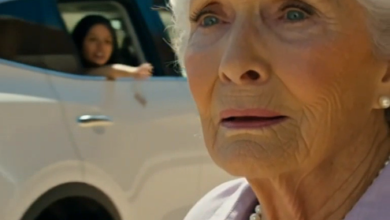
Evelyn Harper had not wanted to attend the wedding.
Not because she disliked Natalie.
Natalie was the child she had helped raise after her daughter-in-law died. She was the little girl who used to sleep on Evelyn’s sofa during thunderstorms, one hand wrapped around the old woman’s nightgown. She was the girl who called every Sunday through college, even when the calls lasted only four minutes.
No, Evelyn wanted to stay home because the invitation had come with a name that made her hands go numb.
Andrew Whitman.
The Whitmans were not strangers.
Not to Evelyn.
Not to the town.
Not to the old courthouse records nobody read anymore.
Forty-two years earlier, Evelyn’s eldest daughter, Clara, had been engaged to a young man named Thomas Whitman. He was charming, handsome, and adored by families who mistook polished manners for goodness. Clara was nineteen, soft-spoken, and in love with piano music, library books, and a string of pearls Evelyn had saved three years to buy.
Those pearls were not expensive by rich people’s standards.
But Evelyn had cleaned offices at night to pay for them.
She gave them to Clara on the morning of her engagement party.
“Something of your own,” Evelyn had said.
Clara wore them in every photograph that summer.
Then Clara disappeared.
Not entirely.
Worse.
She came home one September night without the pearls, without her engagement ring, and without the light in her eyes.
She said Thomas had changed his mind.
She said not to ask questions.
She begged Evelyn not to go to the Whitmans.
Two weeks later, Thomas left town.
His family told everyone Clara had embarrassed herself by becoming clingy. They implied she had imagined a stronger promise than he made. Clara never corrected them. She shrank under the gossip, married no one, and spent the rest of her life working quietly at the public library.
She died at forty-three from a sudden aneurysm.
Before she died, she gave Evelyn a sealed envelope and made her promise something strange.
“Do not open this unless those pearls come back into our family wearing a lie.”
Evelyn did not understand then.
For years, she kept the envelope in the bottom drawer of her cedar chest.
Then, three months before Natalie’s wedding, Andrew’s mother, Patricia Whitman, came to the bridal shower wearing Clara’s pearls.
Evelyn recognized them before she recognized the woman.
Pearls are not fingerprints, people might say.
But Evelyn knew the small flaw near the clasp. She knew the way one pearl sat slightly smaller than the others. She knew the tiny gold repair made by a jeweler named Mr. Bell after Clara dropped them in the kitchen sink.
Evelyn stared across the room as Patricia laughed with the bridesmaids, touching the necklace like a trophy.
“Beautiful pearls,” someone said.
Patricia smiled. “Family heirloom.”
Evelyn nearly dropped her teacup.
That was the first crack.
The second came when Natalie later showed Evelyn the pearl comb she planned to wear at the wedding.
“Andrew’s mother gave it to me,” Natalie said. “She said it belonged to the Whitman women.”
Evelyn looked at the comb.
Three pearls from Clara’s necklace had been removed and set into silver.
Her breath caught.
“Do not wear this,” she said.
Natalie laughed softly, thinking her grandmother was sentimental.
“Grandma, it matches the dress.”
“Promise me.”
Natalie’s smile faded.
“Why?”
Evelyn wanted to tell her.
But the words were buried under Clara’s old fear, under forty-two years of silence, under a promise not yet broken in the way Clara had named.
So Evelyn only touched Natalie’s hand and said, “Some beautiful things come from ugly places.”
Natalie thought it was grief talking.
She promised not to wear the comb.
But on the wedding day, when Evelyn saw Natalie walk into the chapel, the pearl comb shone beneath her veil.
The old woman gripped her cane until her knuckles hurt.
Still, she said nothing during the ceremony.
She watched Natalie smile at Andrew. She watched Patricia dab her eyes with a lace handkerchief. She watched Michael, Natalie’s father, beam with relief that his daughter was marrying into a family with money, reputation, and a lakeside home.
At the reception, the final piece arrived.
Patricia rose before the scheduled toast and asked the band for attention.
She held a champagne glass and smiled toward Natalie.
“In our family,” Patricia said, “pearls are passed to women who know how to honor tradition.”
Evelyn felt the room tilt.
Patricia continued.
“These pearls belonged to Andrew’s grandmother, and now pieces of them are with Natalie, where they belong.”
That was the lie.
Clear.
Public.
Wearing flowers and candlelight.
Evelyn looked at Natalie’s face, bright with trust. She looked at the comb in her granddaughter’s hair. She looked at Patricia, who had taken Clara’s memory and dressed it as heritage.
Then Evelyn opened her purse.
Inside was Clara’s sealed envelope.
And a photograph.
Clara at nineteen, wearing the same pearls.
Evelyn stood before her body could talk her out of it.
By the time she reached Natalie, the old anger had mixed with something more painful.
Fear.
Not fear that Natalie would marry Andrew.
Fear that she would enter a family built on a lie and never know the cost of what touched her hair.
The slap came before the words.
Evelyn hated herself for it even as her hand fell.
But she knew one thing about a room full of people watching a perfect wedding.
A whisper could be dismissed.
A warning could be managed.
A slap could not be ignored.
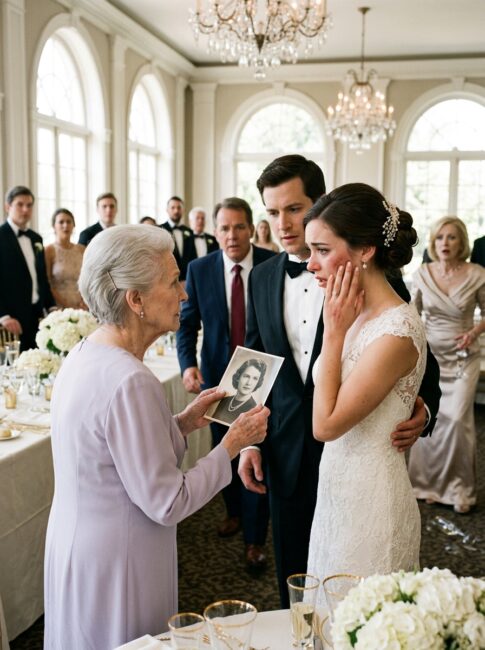
The reception hall remained frozen around the broken champagne glass.
Patricia Whitman stood beside the head table, her face drained of color. Andrew looked from his mother to Evelyn, confused and angry in equal measure.
“What is she talking about?” he asked.
Patricia opened her mouth, but no answer came.
Natalie still held one hand against her cheek. Her eyes were wet now, not from pain, but from the collapse of trust happening too quickly to name.
“Grandma,” she whispered, “why did you hit me?”
Evelyn’s face broke.
“I am sorry, baby,” she said. “I needed everyone to stop pretending long enough to listen.”
Michael grabbed his mother’s arm.
“You do not get to do that to my daughter.”
Evelyn looked up at him.
“No,” she said. “I do not.”
The honesty of it confused him.
She did not defend the slap. She did not dress it as courage. She simply accepted the ugliness of what she had done and placed the folded photograph in Natalie’s trembling hand.
Natalie looked down.
The picture showed a young woman on a porch in 1981, wearing a pale yellow dress, holding a bouquet of daisies.
Around her neck was the same pearl necklace Patricia had called an heirloom.
Natalie’s voice thinned.
“Who is she?”
Evelyn closed her eyes.
“Your Aunt Clara.”
A murmur moved through the Harper side of the room.
Clara was a name they knew, but not a story they had been told completely. Michael had been six when she died. To him, she was a quiet aunt who shelved books, brought birthday cards, and never came to family reunions unless Evelyn drove her.
Evelyn reached into her purse again and pulled out the sealed envelope.
Clara’s handwriting covered the front.
Mama, if the pearls return wearing a lie.
Natalie looked at the handwriting.
“So open it,” she said.
Evelyn’s fingers trembled too badly.
Michael took the envelope.
For a moment, anger and fear struggled across his face. Then he opened it carefully, as if the paper itself might bruise.
Inside was a letter and a small receipt from Bell & Sons Jewelers.
Michael read silently at first.
His jaw tightened.
Then he looked at Patricia.
“You knew her.”
Patricia whispered, “I was young.”
Andrew stiffened.
“Mom?”
Michael began reading aloud.
Not everything.
Just enough.
Dear Mama,
If you are reading this, it means the pearls came back in a place I was afraid they would. I am sorry I never told you the whole truth. Thomas did not simply leave me. He borrowed money from me, then took the pearls when I asked for it back. He said no one would believe a library girl over a Whitman son.
The room seemed to shrink.
Patricia sat down as if her knees had failed.
Michael’s voice broke but continued.
His sister Patricia was there that night. She told me to be quiet because families like theirs survive by keeping girls like me ashamed. I believed her.
Andrew turned slowly toward his mother.
“You were there?”
Patricia’s lips trembled.
“I did not steal them.”
“No,” Evelyn said. “You kept them.”
That sentence moved through the room like cold air.
Patricia began to cry, but not loudly.
“I was sixteen,” she said. “Thomas brought them home. He said Clara gave them back. I knew that was not true.”
“Then why keep them?” Natalie asked.
Patricia looked at the bride, and for the first time her elegance seemed less like grace and more like armor.
“Because my mother told me a Whitman never returns something after an accusation,” she said. “She said returning them would make the story real.”
Evelyn laughed once, bitter and tired.
“It was real before you admitted it.”
The fifth twist came from Andrew.
He reached for the pearl comb in Natalie’s hair.
Gently.
Not to claim it.
To remove it.
Natalie flinched, and he stopped immediately.
“May I?” he asked.
She studied his face, searching for the man beneath the family name.
Then she nodded.
Andrew removed the comb and placed it on the table between both families.
“I did not know,” he said.
Evelyn looked at him.
“I believe you.”
Patricia covered her face.
Andrew turned to his mother.
“But you did.”
The silence that followed belonged to every dinner where reputation had been served instead of truth.
Patricia stood unsteadily.
“I thought if Natalie wore them, maybe it would make them clean.”
Natalie stared at her.
“Clean for who?”
Patricia did not answer.
Evelyn picked up Clara’s letter and read the last paragraph herself.
Mama, if Natalie or any girl after me ever wears them, do not let her think silence is kindness. I stayed quiet because I was afraid of being called bitter. I was afraid of ruining rooms. I did not know that some rooms deserve to be ruined before another girl is decorated with what hurt you.
Evelyn lowered the paper.
Tears ran freely down her face now.
“I failed Clara,” she said. “I thought respecting her silence was love. Then I saw those pearls in your hair.”
Natalie touched her cheek where the slap had landed.
The mark was fading.
The meaning was not.
“I wish you had told me another way,” she said.
Evelyn nodded.
“So do I.”
That was the redemption nobody expected.
Evelyn was not forgiven because the slap was right.
She was heard because the pain behind it had been ignored too long.
Andrew stepped beside Natalie.
“I will understand if you need to stop the reception.”
The room waited.
Natalie looked at the pearl comb.
Then at Patricia.
Then at Evelyn.
“I do not want to stop my marriage,” she said quietly. “But I am stopping the lie.”
She removed her veil completely.
Without the comb, it slid loose into her hands.
Then she walked to the microphone.
Her voice shook, but it carried.
“These pearls belonged to my Aunt Clara Harper. They were taken from her. Tonight, they are not a Whitman tradition anymore.”
She turned to Evelyn.
“Grandma, I cannot pretend what you did did not hurt.”
Evelyn nodded, crying.
“But I also cannot pretend what they did did not hurt more.”
Natalie placed the comb in Evelyn’s hands.
“Take them home.”
Evelyn looked at the pearls as if they were bones.
Then she held them against Clara’s photograph.
For the first time in forty-two years, Clara’s name stood in a room full of witnesses, not as gossip, not as shame, but as truth.
Nobody clapped.
It was better that way.
Some moments ask for applause.
Others ask people to sit still with what they helped inherit.
The reception continued, but the shape of it changed.
The band played softly. The food was served. People spoke in lower voices, not because they were bored, but because the room had become too honest for easy laughter.
Patricia left before dessert.
Andrew did not stop her.
He stood beside Natalie near the garden doors, both of them watching Evelyn sit alone at a small table with Clara’s photograph and the pearl comb in front of her.
“I am sorry,” Andrew said.
Natalie looked at him.
“You did not do it.”
“No,” he said. “But I benefited from a family that taught me not to ask where beautiful things came from.”
Natalie slipped her hand into his.
That answer did not fix everything.
It only made space for the work ahead.
Across the hall, Michael sat beside Evelyn.
For most of his life, he had thought of his mother as stern, old-fashioned, and too loyal to the dead. Now he saw her as a woman who had spent decades carrying a daughter’s unfinished sentence.
“You should have told me,” he said.
Evelyn nodded.
“I know.”
“I could have helped.”
“You were a boy when it happened.”
“I am not a boy now.”
She looked at him then, really looked.
The grief in her face softened into something like relief.
“No,” she whispered. “You are not.”
Later, Natalie came to sit with them.
For a moment, grandmother and granddaughter faced each other with the slap still between them.
Evelyn reached out, then stopped herself.
Natalie noticed.
Slowly, she took the old woman’s hand and placed it against her cheek.
Not where the slap had landed.
The other side.
Evelyn began to cry again.
“I wanted to protect you from wearing pain as decoration,” she said.
Natalie leaned her forehead against Evelyn’s.
“Next time, use words first.”
A broken little laugh escaped Evelyn.
“I will try.”
Near the end of the night, Andrew returned with a small velvet pouch. He had asked a waiter for it after removing the pearls from the comb setting. Three loose pearls rolled into Evelyn’s palm, dull and luminous beneath the reception lights.
“We will send the rest back too,” he said. “The necklace is at my parents’ house. I will get it.”
Evelyn closed her fingers around them.
“No,” she said softly.
Andrew looked uncertain.
Evelyn opened her hand again and studied the pearls.
“For years, I thought returning them would bring Clara back. It will not.”
Natalie sat still.
“So what do you want to do?”
Evelyn looked toward the memory table near the entrance, where photographs of loved ones had been arranged with candles. Clara’s picture had not been included because no one knew how close she was to the story of the day.
Now Natalie stood, took Clara’s photograph, and placed it in the center.
Evelyn followed with the pearls.
She set them beneath the frame.
Not around anyone’s neck.
Not in anyone’s hair.
Just there.
Small.
Unclaimed.
At last.
The photographer, who had kept his distance after the scene, captured one quiet image near the end of the reception.
Natalie in her wedding dress, veil folded over one arm, holding Evelyn’s hand beside Clara’s photograph. On the table between them lay three loose pearls and a letter yellowed by time.
It was not the picture Natalie had imagined when she planned her wedding.
It became the one she kept.
Months later, after the necklace was recovered, Natalie had the pearls reset into a simple bracelet. On the inside of the clasp, she engraved Clara’s initials.
Not hidden.
Not loud.
Just present.
At family gatherings, when someone asked about it, Natalie told the truth carefully. Not to embarrass Andrew. Not to punish Patricia. Not to reopen old wounds for entertainment.
She told it because silence had already taken enough.
Evelyn lived two more years.
On her last Christmas, Natalie placed the bracelet in her grandmother’s palm.
Evelyn touched the initials with one finger.
“She would have liked you,” she whispered.
Natalie smiled through tears.
“I think I would have liked her too.”
Evelyn looked toward the window, where winter light rested gently on the sill.
“She deserved a room that believed her.”
Natalie held her hand.
“She has one now.”
After Evelyn passed, Natalie kept Clara’s photograph in her own home, near the hallway mirror where she put on earrings before dinner, church, or ordinary errands.
Sometimes, before leaving, she would touch the bracelet lightly.
Not because pearls made her beautiful.
Because now she knew whose truth she was carrying.
Follow this page for more emotional stories about buried truths, quiet courage, and the moments that change how families remember.