Part 2: The Homeless Old Man Was Laughed at Inside a Diner Because He Couldn’t Pay for Coffee, Until a Tattooed Biker Put His Helmet on the Table and Silenced the Whole Room
Walter Finch had not always been invisible.
There were photographs once.
Real photographs.
Not the kind taken by strangers through phone screens, but pictures kept in frames and wallets: Walter in uniform at nineteen, Walter holding a fishing pole beside his younger brother, Walter standing in front of a yellow house with his wife, Marianne, both of them squinting into sunlight as if the future were too bright to look at directly.
He served in Vietnam.
Came home quiet.
Worked thirty-one years at a sheet metal plant outside Tulsa.
Paid taxes.
Fixed his own porch.
Loved one woman.
Buried her after a stroke took her speech first and her body later.
Then the plant closed.
Then the house needed repairs.
Then medical bills stacked themselves on the kitchen table like they had learned to breed in the dark.
Walter did not become homeless all at once.
Most people don’t.
He missed one payment.
Then another.
Moved from the house into a rented room.
From the rented room into a cheaper motel.
From the motel into his truck.
Then the truck broke down, and a man who had once owned tools for every problem stood in a parking lot holding a plastic grocery bag full of clothes and realized the world could take your address faster than it took your name.
After that, people stopped seeing him clearly.
They saw the coat.
The beard.
The cart.
The slow walk.
The careful way he counted coins before entering a place where the menu prices had left him behind.
But Walter still had rules.
Wash your hands before eating.
Say ma’am and sir.
Fold blankets before leaving a shelter cot.
Do not ask twice if someone says no.
And never, ever pretend hunger is someone else’s fault just because it is easier than admitting you need help.
That morning, he wanted coffee because his hands hurt from cold and because coffee, real diner coffee in a heavy mug, made him remember breakfast with Marianne. She used to say he ruined coffee by drinking it black. He used to say sugar was for people who did not trust beans.
It was their joke.
Not a good joke.
But marriage is full of small jokes that become holy after death.
The first seed was Walter’s Army cap.
It was folded under his arm, not worn, because the seam was coming loose and he did not want rain to ruin it further.
The second seed was the dented silver lighter in his coat pocket, engraved with three initials: A.R.M.
The third seed was the dog tag tied to Gravel’s Harley mirror.
Gravel had carried that dog tag for almost four decades, not because it was his, but because it belonged to the man who carried him through fire when he was twenty-three and too scared to admit he wanted to live.
He had never found that man.
Not until Betty’s Star Diner.
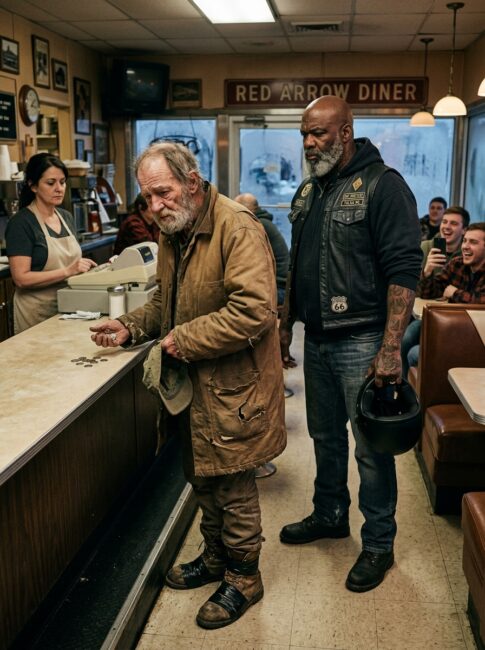
Not until an old homeless veteran stood beside the counter with seventy-three cents in his palm.
Gravel had not planned to stop at Betty’s that morning.
He was supposed to ride straight to Oklahoma City for a veterans’ benefit run, meet his club at 8:00, drink bad church coffee, shake too many hands, and pretend his knees did not hurt when he got off the Harley.
But cold rain started before sunrise, and the Road King began sputtering near Tulsa, so he pulled into Betty’s lot to warm up and check the plugs.
That was when he saw Walter through the window.
At first, it was just a scene.
Old man at counter.
Coins in hand.
Cashier tired.
Young men in booth laughing.
Gravel had seen scenes like that before.
Everyone has.
The question is never whether we see them.
The question is how quickly we explain them away.
Gravel almost did.
He was tired. Wet. Late. The diner was not his business. The old man might not want help. The boys might stop if ignored. The waitress might handle it. Someone else might step in.
Then one of the young men lifted his phone.
That changed the shape of the room.
Humiliation is one thing when it passes through air.
It becomes another when someone tries to preserve it.
Gravel stepped inside.
The bell over the door rang once, bright and small against the thick quiet that followed him. People looked up because men like Gravel make rooms adjust. He was large without trying. His beard was gray, his arms tattooed, his vest dark from rain, and his boots heavy enough that every step announced itself on the diner tile.
The young men stopped laughing.
Not because they were sorry.
Because the target changed.
Gravel walked past them without looking long enough to feed their fear.
He went to Walter.
The old man had already turned toward the door, clutching his folded cap under one arm like leaving with dignity required both hands.
“Sir,” Gravel said.
Walter stopped.
Gravel held out one open hand, not too close.
“You got a table?”
Walter blinked.
“No.”
“Then share mine.”
“I wasn’t staying.”
“You are if you want coffee.”
The cashier looked relieved and embarrassed at the same time.
“I can get—”
Gravel nodded.
“Two coffees. Two breakfasts. Whatever he wants first.”
Walter stiffened.
“I don’t take charity.”
Gravel removed his helmet slowly and placed it on the nearest table.
Not on the floor.
Not beside him.
In the center.
Like a marker.
Like a flag.
Like a man saying this table is not for pity.
“This ain’t charity,” Gravel said. “This is me asking permission to sit with a soldier.”
The diner went silent.
That should have been the false climax.
A rough biker defends an old homeless man. The rude boys go quiet. Coffee arrives. Dignity restored.
But then Walter looked at the dog tag tied to Gravel’s keychain.
His eyes narrowed.
His hand moved toward his coat pocket.
And the past walked into the diner before the waitress could pour the coffee.
Walter pointed at the dog tag.
“Where’d you get that?”
Gravel’s face changed.
Not defensively.
Carefully.
He lifted the keychain and held it flat in his palm.
The metal tag was tarnished, edges worn smooth from years of wind and rain. The name stamped into it had faded but not disappeared.
MORRIS, A.R.
Walter stared at it.
His lips parted slightly.
“What was his name?” he asked.
Gravel sat down slowly.
“Arthur Ray Morris. Everybody called him Artie.”
Walter closed his eyes.
The diner disappeared from his face.
When he opened them again, he looked older and younger at the same time.
“I knew Artie.”
Gravel’s voice went low.
“You were there?”
Walter reached into his coat pocket with shaking fingers and pulled out the dented silver lighter. He set it beside the helmet.
The initials matched.
A.R.M.
The young men in the booth leaned forward without meaning to.
So did everyone else.
Walter touched the lighter like it might vanish.
“Artie was my friend.”
Gravel swallowed.
“He saved my life.”
Walter nodded once, slowly.
“He saved a lot of lives. Never knew what to do with his own.”
That was the twist.
The old homeless man the diner had almost pushed back into the rain had served with the man whose dog tag Gravel carried like a prayer.
In 1986, Gravel was not Gravel yet. He was Amos Reeves, twenty-three years old, fresh out of the Army, angry, drinking too much, riding too fast, and trying to outrun memories that did not care how loud a motorcycle got. He met Artie Morris at a veterans’ shelter in Little Rock after a week of sleeping behind a bus station.
Artie was older.
Vietnam veteran.
Sharp eyes.
Bad limp.
A laugh like gravel in a tin cup.
He gave Amos half a sandwich, then insulted his boots.
That was how some men show affection when tenderness feels unsafe.
For six months, Artie kept Amos alive in the practical ways that matter most. Told him where to get day work. Dragged him to a VA appointment. Sat beside him through the first nightmare he admitted having. When Amos bought his first battered motorcycle, Artie tied his dog tag to the mirror and said, “So somebody dead smarter than you can help navigate.”
Then Artie disappeared.
No goodbye.
No forwarding address.
Only the tag remained.
Gravel had searched, on and off, for thirty-eight years.
He found nothing.
And now Walter Finch sat across from him with Artie’s lighter.
“Where did you get that?” Gravel asked.
Walter’s eyes filled.
“He gave it to me the night before he died.”
The diner did not move.
Even the coffee seemed to wait.
Walter told the story slowly.
Not because he wanted drama.
Because memory at seventy-six sometimes needs to walk with a cane.
He and Artie had served together in Vietnam, different units at first, then the same supply convoy route near Da Nang. Walter was nineteen and terrified. Artie was twenty-one and already pretending fear was something younger men did. They became friends the way soldiers sometimes do, not through conversation but through shared cigarettes, bad jokes, rain, heat, and the silent agreement to notice when the other man’s eyes went too far away.
After the war, they lost each other.
Then found each other again years later at a veterans’ clinic in Memphis.
Both older.
Both damaged.
Both pretending they were fine.
Artie had been living rough by then, helping younger veterans navigate shelters because he understood systems better than he understood peace. Walter had a job, a wife, a house, a life with enough structure to disguise the cracks.
“He asked about you,” Walter said to Gravel.
Gravel looked stunned.
“Me?”
“Black kid with a motorcycle and no sense.”
A rough laugh escaped Gravel before he could stop it.
“That was me.”
“He said you might make it if you stopped arguing with every hand trying to pull you out.”
Gravel looked down.
Walter continued.
“The night before Artie died, we sat behind a church shelter. He knew his heart was bad. Wouldn’t go in. Said hospitals smelled like unfinished business.”
Walter’s hand closed around the lighter.
“He gave me this and said, ‘If you ever find Amos, tell him the road was never the point. Getting back was.’”
Gravel covered his mouth with one tattooed hand.
For nearly four decades, he had believed Artie vanished because that was what broken men did.
But Artie had remembered him.
Had spoken his name.
Had left a message that traveled through a homeless old man carrying a lighter and enough grief to sink him.
The waitress set coffee on the table with tears in her eyes.
Nobody teased her.
Nobody spoke.
Then the oldest of the young men in the booth stood awkwardly.
His face was red.
“Sir,” he said to Walter, voice smaller now, “I’m sorry.”
Walter looked at him.
Not cruelly.
Just tired.
The young man swallowed.
“For laughing.”
Walter nodded.
“Don’t get old too fast,” he said. “It surprises you who you become.”
That sentence did more than anger would have.
It made the boy sit down like his bones had learned something.
Gravel did not let Walter leave alone.
That morning, he missed the veterans’ ride.
When his club president called, Gravel answered and said, “Found a man who knew Artie.”
The president, a white American woman named Denise “Saint” Harlan, went quiet.
Then said, “Where?”
“Betty’s.”
“What do you need?”
Gravel looked at Walter, who was eating eggs like a man trying not to look hungry.
“Everything quiet.”
Saint understood.
Within an hour, three members of the Iron Lantern Riders arrived at the diner. Not loud. Not in a parade. Just enough people to help without turning Walter into a project. One was a retired social worker. One worked at the VA. One owned a small apartment building with a vacant unit above a barber shop.
Walter resisted all of it.
Of course he did.
Pride does not disappear because breakfast arrives.
“I’ve managed,” he said.
Gravel nodded.
“Badly.”
Walter glared at him.
“You always this rude?”
“Yes, sir.”
“Good. Thought I was special.”
By noon, Walter had agreed to visit the VA office.
By evening, he had a warm motel room paid for anonymously, though everyone knew who had paid and politely lied about it. Within two weeks, the club helped him replace documents, apply for benefits he had never known he qualified for, and move into the tiny upstairs apartment near the barber shop.
He kept the lighter.
Gravel kept the dog tag.
But once a week, they met at Betty’s Star and placed both on the table between them.
Helmet.
Dog tag.
Lighter.
Coffee.
Two men carrying pieces of a dead friend who had somehow brought them together long after anyone expected him to still be working.
The young men from the booth came back too.
Not all at once.
The oldest one, named Kyle, showed up first and paid for Walter’s coffee without saying anything. Walter noticed anyway.
“You paying because you’re sorry or because you want me to like you?” he asked.
Kyle froze.
“Both?”
Walter nodded.
“Honest. Sit down.”
So he did.
Sometimes shame can become service if someone teaches it where to sit.
Three months later, Betty’s Star added a new item to the menu board.
Not officially.
Just a handwritten note taped near the register:
VETERAN COFFEE FUND — BUY ONE FOR SOMEONE WHO NEEDS WARMTH
No names.
No photos.
No speeches.
People dropped dollars into a jar. Truckers. Nurses. Bikers. College kids. The cashier who once told Walter the price too plainly now kept extra muffins behind the counter and claimed they were “mistakes,” though her mistakes always looked fresh.
Walter came every morning.
Clean coat now.
Trimmed beard.
Army cap repaired by Saint’s wife, who sewed like a woman correcting history.
He sat at the same table where Gravel had placed the helmet. Sometimes alone. Often not.
One cold morning, a young man came in with a backpack, wet shoes, and the hollow look of someone counting coins before hunger. He stood near the counter, embarrassed by his own need.
Walter saw him.
So did Gravel, who had just walked in behind him.
The young man started to turn away.
Walter lifted a hand.
“Son.”
The man stopped.
Walter pointed to the chair across from him.
“Coffee’s already paid for at this table.”
The young man hesitated.
Gravel removed his helmet and placed it in the center of the table.
Just like before.
The diner went quiet for half a second, not out of fear this time, but recognition.
A ritual had begun.
The young man sat.
Walter pushed the sugar toward him.
“You take it black?” he asked.
The young man shook his head.
Walter smiled faintly.
“Smart. Black coffee is for people who don’t trust joy.”
Gravel laughed, deep and rough.
Outside, his Harley waited by the curb, dog tag moving gently from the mirror in the cold wind.
Inside, an old homeless man who had been laughed at months earlier poured coffee for someone else who needed to be seen.
And on the table, the helmet stayed where everyone could see it.
Not as a warning.
As a promise.
Follow the page for more stories about the people you almost judged before you knew whose table they were saving a seat at.