The Hospital Had No One Left to Sign for the Old Man — Until a Biker Took the Pen
“Don’t let that biker touch the discharge papers,” the woman near the nurses’ station whispered, just as the old man in Room 412 started crying.
It was 9:17 on a pale Tuesday morning in late November, at St. Agnes Memorial Hospital in Columbus, Ohio, the kind of morning when fluorescent lights seemed harsher than usual and every hallway smelled faintly of disinfectant, coffee, and exhaustion. Families moved in clusters. Volunteers pushed carts of paperback books no one took. Nurses walked fast with faces trained into calm. The whole building breathed in the quiet, relentless rhythm of American illness—monitors chirping, rubber soles squeaking, voices lowered out of habit even when fear was doing the talking.
Then the elevator doors on the fourth floor opened, and the biker stepped out.
He was too large for the soft beige hallway. That was everyone’s first thought.
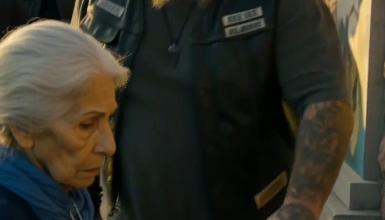
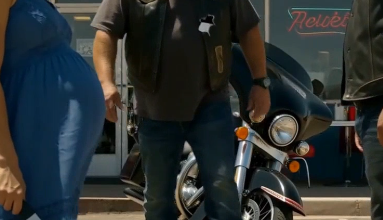
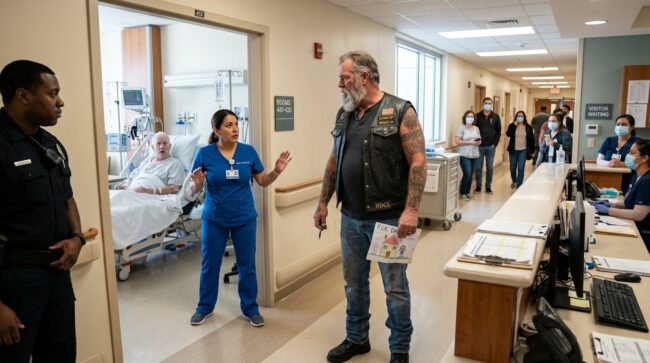
Broad shoulders under a sleeveless black leather vest. Tattooed forearms weathered by age and work. Heavy boots dark with melted slush from outside. A rough gray beard, a face worn down by sun and bad weather, and the kind of silence that made him seem less like a visitor and more like a problem someone had forgotten to warn them about.
He did not stop at the reception desk.
He did not smile.
He did not even glance at the sign-in clipboard until the volunteer in the cardigan said, “Sir, excuse me,” in a voice that came out thinner than she wanted.
He kept walking.
Straight toward Room 412.
A woman near the vending alcove pulled her purse closer. A resident physician turned halfway in the corridor, unsure whether to intervene or stay out of it. At the nurses’ station, Marisol Vega—charge nurse, forty-one, two children, no patience left for dramatic men in public buildings—looked up from a chart and felt the entire mood of the floor tighten around his approach.
“Can I help you?” she called.
The biker stopped only long enough to glance toward the station.
“I’m here for Walter.”
Not Mr. Greene.
Not the patient in 412.
Walter.
That alone was enough to make Marisol stand.
Room 412 had been trouble all morning, though not the kind hospitals knew how to code quickly. No screaming. No crash cart. No blood on the floor. Just a discharge delayed because eighty-two-year-old Walter Greene was medically stable enough to leave and had no one willing to take responsibility for receiving him.
His daughter’s number went straight to voicemail.
His grandson had answered once at 7:12 a.m., listened for eight seconds, then said, “I can’t do this again,” and hung up.
The social worker had tried three more contacts. Nothing.
Walter had hearing aids he kept forgetting to put in, a zipper bag of medications that confused him, and a bruised stubborn pride that kept making him insist he’d be “just fine on his own” in the same tone people used when they knew they would not be fine at all.
He had also spent the last forty minutes pretending not to listen every time someone said the words discharge plan outside his half-open door.
Marisol stepped around the station. “And you are?”
The biker pulled a folded paper from his vest pocket. Not fast. Not threatening. Still, three sets of eyes tracked the movement.
He held out the paper.
Her gaze flicked down. A patient contact note. Handwritten. Old-fashioned. The kind of thing usually completed at admission when someone listed who could be called in an emergency.
The name on it read: Daniel “Mercy” Mercer.
Relationship box: Friend.
Marisol looked back up.
The biker said, “I got a call.”
That was strange enough.
Walter Greene did not look like a man with biker friends. He looked like a man who had spent thirty years in pressed work shirts and another ten growing brittle in quiet rooms no one visited often enough. Thin white hair combed carefully across a spotted scalp. Long hands. A face that would have seemed dignified if loneliness had not sharpened it into something harder to look at directly.
From inside 412 came the scrape of movement, then Walter’s voice, papery and irritated.
“Who’s out there?”
The biker’s head turned toward the room at once.
And the expression on his face—so hard in the hallway a second earlier—changed just enough to unsettle Marisol more than if it had stayed cold.
Not warmth.
Recognition.
He started forward again.
Marisol stepped into his path. “Sir, you cannot enter a patient room until I verify—”
He stopped.
Not aggressively.
Not apologetically either.
Just stopped, looming in the narrow spill of hospital light while everyone nearby made a private decision about what kind of scene this might become. The volunteer in the cardigan had already reached for the desk phone. A young orderly down the hall slowed his cart of linens. Somewhere behind a curtain, someone’s television laughed too loudly at a daytime game show.
The biker lowered his voice. “Then verify fast.”
That was the wrong tone.
Not loud.
Worse. Controlled.
A resident in blue scrubs muttered, “Should we call security?” and Marisol, already thinking it, hated him a little for saying it first.
Inside the room, Walter called again, sharper this time. “Who is it?”
The biker didn’t take his eyes off Marisol.
Then he said, “Tell him Mercy’s here.”
The silence that followed was instant and strange.
Because from inside Room 412 came a sound no one on the floor expected from Walter Greene—no irritation, no confusion, no sleepy old-man delay.
A sharp inhale.
Then, after one suspended beat, a voice suddenly stripped bare by something deeper than weakness:
“No.”
Marisol turned toward the room.
Walter had pushed himself halfway upright in bed, thin hands clutching the blanket, eyes wider than she had seen them since admission.
Not fear.
Something far more complicated.
The volunteer at the desk had the phone to her ear now. The resident took a step back. And in the doorway of 412, with a biker waiting outside like a storm no one had prepared for, Walter Greene whispered one more thing so softly only the nearest people heard it.
“I thought he was dead.”
Hospitals know how to manage the obvious emergencies.
A chest pain patient whose numbers are crashing. A confused man pulling out his IV. A family member shouting at a surgeon in the hall. Those can be named. Charted. Escalated. The staff on Four West had scripts for those.
But a rough-looking biker arriving unannounced to claim an abandoned old man no one else wanted to sign for? That moved differently. Faster in some people, slower in others, and crooked through the whole floor.
Within two minutes, there were already three versions of the story.
In one, the biker was a gang collector come for some old debt Walter had hidden from his family.
In another, he was a scammer who had somehow found out the patient was vulnerable and alone.
By the third, whispered by the woman near the vending machines to her sister over speakerphone, he was “probably one of those men who targets old people and pressures them into signing things.”
Nobody knew anything.
That never stopped anyone.
Marisol took the contact note back to the nurses’ station and called admissions to verify it while keeping one eye on the biker, who stood exactly where she left him, hands visible, posture patient in a way that did not feel reassuring. He was not pacing. Not protesting. Not performing innocence. He simply waited, broad and quiet under the fluorescent lights while every person who passed made a private judgment and glanced again.
Hospital security arrived in the form of Leonard Briggs, sixty, former Marine, soft voice, thick neck, and the unglamorous instincts of a man who had watched every kind of family unravel beside an elevator bank. He positioned himself two yards from the biker and asked, “Mind telling me why you’re here?”
The biker looked at him once. “Got a call.”
“From who?”
“Walter.”
Leonard glanced toward Marisol, who gave the slightest shake of her head. That was not possible—or rather, not supposed to be. Walter’s hands had trembled too badly for his cell phone that morning. His contacts list had been a mess of half-names and disconnected numbers. The social worker had found the emergency contact note in a paper file because the digital chart had never been updated after his wife died three years earlier.
Yet there it was. Daniel Mercer. Friend.
Marisol covered the receiver with her hand. “Admissions says the name was entered nineteen years ago,” she murmured to Leonard. “No recent updates.”
Leonard looked back at the biker.
The man gave nothing away.
Inside Room 412, Walter had stopped calling out. That was worse somehow. Marisol knew his rhythms now: the brittle complaints, the false confidence, the little bursts of pride that usually hid panic. Silence meant he was listening to everything.
She stepped to the doorway.
Walter sat against his pillows looking suddenly smaller than the bed. He had put in only one hearing aid. The other rested in a plastic cup beside untouched applesauce. His hospital gown hung loosely from shoulders that had once probably been wider. On the rolling table nearby sat discharge forms, a white paper bag of medications, and the humiliating practicalities of being old in America: a walker, a pair of slip-resistant socks, and no one arriving.
He saw her glance toward the hall.
“That him?” he asked.
“Yes.”
Walter closed his eyes briefly.
“Send him away.”
The words were immediate. Too immediate.
Marisol folded her arms. “Do you know him?”
His jaw tightened. “I said send him away.”
That was not an answer.
Outside, two visitors walking to 418 slowed openly to stare. One of them—a middle-aged man in a fleece jacket carrying balloons that said GET WELL GRANDPA—shook his head and muttered, “Unbelievable,” as if the biker’s very presence had already contaminated the floor.
Leonard heard it too. So did the biker. He did not react.
Then the granddaughter from 414, a girl of about ten coloring unicorns in the waiting alcove, looked up at him with huge fascinated eyes and whispered loudly to her mother, “Is he here to hurt someone?”
Half the hall heard that.
The mother yanked the child closer. “Don’t look.”
Wrong question. Wrong answer. Exactly the wrong moment.
The biker shifted his weight once, just enough to remind everyone how much physical space he occupied. His leather vest creaked faintly. A silver key clip tapped against his belt. From the station, Marisol saw three different people watch his hands.
Then Walter’s room phone rang.
Everybody jolted.
Marisol went in and answered it.
Social work.
Rachel Kim downstairs, voice clipped with the exhaustion of someone managing six impossible discharges before noon. “I just got another refusal from the grandson,” she said. “Daughter’s still not answering. Medicaid transport can take him to the motel address if he insists, but nobody can release him alone with the medication changes. Has your mystery guest said who he is yet?”
Marisol’s eyes moved to Walter, who stared stubbornly at the blanket over his knees.
“Not enough,” she said.
“Then don’t let him sign anything,” Rachel replied. “Not until legal clears it.”
Too late for that instruction to feel harmless.
Because out in the hallway, where people had already decided the biker wanted something from the old man, the words don’t let him sign anything would sound like confirmation.
And as if the day had been waiting for that exact crack, the woman near the vending machine chose that moment to say, too loudly, “I knew it.”
Her voice traveled.
Heads turned.
The resident in blue scrubs looked from Marisol to the biker and back again as if a fraud case had just begun unfolding in real time. Leonard moved half a step closer. The volunteer at the desk stopped pretending not to listen. Even the little girl with the coloring book went still.
The biker finally spoke again.
“Walter can hear all of you.”
That was true.
It also sounded like a warning.
The fleece-jacket grandfather snapped, “Then maybe you shouldn’t be lurking outside his room.”
The biker looked at him once. Nothing dramatic. But the silence after was worse than argument, because it made the older man flush and glance away first.
Walter spoke from inside, louder than before. “Marisol.”
She turned.
“Get the papers out of here.”
His voice shook. Not from weakness now. From anger—or something close enough to anger to wear its face.
She moved to gather the discharge packet from the rolling table.
And before anyone could fully process it, the biker stepped into the doorway.
Leonard’s hand came up instantly. “Sir.”
The biker ignored him. Not by shoving past. Just by focusing on Walter with a kind of grave, infuriating certainty that made everyone else vanish from importance.
Marisol straightened. “You need to stay outside.”
Walter’s face had gone pale.
“Don’t,” he said.
Nobody knew which of them he meant.
The biker’s gaze dropped to the paperwork in Marisol’s hand, then to Walter, then back to the room. His jaw worked once, as if he were biting through ten things he had chosen not to say.
Then, in front of the nurse, security officer, volunteer, two horrified visitors, one listening child, and an old man with nobody else coming, the biker did something that made the floor seem to lean.
He pulled a pen from inside his vest.
The reaction was instant and disproportionate, which is another way of saying completely human.
Leonard Briggs stepped forward hard enough that the keys on his belt clattered. The volunteer at the nurses’ station gasped as if the biker had drawn a knife. The fleece-jacket grandfather barked, “I knew it!” with the cheap confidence of a man who loved being frightened when it let him feel correct afterward.
Marisol’s shoulders locked.
It was only a pen.
A black metal one. Heavy-looking. Scratched along the clip. Nothing more.
But context is everything, and in that hallway the motion looked wrong enough to turn a tired hospital floor into an accusation.
“Sir, put that away,” Leonard said.
The biker didn’t.
Not immediately.
He stood in the doorway of 412, pen in hand, eyes fixed not on the forms but on Walter Greene, who had gone so still he seemed almost to have stopped breathing. Marisol, holding the discharge packet against her chest, suddenly felt the whole situation narrowing toward something she could no longer manage with routine tone and competent posture.
The biker took one step into the room.
That was when the resident in blue scrubs finally did what frightened young doctors often do when they want to be useful and are secretly afraid of looking passive in front of chaos.
He reached for the wall phone and said, “I’m calling admin.”
The words made everything worse.
Because now there would be more witnesses, more assumptions, more people crowding around a private disaster none of them understood. Walter heard it too. His head turned sharply toward the hall, then back toward the biker. He looked trapped in a way Marisol had not seen yet—not just by age, illness, or loneliness, but by history entering the room before he was ready.
“Daniel,” Walter said.
First name.
At last.
The biker’s face changed slightly at the sound of it. Not softened. Tightened, maybe. As if being named cost him more than being feared.
Walter licked dry lips. “You weren’t supposed to come.”
Leonard glanced between them. The hall fell quieter than before.
The biker answered in the same low, controlled voice he had used since arriving. “You called.”
Walter looked at Marisol. “I did no such thing.”
Marisol almost believed him for half a second.
Then she remembered the charting from 8:02 a.m., when Walter had insisted on one more attempt through the old emergency contact list before anyone “started talking about shelters like I wasn’t sitting right there.” Rachel had done the dialing. Maybe Walter had forgotten. Maybe he had hoped the number would be dead. Maybe hope and dread had become the same flavor in his mouth years ago.
The biker lifted the pen once.
Not toward Marisol.
Not toward the form.
Toward Walter.
“I’m not here to take anything,” he said.
The phrasing should have reassured the room.
Instead, it only sharpened the suspicion already hanging there, because people who say that in a hospital room with paperwork nearby sound exactly like people trying to take something. The fleece-jacket grandfather in the hall let out an incredulous laugh. The volunteer at the desk whispered, “Oh my God.” The mother with the coloring child stood up altogether now, guiding her daughter farther back.
Marisol stepped between the biker and the bed.
“Enough,” she said. “Nobody is signing anything until this is clarified.”
The biker looked down at her—not dismissively, not warmly. Just long enough for her to register that his eyes were much older than the rest of him.
Then his gaze shifted to the discharge packet in her arms.
“Then clarify it,” he said.
Again, the control in his voice made him sound more dangerous, not less.
Walter pushed the blanket off his legs as if he meant to stand. His hands failed him on the first try. The walker beside the bed rattled. Marisol turned instinctively toward him, and that small opening was all the room needed to feel like it had tipped over.
Because the biker moved at the same moment.
Fast.
Too fast for anyone already primed to see aggression.
He reached past Marisol—not striking, not grabbing at her, not lunging for Walter the way two people in the hall later claimed—but taking the discharge clipboard directly from the overbed table before it could slide to the floor.
Leonard lunged in. “Sir!”
The resident in blue scrubs dropped the phone against the wall so hard it bounced. The fleece-jacket grandfather took two dramatic steps backward. A patient down the corridor opened his door. Somewhere behind the station, an alarm began chirping because somebody had forgotten a call light.
Walter flinched as if the clipboard itself were a weapon.
Marisol’s anger rose clean and hot now. “Give me that.”
The biker didn’t resist.
He held the clipboard in one hand, pen in the other, eyes still on Walter, and for a second the entire scene looked exactly as bad as everyone feared: a rough stranger standing over a frightened old man with hospital papers and a pen, while staff converged too late to stop him.
Then he placed the clipboard carefully at the foot of the bed instead of on Walter’s lap.
Too deliberate. Too strange.
Nobody relaxed.
“What are you doing?” Marisol demanded.
The biker didn’t answer her.
He looked at Walter and said, almost quietly enough not to count as speech, “Look at me.”
Walter didn’t.
His chin had started to shake.
Leonard reached for the biker’s arm, and the biker finally did the one thing that made the entire room recoil—not violence, not shouting, but refusal. He stepped back just enough to keep Leonard from taking hold without making it a physical contest. A disciplined move. Small. Experienced. The kind of movement that said he knew exactly how much force not to use.
That frightened Marisol more than clumsiness would have.
Because it meant this man understood confrontation.
Because it meant he had done some version of this before.
Because it meant the old fear blooming through the room might not be wrong after all.
The resident blurted, “Security backup is coming.”
Walter shut his eyes.
The biker heard that. So did everyone else.
And for the first time since arriving, he seemed to make a decision.
He set the pen down on top of the discharge papers. Slowly. Openly. Then reached into the inside pocket of his vest one more time.
A second collective inhale swept through the hall.
Leonard’s voice hardened. “Don’t.”
The biker ignored him.
He pulled out something flat and yellowed at the edges. Folded twice. Worn thin across the creases. Not a legal document. Not money. Not identification.
A child’s drawing.
Crayon, faded by years. A crooked motorcycle in blue. A stick-figure man with gray scribbles for a beard. Beside him, another figure in a hospital bed holding what looked like an absurdly large pen. Across the top, in shaky block letters written by an unsteady hand:
IF I SLEEP FIRST, YOU SIGN ME OUT, MERCY.
No one in the room spoke.
Walter’s eyes opened and landed on the drawing.
The old man made a sound then—not quite a laugh, not yet a sob, but something torn from the center of him by surprise and memory arriving at once.
Marisol stared at the paper.
Leonard lowered his hand.
The mother in the hall stopped pulling her child away.
The biker held the drawing out without moving closer, and when he finally spoke again, his voice had changed. Still low. Still rough. But no longer edged for strangers.
“You don’t get to pretend you don’t remember.”
Walter looked at the drawing, then at the pen on the clipboard, then at the man in the doorway everyone had spent fifteen minutes fearing for the wrong reasons.
And in a voice so thin it forced the whole room to lean toward him, he whispered:
“That was my boy’s handwriting.”
The whole room changed shape around that drawing.
Not all at once. Not dramatically. More like a floor settling under too much weight. Leonard Briggs, who had been ready to put a hand on the biker’s shoulder two seconds earlier, let his arm drop to his side. Marisol’s grip loosened on the edge of the bed rail. Even the resident in blue scrubs, flushed with the adrenaline of almost making things worse, stopped trying to look important and simply stared.
Walter Greene did not.
He looked as if someone had reached into his chest and turned a key he had spent years pretending was gone.
“That was my boy’s handwriting,” he said again, quieter this time, as though repeating it might slow what the memory had done to him. His eyes moved over the faded blue motorcycle, the stick figure in the bed, the giant ridiculous pen. Then to the name written across the top in blocky, childlike letters. Mercy.
The biker—Daniel Mercer, apparently, though nobody on Four West thought of him that way yet—held the paper steady.
Walter’s face had altered in a way Marisol had never seen. Not simply softened. Opened. The old anger that had been keeping him upright all morning seemed to thin at the edges. Under it was something rawer, and much older.
“You kept that,” he whispered.
Daniel’s jaw moved once. “You mailed it.”
Walter blinked, as if those words had to travel through more than hearing to reach him. Then his gaze flicked up—past the beard, past the leather vest, past the years weathering the man in the doorway—and whatever he saw there made him lean back against the pillows like a person bracing against a wave coming from decades away.
The woman in the hall with the balloons said, very softly now, “What is this?”
No one answered her.
Hospitals are full of moments that belong to people who do not want witnesses, yet witnesses gather anyway. That was what Room 412 had become: a place where staff, visitors, and strangers had all crowded close enough to feel the heat of an old story before anyone fully understood it.
Walter lifted one hand from the blanket.
It shook halfway to the drawing.
Daniel stepped forward exactly one pace, no more, and let the paper cross the space between them. Walter took it with surprising care, both hands working together because one alone would not quite obey. He stared at the page for a long time.
Then he laughed.
It was a small sound, broken in half by age and emotion, and it unsettled Marisol more than yelling would have.
“I told him,” Walter said, still looking at the drawing, “that if I ever got stuck in a hospital again, someone better have the decency to bring a pen.” His mouth twitched faintly. “He thought that was the funniest thing I’d ever said.”
Marisol looked from Walter to Daniel. “Who’s ‘he’?”
Walter didn’t answer at first.
The old man’s thumb traced the stick-figure beard. His eyes shone suddenly, almost angrily, as if tears arriving this late in life were an insult. Outside the room, someone’s call light kept chiming from farther down the hall until another nurse silenced it. The hospital resumed its usual noises around them, but Room 412 stayed suspended.
At last Walter said, “My son. Peter.”
Daniel remained still. He did not sit. Did not edge nearer. He stood with the strange discipline he had carried since stepping off the elevator, as though he knew the worst thing he could do now was rush a truth that had finally started speaking.
Walter turned the drawing over.
There was more on the back. A date written in adult ink. A hospital name from twenty-three years earlier. A child’s penciled attempt at a motorcycle helmet in one corner, almost erased.
Marisol felt the practical part of her brain catching up. “Your son made this for him?”
Walter’s lips parted. Closed. Then he nodded.
Leonard shifted his weight in the doorway. “So you do know each other.”
That sentence, so flat and obvious, should have relieved everyone. Instead it deepened the mystery. Because knowing each other did not explain why Daniel Mercer had arrived like a threat, why Walter had first denied him, or why an old man abandoned by family had gone pale at the sight of the only person who seemed willing to come.
Walter finally looked at Daniel.
“You weren’t supposed to answer that number,” he said.
Daniel’s reply came low and rough. “It rang.”
“That isn’t what I mean.”
Nobody in the room missed the fact that Walter had forgotten to keep refusing him.
The resident, sensing the story had moved out of official control, cleared his throat. “Maybe we should give the patient some privacy.”
Marisol almost laughed at that. It was a humane thought, but much too late. Privacy had left the floor the moment Daniel stepped off the elevator and walked past the sign-in clipboard like rules were for people less certain of their business.
Still, she turned toward the hall. “Everybody who doesn’t need to be here, out.”
The visitors hesitated first, which told her all she needed to know about how much humans value drama over dignity. Leonard helped by taking two steps forward and making his broad security body useful. The woman with the balloons moved away. The mother with the little girl tugged her daughter gently down the hall. The resident retreated with visible relief. In less than thirty seconds, the room thinned to the people who belonged closest to the problem: Walter, Daniel, Marisol, Leonard, and the discharge papers still waiting like an accusation at the foot of the bed.
When the doorway finally cleared, Walter looked down at the drawing again and said, almost to himself, “He was seven.”
Daniel nodded once.
Walter swallowed. “You still carry it.”
Daniel’s eyes stayed on him. “Yes.”
That single word seemed to cost him something.
Then Walter looked at the pen lying on the clipboard and let out another brittle breath of a laugh. “Jesus,” he murmured. “You always did have terrible timing.”
A faint sound escaped Daniel that might have been agreement.
The tension in the room changed again. Not dissolved. Tilted. Something had entered that was heavier than fear and much harder to manage with hospital procedure.
Marisol folded her arms and asked the only question that still mattered to the floor, even if it now felt too blunt for the air in the room.
“What exactly is he to you, Mr. Greene?”
Walter did not answer immediately.
He kept staring at the drawing, the edges trembling slightly in his hands.
Then he said, “That depends on whether you’re asking me twenty-three years too late… or ten minutes too early.”
And nobody in Room 412 knew yet which answer would hurt more.
The truth came in pieces, not because anyone was trying to dramatize it, but because old guilt rarely arrives in a straight line.
Marisol closed the door halfway, leaving it cracked enough for policy and privacy to coexist badly, then pulled the visitor chair away from the wall.
“Sit,” she said to Daniel.
He glanced at Walter first, as if the old man had some higher claim over where he stood. Walter looked away instead, which was answer enough. Daniel sat, though even seated he looked too large for the room, leather vest creaking faintly against the flimsy plastic chair.
Walter kept the child’s drawing on top of the blanket.
“My son Peter,” he said, voice thinner now but steadier, “had a dirt bike phase when he was seven. Not a real dirt bike. A battery-powered thing his mother thought was too loud and I thought was the greatest engineering triumph ever sold at Sears.” The corner of his mouth moved. “He wanted to ride with grown men. Thought helmets made you invincible.”
Daniel watched him in silence.
“We were at County General back then,” Walter continued. “Not here. Peter’d broken his arm falling off a swing set and decided the hospital was the worst place on earth until this idiot”—his eyes flicked once toward Daniel—“walked in looking like the opening scene of a bad idea.”
Marisol said nothing.
Leonard leaned one shoulder against the wall, hands clasped in front of him now, no longer guarding against violence so much as holding a boundary for whatever this had become.
Walter’s gaze softened in memory despite himself. “Daniel was in the room across from Peter. Motorcycle wreck. Compound fracture, ribs, concussion. He was twenty-something and mean as a snake to everyone on staff. Except children.”
Daniel let out the faintest breath through his nose. Not quite a laugh. More like a protest he did not have the energy to finish.
Walter ignored it. “Peter heard his bike stories through the curtain and became obsessed immediately. Wanted to see the motorcycle man. Wanted proof the beard was real. Wanted to know whether tattoos hurt. I should’ve said no.” His fingers tightened on the paper. “Instead I wheeled him down the hall because he had not smiled once all week and because his mother had gone home to shower and I…” He stopped. Started again. “I was tired enough to say yes to the wrong things.”
Marisol heard that last line the way nurses do—not as general regret, but as a sentence with a date attached somewhere.
Walter went on. “Daniel gave Peter this little metal keychain off his saddlebag. Stupid thing. Skull with wings.” He closed his eyes briefly. “Peter thought it was treasure. Drew him the next morning with that giant pen because he heard me joke about signing myself out.” Walter held up the paper without looking at it. “Then he made me promise that if the motorcycle man ever got stuck somewhere alone, I’d go get him.”
The room stayed very still.
Marisol felt the pieces lining up now, but not yet locking.
“What happened?” she asked.
Walter did not answer her. He spoke to the blanket instead.
“Leukemia,” he said.
There it was.
Not loud. Not softened. Just placed in the room like a fact too long carried.
Peter Greene had not been a child with a broken arm and a dirt bike obsession. He had been a child with cancer and a broken arm on top of it, because life does not distribute suffering with any sense of narrative fairness.
Marisol looked down.
Daniel’s hands had closed once over his knees.
Walter kept speaking, voice flattening under the effort of staying composed. “He went into remission the year after. Then relapsed at nine. We spent more time in hospitals than in our own kitchen. His mother got tired first, then sick herself, then gone. Pneumonia one winter that turned into something worse. By the time Peter was ten, it was just me and him and bills that multiplied overnight like insects.”
Daniel finally spoke.
“You never told me.”
Walter laughed once without humor. “Told you what? That my kid was dying between rounds of chemo and I couldn’t cover parking by Thursdays? You were a construction worker with one good wrist and bad luck. What exactly was I telling you for?”
The words landed harder because there was no cruelty in them. Only a tired old accuracy.
Daniel accepted them without flinching. “You stopped answering.”
“Yes.”
“Then you moved.”
Walter’s eyes sharpened. “Because debt collectors knock loud enough to wake children.”
That seemed to hit Daniel somewhere old and specific. He looked away for the first time since entering the room.
Marisol said quietly, “You kept the contact note.”
Walter’s gaze moved to her. “Peter made me.”
The answer startled her.
Walter looked back at Daniel. “He said if I was ever in the hospital again and he wasn’t there, I had to call Mercy.” He rolled the nickname in his mouth with equal parts embarrassment and grief. “Wouldn’t stop saying it. Claimed bikers always show up for the last ride.” He swallowed once, hard enough to make his throat work visibly. “Children believe stupid things very sincerely.”
No one contradicted him.
Because the old emergency contact note had lasted nineteen years. Because Daniel Mercer had, in fact, shown up. Because whatever else could be said about children, sometimes they are the only ones foolish enough to write promises adults end up obeying.
Marisol looked at the discharge papers again.
A new question had begun forming under all the others. Not whether Daniel had the right to sign. That was a legal problem and would stay one. The deeper question was why Walter had tried to send him away when he had called him—directly or indirectly—into the room.
Walter answered it without being asked.
“Peter died that spring,” he said.
The words lowered the oxygen in the room.
Daniel did not move. Could not, perhaps.
Walter’s eyes stayed on the drawing. “And I never told you. Not then. Not after. You came by once, I think. My neighbor said some big biker asked for me. I hid in the kitchen until you left.”
This time Daniel’s face changed completely. Not dramatically. Worse than that. It emptied in the way only real pain does when it finally receives a missing fact.
“You knew I came,” he said.
Walter nodded.
“Why?”
Walter lifted his eyes, and what Marisol saw there was not pride or anger anymore. It was shame worn thin by time.
“Because my boy kept talking about you the last week,” he said. “Because he wanted one more ride story and I didn’t know how to hand a dying child another goodbye. Because if I let you walk through that door and he lit up for you, I’d have to watch it go dark again.”
Silence.
Daniel sat motionless, scarred hands braced on his knees, the drawing between them like evidence from a trial neither man had realized was still in session.
At last he said, barely above a whisper, “You should’ve told me.”
Walter’s answer came just as softly.
“I know.”
And with that, everyone in the room understood that the real paperwork had never been on the clipboard at all.
If the story had ended there, it would already have been enough to leave the room raw.
But grief rarely travels alone. It drags other truths behind it, and the cruelest ones often arrive just when people think they have located the center of the wound.
Rachel Kim from social work came up in person ten minutes later, legal pad in hand, practical shoes squeaking softly on the polished floor. Marisol met her at the cracked door and gave a fast summary in low tones. Rachel listened, looked into the room, and immediately recalibrated from institutional problem-solving to the more delicate work of not trampling a history she had just walked into.
“Mr. Greene,” she said gently, stepping inside, “I still need to clarify your discharge support if there’s going to be a safe release today.”
Walter gave a dry sound that might have been amusement. “Of course you do.”
Rachel glanced at Daniel. “And I need to understand who Mr. Mercer is to you now, not twenty-three years ago.”
Walter looked at Daniel for a long moment.
Then he said, “The man my son trusted more than my family did.”
Rachel blinked.
It was not a legal category, but it was the most honest answer in the room.
Still, she did her job. “Would you want him to assist with discharge?”
Walter’s mouth tightened. “That depends what you mean by assist.”
“Transportation. Medication pickup if needed. Making sure you get into your residence safely. Someone responsible enough to understand instructions.”
The room almost managed to breathe around that.
Then Rachel added, “Someone authorized to be contacted if your condition worsens at home.”
Walter’s face changed.
Not anger. Not resistance.
Something closer to panic.
Marisol saw it immediately. Daniel did too.
“No,” Walter said.
The word came too fast.
Rachel kept her voice even. “Mr. Greene, I’m asking because the contacts we reached this morning declined involvement.”
Walter stared at the wall over her shoulder as if there were something written there no one else could see. “I heard.”
“Your daughter did not return—”
“I heard.”
Rachel stopped. Waited. Then said, more softly, “You do not have to protect people who left you here.”
The line landed harder than intended. Marisol winced.
Walter’s chin began to shake again. He covered it by reaching for the water cup on the tray and missing it the first time. Daniel was up before anyone asked him to be, handing the cup over without comment, without making it into a performance. Walter took it with a muttered, “Still crowding my right side,” and Daniel stepped back half a pace, which was somehow more intimate than if he had argued.
Rachel said, “If Mr. Mercer is willing, we can document him as the receiving adult for discharge today, provided you consent.”
Walter did not answer.
Daniel did. “I’m willing.”
That should have settled something. Instead it split the room open one layer deeper.
Because Walter looked at him with sudden fury—not theatrical, not loud, but live. “That’s always been your problem.”
Marisol straightened.
Daniel did not react. “Which part?”
“The willing part.”
The words hit the wall and stayed there.
Walter set the water cup down too hard. “Peter asks for a story, you give him three. My wife asks you to bring soup, you bring groceries. I disappear for twenty years, you still come when the phone rings.” His eyes shone suddenly. “What kind of fool does that?”
No one moved.
Daniel’s answer came low. “The kind who owed him.”
Walter looked down at the drawing, and for the first time since Daniel arrived, the old man truly broke.
Not with big sobs. Not dramatically. His shoulders simply folded inward, as if a structure that had remained standing out of spite and habit had finally been told it could stop. The sound he made was small, the kind that forces decent people to look away because witnessing it feels like trespassing.
Marisol turned toward the partially closed door on instinct, shielding the room from anyone walking by.
Walter dragged a hand over his face. “You didn’t owe him.”
Daniel said nothing.
Walter laughed through the tears once, bitterly. “God, of course you think you did.”
And then the final twist arrived, not from Daniel, but from Walter himself.
“My son didn’t write that note because he thought you were brave,” Walter said, voice ragged now. “He wrote it because of the blood.”
Rachel frowned. “What blood?”
Walter looked at Daniel, and this time it was Daniel who went still in a different way.
“The transfusions,” Walter said. “Peter needed rare blood. We’d burned through the donor list twice. Insurance delays, shortages, all the usual civilized horrors. Daniel got tested after hearing a nurse complain in the hallway and matched.” Walter pressed his lips together. “Came in six times in four months. Missed work for it. Sold his bike parts once to cover meds when my insurance lapsed. Thought I never knew.”
Marisol stared at Daniel.
Leonard’s head came up from the wall.
Rachel stopped writing.
Walter’s breathing shook. “The week before Peter died, he heard me crying in the bathroom because I couldn’t pay for the next round, and he told me, ‘Mercy always shows up when the numbers go bad.’” Walter gave a wet, angry laugh. “Seven years old and already making legends out of exhausted men.”
Daniel looked at the floor.
He had not denied any of it. Had not mentioned a word of it. Had walked into a hospital knowing he looked exactly like the kind of man people distrust, and still said less about himself than anyone else in the room.
Rachel spoke first, because somebody had to.
“Why didn’t you tell us that when you arrived?”
Daniel finally lifted his eyes. “It wasn’t about me.”
That should have sounded noble.
Instead, in that room, it sounded like the simple truth.
Walter’s voice went smaller. “My daughter stopped visiting after the second mortgage. My grandson likes me best on holidays when there’s inheritance to imagine. You know who still answered?” He looked at Daniel with something like accusation and awe braided too tightly to separate. “The man my boy made me promise to call if I was ever left somewhere alone.”
Nobody in Room 412 had a useful answer for that.
The discharge papers on the clipboard suddenly looked absurdly small.
Walter signed the consent himself.
That mattered to Marisol, to Rachel, to legal, to charting, to all the pieces of the system that needed a box checked and a signature witnessed before a vulnerable old man could leave. But what mattered more—though nobody said it aloud—was the way he signed.
Not quickly.
Not reluctantly.
He asked Marisol for the black metal pen Daniel had set down earlier.
Marisol handed it over without comment.
Walter turned it in his fingers, studied the scratches along the clip, then looked up at Daniel. “Still carrying junk that lasts longer than it should.”
Daniel’s mouth moved faintly. “Yes.”
Walter nodded once and signed the form.
The signature shook. The decision did not.
By 11:06 a.m., the discharge packet had been reviewed, medication changes explained twice, follow-up appointments printed, and transportation questions reduced to one final fact: Daniel Mercer would take Walter Greene home.
Not to a motel, as Walter had threatened earlier in the morning.
To Walter’s apartment, where Rachel confirmed the utilities still worked and Marisol quietly arranged for home health to evaluate within forty-eight hours.
The fourth floor resumed its ordinary pace around them, as hospitals always do after nearly private earthquakes. Lunch trays came. A respiratory therapist passed by talking about room 406. The volunteer in the cardigan found somewhere else to stand and feel guilty. The mother with the little girl avoided eye contact with Daniel altogether on her way out. The man with the balloons did not come back.
When it was time to leave, Daniel lifted Walter’s duffel from the closet and frowned at how light it was.
“That all?” he asked.
Walter adjusted the hospital blanket over his knees while Marisol locked the wheelchair brakes. “At my age, if it doesn’t fit in a bag, it’s probably disappointment.”
Marisol snorted before she could stop herself.
Walter glanced up, pleased with the reaction despite everything, and for one brief second Marisol saw the father who had once made a child laugh in hospital rooms full of impossible things.
Daniel knelt without ceremony to adjust the footrests on the wheelchair. His hands were large and careful. He did not ask Walter whether he could. He simply did the work like a man long practiced at helping without decorating the help.
Walter watched him. “You still ride?”
“Yes.”
“Still too fast?”
Daniel looked up once. “No.”
Walter’s brows lifted skeptically. “Liar.”
That was the closest thing to ease the room had heard all day.
They moved through the corridor slowly, Walter in the chair, Daniel behind him, Marisol walking beside them until the elevator. Staff glanced up. Some recognized the biker as the threatening figure from earlier. Some recognized only the old man finally leaving. None of them knew the whole of it, and perhaps that was mercy too.
At the elevator bank, Leonard held the doors open.
Walter tilted his head back enough to look at him. “You thought he was going to rob me.”
Leonard, to his credit, did not dodge. “For about three minutes, yes.”
Walter nodded. “That’s fair. He looks like terrible judgment.”
Daniel said nothing.
Leonard’s mouth twitched. “He also looks like the only person who showed up.”
That landed.
Walter’s eyes moved forward again. “Yes,” he said quietly. “He does.”
In the lobby, near the automatic doors and potted plants trying their best against hospital air, Daniel paused beside a display shelf of donated books. Something there caught Walter’s eye.
A child’s paperback about motorcycles. Bright red cover. Bent corners.
Walter made a sound halfway between amusement and grief. “Peter would’ve stolen that.”
Daniel reached for it. Opened the front cover. Found a blank page.
Then, without flourish, he took out the same black metal pen.
Marisol watched from two steps back as Walter looked up at him.
“What are you doing?”
Daniel handed him the pen.
Walter stared.
Then, slowly, he understood.
His hand shook as he wrote on the title page:
If I sleep first, you sign me out.
—Walter
Below it, after a pause long enough to ache, he added:
For Peter. Who was right about the biker.
Daniel closed the book gently and placed it in Walter’s lap.
No speeches followed.
No one in the lobby applauded. The receptionist barely looked up from her screen. Beyond the sliding glass doors, the Ohio sky had turned the pale metallic color of coming snow, and Daniel’s motorcycle sat at the curb beside the pickup Rachel had arranged for Walter’s wheelchair ride home.
“Not putting me on that damn bike,” Walter muttered.
Daniel’s answer came dry and immediate. “Wasn’t offering.”
Marisol laughed then, and this time she did not hide it.
The transport van pulled up. Daniel lifted Walter’s duffel, then the folded blanket, then stood back while the driver secured the chair lift. Walter was halfway into the van when he stopped.
“Mercy.”
Daniel looked up.
Walter held out the pen.
Daniel took it.
Walter’s eyes dropped briefly to the vest, the beard, the years in between, and when he spoke again, the words came thin but clear.
“You were late,” he said.
Daniel nodded once. “I know.”
Walter settled back into the chair, hands folded over the little red book on his lap. “Still came.”
That was all.
The van doors closed. The engine turned over. Daniel stood on the curb with the pen in one hand and melted slush darkening his boots, watching until the vehicle disappeared into midday traffic.
Only then did he look down.
Marisol, still by the hospital doors, saw him turn the pen in his fingers and notice something scratched faintly into the barrel, almost worn smooth by time.
Three uneven letters.
P.G.
Peter Greene.
Daniel closed his hand around the pen and said nothing.
Above them, four floors up, Room 412 was already being cleaned for the next patient who would arrive with a chart, a problem, and a version of loneliness nobody else could see at first glance.
And out on the curb, under a sky threatening snow, the biker stood a few seconds longer than necessary before slipping the pen into his vest and walking back toward the motorcycle like a man carrying something that had finally become lighter by being returned.