Part 2: The Little Dog Wouldn’t Leave the Sofa Beside Her Dead Owner — Two Years Later, Elderly Strangers Waited Just to Hold Her
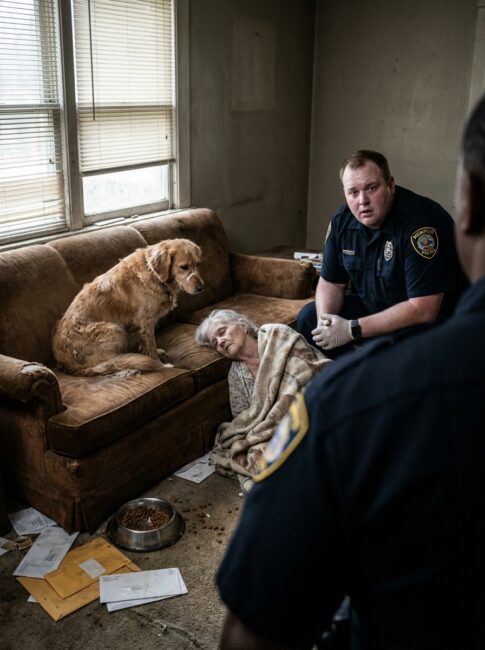
Animal Control took Maggie that night.
I told myself that was the end of it.
Cases move fast in police work.
You finish paperwork.
You answer the next call.
You keep moving.
But three days later, I drove twenty minutes across town during lunch break just to “check on the dog.”
That’s the lie I told myself.
The shelter volunteer recognized me immediately.
“She won’t eat,” she said before I even asked.
Same sentence.
Again.
Maggie sat curled inside the kennel, nose tucked under her tail.
Untouched food bowl.
Untouched water.
The volunteer sighed.
“She only eats if someone sits beside her.”
That hit me harder than the apartment did.
I sat down outside the kennel gate.
Didn’t talk.
Didn’t reach for her.
After maybe ten minutes, Maggie stood up slowly, walked over, and began eating without taking her eyes off me once.
Like she was making sure I stayed.
That became our routine for the next week.
Every lunch break.
Same kennel.
Same metal chair.
Same careful chewing sounds.
The shelter staff started leaving two bowls instead of one—one for Maggie and one empty bowl beside her.
“Maybe she’s used to eating with someone,” a volunteer guessed.
Maybe.
Or maybe loneliness changes habits into survival.
A few days later, I learned more about the woman from Apartment 4C.
Her name was Eleanor Whitmore.
Retired elementary school librarian.
Widowed thirteen years.
No children nearby.
One niece in Arizona she barely spoke to.
Her neighbors said she talked about Maggie more than herself.
One woman from the building remembered Eleanor carrying Maggie downstairs during thunderstorms because the dog hated thunder but refused to leave her lap.
Another neighbor told me Eleanor always bought two sandwiches from the corner deli.
One turkey.
One plain roast beef.
“She ate half of each,” the neighbor laughed softly. “Said Maggie didn’t like eating alone.”
There it was again.
That sentence.
By the second week, Maggie started waiting by the shelter door around noon.
Every day.
Like she could tell time.
One afternoon, I arrived late because of a domestic disturbance call downtown.
The shelter worker met me outside.
“She cried today,” she said quietly.
Dogs make noises.
But this wasn’t barking.
Maggie had apparently sat by the gate making these tiny broken sounds every time footsteps passed the hallway.
Waiting.
For me.
That night, I brought home the old ceramic bowl from Eleanor’s apartment.
I don’t know why.
Evidence had already been cleared.
The apartment emptied.
But something about leaving that bowl behind felt wrong.
Maggie came home with me three days later.
The first night, she refused to sleep anywhere except beside my couch.
Not on it.
Beside it.
Curled tight against the fabric.
At around 2:13 a.m., I woke up to soft scratching.
Maggie stood staring at the hallway.
Ears raised.
Tail stiff.
Then she walked slowly toward the kitchen and stopped beside the empty second chair at my small dining table.
Just stood there.
Looking.
Waiting.
I checked the locks twice that night.
The strange thing?
From then on, Maggie always left one side of the room untouched.
One couch cushion.
One side of the bed.
One chair at the table.
Like she was saving space for someone who hadn’t arrived yet.
Or someone who already had.
Months passed.
Winter turned into spring.
Maggie learned my routines faster than any partner I’d ever worked with.
She waited beside the bathroom sink while I shaved.
Rested her chin on my knee during late baseball games.
Sat quietly in the passenger seat during midnight drives through downtown Memphis when sleep wouldn’t come.
Especially after the nightmares started again.
The ones I never talked about.
Two years earlier, my younger brother Daniel died from an overdose in a motel outside Little Rock.
We hadn’t spoken in months before it happened.
My last voicemail to him was still saved on my phone.
I never listened to it.
Not once.
Maggie somehow knew the nights were worse.
She’d press herself against my leg whenever I stood too long at the kitchen counter staring into nothing.
And every Tuesday morning—always Tuesday—she’d carry one of my shoes into the living room and leave it beside the couch.
It made no sense.
Until later.
Until everything connected.
Then came the nursing home.
It started by accident.
One of the shelter volunteers invited me to a community fundraiser at St. Agnes Senior Living Center.
I almost skipped it.
But Maggie had grown calmer around strangers, and honestly, I didn’t like going home to silence anymore.
The second we walked inside, something changed in her.
An old man in a wheelchair reached down absentmindedly to pet her.
Maggie froze.
Then slowly climbed halfway into his lap.
Not playful.
Not excited.
Careful.
Gentle.
The old man started crying almost immediately.
Not loud.
Just quiet tears slipping into his beard.
“My wife had a dog that sat exactly like this,” he whispered.
For the next hour, Maggie moved room to room like she already belonged there.
Resting her head on trembling knees.
Sitting beside oxygen tanks.
Leaning against lonely hands that hadn’t held anything warm in months.
And every single time—
she looked directly into people’s faces before settling beside them.
Like she was checking whether they were alone.
I noticed something else too.
She always chose the residents nobody visited.
Always.
The woman whose birthday flowers had dried brown on the windowsill.
The veteran whose television stayed on twenty-four hours a day because silence scared him.
The retired teacher who pretended not to notice when other residents got visitors.
Maggie found them first.
Every time.
The director pulled me aside before we left.
“Has she been trained?”
“No.”
“She should be.”
That sentence changed everything.
Within months, Maggie began certified therapy dog training.
And she passed faster than any dog the trainer had seen.
“She reacts before people cry,” the trainer told me once.
“She notices loneliness before humans do.”
I smiled politely.
But deep down, something unsettled me.
Because that wasn’t training.
That was memory.
Then came the call that shattered the story I thought I understood.
An attorney contacted me almost eighteen months after Eleanor’s death.
Said there was something left behind for Maggie.
At first, I assumed money.
Paperwork.
Some forgotten pet insurance policy.
Instead, the attorney handed me a sealed envelope with my name written across it.
Not Eleanor’s handwriting.
Daniel’s.
My brother’s.
I couldn’t breathe for a second.
The attorney looked confused.
“You knew Eleanor Whitmore?”
“No,” I said slowly. “I don’t think so.”
He opened a file.
“She volunteered twice a week at a recovery outreach center in Little Rock.”
Little Rock.
My stomach dropped.
Then he said the next sentence.
“She met your brother six months before he died.”
I stared at him.
The room tilted sideways.
Apparently, Daniel used to visit the outreach library where Eleanor volunteered.
He talked to her during lunch breaks.
Sometimes for hours.
According to the attorney, Daniel became attached to Maggie immediately.
Eleanor once joked that Maggie listened better than most therapists.
Then came the overdose.
Daniel died alone in that motel room.
Except he hadn’t been completely alone.
Eleanor had driven two hours after Daniel called her late that night asking for help.
She arrived too late.
But Maggie had been in the car with her.
The police report mentioned a small dog refusing to leave the motel parking lot afterward.
Maggie.
The envelope shook in my hands.
Inside was a folded note.
Short.
Just four lines.
“If anything ever happens to me, let the officer keep her.
She already knows his grief.
And he’ll need someone who stays.”
I sat there staring at the paper while eighteen months of strange details rearranged themselves inside my head.
The untouched second chair.
The Tuesday shoe ritual.
The way Maggie watched me during nightmares.
Tuesday was the day Daniel died.
I finally listened to his last voicemail that night.
His voice cracked halfway through.
“Hey, man… there’s this old librarian here with a dog. Weirdest thing—the dog won’t leave my side when I’m having bad days.”
Then silence.
Then one final sentence.
“She looks at people like she already knows what hurts.”
I understood Maggie then.
Not completely.
Maybe nobody ever could.
But enough.
Enough to realize she hadn’t attached herself to me randomly.
She recognized something familiar.
A man carrying absence around like furniture.
After that, St. Agnes became part of our weekly routine.
Every Tuesday morning.
Always Tuesday.
Maggie started visiting hospice centers too.
Then veterans hospitals.
Then grief support groups.
People told me impossible things.
“She sat beside my husband thirty minutes before he finally spoke.”
“She refused to leave my mother’s room the night before she passed.”
“One touch from that dog calmed him more than medication.”
The strange part?
Maggie still refused to eat alone.
Even now.
Especially now.
So every visit ended the same way.
One resident.
One cafeteria tray.
One small piece of turkey.
And Maggie sitting patiently beside someone the world had slowly forgotten.
That became our ritual.
Mine too.
Every Tuesday after visits, I stop at the same corner deli Eleanor used to visit.
I order two sandwiches.
Turkey and roast beef.
I sit at the outdoor table beside Maggie while traffic rolls past and people hurry nowhere.
Sometimes strangers ask if they can pet her.
Sometimes older folks sit down beside us without asking at all.
Maggie never minds.
She leans into them gently.
Like she’s making room.
For grief.
For memory.
For someone missing.
And every single time we leave, Maggie turns once before walking away.
Looking back at the empty chair beside us.
Just to make sure nobody’s sitting there alone.
Last winter, one resident at St. Agnes passed away during the night.
No family.
No visitors.
The nurse later told me Maggie had refused to leave his room the evening before.
Curled against the bed.
Watching him breathe.
The same way she watched Eleanor.
The same way she once waited beside a sofa in Apartment 4C.
Some habits never leave.
Neither do some promises.
And sometimes—
the ones keeping us alive have four legs and tired amber eyes.
If Maggie’s story stayed with you, tell someone to eat beside you today.