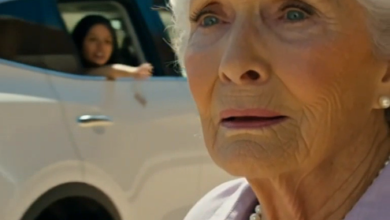
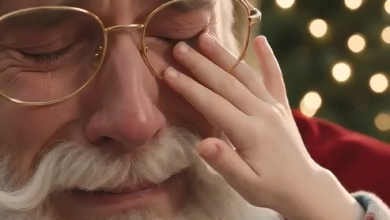
Part 2: The Little Girl Cried When Her Grandmother Snatched the Necklace Off Her Neck — Then the Secret Behind It Left Everyone Silent
Rachel Bennett had spent forty-one years trying to understand her mother.
Margaret Hale was not cruel in obvious ways. She did not shout at waiters, insult neighbors, or forget birthdays. She brought soup when people were sick. She mailed thank-you cards in blue ink. She kept extra umbrellas by the front door in case anyone left without checking the weather.
But she also had doors inside her no one was allowed to open.
Rachel knew those doors well.
One door was marked with her father’s name, Thomas Hale, who died when Rachel was eleven.
Another was marked with the baby pictures Margaret kept in a locked cedar box but never showed anyone.
The deepest door had no name at all.
It was simply the place Margaret went quiet whenever someone asked about the years before Cedar Falls.
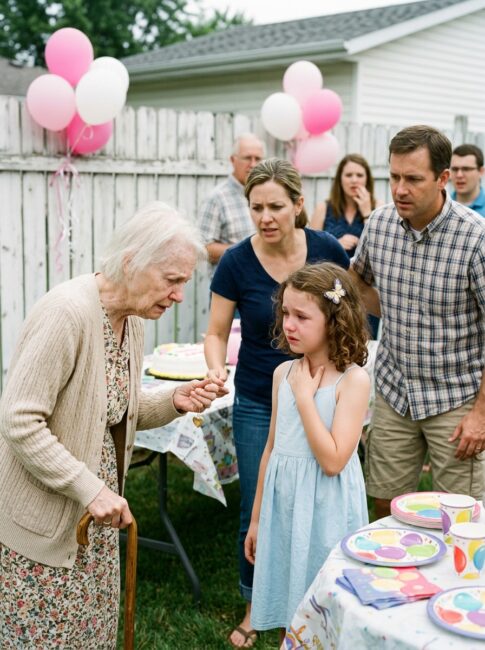
So when Margaret snatched the necklace from Sophie’s neck, Rachel did not see grief first.
She saw control.
She saw all the years her mother had corrected dresses, folded letters before anyone could read them, and changed the subject whenever Rachel asked why there were no photos from before 1985.
Now her daughter was crying at her own birthday party, and Margaret was the reason.
“Give Sophie the necklace,” Rachel said, her voice shaking.
Margaret’s fingers tightened around the locket. “Where did she get it?”
Rachel blinked. “What?”
“Where did she get this?”
“It was in the attic,” Mark said, confused. “Sophie found it in an old shoebox last week.”
Margaret looked at him sharply. “What shoebox?”
Rachel folded Sophie into her arms. “Mom, stop interrogating people and give it back.”
Sophie pressed her face into Rachel’s waist. Her neck had a faint red line where the chain had snapped, not a wound, but enough to make every adult in the yard uncomfortable.
Aunt Linda whispered, “Margaret, you scared the child.”
Uncle Paul muttered, “Over a necklace?”
Margaret heard all of it.
She did not defend herself.
That was the first strange thing.
Margaret was proud, sometimes stubborn, always careful with words. Yet now she stood in the middle of the yard with half the family staring at her like she was some unstable old woman, and she let them.
Her eyes never left the locket.
It was small, old, and heart-shaped, the kind of jewelry someone might buy at a department store in the 1970s. A tiny scratch ran across the front. Near the clasp, the gold had faded almost silver from years of fingers touching it.
Sophie lifted her tearful face. “It was pretty.”
Margaret flinched.
Not at the accusation.
At the word.
Pretty.
Her cane slipped slightly in the grass. Mark reached toward her, but she stepped away.
“Mom,” Rachel said, softer now despite herself. “Why does it matter?”
Margaret’s lips moved, but no answer came.
Then a small sound broke the silence.
A click.
The locket had opened in Margaret’s hand.
Inside were two tiny pictures, faded almost brown.
The first picture showed a young woman with dark hair, laughing at something outside the frame. She was holding a baby wrapped in a yellow blanket.
The second side was empty.
Not missing a picture.
Scraped clean.
Rachel stared.
She had never seen that woman before.
“Who is that?” she asked.
Margaret closed the locket at once.
Nobody missed the fear in her face.
That was the second strange thing.
Margaret had not looked guilty when she yanked the chain.
She looked guilty now.
“Mom,” Rachel whispered, “who is she?”
Margaret took one backward step.
Sophie’s crying had quieted into hiccups. The birthday candles were burning lower, their wax beginning to drip onto the frosting. The party music kept playing from a small speaker on the patio, cheerful and wrong.
A cousin near the fence lifted his phone, but Aunt Linda pushed his arm down.
“Don’t,” she said.
Mark lowered his voice. “Margaret, we can go inside and talk.”
“No.” Margaret shook her head. “Not here.”
“Then give me the necklace,” Rachel said.
Margaret looked at Sophie.
For the first time since the incident, her expression changed. Not anger. Not possessiveness.
Pain.
“I can’t,” she said.
Rachel laughed once, but there was no humor in it. “You can’t?”
Margaret’s chin trembled. “Not until I know who put it in that box.”
That sentence shifted something in the yard.
Because Sophie had found the locket in the attic, not in Margaret’s house.
Rachel and Mark’s attic.
The old Bennett home had belonged to Mark’s family for three generations before Rachel married him. Margaret had never stored anything there.
So how had a necklace that terrified Margaret ended up in a box above Rachel’s own hallway?
Mark looked toward his older brother, Daniel, who stood near the grill.
Daniel’s face had gone pale.
Rachel noticed.
So did Margaret.
Daniel set down his paper plate.
“I think,” he said slowly, “that box belonged to Dad.”
Mark frowned. “What are you talking about?”
Daniel wiped his hands on his jeans, though they were not dirty. “Before he died, Dad asked me to move a few things from the garage into the attic. Old papers, photo albums, stuff from Grandma Bennett’s estate.”
Margaret stared at Daniel like he had just unlocked a grave.
Rachel turned back to her mother.
“Why would Mark’s father have your necklace?”
Margaret’s face collapsed.
And then, quietly, like someone surrendering after decades of running, she said, “Because it was never mine.”
The wind moved through the yard.
One balloon loosened from the fence and rose into the clean afternoon sky.
Nobody reached for it.
They moved inside because Sophie was shivering, though the day was still warm.
Rachel wrapped a cardigan around her daughter and sat her on the living room sofa. The cake remained outside, candles burned out, frosting untouched. Relatives gathered in doorways and along the hall, speaking in half-whispers.
Margaret sat in the armchair near the window.
The locket lay on the coffee table between them.
It looked smaller there.
Almost harmless.
Rachel sat opposite her mother, eyes red but steady. “Tell me the truth.”
Margaret looked at Sophie. “Not in front of her.”
Sophie straightened. “It was on my neck.”
No one argued.
Margaret nodded slowly, accepting that.
Then she opened the locket again and held it toward Rachel.
The faded photograph showed the young woman with the baby in the yellow blanket.
“Her name was Evelyn Carter,” Margaret said. “She was my best friend.”
Rachel had never heard the name.
“She lived next door to us in Ohio. We were twenty-eight. Your father worked nights at the factory, and Evelyn worked at a diner two blocks from our apartment. She had a little girl.”
Margaret’s voice thinned.
“Her name was Anna.”
Rachel looked at the baby in the photo. “What happened?”
Margaret closed her eyes.
“She disappeared.”
The room seemed to shrink.
Aunt Linda covered her mouth. Mark put one hand on Sophie’s shoulder.
Margaret continued before anyone could ask the question sitting in the air.
“Evelyn was leaving her husband. He drank. He hit walls. Sometimes worse. She was going to stay with us for two nights, then take a bus to her sister in Illinois.”
Sophie leaned against Rachel, silent now.
“She came to our apartment with Anna and one suitcase. She wore that locket every day. Evelyn said it was cheap, but Anna liked to put her fingers on it when she was sleepy.”
Margaret touched the gold heart.
“That night, your father came home early. He and Thomas argued with Evelyn’s husband in the hallway. There was yelling. A neighbor called the police. By morning, Evelyn was gone.”
Rachel frowned. “Gone where?”
Margaret shook her head. “That was the question.”
A third twist entered quietly.
Evelyn had not simply left.
“Her husband told everyone she ran off and abandoned the baby,” Margaret said. “But Anna was gone too. So was the suitcase. So was the locket.”
Rachel’s voice cracked. “Then why do you have the picture?”
“Because Evelyn left it in my kitchen.” Margaret looked at her daughter. “She asked me to keep it safe. She said if anything happened, I should remember that Anna was loved.”
Sophie whispered, “Did something happen?”
Margaret’s face folded with age and regret.
“Yes.”
For years, Margaret explained, she searched in the only ways a young mother with little money could search. She called shelters. She wrote letters. She visited bus stations. She kept Evelyn’s photo hidden because Evelyn’s husband had come by twice, drunk and furious, demanding to know what she had told police.
Then came the part Rachel had never known.
Thomas Hale, Rachel’s father, had been accused of helping Evelyn disappear.
“He lost his job over it,” Margaret said. “People said he ran away with her. They said I was a fool. They said Evelyn was that kind of woman.”
Rachel’s eyes filled.
Her father had not died in some simple accident, as she had been told.
He had died three years later, exhausted and sick, after working construction jobs in freezing weather because the factory never took him back.
“Why didn’t you tell me?” Rachel asked.
Margaret looked at her hands. “You were eleven when he died. I had already let grief take your father. I could not let gossip take your childhood too.”
That was the fourth twist.
Margaret’s silence had not been coldness.
It had been a wall she built badly, but built to keep Rachel from growing up beneath other people’s cruelty.
“But the locket,” Mark said quietly. “How did it get into my father’s things?”
Everyone turned to him.
Margaret looked at Daniel, then at Mark.
“Your father,” she said, “was one of the officers who came that night.”
Mark went still.
His father, Harold Bennett, had been a respected Cedar Falls police lieutenant. His framed commendation still hung in Mark’s hallway.
Margaret’s voice grew steadier, though sadder. “He was young then. Not a bad man, but ambitious. Evelyn’s husband had a brother in the department. The report was written as a domestic argument and possible voluntary disappearance.”
Mark swallowed. “Are you saying my father covered it up?”
“I am saying,” Margaret answered carefully, “that he took Evelyn’s locket from my kitchen table after questioning me. He said it was evidence.”
Rachel stared at the heart on the table.
“But it never became evidence,” Margaret said. “It vanished.”
The room was completely quiet.
Daniel rubbed both hands over his face. “Dad kept boxes from old cases. Things he said were personal reminders. I thought they were just papers.”
Mark stepped back as if the carpet had shifted under him.
Sophie looked from one adult to another. “So Grandma didn’t want me to wear it because it belonged to the baby’s mommy?”
Margaret’s eyes flooded.
“That is part of it.”
Rachel heard the careful words. “What is the other part?”
Margaret reached into her purse and removed a folded newspaper clipping, soft from years of being opened. She handed it to Rachel.
The article was from 1998.
A woman named Evelyn Carter had been found in a river outside Dayton.
No child was mentioned.
Rachel read it twice.
“Anna was never found?”
Margaret shook her head.
“I kept hoping she lived,” Margaret whispered. “I thought if the locket ever surfaced, maybe it would mean someone had finally told the truth.”
Sophie looked down at her bare neck.
“Grandma,” she said softly, “you thought the necklace was bad?”
Margaret looked at the child she had frightened and seemed to break all over again.
“No, sweetheart. I thought it was evidence. I thought if it got lost, if the clasp broke, if someone cleaned it or sold it, the last piece of Evelyn might disappear again.”
Rachel wiped her face.
The shove of a hand, the snapped chain, the backyard gasp, the child’s tears; all of it looked different now.
Margaret had not seen jewelry.
She had seen a dead woman’s voice hanging around a child’s throat.
She had seen her husband’s ruined name, her own fear, and a missing baby no one had searched for hard enough.
Still, Rachel looked at Sophie’s neck.
“You hurt her.”
Margaret nodded at once.
“I know.”
“You scared her.”
“I know.”
“You should have said something.”
Margaret’s mouth trembled. “I have spent forty years not saying things. Sometimes silence becomes a habit you mistake for protection.”
No one answered.
That was the fifth twist, and maybe the hardest one to forgive.
Margaret had protected her daughter from a story, but she had also left her alone with a mother she could never fully understand.
Sophie slid off the sofa.
Rachel reached for her, but Sophie walked to the coffee table and picked up the locket by its broken chain.
Everyone held their breath.
She carried it to Margaret.
The old woman lifted both hands, not taking it, just trembling beneath it.
“I’m sorry I wore it,” Sophie said.
Margaret shook her head quickly. “No. You did nothing wrong.”
Sophie looked at the faded photograph inside. “Was Anna little like me?”
Margaret covered her mouth.
“She was smaller.”
“Did she like yellow?”
Margaret let out a sound between a laugh and a sob. “Her blanket was yellow.”
Sophie nodded, absorbing this private detail as if accepting a responsibility.
“Then we shouldn’t hide it in a box anymore.”
Rachel looked at her daughter.
Margaret looked at the locket.
For the first time all afternoon, the necklace was not something stolen, cursed, or dangerous.
It was a witness.
Mark, pale and shaken, went upstairs and brought down the shoebox from the attic. Inside were old reports, Polaroids, receipts, and a sealed envelope marked Carter in Harold Bennett’s handwriting.
Daniel opened it with careful hands.
Inside was the missing second picture from the locket.
A baby in a yellow blanket.
On the back, someone had written one word.
Anna.
Margaret pressed the photo to her chest and bent forward as if forty years had finally found somewhere to land.
No one in that room tried to stop her from crying.
The birthday party did not resume the way parties usually do.
There was still cake, but the frosting had softened in the sun. The balloons moved lazily in the afternoon breeze. Children from neighboring houses were sent home with paper plates wrapped in foil, and relatives left quietly, carrying more questions than leftovers.
Rachel stayed with Margaret on the porch after everyone else had gone inside.
For a while, neither woman spoke.
Across the yard, Sophie sat beside Mark on the grass, drawing something with sidewalk chalk near the fence. Every few minutes, she touched her bare neck, then looked toward the house where the locket now rested in a clear plastic bag on the dining room table.
Not hidden.
Not worn.
Protected.
Rachel turned to her mother. “I used to think you kept secrets because you didn’t trust me.”
Margaret watched Sophie drawing. “Sometimes I didn’t trust the world near you.”
“That sounds almost kind,” Rachel said.
Margaret gave a tired smile. “It was also unfair.”
Rachel looked at the woman who had raised her with locked boxes, careful answers, and a sadness that always sat at the dinner table like an extra guest.
For years, Rachel had wanted one clean explanation for her mother.
Now she had one, and it was not clean at all.
It was grief mixed with fear. Love mixed with silence. Protection mixed with damage.
“I wish you had told me about Dad,” Rachel said.
Margaret nodded. “So do I.”
No excuses followed.
That was what made the apology feel real.
The next week, Officer Reyes, an old friend of Mark’s, helped them contact the Dayton cold case unit. The evidence was fragile, and the people involved were mostly dead or elderly, but the locket, the photograph, and Harold Bennett’s envelope were enough to reopen a file that had slept too long.
Months later, they learned that Anna Carter had not died that night.
A retired nurse remembered a toddler left at a church shelter under a different name. Records led to adoption papers, then to a woman living in Wisconsin named Anne Miller, who had grown up never knowing why she loved yellow blankets and cried whenever old diner songs played on the radio.
There was no grand reunion in a ballroom.
No television crew.
Just a quiet meeting in a library conference room, where Anne, now in her forties, held the locket with both hands and stared at the photograph of a young mother laughing outside the frame.
Margaret sat across from her, older than the guilt she had carried.
“I looked for you,” Margaret said.
Anne’s eyes filled.
“I believe you.”
Those three words did not fix everything.
They did not bring Evelyn back. They did not restore Thomas Hale’s lost years. They did not erase the moment Sophie cried in the backyard while everyone judged Margaret as cruel.
But they loosened something.
A knot that had been pulled tight for forty years.
On Sophie’s tenth birthday, the family gathered again in the same backyard. This time, the cake was lemon, because Anne said her mother used to bring home lemon pie from the diner.
Near the porch, on a small table covered with white cloth, sat a framed copy of Evelyn’s photograph.
Beside it lay the gold heart locket, repaired but unworn.
Sophie asked if she could touch it.
Rachel looked at Margaret.
Margaret nodded.
Sophie opened the heart carefully. Inside were two pictures now.
Evelyn with baby Anna.
And, on the other side, a new tiny photograph of Sophie, Margaret, Rachel, and Anne standing together outside the library, four lives gathered around one old piece of gold.
Sophie smiled at her grandmother.
“I won’t wear it,” she said. “But I’ll remember it.”
Margaret reached for her hand and held it gently this time.
No pulling.
No fear.
Just fingers around fingers, soft as a promise finally spoken aloud.
If this story stayed with you, follow this page for more heartfelt stories about family, secrets, and the quiet truths people carry.