Part 2: The Man Mistaken for a Driver at the Company Party — When the CEO Walked Over and Hugged Him, the Room Froze
Leonard seemed uncomfortable with the attention.
He held Claire briefly, then stepped back as though he had entered the wrong room by accident.
“You came,” Claire said.
Leonard gave a small smile. “You invited me.”
“I have invited you every year.”
“And I have congratulated you every year.”
“From your kitchen table,” Claire replied. “On a card.”
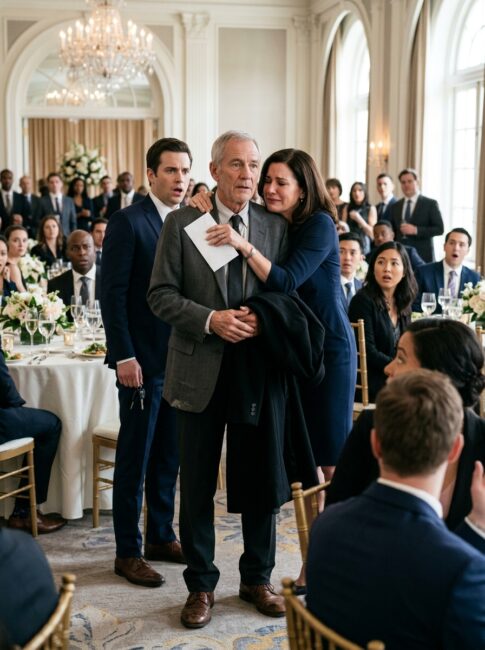
Leonard glanced around the ballroom.
Several employees were watching openly now.
Brent stood near the bar with a drink in one hand, the confidence draining from his face.
Claire noticed the coat folded over the chair.
Then she noticed the car keys still resting in Leonard’s palm.
“What happened?” she asked.
Leonard looked at the keys and seemed mildly embarrassed.
“A gentleman needed something from his car.”
Claire followed his gaze.
Brent stepped forward immediately.
“I misunderstood,” he said. “I thought he was with the transportation company.”
Leonard held out the keys.
“No harm done.”
Brent accepted them, but the apology did not settle anything.
Claire looked at Leonard’s worn jacket, then toward the table reserved for executives and board members.
“Come sit with us.”
Leonard shook his head.
“I would be more comfortable near the back.”
“Mr. Hayes,” Claire said gently, “you have spent enough years standing near the back.”
The sentence caused a murmur among the guests.
Leonard lowered his eyes.
He had never liked rooms filled with applause.
The banquet server who brought his water returned with a fresh glass and studied him carefully.
Her name tag read MAYA.
“Mr. Hayes?” she asked.
Leonard looked at her face for a moment.
Then he smiled.
“Maya Thompson. Your mother worked the night shift on Archer Avenue.”
Maya’s eyes widened.
“You remember her?”
“Of course. You used to sit in the break room after school with a purple backpack and a book about horses.”
Maya covered her mouth.
Claire watched the recognition pass between them.
“You know each other?” she asked.
Maya nodded slowly.
“My mother was a caregiver for Northbridge when I was a kid. There was one winter when her car broke down. Mr. Hayes drove her to every overnight shift for almost two weeks.”
Leonard shrugged.
“Your mother had patients waiting.”
Maya’s voice became quieter.
“He also brought groceries to our apartment.”
Leonard looked uncomfortable.
“That was a long time ago.”
Before Claire could respond, the hotel event coordinator approached.
“We are ready for the anniversary video,” she said.
Claire nodded, but Leonard touched her arm lightly.
“I should give you this first.”
He handed her the white envelope.
Claire did not open it immediately.
“What is it?”
“Something Ruth left behind.”
At the mention of Leonard’s wife, Claire’s expression softened.
Ruth Hayes had died six months earlier after forty-one years of marriage.
Most people in the ballroom had never heard her name.
Claire held the envelope carefully.
“Leonard, you did not need to bring anything.”
“I know.”
He looked toward the stage.
“But Ruth thought some things should arrive before the lights go out.”
Claire opened the envelope.
Inside was a cashier’s check and a folded sheet of lined paper covered with Ruth’s neat handwriting.
Claire read the amount once.
Then again.
Her eyes filled.
“Leonard,” she whispered, “this is too much.”
He shook his head.
“It was never ours to keep.”
Brent remained several feet away, unable to hear the conversation.
But he could see that the CEO’s hands were trembling.
Claire folded the letter carefully and held it against her chest.
Then she turned toward the stage.
“Please stay,” she said.
Leonard looked at the crowded room.
“I did not come for a speech.”
“I know,” Claire replied. “That is why there needs to be one.”
Twenty-five years earlier, Northbridge Home Care did not occupy three floors of a glass office building.
It operated from two rented rooms above a pharmacy.
The carpet smelled faintly of dust. The copier jammed every morning. The waiting area contained four mismatched chairs and a coffee machine that worked only when someone held the button down.
Claire Donovan was twenty-seven.
Her mother had founded the small caregiving agency after spending years caring for Claire’s grandmother at home.
When Claire’s mother died suddenly, the agency was left with overdue bills, eleven employees, and more patients than Claire knew how to manage.
She had studied accounting, not nursing.
She understood spreadsheets.
She did not yet understand how much trust could be carried inside a caregiver’s knock at an elderly patient’s door.
Leonard understood.
He was the agency’s first driver.
His official job was simple. He transported caregivers to homes when buses were late, delivered medical supplies, and picked up paperwork from hospitals.
His unofficial job was everything else.
He fixed broken locks at the office. He waited with employees after dark when their rides did not arrive. He brought soup when someone was sick and stayed beside patients until family members reached the house.
Ruth packed extra sandwiches in Leonard’s lunch bag because she knew he would return home without eating his own.
Three months after Claire took over, Northbridge nearly closed.
A hospital reimbursement delay left the company unable to meet payroll.
Claire spent a Friday afternoon calling banks and asking for a temporary loan.
Every request was rejected.
By six o’clock, she sat alone inside the office with eleven paychecks she could not issue and a list of patients who still needed care on Monday morning.
Leonard found her staring at the copier.
“You should go home,” Claire told him.
“So should you.”
“I cannot pay anyone.”
Leonard pulled a chair beside her desk.
Claire expected advice.
Instead, Leonard placed a folded bill of sale in front of her.
He had sold his pickup truck.
The truck was eight years old and carried scratches along one side, but it was fully paid off.
Leonard used it to work a second job delivering appliances on weekends.
Claire looked at the amount written on the paper.
It was enough to cover payroll.
“I cannot take this,” she said.
“You are not taking it.”
“What do you call this?”
“Keeping the doors open.”
Leonard’s voice remained calm.
“Caregivers cannot miss rent because insurance paperwork is late. Patients cannot miss visits because we are embarrassed to ask for help.”
Claire pushed the bill of sale back toward him.
“What will you drive?”
“I still have the bus route.”
“And Ruth?”
Leonard smiled faintly.
“Ruth told me to sell it.”
Claire later learned that Ruth had removed the tools from the truck herself and cleaned the glove compartment before the buyer arrived.
Leonard never asked for interest.
He never asked for shares in the company.
He accepted repayment slowly, in small monthly amounts, after Northbridge became stable again.
But that was not the only reason Claire crossed the ballroom to hug him.
As the company grew, Leonard noticed something Claire initially missed.
Caregivers were caring for elderly patients while quietly struggling to feed their own families.
Some missed shifts because their cars needed repairs. Others chose between prescription medication and electricity. Several slept in hospital parking lots between jobs because driving home cost too much gas.
Leonard began leaving envelopes in the office.
There was no name on them.
Only short notes.
For the tire replacement.
For the electric bill.
For groceries until Friday.
Claire assumed the money came from a donor who wished to remain private.
Years passed before she discovered the truth.
One December morning, she arrived early and saw Leonard placing an envelope inside the desk drawer of an employee whose husband had been hospitalized.
Claire waited until Leonard stepped into the hallway.
“How long have you been doing this?” she asked.
Leonard looked genuinely surprised that she had noticed.
“Not long.”
The employee records told a different story.
There had been quiet envelopes for almost a decade.
Some came from Leonard’s overtime pay.
Some came from Ruth’s sewing work.
Some came from the repayment checks Claire had sent after the company recovered.
Leonard and Ruth never had children.
They rented the same modest apartment for thirty-four years and kept a coffee can inside a kitchen cabinet labeled WHEN SOMEONE NEEDS A LITTLE ROOM.
Claire asked Leonard why he had never told her.
“People accept help differently when they believe nobody is watching,” he replied.
That sentence changed how Northbridge operated.
Claire created an employee emergency fund.
She expanded it slowly, careful not to turn kindness into a public relations campaign.
Leonard refused to let the fund carry his name.
He retired at sixty-three and stopped attending company gatherings because large rooms made him uncomfortable.
But he continued sending a small check every month.
After Ruth died, Claire assumed the checks would stop.
They did not.
Now, inside the hotel ballroom, Claire stood behind the microphone with Ruth’s final letter in her hands.
Leonard remained near the service hallway.
He had resisted every attempt to bring him closer to the stage.
Claire looked toward him.
“Many of you know that tonight marks twenty-five years since Northbridge began,” she said. “You know our numbers. You know how many families we serve.”
The screens behind her displayed photographs of caregivers, patients, offices, and community events.
Then the image changed.
A faded photograph appeared.
It showed a younger Leonard beside an old white van, holding a paper cup of coffee. Ruth stood beside him with one hand resting on his shoulder.
Neither of them seemed aware that the photograph was being taken.
Claire continued.
“What you may not know is that this company survived its hardest season because two people decided that other families should not carry our failure.”
Leonard lowered his head.
Claire told the room about the truck.
Then she told them about the envelopes.
Maya, the banquet server, stood near the kitchen doors with tears in her eyes.
A middle-aged supervisor near the front table pressed both hands against her mouth.
“I received one,” she whispered.
Another employee raised his hand slightly.
“So did I.”
Then another.
And another.
The room began filling with small acknowledgments.
A caregiver named Teresa stood from her chair.
“My furnace stopped working during the coldest week of January,” she said. “My boys were six and nine. Someone paid the repair company directly.”
Leonard shifted uncomfortably.
Teresa looked at him.
“I never knew.”
Claire opened Ruth’s letter.
Her voice wavered as she read only the final lines.
Ruth had left the remaining balance of the coffee-can savings account to the employee emergency fund.
The amount was not enormous by corporate standards.
But it represented years of saying no to small comforts so someone else could say yes to groceries, heat, or a repaired car.
Claire placed the cashier’s check beside the microphone.
“Leonard came tonight to deliver Ruth’s final envelope,” she said. “He did not come to be recognized.”
Near the bar, Brent looked down at the keys in his hand.
Leonard had carried a coat through the rain for a man who could not be bothered to look at his face.
Claire stepped away from the microphone.
For a moment, the ballroom remained completely silent.
Then Maya began clapping.
Teresa joined her.
Within seconds, every employee in the room stood.
Leonard did not step onto the stage.
He did not wave.
He simply looked toward the photograph of Ruth and placed one hand over the pocket of his worn jacket.
After the speeches, the party continued more quietly.
The jazz trio resumed playing. Plates were cleared. Employees gathered near Leonard in small groups rather than surrounding him all at once.
Some thanked him.
Others told him about the children who had grown up inside homes warmed by repairs they could not afford at the time.
Leonard listened patiently, but he redirected every compliment toward Ruth.
“She remembered the names,” he said more than once. “I only delivered the envelopes.”
Brent waited until the crowd thinned.
He approached Leonard holding his coat over one arm.
“I owe you an apology,” he said.
Leonard looked at him.
Brent’s voice became quieter.
“I handed you my keys without asking who you were. I did not even introduce myself.”
“No,” Leonard said. “You did not.”
Brent swallowed.
“I am sorry.”
Leonard studied the younger man for a moment.
Then he nodded.
“Thank you for saying it plainly.”
Brent glanced toward the ballroom doors.
“I could drive you home.”
Leonard smiled slightly.
“The train still runs.”
“At least let me walk you to the station.”
Leonard considered the offer.
Then he picked up his folded umbrella.
“All right.”
Outside, the rain had slowed to a fine mist.
The city lights stretched across the wet pavement, and the river reflected the windows of the hotel.
Brent carried the umbrella at first, holding it carefully above Leonard’s shoulder.
Halfway to the station, Leonard noticed the younger man’s expensive shoes becoming wet near the curb.
He shifted the umbrella slightly so it covered both of them.
Neither man spoke for several steps.
At the entrance to the train station, Brent handed Leonard a business card.
“My direct number is on the back,” he said. “The emergency fund committee meets next month. I would like to help.”
Leonard placed the card inside his jacket pocket.
“Start by learning the names of the people who clean your office after you leave,” he said.
The words were not delivered harshly.
They sounded more like directions.
Brent nodded.
“I will.”
The following Monday, Claire visited the original Northbridge office above the pharmacy.
The company still rented the space, although nobody worked there full-time anymore. Claire kept it because she could never bring herself to remove the old sign above the stairs.
Leonard was waiting inside.
He stood beside the same coffee machine that still required someone to hold the button down.
Claire carried a small wooden box.
Inside was Ruth’s handwritten letter and the cashier’s check receipt.
“I thought you might want this back,” Claire said.
Leonard ran his fingers along the edge of the paper.
Then he folded the letter once and placed it inside his jacket.
On the wall near the desk hung the faded photograph from the anniversary party.
Ruth stood beside the van with her hand on Leonard’s shoulder.
Claire looked at the photograph.
“You could have asked for more,” she said. “A title. A place on the board. Something with your name on it.”
Leonard pressed the coffee-machine button and waited for the cup to fill.
“Ruth and I had a place,” he replied.
He nodded toward the photograph.
Then he handed Claire the coffee.
Before leaving, Leonard opened the drawer of the old desk.
Inside were several blank envelopes.
He removed one, wrote a short note across the front, and slipped Brent’s business card inside.
Claire raised an eyebrow.
“What is that for?”
“Your young executive said he wanted to help.”
Leonard placed the envelope inside the drawer.
“Sometimes people need somewhere to begin.”
He switched off the office lights and walked down the narrow stairs in his cracked leather shoes.
Above the desk, Ruth remained beside the old white van, smiling at something beyond the edge of the photograph.
Follow our page for more stories about the quiet people whose names may be missing from the spotlight, but never from the lives they changed.