Part 2: The Man Was Knocked Down on the Sidewalk While Strangers Stepped Around Him, but the Security Camera Caught the Moment a Tattooed Biker Dropped to His Knees
Bishop Kane was not a man who liked being filmed.
That was the first thing everyone got wrong after the video spread.
People online called him a hero before knowing his name, which he hated. Local news called him “the biker Good Samaritan,” which made him turn off the television so hard the remote batteries fell out. One morning, a woman at the gas station recognized him and tried to thank him for restoring her faith in humanity.
Bishop looked at her and said, “Ma’am, I barely got faith in gas station coffee.”
That was Bishop.
Rough edges first.
Kindness only if you watched long enough.
He worked nights at the Riverfront Print Depot, feeding paper into industrial machines, repairing jams, hauling boxes, and listening to old blues through one earbud while the city slept badly around him. Before that, he had been many things: warehouse kid, Army mechanic, divorced husband, sober man, relapsed man, sober again, father from a distance, biker because engines were easier to understand than apologies.
His club, the Iron Psalm Riders, knew him as the man who fixed generators, cooked breakfast on charity rides, and looked personally offended by group photos. He rarely gave speeches. He preferred tools to feelings. But if someone broke down after midnight, Bishop answered the phone.
The silver music note charm on his Harley mirror came from his daughter, Naomi.
Not the daughter he raised well.
That was too generous.
The daughter he loved badly for years and started loving better after she stopped needing him to be perfect.
Naomi was thirty now, Black American woman, violin teacher in Chicago, sharp-eyed like her mother, patient only with children and instruments. When she was eight, she gave Bishop the charm at a school concert he almost missed because he was drunk in a parking lot arguing with himself about whether he deserved to walk in.
He walked in late.
Sat in the back.
Heard only the last song.
Naomi saw him anyway.
Afterward, she pressed the charm into his palm and said, “So next time you remember where the music is.”
That sentence haunted him into sobriety years later.
The first seed was the music note.
The second was the way Bishop reacted to paper on the ground.
He hated seeing books, photographs, letters, drawings, or sheet music stepped on. Men could curse him, shove him, ignore him, but if someone stepped on a child’s drawing or an old woman’s letter, Bishop’s face changed.
The third seed was a memory from 1996.
A younger Bishop, twenty-six years old, half-drunk and fully lost, sitting on a sidewalk outside a cheap jazz club after a fight he started and lost. His trumpet case had split open. Sheet music had scattered across the curb. People stepped around him, laughing, annoyed, unimpressed.
One old man knelt beside him.
Picked up the music.
Put it back in the folder.
Said, “Boy, if you don’t respect the thing that saves you, you’ll lose it before it saves you.”
That old man was Paul Whitcomb.
Bishop did not recognize him at first in the rain.
Not until Paul whispered about the music.
Then the sidewalk folded time in half.
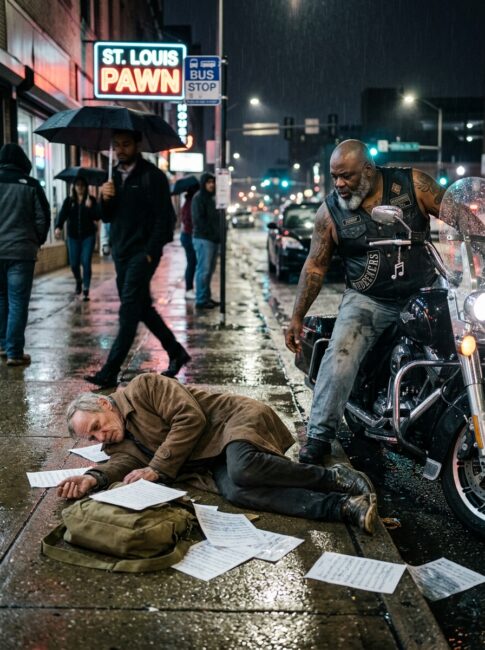
Paul Whitcomb had been a music teacher for thirty-four years.
Not famous.
Not wealthy.
Not the kind of teacher people name buildings after while he is alive.
But the kind whose former students still remembered how he tapped rhythm on a desk, how he refused to let poor kids feel embarrassed by rental instruments, how he kept peanut butter crackers in the bottom drawer because hunger made beginners play sharp.
He taught middle school band in St. Louis until budget cuts turned music from “essential” into “optional,” which is one of the cruelest words adults use when taking beauty away from children.
After retirement, Paul played piano for church choirs and taught cheap private lessons in a room behind a laundromat. He carried sheet music in the same canvas bag he had owned since the early 1990s, the corners patched twice, the zipper replaced by a student’s father who fixed luggage.
On the night he was attacked, Paul had left rehearsal late because the altos could not find the correct entrance in “Amazing Grace,” and he refused to send them home still wrong. He missed his usual bus, decided to walk six blocks to the next stop, and ran into three teenagers near the pawn shop.
They wanted money.
He had fourteen dollars and a church key.
What happened next was quick, stupid, and ugly in the way street cruelty often is. One boy grabbed the canvas bag. Paul held on because the music inside mattered more than the cash in his wallet. Someone shoved him. Someone hit him. He fell.
The bag opened.
Pages spilled into the rain.
That was when the camera began recording the part everyone would later watch.
The false climax was easy to believe.
Man attacked.
Biker saves him.
Security footage proves strangers can still be good.
News clip at eleven.
But the real story was stranger, older, and much more painful.
Because as Bishop knelt there in the rain, gathering Paul’s sheet music before the ambulance arrived, he saw the name written on the top corner of one page in faded pencil.
P. Whitcomb
Bishop stopped breathing for a moment.
“Mr. Whitcomb?”
Paul’s eyes moved toward him, unfocused.
“You know me?”
Bishop looked at the rain-soaked man in the brown coat, the same long fingers, older now, swollen at the joints but still shaped like they belonged on piano keys.
“You picked up my music once,” Bishop said.
Paul blinked.
The ambulance siren grew in the distance.
Bishop leaned closer.
“Outside the Blue Lantern. Long time ago.”
Paul stared at him.
Then, even hurt and dazed, he whispered, “Trumpet?”
That broke Bishop open in a place he thought had scarred over.
“Yeah,” he said. “Trumpet.”
The paramedics arrived then, and the moment scattered under lights, questions, gloves, and stretcher wheels.
But Bishop kept hold of the canvas bag.
He would not let the rain take it.
At the hospital, Paul kept asking for the bag.
Not for his wallet.
Not for his phone.
The bag.
The nurse tried to reassure him that his belongings were safe, but he kept turning his head toward the chair where Bishop sat, still wearing his wet leather vest, one boot leaving a puddle under the leg of the chair.
“Music,” Paul said.
Bishop lifted the canvas bag.
“Right here.”
Only then did Paul close his eyes.
The ER doctor said Paul had bruised ribs, a mild concussion, and a fractured wrist. Painful, but survivable. The police officer took Bishop’s statement in the hallway while a nurse brought towels and told him, with professional exhaustion, that the waiting room was not a garage.
Bishop apologized.
Badly.
Then stayed anyway.
At 3:12 a.m., Paul woke fully enough to recognize him.
“You’re Marcus Kane,” he said.
Bishop sat straighter.
“Yes, sir.”
“You played trumpet like you were mad at the horn.”
Bishop laughed once.
It came out rough.
“I was mad at everything.”
“I remember.”
That was the twist.
Paul had not just picked up Bishop’s music once.
He had kept him from disappearing.
After the sidewalk incident in 1996, Paul found Bishop two days later outside the same club and handed him a folder.
Inside were the pages Bishop thought he had lost, dried carefully, flattened under books, edges wrinkled but readable.
Paul also handed him a phone number.
“Community center needs someone to teach beginner brass on Saturdays,” Paul had said. “Pays almost nothing. Might keep you sober till noon.”
Bishop had cursed at him.
Then showed up.
For six months, he taught kids trumpet, trombone, and how not to blow spit valves on shoes. He was not gentle then. Not patient. But he was present. Those Saturday mornings became the first steady thing in his life after years of drifting.
Then he failed again.
Relapsed.
Missed classes.
Vanished.
He never thanked Paul.
Never returned the folder.
Never told him that those six months were the first proof he had that he could be useful without being dangerous.
Paul remembered him anyway.
“You got old,” Paul said from the hospital bed.
Bishop looked down at himself.
“You got knocked down.”
Paul smiled faintly despite the pain.
“Fair.”
Bishop’s face tightened.
“I should’ve found you before tonight.”
Paul shook his head slightly.
“People find each other when the street insists.”
That sounded exactly like a music teacher.
Annoying.
Beautiful.
True.
The video spread before noon.
A pawn shop employee posted it online with the caption: Biker kneels beside man everyone ignored.
By dinner, local news had it.
By the next morning, Bishop’s phone had sixty-three messages, which he considered a personal attack. The Iron Psalm Riders watched the clip in their clubhouse without speaking much. Their president, a white American woman named Lorraine “Saint” Kellerman, sixty-one, former paramedic, silver hair in a braid, tattooed hands, and no patience for emotional avoidance, looked at Bishop across the table.
“You know him.”
Bishop drank coffee.
“Maybe.”
“Don’t maybe me.”
He told them the story.
The Blue Lantern.
The trumpet.
The music folder.
The Saturday classes.
The relapse.
The missing thank you.
Saint listened without interrupting, which was rare enough that everyone understood the room had become serious.
When Bishop finished, she said, “Then thank him now.”
Bishop shook his head.
“Man’s in a hospital bed because three kids jumped him. He don’t need my redemption project.”
Saint leaned forward.
“No. He needs his rent paid, his wrist to heal, his music dried, and somebody to make sure he gets to choir practice when the doctor clears him. Your feelings can wait in line.”
That was leadership.
Not soft.
Useful.
The club got to work.
No cameras.
No posts.
No heroic nonsense.
They cleaned and dried the sheet music page by page. One rider who worked in legal aid helped Paul file a victim assistance claim. Another repaired the canvas bag. Saint organized rides to appointments. Bishop went to Paul’s apartment and found stacks of music, two houseplants barely surviving, and a piano so out of tune it sounded haunted.
He paid for tuning.
Paul protested.
Bishop ignored him.
The revelation came when Naomi, Bishop’s daughter, saw the news clip.
She called him from Chicago.
“I saw you kneel,” she said.
Bishop closed his eyes.
“Everybody saw me kneel.”
“You hate that.”
“Yes.”
“You knew him?”
“He helped me once.”
Naomi was quiet.
Then she said, “Dad, people helping you is kind of how I still have a father.”
That sentence stayed with him longer than the video.
Paul’s recovery was slow.
Bruised ribs make every breath feel like a bill collector. A fractured wrist makes a pianist angry at soup spoons. Concussions make old men tired and embarrassed because they cannot remember names fast enough.
Bishop visited twice a week.
He always brought coffee Paul said was too strong and crackers he pretended were for himself. He sat in the corner while Paul complained about hospitals, teenagers, weather, and modern worship music.
“You still play?” Paul asked one afternoon.
Bishop looked at him.
“No.”
“Still have the horn?”
“In a closet.”
“That’s not what I asked.”
Bishop sighed.
“Yes.”
“Bring it.”
“No.”
“Coward.”
Bishop stared at him.
Paul smiled like a man who had taught middle school for decades and feared nothing.
The next week, Bishop brought the trumpet.
It was tarnished, stiff, and smelled faintly of old brass and shame. He had not opened the case in years. His hands, so sure on wrenches and handlebars, looked clumsy around the valves.
Paul sat in his recliner, wrist in a brace.
“Play a B-flat.”
Bishop did.
Badly.
Paul winced.
“Good Lord.”
“You asked.”
“I regret many things.”
But they kept going.
Ten minutes at a time.
Then twenty.
By spring, Bishop could play through a simple hymn without sounding like a dying appliance. Paul accompanied him one-handed on the piano, furious about his own limitations, but smiling when he thought Bishop was not looking.
The community center reopened a Saturday music class after the video brought donations. Paul could not teach alone with his wrist recovering.
So Bishop helped.
At first, he only carried chairs.
Then repaired music stands.
Then showed a twelve-year-old boy how to hold a trumpet.
Then stayed for the whole class.
History does not repeat neatly.
But sometimes it gives a man a chance to enter the room again and stay this time.
Six months after the attack, Paul returned to the corner outside Union Station.
Not alone.
Bishop rode beside the bus route on his Harley, then parked near the pawn shop, engine off, music note charm moving gently on the mirror. The Iron Psalm Riders stood along the sidewalk, not as guards exactly, but as witnesses. Former students came too. Choir members. A few neighbors. Even the pawn shop owner, who had posted the video, stood awkwardly near the door holding a framed print of the security footage.
Paul looked at it and frowned.
“I look terrible.”
Bishop said, “You were unconscious.”
“Still no excuse.”
Then the children from the community center arrived with instruments.
Trumpets.
Trombones.
A clarinet that squeaked in warmups and caused Paul visible pain.
They gathered under the awning because rain threatened again. Paul sat in a folding chair with his repaired canvas bag at his feet. Bishop stood beside him holding his trumpet.
The first song was “Amazing Grace.”
The tempo wobbled.
The brass came in uneven.
One trumpet missed the entrance completely and recovered with the confidence of youth.
Paul conducted with his good hand.
Bishop played softly, not leading, not hiding.
Just present.
People stopped on the sidewalk.
This time, they did not step around.
When the song ended, Paul looked at Bishop.
“You found the music,” he said.
Bishop shook his head.
“You kept it dry first.”
Paul smiled.
The pawn shop camera recorded that too.
An old man seated beneath an awning.
A tattooed biker standing beside him.
A group of kids playing a song imperfectly but together.
And a sidewalk where, for once, nobody was invisible.
Follow the page for more stories about the people you almost judged before you knew who once knelt for them first.