Part 2: The Middle-Aged Woman Adopted the Old Dog Everyone Returned — That Night, His Barking Saved an Entire Family Next Door
At first, Clara tried everything the shelter volunteer had suggested.
She spoke softly. She offered Roscoe a treat. She placed a worn blanket beside his bed near the kitchen and sat with him on the floor.
Roscoe ignored the treat.
His body remained rigid.
The old dog had spent most of the evening moving cautiously through the house, sniffing furniture and pausing whenever the refrigerator motor clicked on. He had not barked since the incident with Sophie.
Now his eyes were fixed on the Parker house.
“Roscoe,” Clara whispered. “It’s all right.”
The dog barked again, louder this time.
He pressed both front paws against the window and scratched the glass with a desperation that made Clara’s stomach tighten.
She checked the clock on the microwave.
12:17 a.m.
The Parker house appeared dark except for a small night-light glowing behind the curtain in Sophie’s upstairs bedroom. Daniel’s SUV was parked in the driveway. His wife, Megan, had arrived home from her nursing shift around ten.
Everyone should have been asleep.
Clara pulled the curtain closed.
Roscoe immediately turned toward the back door.
He paced between the door and the kitchen window, whining low in his throat. When Clara placed a hand on his collar, she noticed something unexpected.
He was trembling.
Not with aggression.
With fear.
Clara hesitated, remembering the shelter intake folder she had read before bringing him home. The first page contained only the basics: estimated age eleven, mild arthritis, no bite history, surrendered after his previous owner died.
The later pages told a sadder story.
Roscoe had been adopted by a young couple, returned after two nights, then adopted by an older man who lived in an apartment. The man returned him within a week because neighbors complained about barking.
Another family lasted eleven days.
His most recent adoption ended after he barked through the night during a thunderstorm and scratched through a bedroom door.
Each return slip used similar words.
Anxious. Difficult. Disruptive.
One note had been written in different handwriting at the bottom of the final page.
He is not barking at nothing. He always seems to hear something first.
Clara opened the back door.
Roscoe bolted outside before she could attach the leash.
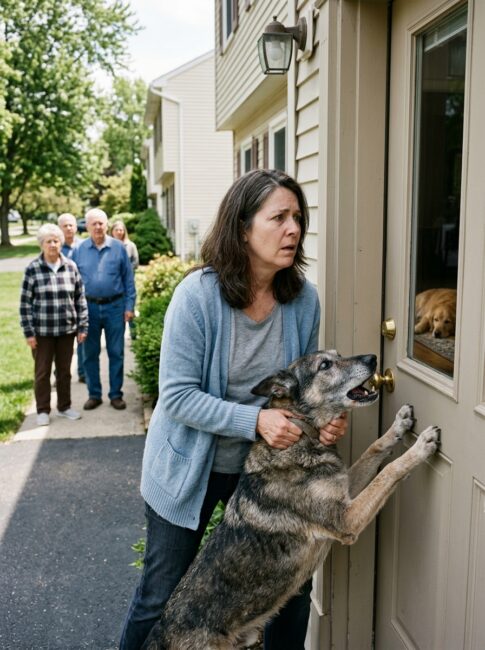
He ran straight across the grass toward the Parker house and stopped beneath Sophie’s window. Then he lifted his muzzle and barked into the darkness.
A porch light snapped on across the street.
A man in sweatpants stepped outside and shouted, “Some of us have work in the morning!”
Clara grabbed Roscoe’s collar.
“I’m sorry,” she called back. “I’m trying to get him inside.”
Roscoe twisted away from her with surprising strength. Instead of running, he limped toward the Parker family’s side door and scratched against it.
His nails scraped the wood.
Once. Twice. Again.
Clara knocked on the door.
“Daniel?” she called. “Megan?”
No one answered.
The dog barked until his voice cracked.
Clara felt embarrassed, then irritated, then suddenly afraid. She remembered Daniel mentioning that Sophie was a light sleeper. A barking dog directly beneath her window should have awakened her.
She walked to the front door and rang the bell.
Still nothing.
The neighbor across the street crossed his arms from his porch.
“Call animal control,” he said. “That dog is out of control.”
Roscoe stopped barking for one brief second.
In the silence, Clara heard a faint electronic chirp from inside the Parker house.
Then another.
The sound was barely noticeable through the closed door, like a smoke detector with a dying battery.
Roscoe heard it differently.
His entire body changed when the chirp sounded again. He flattened his ears and began clawing at the door with frantic, uneven strokes.
Clara pulled out her phone.
She almost called Daniel first.
Then she noticed the family’s golden retriever lying motionless behind the glass panel near the entryway.
Clara dialed 911.
The first fire engine arrived within six minutes.
By then, several neighbors had gathered on the sidewalk in coats and slippers. Some watched Roscoe nervously as Clara held him by the collar. Others stared at the Parker house, where no lights had turned on.
Daniel’s brother, who lived three streets away, arrived after receiving Clara’s call. He used the spare key hidden beneath a ceramic planter.
The moment a firefighter opened the door, a carbon monoxide alarm became clearly audible from inside.
The crew moved quickly.
Daniel was found unconscious in the upstairs hallway. Megan was on the bedroom floor beside the bed, as though she had tried to stand and collapsed. Sophie was curled beneath her blanket in the room facing Clara’s house.
Their golden retriever, Buddy, was carried out by a firefighter and placed on the lawn.
For several long minutes, the neighborhood became a landscape of flashing lights and quiet fear.
Clara knelt beside Roscoe, one hand pressed against his trembling shoulders.
The old dog watched every person carried from the house.
When Sophie appeared on a stretcher wearing an oxygen mask, Roscoe let out a small sound that was nothing like the barking the neighbors had complained about.
It sounded like a whimper of relief.
A paramedic examined him too. Roscoe had never entered the Parker house, but his breathing was fast and his paws were bleeding slightly from scratching the door.
“He probably heard the alarm before anyone else,” the firefighter said. “Those detectors inside are not very loud from the outside.”
Clara looked toward the side of the Parker house.
A furnace exhaust vent was partly blocked by a dense nest of leaves and twigs. The overnight cold snap had caused the heating system to run for hours. Carbon monoxide had slowly filled the home while the family slept.
Daniel’s brother stood beside Clara with both hands pressed over his mouth.
“I talked to him at eleven,” he said. “He sounded tired. I thought he was just exhausted from work.”
The firefighter shook his head.
“It can feel like fatigue or the flu at first. Another hour might have changed everything.”
Across the street, the man who had demanded animal control lowered his eyes.
Roscoe leaned heavily against Clara’s knee.
She expected the commotion to make him bark again, but he had gone quiet. It was as though the urgency had drained out of him the moment the family reached the ambulances.
Sophie and her parents survived.
Buddy survived too.
By the next afternoon, reporters had begun calling the shelter after someone posted a photograph of Roscoe sitting beside Clara on the curb. His ears were down, his paws wrapped in white bandages.
The shelter manager, Elaine Harper, drove to Clara’s house carrying Roscoe’s original file.
“I need to show you something,” she said.
Elaine sat at Clara’s kitchen table and placed a faded photograph beside Roscoe’s paperwork. The picture showed a younger Roscoe sitting beside an older man in a fire department jacket.
The man’s name was Frank Delaney.
He had been a firefighter for twenty-eight years.
After retirement, Frank lived alone with Roscoe in a modest home outside town. Two years earlier, an electrical fire had started in Frank’s garage late at night. A smoke detector sounded, but Frank was asleep after taking medication for a painful back injury.
Roscoe barked until Frank woke up and escaped through the back door.
The house was badly damaged, but Frank survived.
“He told everyone Roscoe saved his life,” Elaine said. “He used to bring him to the station picnics. The firefighters spoiled him.”
Clara ran her fingers along the edge of the photograph.
“What happened to Frank?”
Elaine paused.
“He died last winter. Heart failure. Roscoe was beside his bed when the paramedics arrived.”
After Frank’s death, Roscoe was brought to the shelter. No one had written down the full story in his public adoption profile. The shelter staff knew he had belonged to a retired firefighter, but many details were lost between shifts and paperwork.
What they did know was that Roscoe became distressed by high-pitched noises after Frank died.
He barked at microwave alerts.
He barked at distant sirens.
He once woke an adoptive family because a neighbor’s smoke detector chirped in the apartment upstairs.
Each family saw the behavior as a problem.
None of them understood that Roscoe was still listening for danger.
Clara looked beneath the table.
Roscoe rested his chin on her slipper, exhausted.
Elaine swallowed before speaking again.
“We were worried you might want to return him too.”
Clara did not answer immediately.
She remembered Sophie falling backward in the driveway. She remembered Daniel’s angry expression and the neighbors gathering in the darkness. She also remembered how Roscoe had trembled before anyone else understood what was happening.
“He didn’t lunge because he wanted to hurt Sophie,” Clara said quietly.
Elaine glanced toward the dog.
“No. I don’t think he did.”
That afternoon, Daniel called from the hospital.
His voice was weak, but clear.
“Sophie wants to know if Roscoe is okay.”
Clara looked down at the bandages around the old dog’s paws.
“He’s resting.”
There was a pause on the line.
“Yesterday, I thought you were irresponsible for bringing him home,” Daniel said. “I was angry before I knew anything about him.”
Clara did not rush to comfort him.
She understood the fear behind his reaction. She had felt it too.
Daniel continued.
“The doctor said Sophie was closest to the room where the carbon monoxide level was highest. I don’t know how to thank you.”
Clara looked out the window toward the Parker house, where firefighters had left the windows open to clear the air.
“You should thank Roscoe,” she said. “He refused to let me ignore him.”
That evening, Sophie video-called from her hospital bed.
Her hair was messy, and the oxygen mask was gone. She asked Clara to turn the camera toward Roscoe.
The old dog lifted his head when he heard Sophie’s voice.
“I’m sorry I scared you yesterday,” Sophie said.
Roscoe’s tail tapped once against the floor.
Sophie smiled.
Then she held a handwritten sign close to the screen.
It read:
THANK YOU FOR BARKING.
Clara pressed her lips together, but tears reached her eyes before she could stop them.
The Parkers returned home three days later.
Their furnace had been repaired, new detectors had been installed, and Daniel had hired a company to inspect every vent in the house. A technician also installed a louder outdoor alert system.
The neighborhood changed in smaller ways too.
The same group chat that had criticized Clara now filled with offers. Someone dropped off a bag of senior dog food. Another neighbor left a padded orthopedic bed on Clara’s porch.
The man across the street delivered a box of dog treats without signing the card.
Clara did not mention the earlier comments.
Roscoe did not need a parade.
He needed rest, slow walks, and a place where every unfamiliar sound would not send him back to the shelter.
His paws healed gradually.
His barking did not disappear entirely.
Some nights, he still lifted his head when a truck passed in the distance. Sometimes he paced when the wind rattled the loose gutter outside the kitchen. Clara would sit beside him until his breathing slowed.
She did not tell him there was nothing to worry about.
She simply listened with him.
One Saturday morning, Sophie appeared at Clara’s gate holding a small paper bag and a library book about working dogs.
Daniel stood several steps behind her, letting his daughter decide how close she wanted to go.
Roscoe rested beneath the maple tree in Clara’s yard.
Sophie stopped at the gate.
“Can I give him a treat?”
Clara nodded.
“Hold it low and let him come to you.”
Sophie crouched carefully.
For a moment, Roscoe did not move.
Then he rose slowly, his stiff back legs taking time to straighten. He walked toward Sophie and paused within reach.
The girl placed the treat on her open palm.
Roscoe sniffed it, then took it gently.
Daniel looked away for a second, pretending to check something near the driveway.
Clara noticed anyway.
By early spring, Sophie began visiting Roscoe twice a week. She read to him on the porch while Clara watered the flowers. Roscoe seemed to enjoy stories, especially when Sophie read slowly and rested one hand behind his ears.
The shelter asked Clara for permission to share his story on its adoption page.
Clara agreed, but only after making one request.
“Please mention the older dogs,” she said. “People walk past them because they think their best years are gone.”
Elaine added a photograph of Roscoe beneath the maple tree, with Sophie sitting beside him and a library book open across her knees.
Within a month, three senior dogs from the shelter were adopted.
Roscoe never knew about that.
He spent his days following patches of sunlight across Clara’s living room floor. He slept near the kitchen, where he could hear the refrigerator hum and the wind brush the porch railing.
One rainy evening, Clara found an envelope beneath her front door.
Inside was the faded photograph of Frank Delaney in his fire department jacket, kneeling beside a younger Roscoe.
Elaine had written a note on the back.
Frank would have wanted him to stay where someone believes him.
Clara placed the photograph in a simple wooden frame beside Roscoe’s bed.
Months later, when the neighborhood held its annual spring cookout, Daniel stood near the grill while Megan arranged plates on a folding table. Sophie sat on the grass with Roscoe’s head resting across her lap.
The old dog was grayer now.
His eyes closed while children laughed nearby.
At one point, a timer beeped from the kitchen inside Clara’s house.
Roscoe opened his eyes immediately.
Clara walked over and rested her hand against his shoulder.
“I heard it too,” she said.
Roscoe studied her face for a moment, then lowered his head back into Sophie’s lap.
The neighborhood continued talking around them, but Clara stayed beside him a little longer.
Some sounds were alarms.
Others were reminders that, after being sent away again and again, an old dog had finally found a home where someone listened.
Follow the page for more heartfelt stories about the quiet moments that change people’s lives.